The Triangle Shirtwaist Fire: 18 Minutes That Changed Labor Law
The Triangle Shirtwaist Fire killed 146 New York garment workers in 18 minutes, trapped behind locked doors. What the inquiry found rewrote US workplace safety law.
Read Wikipedia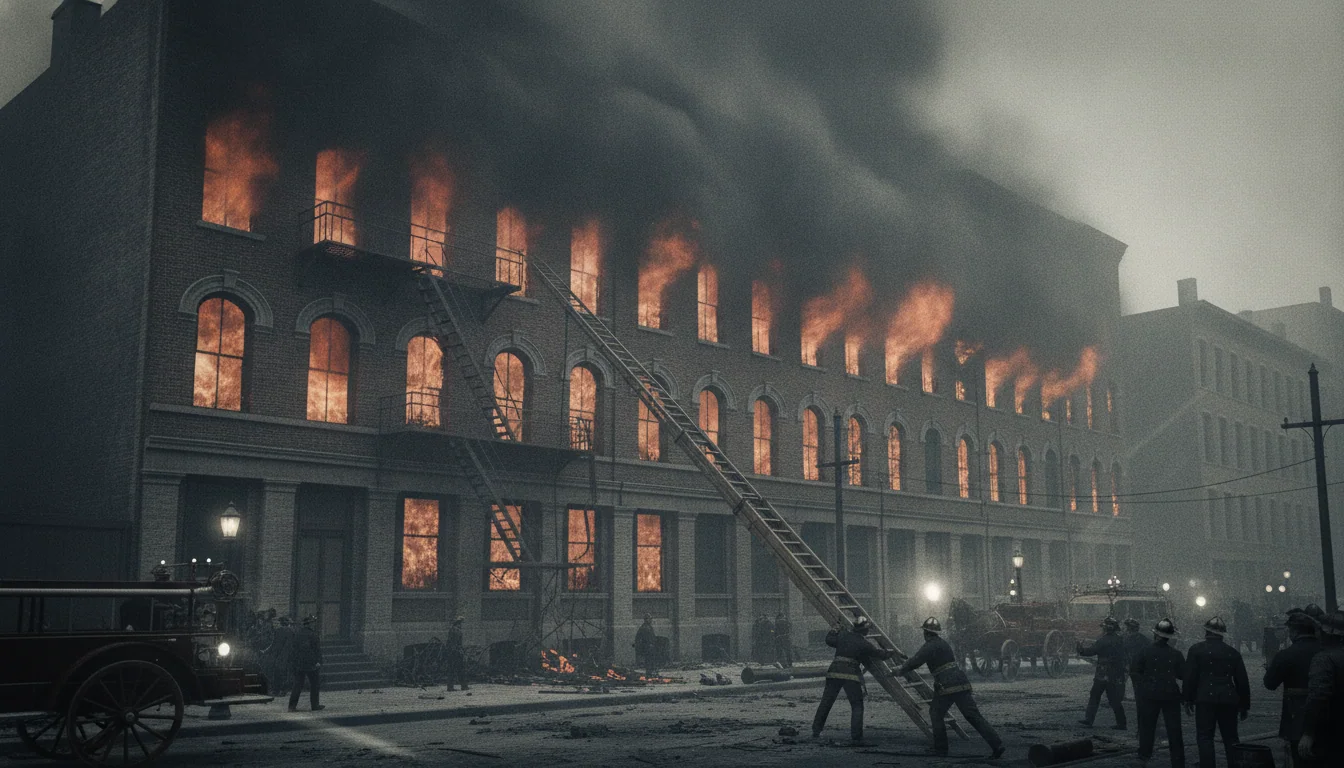
At 4:40 p.m. on March 25, 1911, a fire broke out on the eighth floor of the Asch Building in lower Manhattan, home to the Triangle Shirtwaist Company. By 4:58 p.m., eighteen minutes later, it was over. In that time, 146 garment workers, most of them young immigrant women, died, some in the flames, many more after jumping from ninth and tenth floor windows because the exits meant to save them did not open.
The setting
The Triangle Shirtwaist Company occupied the top three floors of the ten-story Asch Building at the corner of Greene Street and Washington Place, a few blocks from Washington Square. It employed several hundred workers, overwhelmingly young Jewish and Italian immigrant women, many still in their teens, sewing shirtwaists, the popular blouse style of the era, on rows of machines packed tightly together. The factory floor was, by later accounts and photographs, a fire hazard by design: scraps of cotton fabric and tissue paper patterns piled beside cutting tables, wooden bins overflowing with cloth remnants, and aisles narrow enough that workers had to move sideways past machines to reach the exits.
Saturday was a normal workday in 1911 garment manufacturing, and March 25 had been an ordinary shift. Workers were preparing to leave for the evening when the fire broke out on the eighth floor. It is generally believed to have started under a cutter's table, most likely from a discarded match or cigarette igniting scrap fabric, though the exact spark was never established beyond dispute at the subsequent inquiry.
The timeline
The fire spread with terrifying speed through the loose cotton scraps and paper patterns scattered across the eighth floor. Workers there managed to alert most of their colleagues and reach the exits relatively quickly, and casualties on that floor were comparatively limited. The warning did not reach the ninth floor in time. A phone call intended to alert workers above reportedly went unanswered or was placed too late, and by the time the ninth floor understood what was happening, flames and smoke were already climbing the building's elevator shaft and stairwell.
On the ninth floor, workers found one stairwell door locked, a practice the factory's owners maintained during working hours, according to testimony at the later trial, to prevent theft and unauthorized breaks. The other stairwell quickly filled with smoke and flame. The building's single exterior fire escape, an flimsy iron structure, collapsed under the weight of workers trying to descend it, sending several to their deaths and cutting off that route entirely for those behind them. Elevator operators Joseph Zito and Gaspar Mortillalo made repeated trips up through the smoke to rescue as many workers as their cars could hold before the elevators became unusable, saving well over a hundred lives between them before conditions made further trips impossible.
With the stairwell blocked, the fire escape gone, and the elevators no longer running, workers on the ninth and tenth floors were left with windows as their only remaining option. Over the following minutes, dozens of young women jumped from the ninth floor to the pavement roughly eighty feet below, some in pairs holding hands, rather than face the fire behind them. Fire department ladders reached only to the sixth floor; the department's nets, designed for lower-story rescues, proved unable to safely catch bodies falling from that height.
The decisions
Factory owners Isaac Harris and Max Blanck escaped via the roof, along with a group of workers who followed them up rather than down, reaching an adjoining building's rooftop with help from students and faculty at New York University next door. The decision to keep stairwell doors locked during working hours, a common practice at the time across the garment trade to deter theft and unsanctioned breaks, became the case's central and most damning fact. Fire department response was reasonably swift once alerted, but the physical limits of contemporary firefighting equipment, ladders too short and nets too weak for a fire above the sixth or seventh floor, meant the department could do little once workers reached the windows.
The toll
By the time the fire was extinguished, 146 people were dead, the overwhelming majority young immigrant women, some as young as fourteen. Bodies were laid out for identification at a nearby pier, and the scale of the loss, concentrated in a single company on a single afternoon, shocked New York in a way few industrial accidents before it had. A public funeral procession organized by unions and community groups drew an estimated hundreds of thousands of mourners through the city's streets in the days that followed.
The inquiry
Isaac Harris and Max Blanck were indicted on manslaughter charges tied to the locked ninth floor door, and stood trial later in 1911. Their defense argued the door had not been deliberately locked, or that workers had simply been unable to open it in the panic, and the jury acquitted both men, a verdict that generated considerable public anger at the time, not unlike the outrage two decades earlier when no one was held liable for the Johnstown Flood. A separate civil suit years later resulted in a modest settlement paid to victims' families, widely reported as far less per victim than the insurance payout the factory owners themselves received for the fire's property losses.
The more consequential outcome came from New York State's Factory Investigating Commission, formed within months of the fire and chaired by figures including future US senator Robert F. Wagner and future governor Alfred E. Smith, with labor organizer Frances Perkins, who later became US Secretary of Labor, playing a key advisory role after having witnessed the fire firsthand from the street. The commission conducted an extensive multi-year investigation into factory conditions across the state, inspecting thousands of workplaces and documenting hazards far beyond the Triangle factory alone.
Over the following years, the commission's findings led to dozens of new laws in New York covering mandatory fire drills, unlocked and clearly marked exits, sprinkler requirements in larger buildings, improved fire escape standards, and restrictions on child labor and working hours, provisions that became models later adopted in other states and eventually influenced federal workplace safety standards. The Triangle Shirtwaist Fire is widely credited by labor historians as a founding catalyst for the modern American framework of workplace fire and safety regulation, a legacy built, as the commission's own findings made clear, directly on the specific and preventable failures that killed 146 people in eighteen minutes on a Saturday afternoon in 1911, a push toward accountability that the Boston Molasses Flood would reinforce eight years later by exposing similarly lax industrial oversight.
The union movement's turn
The fire also reshaped the labor movement itself. The International Ladies' Garment Workers' Union had organized a major strike among shirtwaist workers in New York just two years earlier, in 1909, an action sometimes called the Uprising of the 20,000, which had pushed for better pay, shorter hours, and safer conditions across the garment trade. Triangle's owners had been among the employers who resisted the union's demands most firmly during that strike, and the factory remained non-union at the time of the fire, a detail that gave the disaster an especially sharp edge in the public reckoning that followed. Union organizer Rose Schneiderman delivered a widely quoted speech in the fire's aftermath arguing that voluntary goodwill from employers could never substitute for enforceable law, a framing that helped steer the public response toward the legislative route the Factory Investigating Commission ultimately took.
What remains uncertain
Not every detail of that afternoon was ever fully settled. Witnesses disagreed on exactly how many of the ninth floor exit doors were locked versus simply jammed by the crush of panicked workers, and the criminal trial's acquittal turned substantially on that ambiguity, since prosecutors could not prove beyond reasonable doubt which specific door Harris and Blanck were responsible for locking, or whether they had personally ordered it locked that particular day. What is not disputed is the outcome: a building that met the fire code requirements of its era, and a workforce that died anyway because those requirements were nowhere near sufficient to protect people crowded into a factory nine floors above the street.
Quick Answers
Common questions about this topic
What caused the Triangle Shirtwaist Fire?
Investigators concluded the fire most likely started from a discarded cigarette or match igniting scrap fabric under a cutter's table on the eighth floor, in a factory piled with flammable cotton and tissue-paper patterns. The exact ignition source was never confirmed with certainty, but the rapid spread through loose fabric scraps was well documented.
How many people died in the Triangle Shirtwaist Fire?
146 workers died, most of them young immigrant women, many in their teens and twenties. Some died from smoke and flame inside the building; many others died after jumping from the ninth and tenth floor windows when the fire escape and exits failed them.
Could the Triangle Shirtwaist Fire have been prevented?
Investigators found the factory's exit doors were routinely locked during working hours, reportedly to prevent theft and unauthorized breaks, and that the building's single fire escape collapsed under the weight of fleeing workers. Contemporary fire codes did not require sprinklers or unlocked, adequate exits in buildings of that size, a gap the disaster directly exposed.
What changed after the Triangle Shirtwaist Fire?
New York state formed a Factory Investigating Commission that inspected thousands of workplaces and led to dozens of new laws covering fire exits, sprinklers, building access, and child labor within a few years. The fire is widely credited as a founding catalyst of modern American workplace safety regulation.

Talk to the Survivors
Hear firsthand accounts from people who lived through history's darkest days.
Create your free account →No card required. Some figures and features require a paid plan.
Join the HistorIQly Club
Get smarter about the past.
Weekly stories, deep dives, and exclusive content straight to your inbox.