The Boston Molasses Flood: When a Tank of Syrup Killed 21 People
The Boston Molasses Flood began when a steel tank burst in the North End on January 15, 1919, sending a 15-foot wave of syrup at 35 mph, killing 21.
Read Wikipedia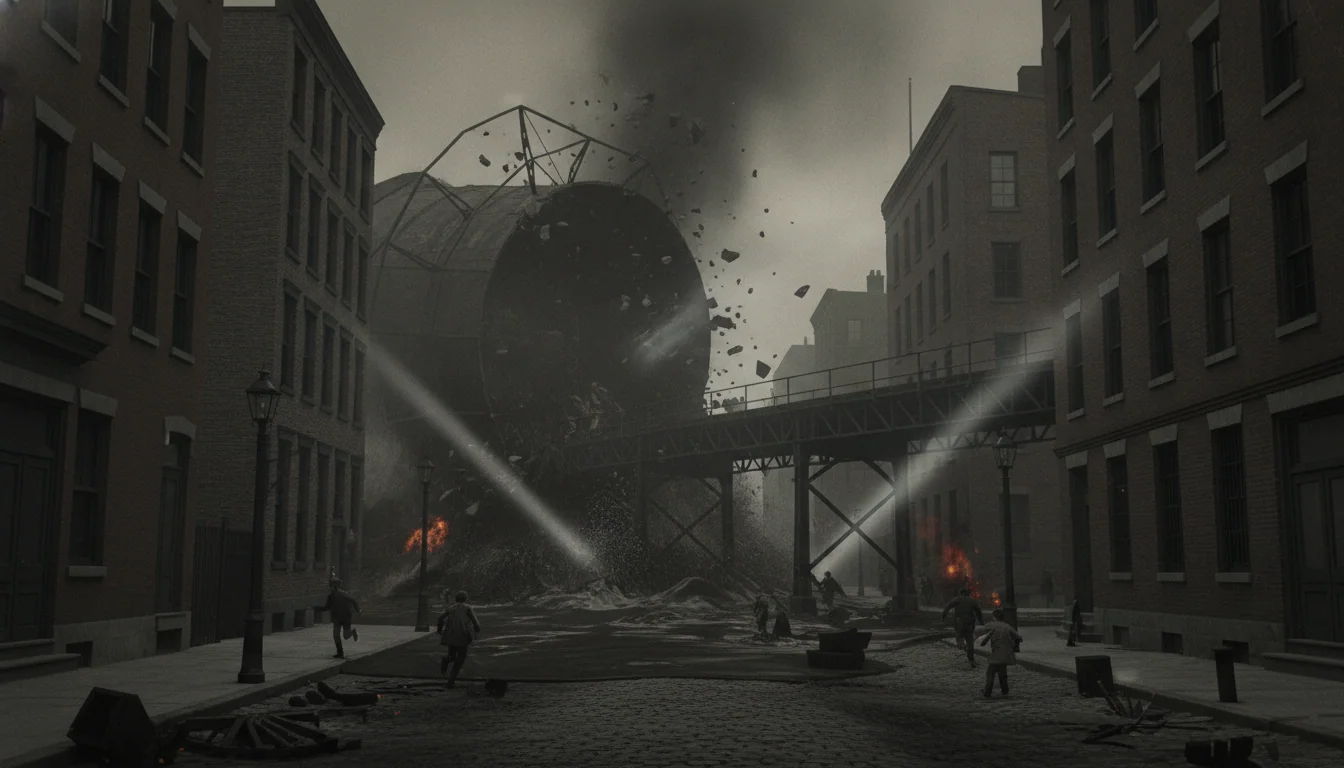
On January 15, 1919, workers in Boston's North End broke for lunch on an unusually warm afternoon, the kind of thaw that follows a hard cold snap. It was a densely packed, mostly immigrant working-class neighborhood of longshoremen, laborers, and their families, with a firehouse, an elevated rail line, and a schoolyard all within a stone's throw of the waterfront. Above them, on Commercial Street, a steel tank five stories tall held roughly 2.3 million gallons of molasses. At around 12:30 p.m., the tank tore itself open. What came out was not a spill. It was a wave reported at about 15 feet high, moving at an estimated 35 miles an hour, faster than anyone in its path could run.
The tank on Commercial Street
The tank belonged to the Purity Distilling Company, a subsidiary of United States Industrial Alcohol. It had gone up in 1915 to hold molasses destined for distillation into industrial alcohol, the raw material for munitions during the First World War. Roughly 50 feet tall and about 90 feet across, it was built in a matter of months, fast even by the standards of a country gearing up for war. When the war ended in November 1918, the same molasses could still be distilled into alcohol for other products, so the tank stayed in business.
Company records and later testimony painted an unflattering picture of how it was built. Construction was overseen by Arthur Jell, the company's treasurer, a man with no training in engineering. Jell reportedly skipped or shortened basic safety checks, including filling the tank with water first to test it under load, a standard precaution that got squeezed out by wartime urgency. From nearly the day it opened, the tank leaked. Children in the neighborhood collected the drips in cans and pails to take home. Rather than fix the seams, the company had the tank painted brown, which did nothing for the leaking and everything for hiding it.
Warnings nobody heeded
Employees and neighbors raised concerns for years. Workers said the tank groaned and its sides trembled whenever it was filled near capacity, sounds that unnerved anyone standing close by. None of it prompted a proper inspection. United States Industrial Alcohol needed the tank running, first for the war effort, and after November 1918, to keep processing molasses before a different deadline arrived: national Prohibition, ratified into the Constitution the very day after the disaster, was closing in, and the company had every incentive to move as much molasses through the tank as it could while the market for industrial alcohol still existed in its wartime form.
The weather added its own pressure. Boston had endured a hard freeze in the days before the disaster, with temperatures down near 2 degrees Fahrenheit, then swung to roughly 40 degrees on January 15 itself. Investigators later concluded that the sudden warmth likely reactivated fermentation inside the tank, building carbon dioxide pressure inside a container that engineers agreed was already too thin-walled for what it was asked to hold. Postwar analysis of the wreckage suggested the steel plating was considerably thinner than sound engineering practice of the era would have called for, with little margin of safety built in at all.
The wave
Witnesses recalled a sound like machine-gun fire in the seconds before the tank failed: rivets popping loose one after another as the seams gave way. Then the steel walls opened outward. A wall of molasses estimated at 15 feet high surged down Commercial Street at around 35 miles an hour, swallowing everything in its path.
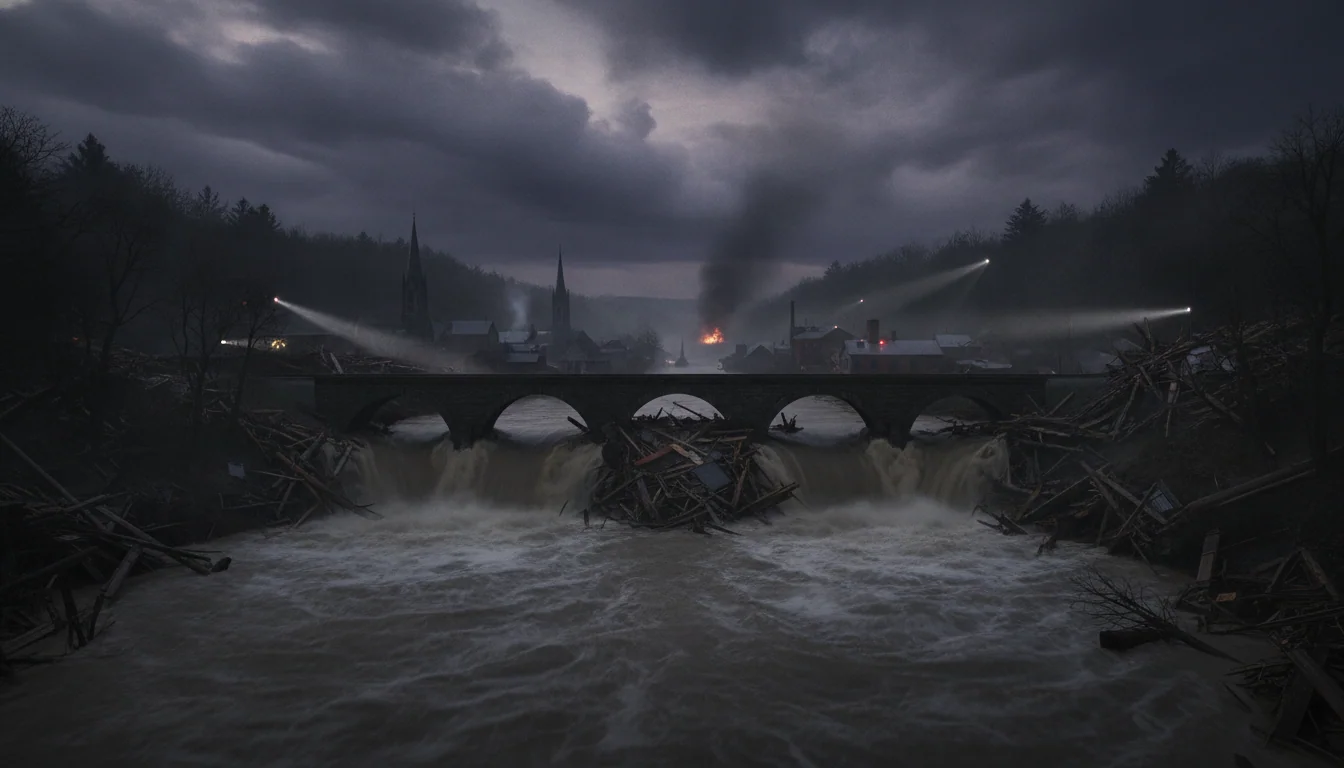
The wave tore buildings from their foundations, snapped the steel girders supporting the Boston Elevated Railway's tracks overhead, and lifted a neighborhood firehouse off its footing, trapping firefighters inside the wreckage. Horses pulling delivery wagons were caught mid-stride and vanished under the surge. A stretch of waterfront that had been full of lunchtime activity moments earlier was buried under syrup several feet deep in places, syrup that grew harder to move through as it cooled and thickened. Motormen on the elevated line noticed the bent trestle just in time to stop trains from running out onto the damaged section, one of the few pieces of luck in an otherwise merciless afternoon.
Rescue was slow, grim work. The molasses set almost like tar as it lost heat, trapping victims who might otherwise have escaped and muffling the calls of those still able to cry out. Sailors from the training ship USS Nantucket, moored nearby, waded in alongside Boston police, Red Cross workers, and volunteers to search for survivors, some tying ropes to each other so no one lost their own footing in the muck.
The toll
Twenty-one people died, drowned or crushed by debris in the flood, and roughly 150 more were injured. It took days to recover all the bodies, and some victims went unidentified for weeks under the coating of syrup. For a long time afterward, residents described the cloying sweetness clinging to fences, cellar doors, and telephone poles across the neighborhood. Cleanup crews reportedly pumped seawater from Boston Harbor to help break the coating up and hose it into storm drains. Locals in the North End have long claimed that on a hot summer day, you can still catch a faint whiff of molasses off the pavement, a piece of folklore that is more charming than verifiable.
Why the story keeps resurfacing
Part of why the Boston Molasses Flood keeps circulating online, decades after the more famous disasters of its era have faded into textbooks, is the sheer wrongness of the premise. A pantry ingredient is not supposed to be a killer, let alone one fast enough to outrun a person on foot. Add a corporate cover-up, a rejected sabotage theory that briefly played like an unsolved mystery, and a court case that ran for years, and the flood has the shape of a true-crime story wearing a slapstick disguise. That is a large part of its appeal as internet trivia, and it is worth remembering, underneath the novelty, that the wrongness was fatal for twenty-one real people who were simply having lunch.
The inquiry
United States Industrial Alcohol first tried to pin the disaster on sabotage, suggesting that anarchists opposed to the war effort had planted a bomb inside the tank. It was a plausible-sounding story for the era, since Boston had recently seen anarchist bombings elsewhere in the city, and it gave the company an external villain to point at instead of its own tank.
More than a hundred lawsuits from victims and their families were consolidated into a single case, one of the first proceedings of its kind in Massachusetts history. An auditor, Hugh Ogden, was appointed to hear the evidence and issue findings, a process that stretched on for roughly six years before he delivered his report in 1925, after testimony from engineers, chemists, and eyewitnesses. Ogden rejected the sabotage theory outright. His findings concluded that the tank had been unsound from the start: the steel was too thin for the pressures it was expected to hold, the design was never reviewed by a qualified engineer, and the company ignored years of leaking and groaning that should have prompted it to empty the tank rather than keep refilling it. United States Industrial Alcohol was found liable and paid damages to the victims and their families.
The case became a turning point for engineering oversight in Massachusetts and beyond. In its wake, the state moved toward requiring that structural plans for tanks and buildings be certified by a qualified engineer or architect before construction went ahead, part of a broader shift toward the kind of professional accountability that civil engineering now takes for granted. Ogden's inquiry could not undo what happened on Commercial Street, but it did the one thing a disaster inquiry can still do: it stated plainly, for the record, that a company had built something it did not understand well enough to be trusted with 2.3 million gallons of anything.
For another industrial disaster that forced US regulators to rethink workplace safety, see the Triangle Shirtwaist Fire. For a different catastrophe born from a failed engineering shortcut, see the Johnstown Flood.
Quick Answers
Common questions about this topic
What caused the Boston Molasses Flood?
A steel storage tank on Commercial Street, built in 1915 by the Purity Distilling Company without adequate engineering review or testing, ruptured on January 15, 1919. A sudden swing from temperatures near 2 degrees Fahrenheit to roughly 40 degrees Fahrenheit is thought to have raised internal pressure from fermentation gases inside a tank that was already too thin-walled for its load.
How many people died in the Boston Molasses Flood?
Twenty-one people were killed and roughly 150 more were injured when a wave of molasses about 15 feet high surged through Boston's North End at an estimated 35 miles per hour.
Could the disaster have been prevented?
Almost certainly. The tank's construction was overseen by a company treasurer with no engineering background, was reportedly never properly tested before use, and had been visibly leaking for years, with the company simply painting it brown rather than fixing the seams.
What did the investigation find?
An auditor named Hugh Ogden spent roughly six years reviewing the case, rejected the company's claim that anarchists had bombed the tank, and concluded it was structurally unsound and should never have been built as it was. United States Industrial Alcohol was found liable and paid damages to victims and their families.

Talk to the Survivors
Hear firsthand accounts from people who lived through history's darkest days.
Create your free account →No card required. Some figures and features require a paid plan.
Join the HistorIQly Club
Get smarter about the past.
Weekly stories, deep dives, and exclusive content straight to your inbox.