The Final Hours of JFK in Dallas
A motorcade route printed in the newspaper, an open car, and six seconds in Dealey Plaza ended the presidency of John F. Kennedy on November 22, 1963.
Read Wikipedia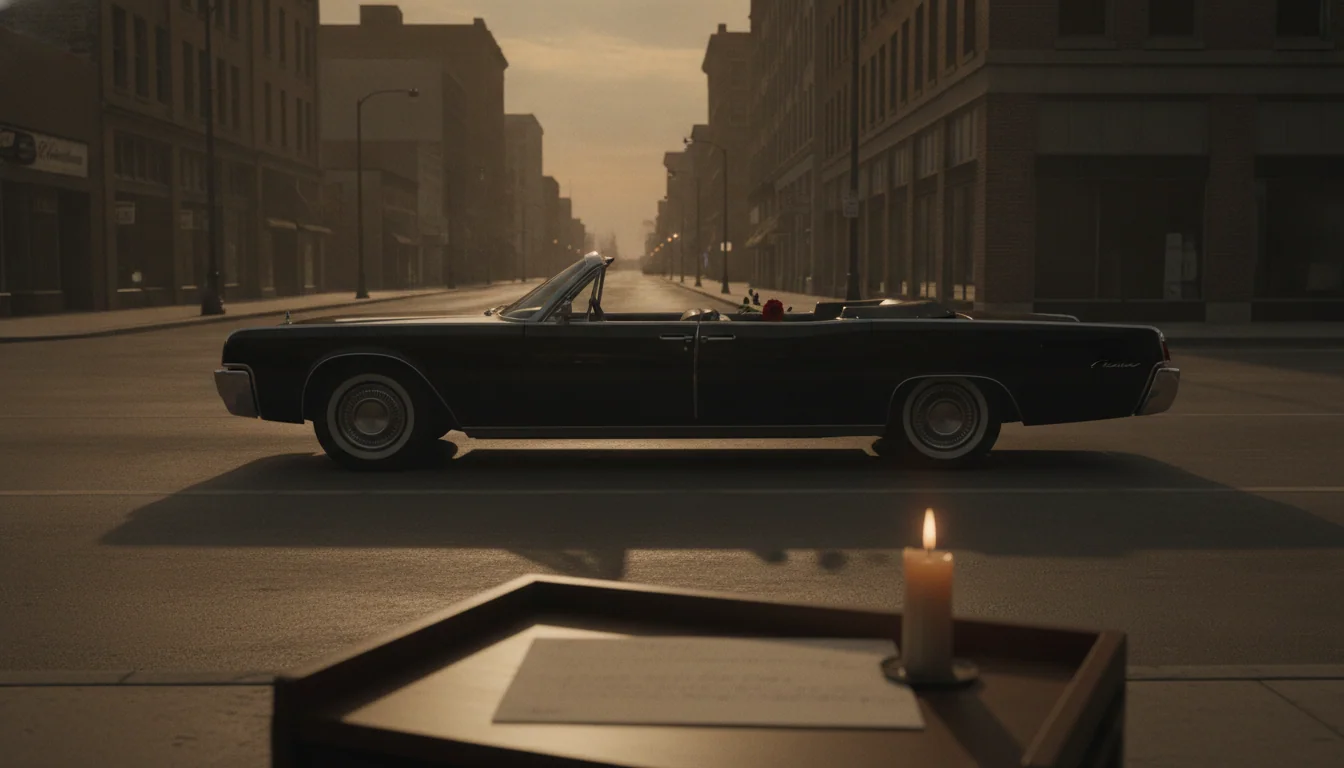
At 11:38 a.m. on November 22, 1963, Air Force One touched down at Dallas Love Field under a clear Texas sky, after a morning weather worry had passed. President John F. Kennedy stepped out to a crowd along the fence line, shook hands, and climbed into the back seat of an open-top 1961 Lincoln Continental beside his wife, Jacqueline, in the pink wool suit she had chosen for the trip. He had a little under an hour left to live.
The morning before
Kennedy had spent the previous two days on a political trip through Texas meant to smooth over feuding factions within the state's Democratic Party ahead of the 1964 election. On the morning of November 22, he addressed a breakfast crowd in Fort Worth, joking about Jacqueline's slow start to the day and telling the audience that no one wondered what she was wearing. He also read a Dallas newspaper that morning that ran a full-page advertisement accusing his administration of being soft on communism, a preview of the political tension awaiting him in the city.
Dallas itself carried a reputation for hostility toward Kennedy's administration. Weeks earlier, Adlai Stevenson, the U.S. ambassador to the United Nations, had been jostled and spat on during a visit to the city, and some of Kennedy's own staff had voiced concern about the trip. Kennedy reportedly waved off the worry, telling aides that if someone wanted to shoot a president from a rooftop with a rifle, there was little any security detail could do to stop it. The full motorcade route through downtown Dallas, including its turn onto Elm Street past the Texas School Book Depository, had been published in local newspapers days in advance, standard practice for the era but a detail later scrutinized closely.
The turning point
The motorcade left Love Field a little after 11:50 a.m., moving slowly through cheering crowds lining the downtown streets, with Texas Governor John Connally and his wife Nellie riding in the same car on jump seats ahead of the Kennedys. As the procession turned from Main Street onto Houston Street and then sharply onto Elm Street, it passed directly beneath the windows of the Texas School Book Depository, slowing to navigate the turn.
It was at this point, according to Nellie Connally's own account, that she turned around to the president and said, "You can't say Dallas doesn't love you, Mr. President," and that Kennedy replied, "No, you certainly can't." Those words, spoken only seconds before the first shot, are among the most reliably documented exchanges of his final hours, recorded by a witness sitting close enough to hear them clearly.
The final minutes
At approximately 12:30 p.m., as the limousine passed the Depository and continued down the gentle slope of Elm Street toward a railroad underpass, shots rang out. The Warren Commission's later investigation concluded three shots were fired from the Depository's sixth floor in a span of roughly eight seconds, one of which missed the motorcade entirely. A second shot struck Kennedy in the upper back and exited through his throat, and, according to the commission's disputed single-bullet theory, continued on to wound Governor Connally, who was riding in front of him. Connally survived his wounds. Zapruder film footage, captured by a bystander with a home movie camera, recorded the sequence and became the most closely studied 26 seconds of film in American history.
The fatal shot struck Kennedy in the head. Secret Service agent Clint Hill, riding on the follow-up car, ran forward and climbed onto the trunk of the presidential limousine as it accelerated toward Parkland Memorial Hospital, roughly four miles away. Jacqueline Kennedy, in the chaos of the moment, climbed partway onto the trunk herself, an action later described by witnesses as an instinctive attempt to retrieve part of the fallen president, though she has also said she does not fully recall her own actions in those seconds.
The end
The motorcade reached Parkland Memorial Hospital at approximately 12:38 p.m. Doctors in Trauma Room One worked on Kennedy for roughly twenty minutes, performing a tracheotomy and administering blood and fluids, though the head wound left little realistic hope of recovery. Father Oscar Huber, a priest from a nearby parish, was called to the hospital and administered the Catholic rite of last rites. John F. Kennedy was pronounced dead at 1:00 p.m. Central time by Dr. Kemp Clark, chief of neurosurgery at Parkland. He was 46 years old.
Governor Connally, treated separately, survived his wounds and recovered fully enough to serve out his term as governor. Jacqueline Kennedy refused to change out of her blood-stained pink suit for the remainder of the day, reportedly telling an aide she wanted "them to see what they have done."
Aftermath
Lee Harvey Oswald, a 24-year-old former Marine and Depository employee, was arrested that afternoon in a movie theater after allegedly shooting and killing Dallas police officer J.D. Tippit during his attempted escape. Vice President Lyndon B. Johnson was sworn in as president aboard Air Force One at Love Field at 2:38 p.m., with Jacqueline Kennedy, still in her stained suit, standing beside him, and federal judge Sarah T. Hughes administering the oath. Kennedy's body was flown back to Washington that evening for an autopsy at the National Naval Medical Center in Bethesda, Maryland.
Oswald himself was shot and killed two days later, on November 24, by Dallas nightclub owner Jack Ruby, live on national television as Oswald was being transferred between jail facilities, a killing that removed the one person who could have been directly questioned about the assassination in open court and helped fuel decades of conspiracy theories that continue to circulate.
The Warren Commission, convened by President Johnson within a week of the assassination, spent nearly a year investigating and concluded in September 1964 that Oswald had acted alone, firing from the sixth-floor window using a mail-order Italian rifle. A later congressional investigation in the late 1970s, the House Select Committee on Assassinations, concluded there was a "probable conspiracy" based on disputed acoustic evidence, a finding that has itself been challenged by subsequent scientific review. No competing account of who was responsible, or why, has been established with the kind of documentary certainty that closes the case for historians, and the assassination remains one of the most examined and argued-over events in twentieth-century American history, its final sequence still measured, frame by frame, in the seconds captured on Abraham Zapruder's home movie camera.
Quick Answers
Common questions about this topic
What were JFK's last words?
Moments before the shooting, Nellie Connally, the Texas governor's wife, turned to Kennedy and said, "You can't say Dallas doesn't love you, Mr. President," to which he reportedly replied, "No, you certainly can't." No further coherent words from Kennedy are documented after the first shot struck him seconds later.
How did JFK die?
Kennedy was struck by rifle fire while riding in an open limousine through Dealey Plaza in downtown Dallas at approximately 12:30 p.m. Central time on November 22, 1963. He suffered a wound to the throat and neck and a fatal wound to the head, and was pronounced dead at Parkland Memorial Hospital at 1:00 p.m.
Who shot JFK?
The Warren Commission concluded in 1964 that Lee Harvey Oswald, firing from the sixth floor of the Texas School Book Depository, acted alone. That conclusion has been challenged by researchers and later congressional review ever since, and conspiracy theories about a second shooter or a broader plot remain widespread, though no alternative account has been conclusively established.
How many shots were fired at JFK's motorcade?
The generally accepted account holds that three shots were fired, one of which missed. The path of the other two, including the disputed single-bullet theory that one round passed through both Kennedy and Governor John Connally, has been argued over by researchers, ballistics experts, and congressional investigators for decades.

Ask Them About the End
Chat with historical figures about their final days, in their own words.
Create your free account →No card required. Talk to anyone in history with 8 free credits a day. Some features require a paid plan.
Join the HistorIQly Club
Get smarter about the past.
Weekly stories, deep dives, and exclusive content straight to your inbox.