If Casanova Lived Today: The Memoirist Who'd Monetize Every Room He Walked Into
If Casanova lived today, the lawyer-turned-escape-artist would trade the Piombi for a members' club and his memoirs for a Substack with a very long waitlist.
Read Wikipedia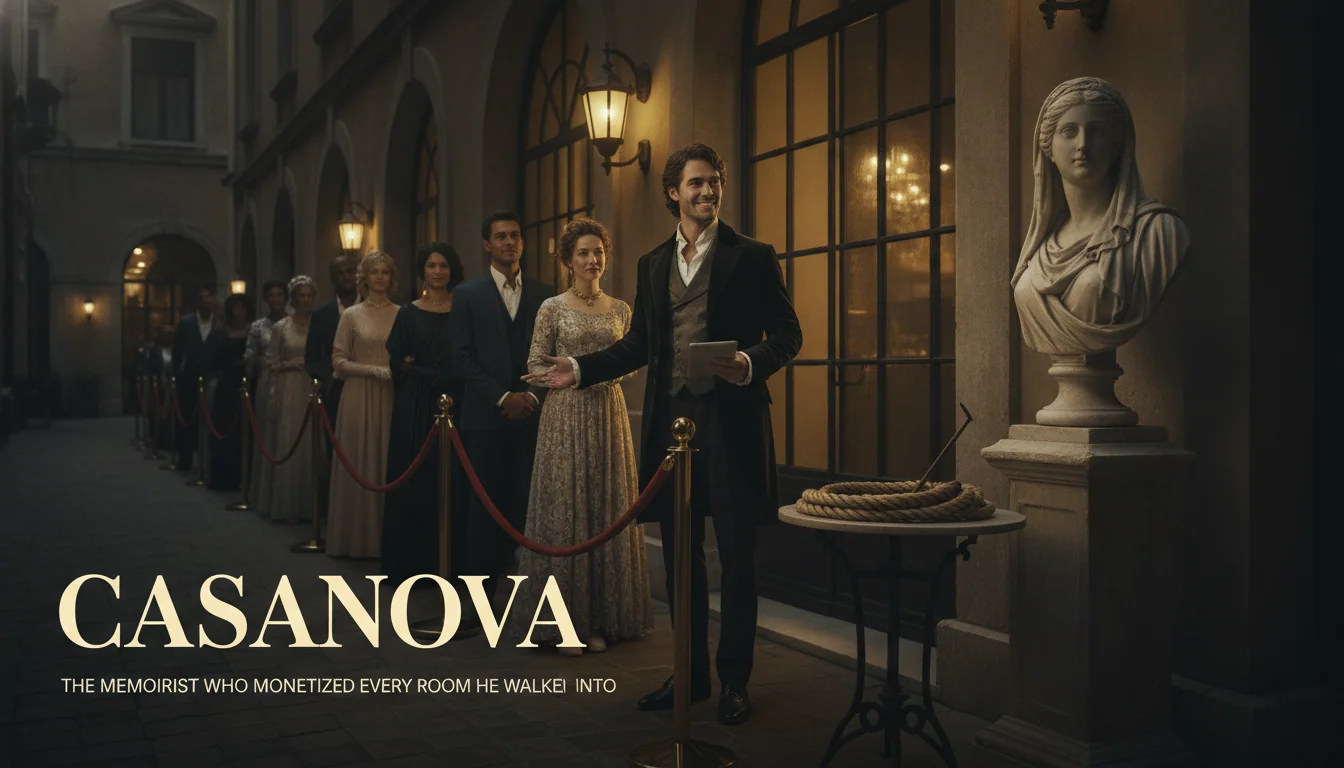
He graduated from law school at seventeen, took minor holy orders soon after, gave it up to play violin in a Venetian theater pit, and eventually became the single most famous escaped prisoner in Europe. Along the way he worked as a scribe for a cardinal, ran France's first state lottery, dueled a Polish count over an actress, corresponded with Voltaire, sat across a dinner table from Catherine the Great, and spent his last thirteen years as a cranky, underpaid librarian in a Bohemian castle writing down everything that had happened to him. The writing down is why anyone still knows his name.
Giacomo Casanova is remembered today almost entirely for one activity, and it is not the one that made him famous while he was alive. If Casanova lived today, the seduction reputation would survive, but the more interesting question is what happens to a man whose real skill was turning his own life into content before content was a word anyone used.
The historical figure
Casanova was born in Venice on 2 April 1725, the son of two working actors, and was largely raised by his grandmother while his parents toured. He was a sickly, nosebleed-prone child sent off to Padua for schooling, where he proved sharp enough to earn a law degree at seventeen. Law never held him. He drifted through a series of half-careers that reads like a résumé nobody would believe: minor clerical orders and occasional preaching, a stint as secretary to a cardinal in Rome, a run as a violinist at Venice's San Samuele theater, and a brief spell as a military officer for the Republic. Each attempt at respectability ended the same way, with Casanova gambling, arguing, or seducing his way out of the job.
What made him internationally famous, at least at first, was not romance but incarceration. In July 1755, Venice's State Inquisitors arrested him for blasphemy, libertinism, and owning forbidden books, and sentenced him without trial to an indefinite term in I Piombi, the notorious prison tucked under the lead sheeting of the Doge's Palace roof. His cell was barely tall enough to stand in, baking in summer and freezing in winter, and shared with rats and fleas. After more than a year inside, he and a fellow prisoner, a renegade monk named Father Balbi, smuggled in an iron spike, cut through the ceiling, crawled across the palace roof in the dark, broke back into the building through a skylight, and calmly walked out the front entrance in the fine clothes Casanova had been wearing on the night of his arrest. It happened on the night of 31 October into 1 November 1756. He was thirty-one. No one had escaped I Piombi before, and the story made him a minor celebrity across Europe before he had written a word of memoir.
The following decades were a tour of nearly every court and capital that mattered: Paris, where he helped launch the French state lottery and made and lost a fortune; Dresden, Vienna, and Prague; Constantinople; London; Russia, where he reportedly discussed calendar reform with Catherine the Great; the Prussian court of Frederick the Great, who considered hiring him; and Ferney, where he visited Voltaire. He worked, on and off, as a financial schemer, a Freemason, a diplomat-without-portfolio, and eventually as an informant for the Venetian Inquisitors who had once imprisoned him, reporting back on gambling houses and suspect literature after he was finally permitted to return home in 1774. He fought at least one serious duel, taking a near-fatal hand wound in 1766 over an actress in a quarrel with a Polish nobleman.
He spent his final thirteen years as librarian to Count Joseph Karl von Waldstein at Castle Dux in Bohemia, a job he found humiliating and mostly tolerated because he had nowhere else to go. There, unpaid and irritable, he wrote Histoire de ma vie, an account of his life that runs into the thousands of pages and stops, unfinished, in 1774. It names roughly 120 romantic relationships, but it is also a detailed, digressive record of law, music, finance, prison, and the internal workings of eighteenth-century Europe, written by a man who understood before almost anyone else that his own life was the most reliably interesting subject he had access to. He died at Dux on 4 June 1798, at seventy-three. The full, uncensored manuscript was not published until the mid-twentieth century.
The modern role
The 2026 Casanova is not primarily a seducer. He is a personal-brand operator who happens to have seduction as one revenue stream among several, and the honest job title on his tax return reads something closer to "founder" than "lover."
He runs a small, absurdly hard to join members' club, part restaurant, part late-night salon, in a city that rewards exactly his skill set. Venice is the sentimental choice, but the money says Milan or Monaco, somewhere the gambling tables, the old money, and the new money all sit at the same bar. The club is the modern I Piombi story turned inside out: instead of an inescapable room he was locked into, it is a room everyone else is desperate to be let into, and he controls the door.
Alongside the club, there is the memoir project, except it never stops and it never becomes a finished book. It is a subscription newsletter, dense, funny, self-aggrandizing, and weirdly well researched, publishing serialized chapters of his own life in the exact digressive style Histoire de ma vie used two and a half centuries ago. Paying subscribers get the parts with names still attached. He treats the newsletter the way he once treated the memoir at Dux: as the only project he actually takes seriously, because it is the one thing guaranteed to outlast him.
The skills that translate
Reinvention on demand. The historical Casanova moved between law, the clergy, music, the military, and finance without ever mastering any of them for long, because mastery was never the goal, credible reinvention was. The modern version treats every failed venture the same way: not as an ending but as material, folded into the next act within a season.
Reading a room as a transaction. He read what a cardinal wanted, what a countess wanted, what a card table wanted, and delivered it convincingly enough to be paid, housed, or forgiven for it afterward. The 2026 version does the same thing across a dinner table, a pitch meeting, and a comment section, often within the same hour.
Turning captivity into content. The I Piombi escape made him famous because he wrote it up and sold it, immediately understanding that the story of his own imprisonment was worth more than his silence about it. That instinct, disaster as a first draft, is the one skill that needs no updating at all.
Where he lives and who he resembles
He keeps a flat in Venice for sentiment and a base in Monaco or Milan for business, and he is on a plane more often than either place would suggest. He does not build a large following so much as an expensive-feeling one: an Instagram presence heavy on unlabeled locations, unnamed dinner companions, and captions that are one clause shorter than an actual answer.
The contemporary figure he most resembles is a gambler-influencer type: someone whose public identity runs on cards, women, private aircraft, and a persistent, unresolved question about how much of the story is true. Casanova's memoirs faced exactly that skepticism in his own century, historians still argue over which anecdotes he inflated, and the honest answer is that verification was never really the point. The point was that the story was good enough that people kept reading anyway, and kept paying to keep reading.
Why it matters
Casanova is easy to flatten into a punchline, and the flattening misses what actually made him unusual. He was a law graduate, a working musician, a financial operator competent enough to help run a national lottery, a man who talked his way out of a supposedly inescapable prison and then, decades later and reduced to a resented castle librarian, sat down and turned an entire improvised life into the document that made him immortal. The seduction was real. It was also the least difficult thing he did.
The 2026 version understood the same lesson the original did at Dux: nobody remembers the job title. They remember whoever wrote the story down first, and best. For other figures whose survival depended on the ability to escape a closing trap and turn it into legend, or on reading a room until it fed them, see If Harry Houdini Lived Today and If Voltaire Lived Today.
Quick Answers
Common questions about this topic
Who was Giacomo Casanova?
Giacomo Casanova (1725-1798) was a Venetian lawyer, violinist, cleric-in-training, gambler, diplomat, and writer best known for his sprawling memoir Histoire de ma vie. He worked across Europe as an occasional spy and financial schemer, was imprisoned in Venice's I Piombi in 1755, and became famous in his own lifetime for his 1756 escape from that prison.
Did Casanova really escape from prison?
Yes. He was arrested in Venice in July 1755 on charges of blasphemy, libertinism, and possessing prohibited books, and held without trial in I Piombi, the lead-roofed prison atop the Doge's Palace. On the night of 31 October into 1 November 1756, he and a fellow prisoner, Father Balbi, cut through the cell ceiling with a smuggled iron spike, crossed the roof, broke back into the palace through a skylight, and walked out the front entrance in a fine suit before the guards realized anyone was missing.
How many women did Casanova claim to have been involved with?
His memoirs describe roughly 120 named romantic and sexual relationships across a life that also covered law, music, gambling, espionage, and finance. The number gets quoted constantly, but it accounts for a small fraction of a memoir that runs to thousands of pages and spans travels through most of Europe.
Was Casanova actually a spy?
He did intelligence work at various points, most documented as an informant for the Venetian State Inquisitors after his eventual return to Venice in 1774, reporting on commerce, gambling houses, and questionable literature. It was minor, transactional work rather than a dedicated intelligence career, closer to a well-connected informant than a professional agent.

Meet Them in Person
Chat with the historical figures behind these modern reimaginings.
Create your free account →No card required. Some figures and features require a paid plan.
Join the HistorIQly Club
Get smarter about the past.
Weekly stories, deep dives, and exclusive content straight to your inbox.