If Voltaire Lived Today: The Satirist Who'd Own Every Platform and Be Banned From Most
If Voltaire lived today, he'd have ten million subscribers, a legal fund, and a neutral country to write from - the Enlightenment's sharpest pen in the algorithm's age.
Read Wikipedia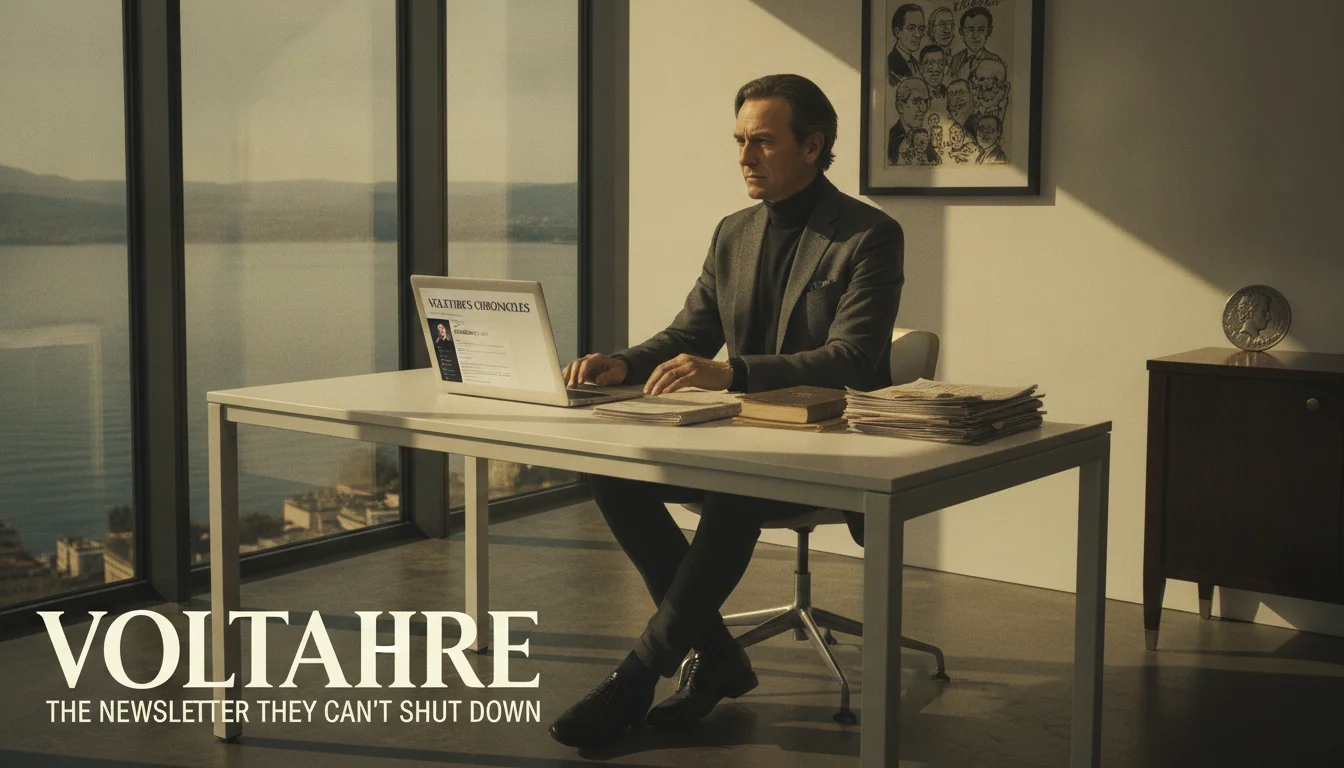
The man published under more than 170 pseudonyms. He kept a house in a border town specifically so he could step into Switzerland if French authorities came to arrest him. He conducted his ideological campaigns through letters, pamphlets, plays, philosophical novels, and a correspondence network that spanned every significant mind in Europe, all while denying authorship of the more dangerous pieces.
Drop Francois-Marie Arouet into 2026 and he is still doing exactly the same thing, except the pamphlet is a Substack post, the sedan chair is a charter flight, and the border town is probably Lugano.
The historical figure
Voltaire was born in 1694 in Paris to a family of the solid professional bourgeoisie - his father was a notary. He was educated by Jesuits, excelled at everything that could be done with language, and by his early twenties had established himself as a promising poet and wit in Parisian society. By his late twenties he had been imprisoned in the Bastille twice: once for writing satirical verses implying that the Regent was committing incest with his own daughter, and once after a brawl with the Chevalier de Rohan's servants in which Voltaire was beaten and then arrested for the inconvenience of fighting back.
The second Bastille stint ended with an offer: prison or exile in England. He chose England and spent three years there, from 1726 to 1729. The experience was transformative in the way that only being shown a completely different way of organizing a society can be. England had religious toleration. England had a Parliament that could check a king. England had Newton, whose discoveries Voltaire translated and popularized for a French audience. He came back to France with the Lettres philosophiques, published in 1734, which compared French institutions unfavorably to English ones often enough that the parlement of Paris ordered the book burned.
He spent the next decade living with the mathematician and philosopher Emilie du Chatelet at the Chateau de Cirey in Lorraine, where she worked on translating Newton and he worked on history, plays, and philosophical verse. By 1759, he had settled at Ferney, on the French-Swiss border, where he could write whatever he wanted and step over the border to Genevan territory if a lettre de cachet arrived.
Candide appeared in 1759 - the story of an optimistic young man whose faith that "all is for the best in the best of all possible worlds" is systematically demolished by earthquakes, war, the Inquisition, and human cruelty. It is 120 pages long and remains the most efficient satirical novel in the European tradition.
The Calas Affair consumed him in the early 1760s: a Protestant merchant wrongly executed for a crime he almost certainly did not commit. Voltaire investigated from Ferney, wrote pamphlets, circulated letters across Europe, lobbied every influential person he could reach, and after three years succeeded in having the conviction overturned posthumously. It was one of the first uses of organized public opinion to reverse a judicial decision, and it established a template that campaigners have used ever since.
He died in 1778, aged 83, having returned to Paris to see a final theatrical production. The strain of the visit, combined with his age, killed him within months.
The modern role
If Voltaire lived today, in 2026, his newsletter is called something like Ecrasez - a title that the French-speaking press recognizes immediately and that 90 percent of his English-language subscribers have to look up once and never forget. It publishes irregularly, without warning, whenever something has made him angry enough to write, which in practice means two or three times a week. Each issue runs between 2,000 and 8,000 words. The paid subscriber count sits somewhere between 8 and 12 million, depending on how you count re-shares.
He has accounts on every platform and has been banned from several. The bans are never permanent because the platforms discover, each time, that banning him costs them more in attention than hosting him does. He returns under slightly different usernames - VoltaireActuel, V_Arouet, FMArouet1694 - and continues without apology. The original accounts are kept suspended as trophies and to prevent impersonation.
The formal business structure is a Swiss LLC based in Zug, which publishes the newsletter, licenses translation rights to publishers in 35 countries, and manages the speaking schedule that he mostly refuses to fulfill. He does not do corporate keynotes. He does three or four conversations per year, publicly, on his own terms, with interlocutors he has pre-approved. The fee is substantial and donated to the legal fund.
The legal fund is real and has active cases in six countries.
The skills that translate
The core technology of Voltaire's operation was the pamphlet: a short, precise, devastating document that made a single argument so clearly and wittily that refutation required more words than the original and therefore lost the attention war. Every medium since has worked the same way, and Voltaire would understand Substack's constraints and affordances within an afternoon of reading.
His prose style was not ornamented. He distrusted abstraction and preferred the concrete particular - the specific wrong, the named official, the documented contradiction. This is the exact style that travels well in digital reading environments, where readers abandon complicated sentences and reward the aphorism.
The pseudonym practice was not cowardice. It was calibrated risk management. You publish under one name until the authorities are sufficiently annoyed, then deny authorship while the pamphlet circulates. The authorities cannot arrest a text. In the modern version, this translates to a disciplined firewall between the newsletter, which he signs, and the more dangerous analysis circulated in closed group chats and through anonymous posting infrastructure. The most damaging things he writes, he does not sign. The most famous things, he does.
The border town remains essential. Ferney-in-2026 is a residence in a country with strong press freedom protections, no extradition treaty with the governments he most frequently infuriates, and enough international credibility that arresting him would cost more in diplomatic friction than it would resolve. He is not hiding. He is positioned.
The Calas equivalent
Every decade there is one case. One person convicted under circumstances that don't hold up, one institution that closed ranks, one piece of documentary evidence being sat on by someone who would prefer it stayed buried. Voltaire's gift was not only that he was incensed by these cases but that he understood how to marshal incensement into a campaign that had enough organizational structure to actually change the outcome.
In 2026, he would do the same thing with the same instincts. His newsletter would pivot from general satire to a case-specific investigation and not leave it for three years. He would use the subscriber base to fund the legal team, the translation infrastructure to place the story in eight languages simultaneously, and the platform accounts to ensure that every time the relevant authority tried to move on, ten thousand new readers learned about the case.
The modern Voltaire does not solve cases. He makes ignoring them expensive. That is the same thing Voltaire did for Jean Calas, and it worked.
Where he lives
The Swiss residence is the operational base. He also has a flat in London - England remains a useful comparison case for whatever country he is currently criticizing - and regular use of an apartment in Paris, technically in someone else's name, for the periodic returns that combine business meetings with theater visits and consultations with a lawyer who has represented three different heads of state and declines to specify which ones.
He does not own the Paris flat because the French government has not formally invited him to own property there, and the grey zone of the arrangement is, to him, aesthetically appropriate.
He does not spend much time in the United States, finding its media ecosystem simultaneously too large and too shallow for sustained work, though he has a substantial American readership and occasional American defenders of considerable influence.
What goes wrong
The historical Voltaire miscalculated occasionally and severely. His late-career antisemitic remarks remain a genuine stain on an otherwise distinguished record of fighting prejudice. He was capable of the same cruelty toward individuals that he condemned in institutions. His ego was considerable and his ability to sustain grudges - against Frederick, against rivals, against critics - sometimes produced campaigns of mockery that were disproportionate to the original offense.
The 2026 version has the same failure modes. The newsletter that is funny in its first iteration on a subject becomes exhausting by the fifth. The target who has already been destroyed is still being pursued. The personal attack that should have stayed in a private letter appears in a public post and requires an apology that arrives late and is not quite an apology.
His defenders say the failures are priced in. You get the Calas campaigns, the Candide, the fundamental architecture of a certain kind of liberal humanist public argument. You also get the feuds and the occasional spectacular misjudgment. The historical Voltaire was not a saint. The newsletter does not pretend otherwise.
Why it matters
Voltaire's persistent relevance is not really about his specific arguments, most of which were won long ago. It is about the model he represents: the independent intellectual who has enough of an audience to be cost-free to silence, who operates outside institutional structures that would compromise his conclusions, who names the thing and describes it precisely and refuses to stop describing it until something happens.
That model is genuinely endangered in 2026 in ways it was not when Voltaire practiced it. The pamphlet could not be algorithmically suppressed; the newsletter can. The border town near Geneva is further from the relevant powers than it used to be.
"One must cultivate one's garden," Candide concludes. The 2026 Voltaire has one and tends it daily. The garden is the newsletter. The weeds are everything else.
For more historical figures who would thrive - or cause trouble - in 2026, see If Alcibiades Lived Today and If Simon Bolivar Lived Today.
Quick Answers
Common questions about this topic
Who was Voltaire?
Voltaire was the pen name of Francois-Marie Arouet (1694-1778), a French Enlightenment writer, philosopher, satirist, and historian. He is best known for Candide (1759), his philosophical novel satirizing religious optimism, and for his campaigns against religious persecution, judicial torture, and the arbitrary exercise of state power. He was twice imprisoned in the Bastille and spent much of his adult life in exile.
Why was Voltaire exiled from France?
Voltaire spent years outside France at various points in his life, primarily because his satirical writings offended the nobility, the church, and the royal court. He lived in England from 1726 to 1729 after a dispute with the Chevalier de Rohan led to a Bastille stay; he later lived in Prussia at the court of Frederick the Great; and from 1759 until near the end of his life he lived at Ferney, a country estate on the French-Swiss border that let him step across the border if French authorities came for him.
What was the Calas Affair?
In 1762, a Protestant merchant named Jean Calas was broken on the wheel and executed in Toulouse, convicted of murdering his son to prevent him from converting to Catholicism. Voltaire investigated, became convinced Calas was innocent, and mounted a three-year public campaign that led to the conviction being posthumously overturned in 1765. It was one of the first modern campaigns for judicial review and established Voltaire as a defender of the wrongly condemned.
What did Voltaire mean by 'Ecrasez l'infame'?
The phrase, meaning 'crush the infamous thing,' appeared in Voltaire's letters from the 1760s onward and became his signature battle cry. The 'infamous thing' referred to clerical intolerance, institutional religious persecution, and what he saw as the partnership between church authority and state power to suppress dissent. He sometimes signed letters simply 'Ecr. l'inf.'

Meet Them in Person
Chat with the historical figures behind these modern reimaginings.
Create your free account →No card required. Some figures and features require a paid plan.
Join the HistorIQly Club
Get smarter about the past.
Weekly stories, deep dives, and exclusive content straight to your inbox.