If Frederick the Great Lived Today: The Philosopher-General Who Runs the Defense Cabinet
If Frederick the Great lived today, the flute-playing philosopher-general would run defense policy with the same efficiency that crushed French and Austrian armies.
Frederick William I of Prussia, who was in most respects an exhausting and brutal man, produced in his eldest surviving son one of the genuine paradoxes of early modern history: a king who despised militarism as a philosophy, preferred French to German, wrote poetry, played the transverse flute at a near-professional level, corresponded with Voltaire on the nature of enlightened government, and then spent 46 years being one of the most militarily effective rulers in European history.
The combination was not accidental. It was the product of a formative trauma so complete that Frederick spent the rest of his life becoming the opposite of his father while achieving every one of his father's strategic goals.
If Frederick the Great lived today, the paradox would not go away. It would just get a new office, a press secretary, and a much larger weapons procurement budget.
The historical figure
Frederick was born in 1712 into the Hohenzollern dynasty and raised in the cold atmosphere of a Prussian court that valued military drill, pipe tobacco, and a regiment of famously tall grenadiers. Frederick valued the French language, chamber music, and the company of young men his father disapproved of.
The crisis came in 1730, when 18-year-old Frederick attempted to flee to England with his companion Hans Hermann von Katte. Frederick William I intercepted them, arrested both, and had Katte executed by beheading in Frederick's presence at the fortress of Kustrinum. The lesson Frederick took was not the one his father intended. He did not become more obedient. He became considerably more patient.
He succeeded to the throne in May 1740 and within months invaded Silesia, the wealthy Austrian province that Prussia had no legal claim to but that Frederick wanted for strategic and economic reasons. The First Silesian War secured the territory. The Second reinforced the claim. Maria Theresa of Austria never accepted the loss, which meant it was always going to be contested again.
The Seven Years' War (1756-1763) was the reckoning. An alliance of Austria, France, Russia, Sweden, and Saxony mobilized against Prussia. Frederick, with only Britain as an ally and a kingdom of perhaps three million people, fought all of them to a strategic draw. The battles of Rossbach, Leuthen, Zorndorf, and Liegnitz established him as the foremost operational commander of his era. He also lost badly on several occasions and came close to losing the war entirely - a Russian occupation of Berlin in 1760 was among the lowest points - but survived through tactical brilliance, Prussian administrative efficiency, and a stroke of strategic luck when the Russian empress Elizabeth died in early 1762 and her successor Peter III, who admired Frederick personally, reversed Russia's war policy.
The postwar Frederick was quieter, more sardonic, more attached to his Italian greyhounds, and less interested in human company generally. He called himself "the first servant of the state" and governed Prussia with a detailed attentiveness that surprises modern observers who expect an absolutist ruler to delegate the administrative grind. He read his ministers' reports himself, wrote marginal comments in a cramped French hand, reformed the civil service, expanded religious tolerance, and corresponded regularly with the major intellectual figures of his era until he died at Sanssouci on August 17, 1786. Per his wishes - finally honored in 1991, after German reunification - he was buried on the palace terrace alongside his Italian greyhounds.
The modern role
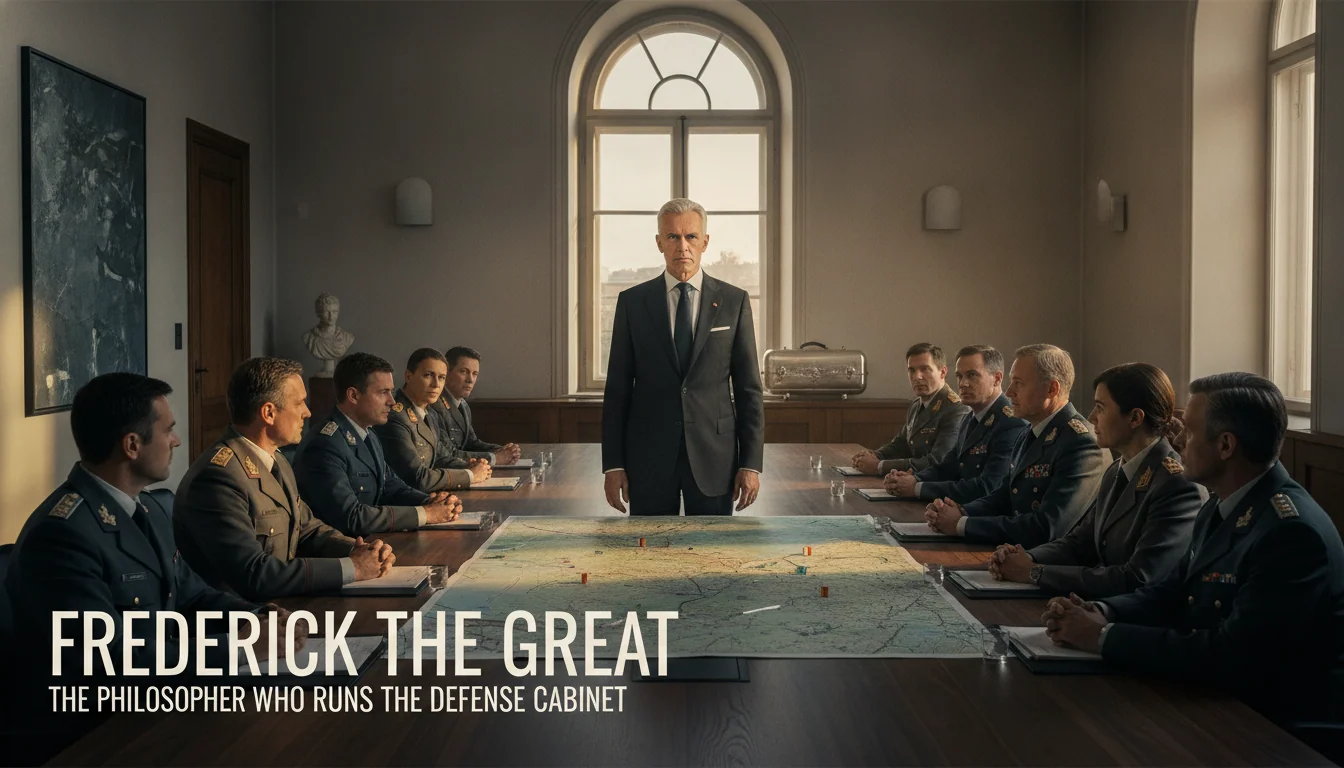
In 2026, Frederick is the defense minister of a mid-sized European state that punches above its weight. It is not Germany, because the modern German relationship with its own military history would exhaust him within a year. It is not France, because French bureaucratic culture would frustrate him in a different and equally total way. Something between the two: a state that can field a credible military force, has complicated relations with the alliance structures surrounding it, and has historical reasons to take its own security with complete seriousness.
His title on the ministerial letterhead is accurate but incomplete. He is the defense minister, and he is also informally the government's chief strategic advisor - the person the prime minister calls after midnight when a crisis is developing in a direction nobody anticipated. He has held the defense portfolio through two governments of different political parties, because both parties discovered that removing him meant losing the person who actually knew where things stood.
He is not popular. He is useful, and he knows the difference.
The skills that translate
Strategic patience is the first. Frederick spent roughly a decade between the death of von Katte and his accession to the throne appearing compliant while internally planning precisely what he would do once power arrived. In 2026, he has outlasted two foreign ministers who disagreed with his procurement priorities, four chiefs of defense staff who believed they understood modern warfare better than he did, and one prime minister who suggested the defense budget could be reduced in an election year. He is still in his position. None of them are.
Operational tempo is the second. Frederick's battlefield insight was that a smaller force that moves and decides faster can defeat a larger force that processes information slowly. He runs meetings the same way: he has read the intelligence brief before anyone else arrives, formed a conclusion before discussion begins, and uses the discussion primarily to identify which colleagues have also read it and which ones are constructing their views in real time. He is, in meetings, visibly slightly bored. People mistake this for indifference. It is not indifference.
Indifference to confessional and ethnic categories is the third, and the one that generates the most friction in a political environment that has made identity central to every policy conversation. Frederick does not particularly care where you are from. He cares whether you can do the job. He recruited French Huguenots, Silesian Catholics, and Prussian Lutherans into the same administrative system because he needed capable people more urgently than he needed confessional uniformity. In 2026 he applies the same logic across all the categories the 21st century has invented for sorting people. His ministerial staff is diverse in every measurable direction, because that is what competence looks like when you actually hire for it. He has the political arguments about this so frequently that he has memorized his own responses without finding them interesting.
The flute problem
Frederick practiced transverse flute two to four hours daily. At Sanssouci he gave regular concerts for his court, performing his own compositions as well as those of his court composer Johann Joachim Quantz. He was, by contemporary accounts from people with no obvious reason to flatter him on this specific point, technically accomplished.
In 2026, the flute case is in his office and is not decorative. He stops meetings at six in the evening to practice scales for forty-five minutes before dinner. His staff have learned to build this into the schedule. He gave one recital, organized by his chief of staff as a morale event after a particularly difficult budget negotiation. The performance was technically impressive and emotionally opaque. Several senior military officers described it afterward as unsettling in a way they could not precisely explain. Frederick did not notice or did not care.
The marriage
Frederick married in 1733 under strong pressure from his father, who believed an heir was necessary to the dynasty's stability. The marriage was publicly maintained and privately empty for over fifty years. His wife Elisabeth Christine lived in a separate palace and was excluded from Sanssouci entirely after 1744. He visited her on state occasions. He found her company uninteresting, which he communicated through absence rather than through any dramatic confrontation.
In 2026, the situation is more elegantly managed because it has to be. There is a wife from a family of appropriate European background, a foundation she directs that gives her independent public presence, and children at boarding school who will eventually come home and ask uncomfortable questions about why their father does not vote in any country. The marriage is not hostile. It is structural. A house in the capital where she lives most of the year, a cordial photograph together at the annual state gala, and a clear division of professional and personal territory that has been in place so long that both parties have stopped negotiating it.
He has close friendships with a small number of men that generate occasional press speculation and which he does not address.
What goes wrong
The problem Frederick encounters, the same problem he encountered as Frederick II of Prussia, is the institutional problem of building systems that depend on his specific cognitive model to function.
Frederick's Prussia was the most administratively efficient state in Europe while Frederick was running it, and was significantly less coherent when he was not present to drive it. His direct reports were competent within the decisions he made and markedly less reliable when required to make decisions in his absence. He knew this. He did not fix it, because fixing it would have required time he was spending on the current crisis, which was always more urgent than the institutional redundancy problem.
In 2026, the same pattern holds. He has built a ministerial structure that works extremely well when he is at the center of it and somewhat less well at two in the morning on a Friday when he is not reachable. His senior staff are good at executing within his framework. They are less practiced at generating their own framework. This is not their failure. It is the structure he built.
He knows the ending of his own biography. He has read Plutarch on Alexander, Machiavelli on Cesare Borgia, and a shelf of works on organizational succession. He will, in this regard, also read them again and not change anything fundamental before the deadline arrives. The same tension between foundational genius and institutional succession appears in other historical reimaginings: Napoleon Bonaparte confronted the limits of systems built around a single strategic mind, and Julius Caesar similarly discovered that battlefield brilliance does not automatically translate into durable institutional structure.
He is buried, per his wishes, with his dogs.
Quick Answers
Common questions about this topic
Who was Frederick the Great?
Frederick II of Prussia (1712-1786) ruled the Kingdom of Prussia from 1740 until his death. He expanded Prussian territory significantly, most notably by seizing Silesia from Austria, and his military campaigns during the Seven Years' War (1756-1763) against a coalition including France, Austria, and Russia are studied in military academies today. He was also a serious flautist, a published author, and a voluminous correspondent with Voltaire.
Was Frederick the Great a religious believer?
Frederick was a deist, privately skeptical of organized religion but publicly measured. His famous statement - 'In my kingdom, everyone may go to heaven in his own way' - reflected genuine policy: Prussia under Frederick was one of the most religiously tolerant states in 18th-century Europe, accepting French Huguenots, Catholic minorities, and Jews when other European powers were still fighting confessional wars.
What was Frederick the Great's relationship with Voltaire?
Frederick and Voltaire corresponded for decades and were close for a significant period. Voltaire lived at Frederick's court at Sanssouci from 1750 to 1753 before the relationship broke down over disputes about plagiarism accusations and a document Frederick wanted suppressed. They reconciled by letter but never met again. Frederick called Voltaire the greatest mind he had encountered; Voltaire called Frederick the most interesting king in Europe, though not always with admiration.
Did Frederick the Great ever marry?
Frederick married Elisabeth Christine of Brunswick-Bevern in 1733, under pressure from his father Frederick William I. The marriage was deeply unhappy. Frederick excluded his wife from Sanssouci palace, visited her rarely, and left no children. His closest relationships were with male friends and courtiers. Whether those relationships were sexual is a matter of historical debate that the surviving evidence does not decisively resolve.

Meet Them in Person
Chat with the historical figures behind these modern reimaginings.
Start the ConversationJoin the HistorIQly Club
Get smarter about the past.
Weekly stories, deep dives, and exclusive content straight to your inbox.