If Pompey the Great Lived Today: The General Who Ran the World Until He Ran Into Caesar
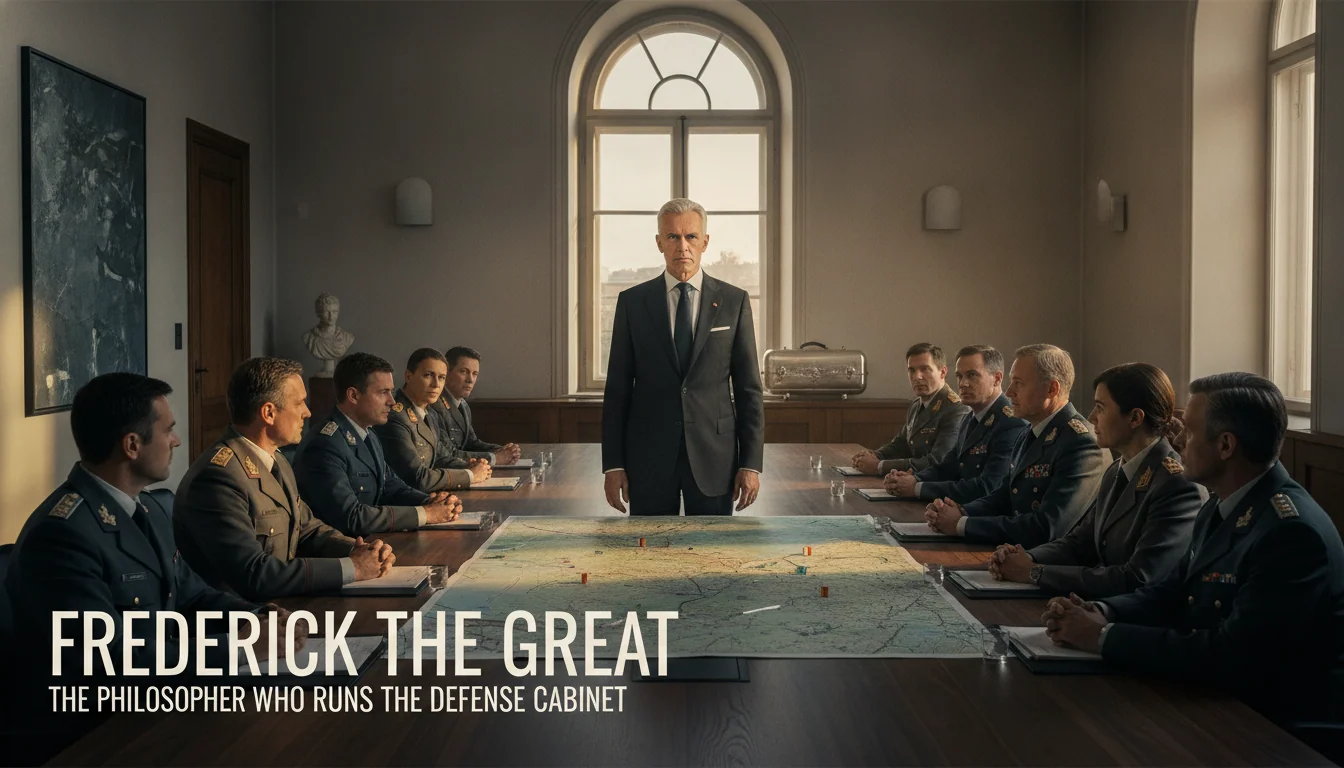
If Pompey the Great lived today, he would be a decorated general with a flawless military record and a political career that collapses just as fast as it once did.
Read Wikipedia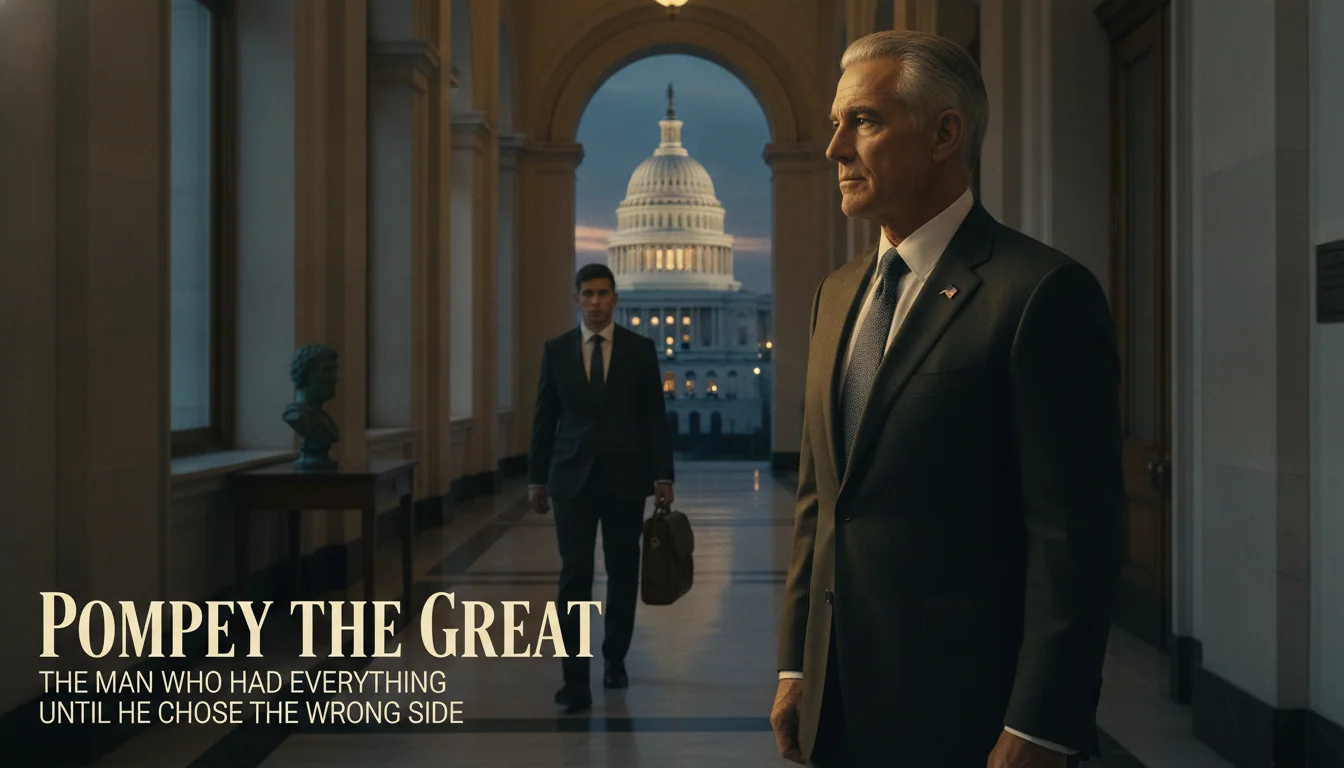
On the morning he arrived in Rome after three years reorganizing the Eastern Mediterranean, Gnaeus Pompeius Magnus had done something no Roman before him had managed. He had extended Roman influence from Spain to the Euphrates. He had defeated the most persistent enemy Rome had faced in a generation. He had settled kingdoms, installed client rulers, and reorganized taxation across the eastern half of the known world. He had also, as a preliminary, eliminated Mediterranean piracy in roughly ninety days.
He stepped off his ship, disbanded his army - a gesture of constitutional loyalty that cost him everything - and walked into thirty years of politics he was never equipped to win.
Drop him into 2026 and the shape of his career translates almost exactly. The military record is extraordinary, the political record is a slow-motion disaster, and the reason is the same in both eras: Pompey was the best player in a game he thought was the only game being played, and he never noticed when someone changed the rules.
The historical figure
Pompey was born on September 29, 106 BC, into a senatorial family from Picenum in central Italy. His father Pompeius Strabo was a successful general with a reputation for brutality and a large network of clients in northern Italy. When Strabo died in 87 BC - reportedly unpopular enough that his funeral procession was attacked - Pompey inherited the estate, the clients, and the problem of surviving the civil war between Marius and Sulla that was tearing the Roman state apart.
He was twenty-three. His response was to raise three legions from his father's clients and march them to Sulla.
Sulla called him "Magnus" - the Great. This was remarkable. The cognomen Magnus was usually a matter of public consensus, accumulating over decades. Sulla awarded it to a young man who had not yet held any elected office, in an implicit acknowledgment that Pompey's organizational ability was already exceptional. Pompey was also aware of it in a way that would have been embarrassing in almost any other culture but fit perfectly into Roman aristocratic performance.
His career for the next twenty years was a series of campaigns that should have been impossible and weren't. He suppressed the rebellion of Lepidus in Italy. He spent five years crushing the brilliant Roman renegade Sertorius in Spain, finishing the job that Metellus Pius couldn't. He arrived back in Italy just in time to intercept the survivors of Spartacus's defeated slave army - Crassus had broken the revolt, Pompey ambushed five thousand escapees - and then claimed joint credit for ending the war, which Crassus never forgave.
In 67 BC, the Roman Senate granted him an extraordinary command under the Lex Gabinia: sole authority over the entire Mediterranean and all its coastline to a distance of fifty miles inland, with the power to raise forces and spend money as he saw fit. The stated purpose was the elimination of Cilician pirates who had been strangling Mediterranean trade for decades.
Pompey divided the Mediterranean into thirteen sectors, assigned a legate to each with orders to sweep simultaneously, and cleared the entire sea in forty days. He was so far ahead of schedule that he spent the remaining part of the season cornering the main pirate bases on the Cilician coast and accepting their surrender. He offered the pirates terms rather than killing everyone, reasoning that dispersed former pirates with farms were less dangerous than dead martyrs. The settlement held.
The Senate then extended his command eastward under the Lex Manilia: he was to finish the Third Mithridatic War and settle the eastern Mediterranean. He spent three years doing so. Mithridates VI of Pontus, who had been resisting Rome for nearly thirty years, was defeated and driven to the Crimea, where he died trying to find allies who no longer existed. Pompey reorganized the successor kingdoms of Anatolia and the Levant, installed client rulers across modern Turkey, Armenia, and the Caucasus, ended the Seleucid dynasty by annexing Syria as a Roman province, and entered Jerusalem. He walked into the Temple's Holy of Holies - to see what was actually in there, apparently - looked around at nothing in particular, and left without touching anything. This was considered remarkable restraint for a Roman general.
He returned to Rome in 61 BC and celebrated the largest triumph the city had ever seen. He claimed to have conquered twenty-two kingdoms.
Then the politics started, and almost immediately things went wrong.
Why the politics never worked
Pompey was, by nearly universal ancient assessment, a man of ordinary political intelligence and extraordinary organizational intelligence. He could plan a three-front campaign against piracy across the entire Mediterranean in his head. He could not read a room in the Senate.
The problem ran deeper than that. Pompey's power rested on personal prestige, on the loyalty of his veterans, and on the informal network of clients and dependencies he had built across thirty years of successful campaigning. He was not comfortable with the daily brutality of late-Republican political maneuvering - the bribery, the public character assassination, the willingness to incinerate a long-standing alliance over a short-term tactical advantage. He kept wanting to resolve things through dignity and legitimate process at exactly the moments when dignity and legitimate process were no longer the currency anyone was trading in.
His alliance with Caesar and Crassus in the First Triumvirate of 60 BC was a marriage of necessity. Caesar needed money and military prestige. Crassus needed political cover for his financial interests. Pompey needed legislative support for his land grants to veterans and his eastern settlement package, which the Senate had been blocking for two years. The alliance solved everyone's immediate problem and created a much larger structural problem: three men who each needed the other two to be weaker than himself.
Caesar's daughter Julia married Pompey in 59 BC and was, by all ancient accounts, genuinely beloved by her husband. When she died in 54 BC, the human bond between Pompey and Caesar died with her. Crassus died at Carrhae in 53 BC, chasing a military reputation he had no business seeking. The Triumvirate dissolved into the civil war that Caesar had always been more willing to fight than Pompey was willing to admit was coming.
The modern role
If Pompey the Great lived today, he is a retired four-star general with a record so impressive that both parties spent a decade trying to recruit him for president, and a judgment of contemporary politics so poor that he eventually ends up attached to the wrong side at exactly the wrong moment.
His resume, updated: Supreme Allied Commander of a coalition that cleared a major maritime chokepoint of non-state actors in record time - an operation that military historians cite for decades as a model of simultaneous-sector sweep doctrine. Commander of a follow-on stabilization force that reshaped three regional governments and produced the longest-running coalition of allied client states in the affected region's modern history. Author of a post-operation settlement framework that three different administrations subsequently tried and failed to renegotiate.
He runs for office eventually. His campaign advisors are brilliant and his instincts are wrong. He is too large for retail politics and not sufficiently Machiavellian for the insider game. He believes that his record speaks for itself in a media environment where records only speak if you control the speaker.
His modern rival - the Caesar in the model - does not have a better record. The rival has fewer constraints. The rival is willing to say and do things that Pompey considers beneath contempt, which means the rival is doing them while Pompey is still deciding whether to respond. By the time Pompey's advisors convince him to respond, the news cycle has moved three times.
His business card says "Senior Advisor, Atlantic Security Initiative." The institute has a conference room, a modest endowment, and an address in Washington. It is not where the power is anymore, but it is where the power used to be, and Pompey is comfortable in that particular past tense.
The peer he most resembles
The contemporary figure who maps most cleanly onto Pompey is not a single person but a composite: the decorated military figure whose public standing was so high that the political class treated him as a solution to problems he was never suited to solve. Eisenhower succeeded at that transition because he was genuinely politically intelligent, not merely politically respected. Pompey was respected but not intelligent, in that domain. His modern equivalent is closer to the general who everyone agrees should run for president, who runs, and who loses to someone with a quarter of the credentials and three times the willingness to do whatever it takes.
The Pharsalus of 2026 is probably a primary campaign that collapses somewhere in the second quarter, not a battlefield. The Egypt is probably a failed attempt to leverage a foreign-policy relationship into domestic political capital.
The ending is not a sword on a beach. But the failure mode is identical: a man who was the best at something real, who mistook that mastery for qualification in a different and more ruthless game, who made one too many assumptions about what the rules were before he noticed that the other player had already stopped following them.
For the rival who also ended badly, see If Julius Caesar Lived Today. For the general who stayed loyal to a system that could not protect him, see If Belisarius Lived Today.
Quick Answers
Common questions about this topic
Who was Pompey the Great?
Gnaeus Pompeius Magnus (106-48 BC) was a Roman general and statesman who cleared the Mediterranean of pirates in 67 BC, conquered most of the eastern Mediterranean between 66 and 63 BC, and formed the First Triumvirate with Julius Caesar and Marcus Crassus. He led the Republican forces against Caesar in the civil war of 49-48 BC and was assassinated in Egypt after his defeat at the Battle of Pharsalus.
What were Pompey's greatest military achievements?
His most impressive achievement was the elimination of Mediterranean piracy under the Lex Gabinia in 67 BC - he cleared the entire sea in roughly three months by dividing it into sectors and attacking all of them simultaneously. He then spent three years reorganizing the eastern Mediterranean after defeating Mithridates VI of Pontus, settling client kingdoms across modern Turkey, Syria, and the Caucasus, and entering Jerusalem.
Why did Pompey lose to Caesar?
Pompey had a larger, better-supplied army at Pharsalus but lost because Caesar's veteran troops were more aggressive and cohesive, and because Pompey's cavalry, on which he had placed decisive weight, was routed by an improvised counter-attack. Fundamentally, Pompey spent the civil war trying to win through attrition while Caesar forced battle at moments of Caesar's choosing - a mismatch of strategic temperaments.
How did Pompey die?
Pompey fled to Egypt after Pharsalus, hoping Ptolemy XIII would provide refuge. Ptolemy's advisors decided that sheltering Rome's defeated general was too risky and that killing him would please Caesar. Pompey was stabbed as he came ashore on September 28, 48 BC, by Lucius Septimius, a former Roman officer who had served under him. Caesar reportedly wept when Pompey's severed head was presented to him.

Meet Them in Person
Chat with the historical figures behind these modern reimaginings.
Create your free account →No card required. Some figures and features require a paid plan.
Join the HistorIQly Club
Get smarter about the past.
Weekly stories, deep dives, and exclusive content straight to your inbox.