If Mata Hari Lived Today: The Spy Who Was Mostly a Story She Told About Herself
If Mata Hari lived today, the self-invented spy would trade the Parisian stage for Instagram and the firing squad for a polite legal letter and a frozen bank account.
Read Wikipedia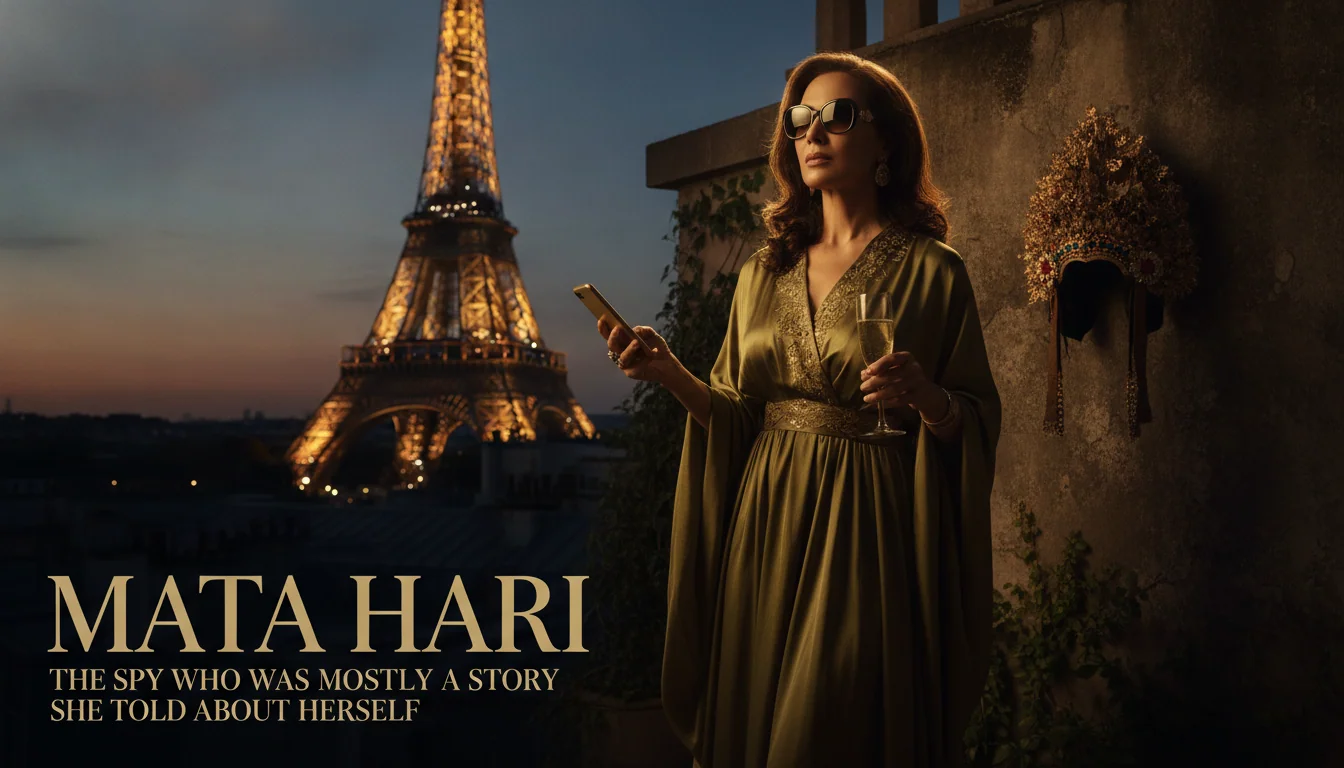
Margaretha Geertruida Zelle was born in 1876 in Leeuwarden, a provincial Dutch city, the daughter of a hat merchant. She married a Dutch colonial army officer in 1895, moved to the Dutch East Indies, had two children, survived an abusive marriage, lost a son to illness, and had her daughter taken from her when the marriage collapsed. She returned to Europe with nothing except the years she had spent in Java watching the landscape.
From that wreckage she constructed, in Paris around 1905, one of the most elaborate personal fictions in the history of entertainment. She became Mata Hari - Eye of the Day, sacred Javanese temple dancer, initiated in the ancient mysteries of the East. The dances were not authentically Javanese. The mythology was entirely invented. The impact was real: she became the most talked-about performer in Paris, then the most talked-about courtesan in Europe, and ultimately one of the most famous women of her era, which ended when a French firing squad shot her at Vincennes at five in the morning on October 15, 1917.
She was forty-one. The charges were espionage. The evidence was partial, contested, and almost certainly manipulated by German intelligence, which had burned her deliberately to protect sources worth more than she was.
The historical figure
To understand what Mata Hari becomes in 2026, you need to understand what she actually was in 1905.
She was not a great dancer. Contemporary accounts are divided, and some are clearly purchased praise. She was, however, an extraordinary performer in the broader sense - someone who created an experience around herself and made powerful men want to be near her. The exotic persona gave them permission to treat the encounter as an encounter with the genuinely foreign and mysterious. That permission was entirely the product of her construction.
Her clients, lovers, and patrons over the next decade included military officers, industrialists, and diplomats from most of the major European powers. This was not coincidence. She actively pursued men with access to information and resources, partly for financial security and partly, it seems, because she was genuinely interested in the worlds they moved through. She had survived a bad life by being indispensable to men who could protect her. She understood the economy of access before anyone gave it a name.
When war began in 1914, she was forty years old, still traveling between Paris, Amsterdam, Madrid, and the various spas and resorts where European society convened. French intelligence, run by a colonel named Georges Ladoux, recruited her as an asset in 1916 - designation H-21. She was sent to Spain to gather information on German networks there.
What exactly she did in Spain is disputed. What is clear is that the German intelligence service intercepted her communications, identified her to French authorities through decoded telegrams in a way that appears deliberately timed, and effectively handed her over. She was arrested in Paris in February 1917, tried in secret that July, and executed that October.
The Germans had decided she was worth more as a burned asset than as an operational one.
The modern role
Drop her into 2026 and the first thing to understand is that the historical Mata Hari would immediately recognize the world's information economy as the environment she was always trying to navigate.
She does not build a persona from nothing this time - the infrastructure exists. The 2026 Mata Hari is present on Instagram with 4.2 million followers. The account features no dance, no obvious theatrics, no overt mysticism. What it features is a sustained visual argument that she exists at the intersection of worlds most people never see: a Paris apartment flooded with afternoon light, an Omani desert at dawn, a dinner table in Singapore where the other guests are the kind of people who do not appear in photographs. The account is impossible to look away from and impossible to fully explain. It feels like access to something real. This is, of course, entirely the point.
Her professional description changes depending on who is asking. To brand partners, she is a luxury lifestyle consultant with a documented reach in high-net-worth markets across three continents. To diplomatic contacts, she is a cultural entrepreneur with meaningful connections in the Gulf, Southeast Asia, and French government circles. To the two intelligence services that have her on separate contact lists - she knows about one, suspects the other - she is an asset whose value lies in the rooms she naturally enters and the conversations she can relay from memory.
She operates from a primary base in Paris, specifically the 7th arrondissement, in an apartment whose rent would make a French civil servant weep. She travels seven months of the year.
The skills that translate
Three capabilities survive the century and a half almost entirely intact.
Persona construction. The historical Mata Hari built a false identity and sustained it for twelve years across multiple countries and cultures, adjusting the details for each audience without losing the coherent brand. The 2026 version does the same thing, but the tools are better. She has a consistent digital presence that is curated to feel spontaneous. She has professional photographers who understand exactly what lighting makes her look like someone whose life you want. She has, above all, the same instinct the historical Mata Hari had for what each specific audience wants to believe about her - and the patience to let them believe it.
Asymmetric information. The historical figure's value to every intelligence service was the same: she moved through rooms that were hard to access, and she remembered what people said when they thought they were speaking privately. The 2026 version has a structural advantage her predecessor did not - she knows the concept of plausible deniability, she has lawyers, and she has enough understanding of the information game to know when a piece of intelligence she is being asked to relay has been crafted to burn her.
The art of being burned slowly. This is where the 2026 version departs most significantly from the original. Mata Hari in 1917 did not see the burning coming. The 2026 version has read the history. She knows that every intelligence service that recruits a civilian asset is also calculating the moment when the asset's exposure costs less than their continued operation. She runs the same calculation in reverse, and she has exit strategies the historical Mata Hari never thought to build.
Where she lives and who she is to different people
To the luxury brand that retains her as a consultant, she is the most effective market researcher in Southeast Asia they have never been able to properly explain.
To the French diplomat who has dinner with her in Beirut twice a year, she is a woman with unusual access to Gulf political circles who occasionally mentions things she has heard in passing.
To the German intelligence officer who believes she is a cooperative asset and has been paying her a modest monthly retainer for eighteen months, she is H-21 - the same designation her predecessor carried. He thinks this is ironic and charming. He is not the first person to find his own cleverness more amusing than it should be.
To the family she no longer has contact with, in the Dutch city where Margaretha Zelle was born, she is the name on a Wikipedia page they have stopped reading.
What goes wrong
The historical Mata Hari was brought down by a combination of bad luck, institutional panic, and deliberate sacrifice by the German intelligence service that found her more useful as a burned asset than as an operational one.
The 2026 version faces the same structural problem with better tools and worse odds, because the surveillance environment is incomparably more thorough than anything that existed in 1917.
The German officer's retainer payments are metadata. The Paris meetings with the French contact are on three different camera networks. The Singapore dinner is photographed by someone whose phone is indexing her face in real time. She knows all of this. What she cannot fully control is the moment when someone with institutional authority decides that the liability of her continued independence exceeds the value of what she provides.
When that moment comes, it comes quickly and it looks nothing like a firing squad. It looks like a very politely worded legal letter, a coordinated series of unflattering stories in three different publications, a frozen bank account pending an investigation that is never formally explained, and a period of public silence from every contact she thought she could rely on.
She is forty-two years old when it happens. She has been more careful than Margaretha Zelle. It does not make much difference.
Why she remains interesting
Mata Hari's historical persistence has less to do with espionage than with what her story reveals about the relationship between beauty, persona, information, and power. She was not a particularly effective spy. She was an extraordinarily effective argument that access is its own form of capital - that the ability to be present in certain rooms, to be remembered by certain men, to have one's presence feel like a gift rather than an intrusion, constitutes a real form of leverage that intelligence services have been trying to systematize ever since.
The 2026 version of this argument is digital. The rooms are virtual as often as physical. The men with access are sometimes men with followers. The leverage is sometimes subscriber data rather than troop movements.
The pattern, though, is identical. Someone who understands how to construct a persona, deploy access, and make powerful people believe they are the beneficiary of a relationship rather than the target of one - that person has been valuable to governments, companies, and criminal enterprises in every era. The name changes. The tools change. The firing squad sometimes gets replaced by something more bureaucratic.
The woman who invented herself once would invent herself again. The ending would probably rhyme. For other historical figures whose survival depended on reading rooms and managing powerful men's perceptions of them, the contemporary reimaginings of Rasputin and Napoleon explore the same instinct - the ability to turn charisma into institutional leverage - in very different registers.
Quick Answers
Common questions about this topic
Who was Mata Hari?
Mata Hari was the stage name of Margaretha Geertruida Zelle (1876-1917), a Dutch woman who reinvented herself in Paris around 1905 as an exotic Javanese temple dancer. She became a celebrated courtesan with wealthy and powerful clients across Europe, and was executed by French firing squad in October 1917 on charges of spying for Germany. Historians debate whether she was a genuine double agent, a naive amateur used by multiple intelligence services, or a convenient scapegoat for French military failures.
Was Mata Hari actually a spy?
The evidence is genuinely ambiguous. She accepted money from a German intelligence officer she had taken as a lover, and French intelligence recruited her as an asset (designated H-21) and sent her to operate in Spain. German intelligence appears to have deliberately burned her - feeding her useless information and then allowing France to intercept identifying telegrams - possibly to protect more valuable sources. Many historians believe she was more naive than malicious, used by everyone and loyal to no one, including herself.
Why was Mata Hari executed?
She was tried by a French military tribunal in July 1917 and convicted of espionage. The prosecution relied primarily on decoded German diplomatic telegrams that appeared to identify her as a paid German agent. The trial was not a fair proceeding by modern standards - evidence was limited, the defense was restricted, and France was under extreme military and political pressure after the 1917 mutinies in the French army. She was shot by firing squad at Vincennes on October 15, 1917, at age 41.
What does 'Mata Hari' mean?
Mata Hari is a Malay phrase meaning 'Eye of the Day' - that is, the sun. Margaretha Zelle chose it for her stage persona, which she constructed as a Javanese sacred dancer born to a Hindu temple family. Almost every element of the backstory was invented. She had lived in Dutch colonial Java as a young wife but had no training in any form of Indian or Indonesian temple dance. The name, like the persona, was a deliberate construction.

Meet Them in Person
Chat with the historical figures behind these modern reimaginings.
Create your free account →No card required. Talk to anyone in history with 8 free credits a day. Some features require a paid plan.
Join the HistorIQly Club
Get smarter about the past.
Weekly stories, deep dives, and exclusive content straight to your inbox.