If Rasputin Lived Today: The Healer Who Gets in the Room
If Rasputin lived today, he would run a wellness empire with millions of subscribers and two careful lawyers. The profile is familiar; the ending still unpredictable.
Read Wikipedia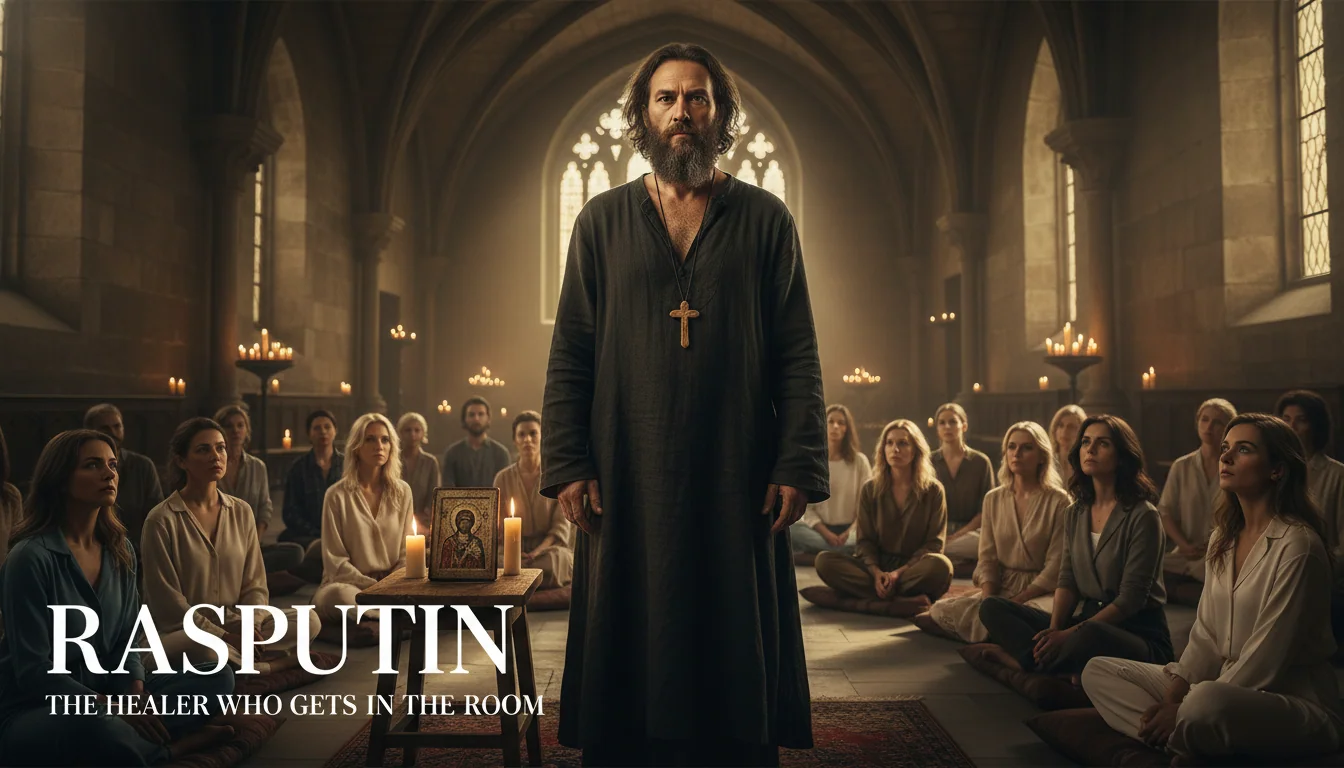
Grigori Rasputin was not a monk, not formally educated in theology, not a con artist by conventional definition. He was a Siberian peasant who discovered, somewhere along the Tobolsk road, that he had a gift for making powerful people believe in him. The Romanov family did not adopt him out of naivety. They adopted him because their son was dying and nothing else worked.
In 2026, that exact profile - the charismatic outsider with apparent healing gifts, no formal credentials, and access to people who would not normally admit him to the room - has a very specific modern equivalent. And the ending is still unpredictable.
Who Rasputin was
Grigori Yefimovich Rasputin was born in 1869 in the village of Pokrovskoye in Tobolsk Governorate, Siberia, the son of a peasant farmer. He had little formal education. As a young man he spent time at a monastery, developed an interest in mystical Christianity, and became a wandering starets - a title in Russian tradition for a person whose spiritual intensity earns them deference outside the normal church hierarchy.
He was not a priest. He was not ordained. He was a peasant who dressed like one and radiated something that made people sit down and listen.
He arrived in St. Petersburg around 1903-1905, was introduced through chains of aristocratic patronage, and by 1906 was receiving audiences at the imperial court. Tsarevich Alexei, the only son of Nicholas and Alexandra, had hemophilia. His blood did not clot. A bruise or cut that was minor for another child could be life-threatening for him. Alexandra had watched court physicians fail repeatedly. When Rasputin appeared to calm the boy during crises - whether through hypnosis, through reducing his agitation and thus his movement and some associated bleeding risk, or through the practical effect of advising against aspirin (a blood thinner, though this was not understood as such in 1906) - the Tsarina's faith in him became total.
His reputation outside the palace was more complex. He drank heavily. He was credibly alleged to have had affairs with multiple women in the aristocratic circles that patronized him. He was regarded with hostility by most of the formal church hierarchy, by large sections of the court who resented a Siberian peasant's access to the imperial family, and by significant portions of the public who assumed the worst about his relationship with Alexandra.
He was murdered in December 1916 by a group that included Felix Yusupov and Grand Duke Dmitri Pavlovich, who believed he was corrupting the monarchy and prolonging the disastrous war through his influence over the Tsarina. The murder involved poison, multiple gunshot wounds, and ultimately the Neva River. An autopsy reportedly found water in his lungs. The poison and the bullets, apparently, were not enough.
The modern role
Drop Rasputin into 2026 and the question of what he does becomes easy to answer. He runs a wellness and spiritual practice with a following in the mid-seven figures, a podcast that consistently places in the top 50 in the spirituality and alternative health categories across multiple countries, and a YouTube channel where longer-form content reliably pulls several hundred thousand views.
The show is called something like The Unfiltered Body or What Conventional Medicine Won't Tell You. He does not formally practice medicine. He is meticulous about this. The legal infrastructure is built around "lifestyle guidance" and "spiritual coaching," and he has a team of two lawyers and a general counsel who review every script before publication.
His clients - he calls them members, not clients, because the word signals a community rather than a transaction - pay a monthly subscription for access to longer content, a private forum, and the possibility of attending a retreat. The retreats are in places with the correct aesthetic: a Georgian manor in the English countryside, a converted monastery in Umbria, a lodge outside Taos. They are expensive. They are always oversubscribed.
The women who attend outnumber the men. This is a general demographic reality of the wellness space and also, in Rasputin's case, something specific to his manner. He listens. He holds eye contact. He does not rush. He says things that feel individually targeted even when he is speaking to forty people at once. This skill - reading an audience, reflecting back what they need to hear, making the generic feel personal - translated from the court of Nicholas II without any modification at all.
What he heals
In the original context, Rasputin appeared to help Alexei's hemophilia episodes. What he actually did remains genuinely unclear. Some historians argue for hypnotic suggestion reducing the boy's anxiety and movement. Others point to the aspirin hypothesis - that his advice to stop what the court physicians were prescribing removed a significant blood-thinning agent from a hemophiliac's treatment. The historical record does not resolve this neatly.
The modern Rasputin does not touch hemophilia. His territory is anxiety, chronic pain, insomnia, autoimmune fatigue, and what he calls "systemic depletion" - a category vague enough to accommodate nearly any condition a wealthy person might self-diagnose while feeling underserved by their existing medical care. He does not claim to cure these things. He says he helps people access their own capacity for restoration. The distinction is legally critical and clinically meaningless.
There are testimonials. Many of them, carefully produced. Some involve measurable improvements: blood pressure, sleep quality, reported pain scores. Whether these improvements are attributable to anything Rasputin specifically does, or to the well-documented placebo and expectation effects that attend any confident healer operating in an environment of reduced stress, is not something that can be resolved from the outside. He does not promote this uncertainty.
The access problem
Rasputin's historical power derived from proximity to people who could not afford to doubt him. Alexandra could not afford to doubt someone who appeared to save Alexei. That dependency became leverage over the entire imperial household and eventually over decisions affecting the war.
The modern equivalent is structural. His most prominent members are not royalty. They are wealthy people with ill family members and eroded faith in conventional medicine. A hedge fund manager whose daughter has an autoimmune condition the leading clinics have not resolved. A technology executive whose wife has completed cancer treatment and is dealing with fatigue that no follow-up appointment adequately addresses. A media figure whose anxiety medication stopped working after two years and whose psychiatrist's answer was a higher dose.
These people have resources, networks, and a specific kind of desperation that conventional medicine is not well designed to serve. Rasputin in 2026, like Rasputin in 1906, fills a gap. The gap is real. Whether what he offers into that gap is beneficial is a separate question.
The debauchery question
The historical Rasputin's personal life is partly documented and partly vastly embellished by enemies who had political reasons to exaggerate. The contemporary witnesses who described his behavior were frequently people who had decided what they thought of him before observing him.
The 2026 version navigates this more carefully. He is not celibate - nobody claims that, and he addresses it proactively in a podcast episode framed around "healing from cultural shame." His relationships are described with the terminology of the wellness industry as "conscious," "intentional," and "non-traditional." No specific arrangement is ever confirmed. No specific person is ever named. The photographic record shows him in unambiguous social situations with nobody in particular.
The drinking is managed with equal precision. He drinks, reportedly. He discusses his relationship with alcohol in content that positions it as a resolved spiritual journey, which makes the audience feel both confided in and reassured that he has done the work.
What goes wrong
The historical Rasputin was killed because he had become politically intolerable. Felix Yusupov and Dmitri Pavlovich were not wrong that he was influencing imperial decisions in a period of catastrophic military failure. They were wrong about whether killing him would fix anything.
The modern equivalent of political intolerance is a documentary and an investigation by a journalism outlet that has spent eighteen months talking to former members.
The documentary identifies a pattern. Several women describe interactions at retreats that were framed as spiritual encounters and read differently afterward. A former content team member describes the careful construction of Rasputin's language as deliberate legal strategy rather than genuine belief. A professor of medical ethics provides context for how the framework of "wellness guidance" functions as regulatory arbitrage.
The podcast goes quiet for six weeks. Lawyers negotiate. Settlement terms are sealed.
He does not go away. A reduced audience - perhaps two-thirds of the original - reconstitutes around a counter-narrative about media persecution of heterodox healing. The retreats continue. The subscription continues. The people who were there from the beginning find reasons, even having seen the documentary, to decide that the journalist's framing missed what they personally experienced.
The new content, when it returns, is more careful. The lawyers have done more work. The member agreements are more specific about what is and is not being promised.
Why the archetype persists
Rasputin is interesting not because he was a uniquely sinister person but because he occupied a role that regenerates across centuries and cultures: the outsider healer who gains access to the powerful through the vulnerability of the powerful.
The role exists because medicine fails people. Institutions fail people. Wealthy people who are failed by institutions have resources to seek alternatives. The alternative space will always be occupied by someone. When the someone is intelligent, genuinely perceptive about anxiety and suffering, and capable of making individuals feel specifically seen, they can do meaningful good and meaningful harm at the same time - in proportions that are difficult to separate from outside the relationship.
Rasputin's failure mode was the same as the modern version's: he came to believe his own indispensability. He pushed the access further than the people who had granted it were willing to sustain. He was useful until he was not, and then he was a problem to be resolved.
The role he occupied did not end when he died in the Neva River. It was filled by someone else by the time the ice thawed.
For other historical figures whose modern equivalents are equally recognizable, If Napoleon Lived Today reimagines the Corsican commander in the age of geopolitics, and If Marcus Aurelius Lived Today places the Stoic emperor in a boardroom.
Quick Answers
Common questions about this topic
Who was Rasputin?
Grigori Yefimovich Rasputin (1869-1916) was a Siberian peasant who became a wandering holy man and eventually gained extraordinary influence over the Russian imperial family, particularly Tsarina Alexandra, because he appeared to relieve the suffering of Tsarevich Alexei, who had hemophilia. He was murdered in December 1916 by a group that included the nobleman Felix Yusupov.
Why did the Romanovs trust Rasputin?
Tsarevich Alexei had hemophilia, a condition that made him susceptible to internal bleeding from minor injuries. Court physicians could not reliably help him. Rasputin appeared to calm Alexei during crises, and possibly advised stopping aspirin - a blood-thinning agent that would have worsened the condition - which may account for some of the apparent improvement. Alexandra's faith in him became absolute and extended to political matters.
How did Rasputin die?
Rasputin was murdered on the night of December 29-30, 1916, by Felix Yusupov and associates who believed he was corrupting the monarchy and prolonging the war. The murder involved poison, multiple gunshots, and ultimately drowning in the Neva River. Autopsy reports reportedly indicated water in his lungs, suggesting he was still alive when he entered the water, though the exact details remain disputed.
Was Rasputin really a monk?
No. Rasputin was never formally a monk or ordained priest. He was a peasant who spent time at a monastery in his youth, adopted the appearance and manner of a wandering holy man (starets), and built a reputation for spiritual authority outside the official church hierarchy. The Russian Orthodox Church regarded him with suspicion throughout his time at court.

Meet Them in Person
Chat with the historical figures behind these modern reimaginings.
Create your free account →No card required. Some figures and features require a paid plan.
Join the HistorIQly Club
Get smarter about the past.
Weekly stories, deep dives, and exclusive content straight to your inbox.