If Mehmed II Lived Today: The Conqueror Who'd Run Everything at Once
If Mehmed II lived today, he would run everything at once: markets, diplomacy, and infrastructure, the way he once conquered and then rebuilt Constantinople at 21.
Read Wikipedia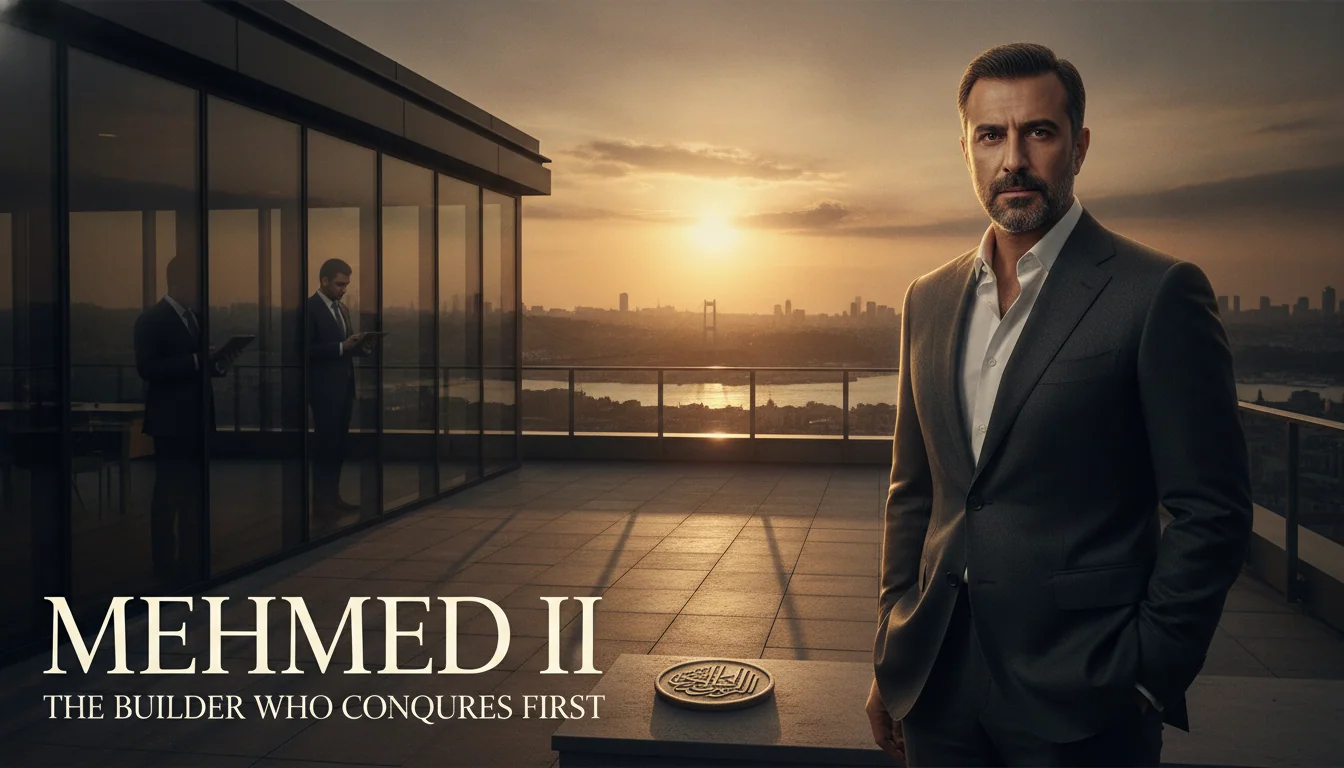
Most conquerors destroy and move on. Mehmed II took Constantinople in May 1453, walked into the Hagia Sophia to offer prayers, and then spent the next decade rebuilding the city he had just seized. He brought in artisans and architects. He allowed the Greek Orthodox Patriarch to stay. He invited Jewish communities expelled from elsewhere to settle. He started the Grand Bazaar. He hired Italian painters.
He was 21 years old when he took Constantinople. He was dead by 49, probably poisoned by someone who could not keep up with him. In between, he added Serbia, the Peloponnese, Trebizond, most of Albania, the Crimean Khanate as a vassal, and Bosnia to his territories, codified Ottoman law, built the Topkapi Palace, and collected books in Greek, Arabic, Persian, Turkish, and Latin. His great-grandson would extend that empire even further; see If Suleiman the Magnificent Lived Today.
Drop him into 2026 and the question is not what he would do. The question is what he would do first.
The historical figure
Mehmed was born in 1432, the third son of Murad II. He was not expected to rule. When his older brothers died, he found himself the designated heir of an empire in the middle of a complicated relationship with Crusader Europe and an increasingly confident Hungarian military force. His father's advisors did not think much of the boy. They were wrong.
He became Sultan for the first time at 12, briefly, when his father abdicated to pursue a quieter life. The Janissaries mutinied because the boy was not Murad. Murad came back. Mehmed watched and learned exactly what happened when a sultan's authority was not absolute and exactly who held the leverage in that situation.
When he came to power permanently after Murad's death in 1451, the first thing he did was have his infant half-brother drowned in a bath, to eliminate a rival. The second thing he did was begin planning the assault on Constantinople in detail, a city the Ottomans had attempted and failed to take twice before. He was 19.
The conquest of Constantinople on May 29, 1453 was not a lucky raid. It was an engineered siege that included the casting of enormous bronze cannon under the supervision of a Hungarian engineer named Orban, the transport of an entire fleet overland on wooden rollers across a hill to bypass the chain blocking the Golden Horn harbor, and a final assault coordinated across multiple breach points. The city fell after 53 days.
What distinguished Mehmed from most conquerors was what came immediately after. Constantinople had been shrinking for a century, its population down to perhaps 50,000 from its medieval peak of several hundred thousand - a decline you can see beginning centuries earlier in A Time Traveler's Guide to Byzantine Constantinople, 540. Mehmed spent the next decades repopulating it, bringing craftsmen, scholars, merchants, and religious minorities from across his territories and from outside them. He wanted a capital, not a trophy.
He spoke at least six languages. He corresponded with Italian humanists. He had the Venetian painter Gentile Bellini travel to Constantinople in 1479 to paint his portrait - the resulting image is one of the most vivid likenesses of any 15th-century ruler and shows a man of sharp intelligence and visible self-possession. He collected Greek manuscripts. He understood that legitimacy required cultural capital as well as military force.
The modern role
If Mehmed II lived today, he would not have a single title. He chairs the board of a sovereign wealth fund headquartered in Istanbul or Abu Dhabi - something with $800 billion under management and investments in defense technology, logistics infrastructure, and digital financial systems. He runs a separate private holding company focused on urban development in underserved emerging markets. He advises two governments through channels that are not publicly disclosed.
On paper, his staff directory is six people. In practice, the number is closer to 300, organized in compartments so that no one below the inner circle knows the full shape of what he is running.
He does not use a press secretary. He gives one or two long interviews per decade to journalists who are vetted in advance. His views on architecture, urban planning, and the failures of contemporary governance are considered and specific. His views on competitors are never stated in public but are communicated with precision through intermediaries.
He speaks English, Arabic, Turkish, and Mandarin in professional meetings. He picks up a new language the way other people pick up a podcast habit - quickly, functionally, without making a fuss about it. His Greek is better than any Turkish national leader's Greek has been in a long time, which matters in certain bilateral contexts and which he deploys precisely once, at the right moment.
Where he lives
His primary residence is a converted Ottoman-era yali (waterside mansion) on the Bosphorus, extensively renovated with contemporary interiors that manage not to look like a renovation. There is also a floor in a Geneva tower, a house in Lisbon that he has visited twice, and access to a compound in the Gulf that belongs to a related entity he does not technically own.
He is in the air approximately 180 days per year. He travels on a private aircraft registered to a holding company registered in the British Virgin Islands registered to another holding company. Getting a meeting with him requires knowing which of his three primary contacts to reach, and which of those contacts is currently in a position to say yes.
The building compulsion
The thing that would be most visible about Mehmed in 2026 is not the deal-making. It is the building. He cannot stop building. He would be responsible for infrastructure projects that looked reckless when announced and operational five years later - deepwater ports in East Africa, fiber backbone networks through Central Asia, cultural institutions in cities nobody was investing in yet.
He would be the person who showed up in a city that had been written off and bought the central block, not to flip it but to build something on it that would still be standing in 200 years. He has opinions about materials and sight lines. His architects receive notes at 2 a.m.
The dark side
Mehmed II executed his grand viziers with a frequency that his biographers note somewhat delicately. He went through at least six in 30 years of rule. The pattern was consistent: a man would accumulate power and proximity, Mehmed would conclude he was becoming indispensable, and the man would be removed. Several were executed.
In 2026, this tendency would translate into a particular kind of professional toxicity. Brilliant people would be drawn to work for him because he is genuinely brilliant, because the resources available are extraordinary, and because being associated with his operations opens doors. Those people would stay until they began to feel too important to the operation, at which point they would find themselves quietly removed from the inner circle, their access revoked, their names no longer on the calendar.
The departures would not be violent. They would be thorough.
His contemporary peer
The figure Mehmed most resembles in 2026 is not a single person but a type: the builder-conqueror who operates at sovereign scale without a sovereign's formal constraints. He is what happens when someone with Ataturk's institutional ambition, a private equity fund's structural patience, and a historical memory that runs deeper than any living competitor's gets access to serious capital.
The closest living approximation might be found somewhere in the Gulf, or in Singapore, or in the back row of a security conference in Munich - someone who holds no elected office, controls more than any official title would imply, and has been underestimated for about fifteen years, mostly by people who are no longer in a position to underestimate anyone.
He would be 21 when he makes his defining move. Everything after that would be rebuilding.
Quick Answers
Common questions about this topic
Who was Mehmed II?
Mehmed II (1432-1481) was the Ottoman Sultan who conquered Constantinople in 1453 at age 21, ending the Byzantine Empire after more than 1,100 years. Known as Fatih, the Conqueror, he went on to expand the Ottoman Empire across southeastern Europe and Anatolia, built the Topkapi Palace, spoke at least six languages, and patronized scholars and artists from multiple traditions. He died at 49, probably poisoned.
What languages did Mehmed II speak?
Contemporary sources credit Mehmed with fluency in Ottoman Turkish, Arabic, Persian, and Greek, and working knowledge of Latin and Serbian. He commissioned works in multiple languages, corresponded with Italian humanists, and had the Venetian painter Gentile Bellini paint his portrait in 1480. He was unusually cosmopolitan even by the standards of Renaissance-era rulers.
What did Mehmed II do after conquering Constantinople?
Immediately after the conquest in 1453, Mehmed worked to repopulate and rebuild the nearly empty city. He allowed the Greek Orthodox Patriarch to remain and continue operating, invited Jewish communities expelled from elsewhere in Europe to settle in Constantinople, built the Grand Bazaar and the Topkapi Palace, established a systematic legal code, and continued military campaigns across the Balkans, Anatolia, and Crimea. He was building while still fighting.
Who would Mehmed II be most like today?
Mehmed combined military command, infrastructure development, multilingual diplomacy, and cultural patronage at a scale and speed that has no clean modern parallel. He resembles figures who build platforms while simultaneously doing geopolitics - the kind of person who would chair a sovereign wealth fund, run a defense technology company, serve on the boards of major cultural institutions, and conduct diplomatic back-channels in three different languages on the same afternoon.

Meet Them in Person
Chat with the historical figures behind these modern reimaginings.
Create your free account →No card required. Some figures and features require a paid plan.
Join the HistorIQly Club
Get smarter about the past.
Weekly stories, deep dives, and exclusive content straight to your inbox.