If Nero Lived Today: The Influencer-Emperor Who Burned Everything Down
If Nero lived today, the entertainer-emperor who inherited power at seventeen, murdered his way through family ties, and lost the generals he forgot to manage would fit 2026 perfectly.
Read Wikipedia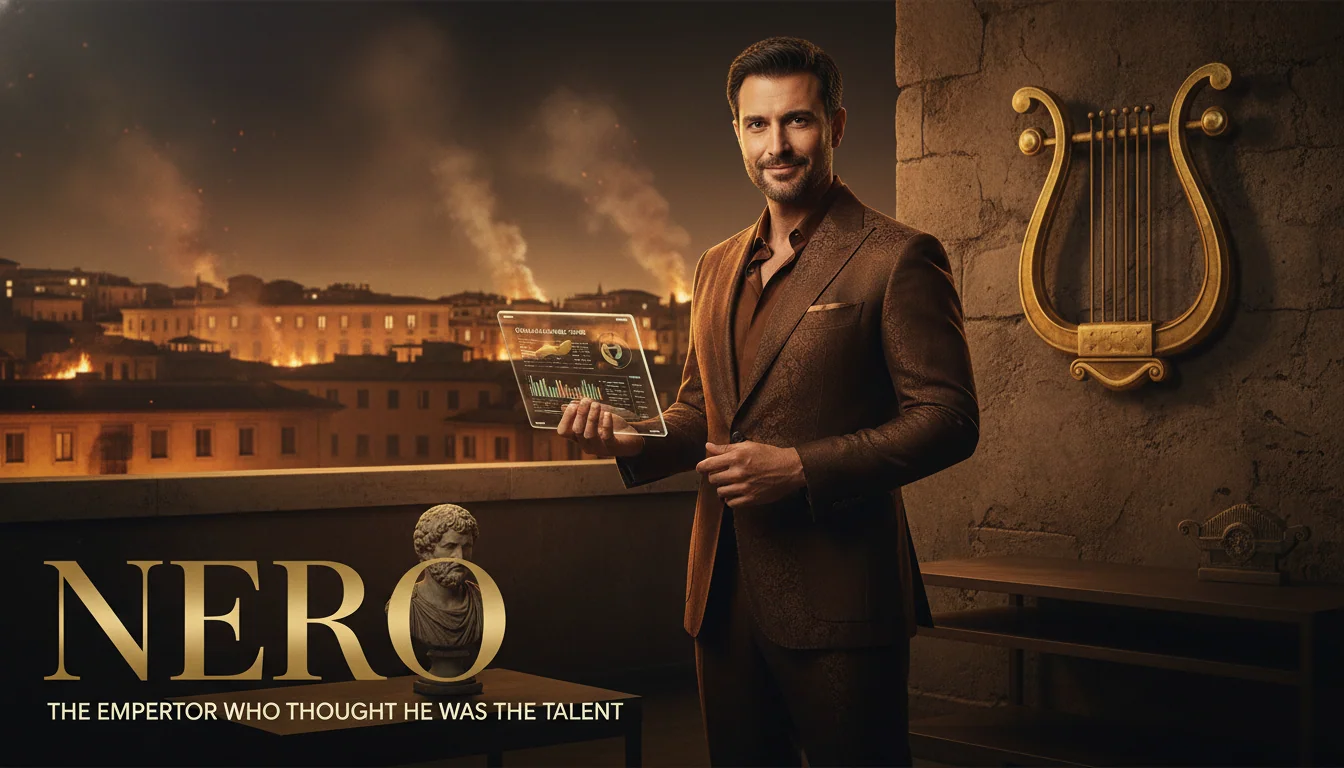
He came to power at seventeen. His mother had arranged everything. His early years were managed by a brilliant older advisor - Seneca, in the original - who kept the machinery running while the young emperor learned his lines. For a few years, by ancient consensus, the administration was actually quite competent.
Then the young emperor got comfortable, decided he was the most talented performer of his generation, and began removing the people who had told him otherwise.
In 2026, Nero would not be unusual. He would be a type.
The historical figure
Nero's childhood was unstable in the specific way that destabilizes people for life: his father died when he was two, his mother Agrippina was exiled by the emperor Caligula, and he was eventually adopted by the emperor Claudius after Agrippina married him. By the time Nero became emperor in 54 CE at seventeen, he had already watched two emperors manage two court cultures and understood, at a gut level, how power was performed.
His first years were ruled by a triumvirate of advisors: his mother Agrippina, who had maneuvered him to the throne; the philosopher Seneca, who was his tutor and chief minister; and the praetorian prefect Burrus, who commanded the guard. Ancient sources called this early period the quinquennium Neronis, the five good years of Nero, because the administration was rational and the executions were limited.
Nero's personal interests during this period were already clear. He performed on the lyre. He composed poetry. He competed in theatrical productions - sometimes publicly, to the horror of the Senate, which considered public performance incompatible with imperial dignity. He was genuinely talented by the accounts of people who had no reason to flatter him, though the accounts of people who had every reason to flatter him are much louder.
What followed was the elimination of everyone who constrained him. He had his mother killed in 59 CE, after two failed assassination attempts, when her political influence had become intolerable to him. He divorced and executed his first wife Octavia in 62 CE. His second wife, Poppaea Sabina, who shared his aesthetic interests and apparently his genuine affection, died in 65 CE under circumstances the ancient sources describe as a kick from Nero during an argument while she was pregnant. Whether the death was deliberate or accidental, Nero's grief afterward was reportedly genuine and elaborate. This is consistent with a person who could love intensely and destroy the loved thing without separating the two impulses.
The modern role
In 2026, Nero's title is not emperor. His title is chairman and executive producer of a streaming and entertainment group that bears his family's name, which he inherited at twenty-three from an uncle who died without children and whose assets were worth more than the board realized at the time.
The company had traditional divisions and a competent management layer. For a few years, under his mother's close supervision and with an excellent CFO named, let's say, Seneca, the company performed creditably. The stock went up. The press wrote about the next generation taking over with cautious optimism. He gave an interview to the Financial Times in which he described his vision with an earnestness that was only slightly performative.
Then he released an album.
It was not bad. Three tracks were genuinely interesting. He had been writing music since his teens and had real instincts. The problem was not the music. The problem was the press conference afterward, at which he announced that he intended to divide his time between running the company and pursuing a full-time artistic career, and that he saw no contradiction between these two things. The board saw considerable contradiction.
Within eighteen months of the album, his mother - who had held the actual operational relationships that kept the company's licensing deals afloat - was pushed out of her advisory role in a restructuring that she called, in a text message that was subsequently leaked, "a coup by someone who needed me until he didn't." She was correct. She was also out.
The skills that translate
Nero's genuine talent was for performance in the broad sense: knowing what an audience wanted, inhabiting a role completely, and creating events that people talked about for decades. He did not separate this from governance because he did not believe they were separate things. An emperor who performed publicly was, in his understanding, demonstrating vitality, divine favor, and cultural authority. The applause was not vanity. It was proof.
In 2026, this is a recognizable executive posture. The performer who is also the product who is also the brand who is also the boss occupies a specific lane in the culture, and Nero was made for it. His Instagram presence is enormous. His live streams have genuine warmth, genuine wit, and an occasional burst of musical performance that reminds you why he got famous in the first place.
What he cannot do is manage people he does not respect. And he respects almost no one.
The vanity project
The Great Fire of Rome in 64 CE destroyed large parts of the city. Nero's response was to rebuild on the cleared land with a personal palace complex, the Domus Aurea, whose scale and ambition appalled even those ancient Romans who had seen large buildings.
In 2026, the equivalent is a private arts complex announced in the aftermath of a public scandal - the fire is a collapse in company stock following a regulatory investigation that Nero had been warned about and ignored. The arts complex, a multi-venue facility on a hundred acres outside a major American city, is paid for using the company's real estate holdings. It is genuinely beautiful. It is also completely disproportionate to any artistic purpose it claims to serve.
The Senate - in this version, the board of directors and several institutional shareholders - passes a resolution demanding oversight. Nero responds by hiring a communications firm and doing a long-form interview in which he is photographed playing the lyre.
The family
The modern Nero marries a woman from a political family at twenty-six because his mother arranged it and because the marriage was strategically useful. It lasts four years. The divorce is acrimonious and draws significant press attention, partly because his second wife appears eighteen months before the divorce is finalized.
His second wife is from the entertainment world rather than the political one. She shares his artistic interests and provides something the first wife could not: genuine enthusiasm for what he is trying to build. He is, within the limits of his nature, devoted to her. She dies in a yachting accident under circumstances that his friends describe as a tragic series of failures and his critics describe as circumstances that were preventable and that involved a quarrel no one witnessed.
He grieves publicly and at length. He funds an arts foundation in her name. He then marries again within a year, to someone fifteen years younger, and refuses to discuss the transition.
What goes wrong
What destroyed Nero was not the art or the fire or even the murders. It was his indifference to the people who controlled the armies. The contrast with leaders who cultivated institutional loyalty obsessively - like Julius Caesar, who built his military relationships with relentless care - could not be sharper. If Nero lived today, that same pattern would be the fatal variable.
He had neglected the provincial governors who commanded real military forces. He had offended the officers of the Praetorian Guard through years of erratic treatment. He had spent political capital on the culture war between his artistic vision and senatorial dignity, and when the governors rebelled in 68 CE he had no reservoir of loyalty to draw on.
In 2026, the equivalent is losing the confidence of the institutional investors and the senior management simultaneously. When the board calls a vote in his absence, he does not have the shares to stop them. When the proxy battle fails, he attempts to take the company private through a leveraged deal that falls apart when his financing partner pulls out after a due-diligence call.
He flees to his house in the south of France. He issues a statement calling the board's action illegal and promising to fight. He then does not fight. He issues a second statement twenty-four hours later describing his departure as a "strategic transition." He is found six days later in the guest bedroom of his property manager's house near Antibes, apparently having spent three days debating with himself what to do next.
He is thirty-one years old.
The modern comparison
The contemporary figure Nero most resembles is not any single person but a composite: the entertainer-executive who inherited enormous institutional power, had genuine talent, lacked the ability to separate his personal obsessions from institutional responsibilities, and eventually lost everything because he forgot that power runs on relationships and not on performances. Marcus Aurelius inherited the same imperial machinery and made the opposite set of choices - a useful contrast in how much personal temperament matters when the structure of power is otherwise identical.
He is someone most of us have seen somewhere in the culture in the last decade. The main thing that distinguishes Nero from his modern equivalents is that the ancient world did not have a graceful exit path. There was no board-approved golden parachute. There was no consulting agreement. There was only the Senate declaring you a public enemy and the sound of horses on the road.
He was thirty when it ended. He had spent thirteen years destroying the people around him and building things that didn't last and performing for audiences that applauded because the alternative was dangerous. He said, at the end, "What an artist dies with me."
He probably meant it. That may be the saddest thing about him.
Quick Answers
Common questions about this topic
Who was Nero?
Nero Claudius Caesar Augustus Germanicus (37-68 CE) was the fifth Roman emperor, ruling from 54 to 68 CE. He came to power at seventeen through his mother Agrippina's political maneuvering and spent the first years of his reign presiding over a competent administration managed largely by his advisors. He then progressively eliminated those advisors, had his mother killed, divorced and executed his first wife, and devoted increasing imperial resources to his own artistic performances before being overthrown and committing suicide at thirty.
Did Nero really set fire to Rome?
The Great Fire of Rome in 64 CE was a real disaster that destroyed roughly two-thirds of the city. Whether Nero deliberately set it, as some ancient sources claimed, is disputed. Several ancient writers stated he did not; others claimed he watched the fire from a tower while singing. What is documented is that Nero used the cleared land to build his vast personal palace complex, the Domus Aurea, and that he blamed the fire on Christians, initiating one of the first state persecutions of Christianity in Rome.
What was the Domus Aurea?
The Domus Aurea, or Golden House, was a massive palace complex Nero built on the land cleared by the Great Fire of 64 CE. Ancient sources describe it as covering a substantial portion of central Rome, featuring a rotating dining room, rooms with ivory ceilings that sprayed perfume, and an artificial lake where Trajan's Baths now stand. It was not a residence in the conventional sense but a theatrical environment built to Nero's specifications for how an emperor-artist should live.
How did Nero's reign end?
In 68 CE, three provincial governors simultaneously rebelled, the Praetorian Guard and the Senate both declared against him, and Nero fled Rome in disguise. He took shelter at a freedman's villa outside the city. When the Senate declared him a public enemy and dispatched horsemen to arrest him, Nero attempted to kill himself and could not, and had to be helped by his secretary Epaphroditos. He died at thirty, reportedly saying 'What an artist dies with me.' The civil war that followed, the Year of the Four Emperors, resulted in the rise of the Flavian dynasty.

Meet Them in Person
Chat with the historical figures behind these modern reimaginings.
Create your free account →No card required. Talk to anyone in history with 8 free credits a day. Some features require a paid plan.
Join the HistorIQly Club
Get smarter about the past.
Weekly stories, deep dives, and exclusive content straight to your inbox.