If Boudicca Lived Today: The Anti-Empire Politician Who'd Burn It All Down
If Boudicca lived today, she'd be a regional independence leader who took a principled grievance and pushed it further than anyone thought survivable.
Read Wikipedia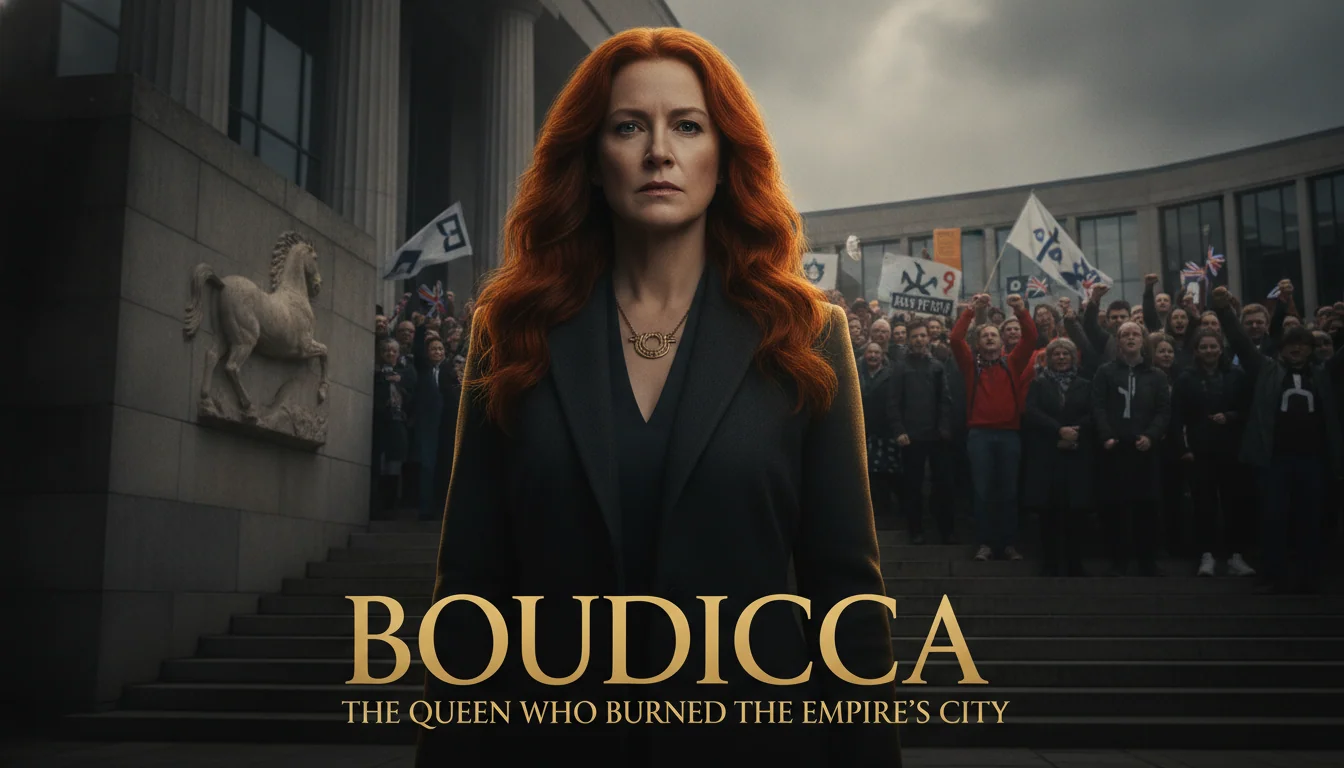
She arrived in the story already wronged. Her husband King Prasutagus, ruler of the Iceni in what is now Norfolk, had built a careful accommodation with Roman power: loyal to Rome in life, he left his kingdom jointly to his two daughters and the Emperor Nero on the assumption that the arrangement would be honored after his death. It was not. Roman officials moved in, annexed the kingdom outright, flogged Boudicca in public, and assaulted her daughters.
She responded by burning three cities.
The revolt she led around 60-61 AD was, by any measure, the most serious military crisis the Roman occupation of Britain ever faced. Three substantial towns were destroyed, a Roman legion detachment was annihilated in the field, and the governor of Britain, Gaius Suetonius Paulinus, had to abandon Londinium to its fate while he gathered enough force to fight. That Boudicca lost in the end does not change what she built, how fast, or why.
If Boudicca lived today - dropped into 2026 - the pattern holds. The same woman, the same skillset, a different empire.
The historical figure
Boudicca was the queen of the Iceni, a tribe of the eastern British lowlands that had cooperated with Rome since the invasion of 43 AD under Emperor Claudius. Prasutagus had maintained client-kingdom status for decades: nominally independent, practically subordinate, paying tribute and accepting Roman cultural penetration while keeping local authority. It was a common arrangement in the Roman empire's management of peripheral territories. It required the Romans to honor their agreements after a client king's death.
They did not. The procurator Catus Decianus, responsible for tax collection in Britain, treated Prasutagus' death as an annexation opportunity. Iceni nobles were stripped of their inherited land. Prasutagus' household was treated as property. Boudicca was flogged, not as a legal punishment but as a demonstration of Roman contempt for the arrangement Prasutagus had spent decades building. Her daughters were assaulted.
She took the Iceni into revolt. She took the Trinovantes with her - the tribe of Essex, with their own grievances against the Roman colonial city of Camulodunum, which had been built over their capital and demanded unpaid forced labor for its maintenance. She may have recruited other groups. The combined force swept down on Camulodunum first, destroying the city and killing the veterans who had settled there, including a Roman infantry detachment that had sheltered in the temple of Claudius.
The Ninth Legion, stationed in the north, sent a force south and it was destroyed in the field. Londinium, the commercial hub, was abandoned by Suetonius before Boudicca arrived and then burned by her forces. Verulamium (St Albans) was third.
Suetonius chose his ground carefully - a narrow defile with woodland behind him and open terrain in front - and waited for Boudicca's much larger force to attack uphill against disciplined heavy infantry. The Romans won. The ancient sources, both writing decades or more after the fact, give the rebel casualty figures as wildly implausible. What is certain is that the defeat was decisive, Boudicca did not survive it, and Roman reprisals in the following months were severe enough that Nero's administrators eventually had to moderate them for fear of triggering another rising.
The modern role
In 2026, Boudicca is a regional party leader. The party's name is something principled and slightly awkward - "Iceni Alliance" is what the newspapers use, not what the membership calls it - and it holds seven seats in a devolved assembly. The seats are not enough to govern. They are enough to be impossible to ignore.
She arrived in politics the same way she arrived in revolt: through a specific, documented injustice. The grievance was real, the institutional response was dismissive, and she organized what followed with a thoroughness that caught everyone unprepared. The local issue became a platform. The platform became a movement. The movement began attracting people whose original grievances had nothing in common with hers except the feeling that a distant administrative center had treated them as an afterthought.
She is not an ideologue. Her policy positions are a pragmatic collection of whatever keeps the coalition together, and she knows it. The theoretical architecture is less important to her than the immediate aim of extracting concessions from the people who still have the power to deliver them. This makes her useful to her coalition and alarming to everyone else.
The skills that translate
Three things carry over from 60 AD almost without modification.
Grievance as recruitment. Boudicca did not start the revolt with an army. She started it with a wrong that everyone around her could see and name. The Trinovantes joined not because they were Iceni but because they had their own list of Roman injuries, and Boudicca's rising offered them a vehicle. The 2026 version does the same thing: the original injustice that brought her into politics still sits at the front of every speech, because it explains why all the subsequent grievances belong together. She is the connective tissue between communities who would not naturally organize.
Tactical intelligence under pressure. The revolt's first phase - Camulodunum, the destruction of the Ninth Legion detachment, Londinium, Verulamium - unfolded with a speed that Roman administrators did not anticipate and could not immediately counter. Suetonius was on the far side of the island when the revolt began. Boudicca used the time. In 2026 this translates to an instinct for timing: she moves when the opposition is distracted, brings her strongest arguments when the cameras are already pointing somewhere else, and rarely picks a fight she has not already counted. Her staff find her demanding in inverse proportion to how calm she appears.
The willingness to escalate. The historical Boudicca's escalation from legitimate grievance to the sacking of three cities is, by modern standards, disproportionate. What it communicated was that she was serious in a way that polite complaints to the procurator were not. The 2026 version escalates differently - leaking to the press, organizing public occupations, commissioning independent legal challenges - but the underlying logic is the same: whatever forum the other side controls, she will find the forum they do not, and she will use it loudly.
The family
She remarried after the historical record ends - the historical Boudicca's daughters are mentioned by Tacitus as surviving the revolt's aftermath - and the 2026 version has two adult daughters who are both deliberately out of politics. One is a civil engineer. One teaches secondary school in a town three hundred miles from the constituency. Neither of them attends party events unless specifically asked, and Boudicca respects this with a precision that suggests she understands exactly why they made that choice.
Her former partner, a man who came into the relationship when the movement was smaller and less consuming, left quietly four years ago. She has not discussed it publicly and shows no inclination to. The absence of a public-facing personal life is itself communicative: she has decided, consciously, that the movement is the thing.
Where she lives
A house in the constituency she represents, purchased when the prices were lower. A flat in the capital for legislative weeks. The constituency house has a garden she actually maintains, which her staff consider an unexpected character detail. The capital flat has a kitchen that has never been properly set up.
She drives herself when she can, which her security people consider non-negotiable until it becomes clear she is going to do it anyway. She knows the roads in her constituency better than her driver. She knows which estates have the worst flooding and which roads were promised repair three governments ago and still have not received it. This is partly instinctive politics and partly that she is genuinely angry about the roads.
The contemporary peer
The closest modern comparison is not a British politician, which would require naming someone currently in office. It is more useful to observe the structural pattern: a regional leader, representing a community with specific historical grievances against a centralizing state, who built a coalition large enough to be ungovernable without being large enough to govern. The leverage comes from being impossible to simply wait out. Among historical templates, Julius Caesar's career offers an instructive parallel: a figure who moved faster than established institutions could coordinate a response.
The historical Boudicca's error was the final battle. She let Suetonius choose the ground. The 2026 version, operating in a different kind of conflict, has not yet made an equivalent mistake - has not yet committed to the fight on the other side's terms. Whether that prudence holds indefinitely, or whether the logic of the movement eventually demands an overreach, is the question her allies discuss in private and her opponents hope for loudly.
The statue on the Thames Embankment, put there by the Victorians who admired her without noticing the irony, overlooks the parliament she never got to see. In 2026 she would walk past it on the way to the chamber, probably without looking up.
Quick Answers
Common questions about this topic
Who was Boudicca?
Boudicca (also spelled Boadicea) was queen of the Iceni tribe in Roman-occupied Britain. Around 60-61 AD she led a major uprising against Roman rule after her husband King Prasutagus died and Roman officials annexed his kingdom, publicly flogged her, and assaulted her daughters. She united several tribes, sacked three Roman cities including Londinium, and was ultimately defeated in battle by Roman governor Gaius Suetonius Paulinus.
How did Boudicca die?
The sources disagree. Tacitus, writing within living memory of the revolt, says she took poison after the final defeat. Cassius Dio, writing about 150 years later, says she fell ill and died. Some modern historians suggest she may have died of wounds. What is certain is that she did not survive the Roman retaliation.
How large was Boudicca's revolt?
The ancient sources give wildly inflated figures - Cassius Dio claims 230,000 rebels - that modern historians do not accept. What the archaeological record confirms is that Camulodunum (Colchester), Londinium (London), and Verulamium (St Albans) show destruction layers consistent with burning around 60-61 AD. The revolt was real, large, and temporarily devastating for Roman authority in Britain.
Why is Boudicca still famous?
Boudicca survived the Middle Ages as little more than a footnote, but was rediscovered during the Victorian period when Tacitus' Annals became widely read. The Victorians, somewhat paradoxically, made her a symbol of British national character - a queen who stood against imperial oppression - which required ignoring that she was fighting the founders of the British tradition she was being used to celebrate. The bronze statue of her on the Thames Embankment in London dates from that era.

Meet Them in Person
Chat with the historical figures behind these modern reimaginings.
Create your free account →No card required. Some figures and features require a paid plan.
Join the HistorIQly Club
Get smarter about the past.
Weekly stories, deep dives, and exclusive content straight to your inbox.