If Scipio Africanus Lived Today: The General Who Won Everything and Lost the Peace
If Scipio Africanus lived today, he would be the most decorated general in NATO, undone not by the battlefield but by the senators who resented his success.
Read Wikipedia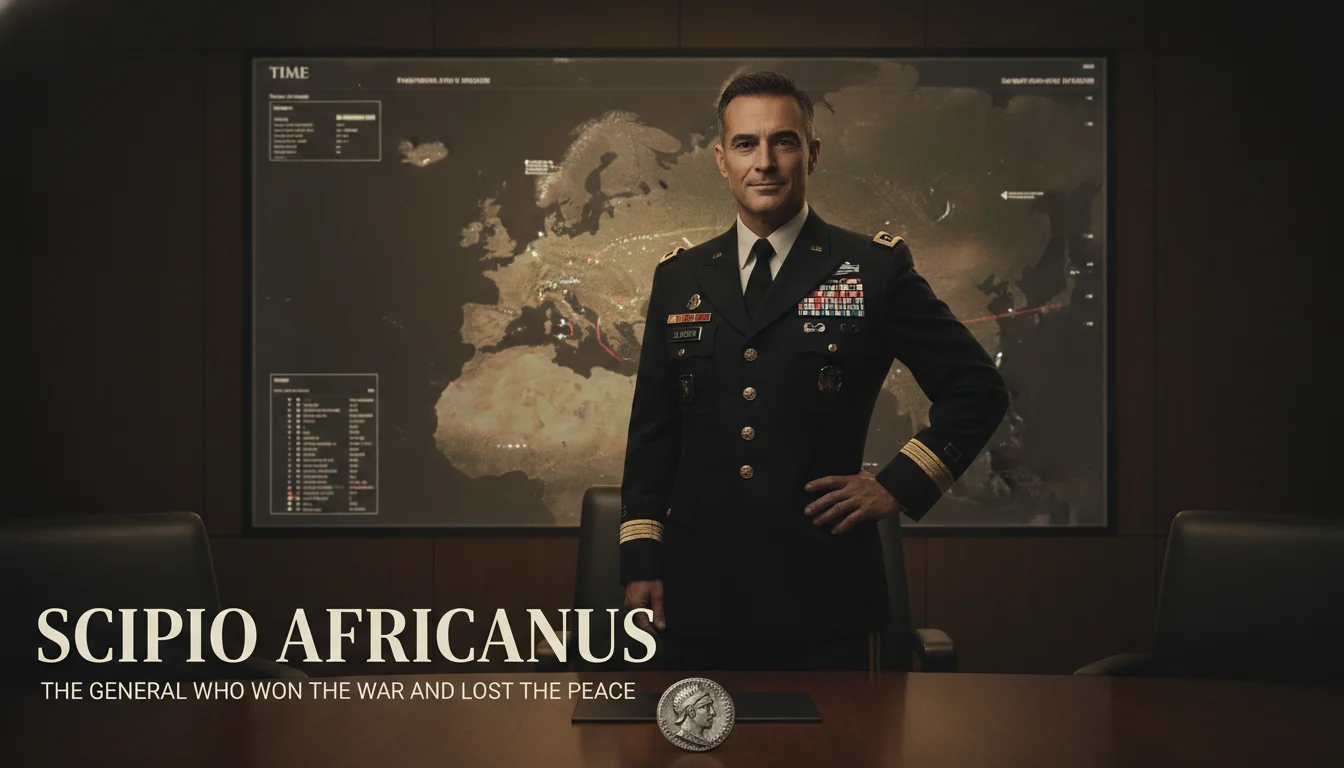
At 25 years old, Publius Cornelius Scipio stood before the Roman Senate and asked for command in Spain. Rome's armies in the peninsula had just been destroyed. His father and uncle had been killed there. The Senate, running out of better options, gave him the command. Within months he had captured Carthago Nova, the main Carthaginian supply base in Spain, in a single day's assault that his own officers thought was impossible.
This is the pattern that defines his life: the audacious move that nobody else attempted, succeeded at by someone too young to know it couldn't be done, followed eventually by betrayal from the institution he served.
In 2026, Scipio Africanus would be the most decorated general in NATO who couldn't get a second government posting because the wrong senators hated him.
The historical figure
Scipio was born around 236 BC into one of Rome's most prominent families. His father, Publius Cornelius Scipio the elder, was himself a consul and general. When Hannibal crossed the Alps in 218 BC and began destroying Roman armies - the Trebia in 218, Lake Trasimene in 217, Cannae in 216, where perhaps 50,000 Romans died in a single afternoon - the Scipio family was at the center of Rome's desperate attempt to respond.
His father and uncle took the war to Spain to cut Hannibal off from Carthaginian reinforcements. In 211 BC they were both killed at the Battle of the Upper Baetis. Spain was lost. Rome's Iberian campaign was collapsing.
The Senate needed someone willing to take command of a failing theater of war against the most effective general alive. Scipio volunteered. He was young, possibly around 24 or 25, and lacked the consular experience that Roman custom demanded. The Senate waived the requirement and sent him anyway.
What followed was one of the most methodical campaigns in ancient history. Scipio studied Carthaginian dispositions in Spain and identified that the three Carthaginian armies there were spread across an enormous area, unable to quickly reinforce each other. He struck Carthago Nova - modern Cartagena - in 209 BC with a combined land and sea assault at low tide on the lagoon side of the city, using intelligence about water depths that his enemies hadn't considered exploitable. The city fell in a day. Its capture ended Carthaginian supply dominance in the peninsula.
He cleared the Carthaginians from Spain entirely by 206 BC, winning the decisive engagement at Ilipa through a tactical misdirection that drew the enemy's best troops to the center while he crushed their wings. He then crossed to Africa, allied with the Numidian king Masinissa, and forced Hannibal - still undefeated in the field for sixteen years - to return from Italy to defend Carthage.
The Battle of Zama in 202 BC ended the war. Scipio neutralized Hannibal's elephant corps by ordering his maniples to open lanes that funneled the animals through harmlessly. He held the center while his Numidian cavalry, which had routed the Carthaginian horse, wheeled back to strike the enemy rear. Hannibal, facing the same envelopment he had inflicted on Rome at Cannae, lost the battle and the war.
The peace terms were Scipio's too: generous enough that Carthage survived as a functioning state, harsh enough that it posed no immediate threat. Cato the Elder spent the next half-century arguing this was a mistake and ending every Senate speech with the demand that Carthage be destroyed. Scipio thought the calculus of power was more complex than that. He was right. Carthage posed no further military threat. That didn't save him from Cato.
The political destruction
The prosecution came in stages. Scipio's brother Lucius had commanded the Roman forces against the Seleucid king Antiochus III after Zama, with Scipio along as a legate. The campaign succeeded - Antiochus was defeated at Magnesia in 190 BC - but the political settlement left funds unaccounted for in ways that Scipio's enemies found useful. The Petillius brothers, working on Cato's behalf, brought charges of bribery against both brothers.
Scipio's response was characteristic. On the day of his trial, he reminded the Roman people that it was the anniversary of Zama and invited them to join him in thanksgiving at the temples rather than waste the day on political theater. He reportedly walked out. Most of Rome followed him. The trial collapsed.
But the campaign against him continued. Further charges, further investigations. Rather than fight indefinitely in an arena where his enemies controlled the terms, Scipio retired to his villa at Liternum, on the Campanian coast, and refused to return. He died there, reportedly around 183 BC - the same year, tradition says, as Hannibal, who died in exile in Bithynia rather than surrender to Rome.
His requested epitaph: "Ungrateful fatherland, you shall not have my bones."
The modern role
If Scipio Africanus lived today, the first question is what military track he ends up in. The answer is all of them, briefly, before one of his landings irritates enough people to stall the next promotion.
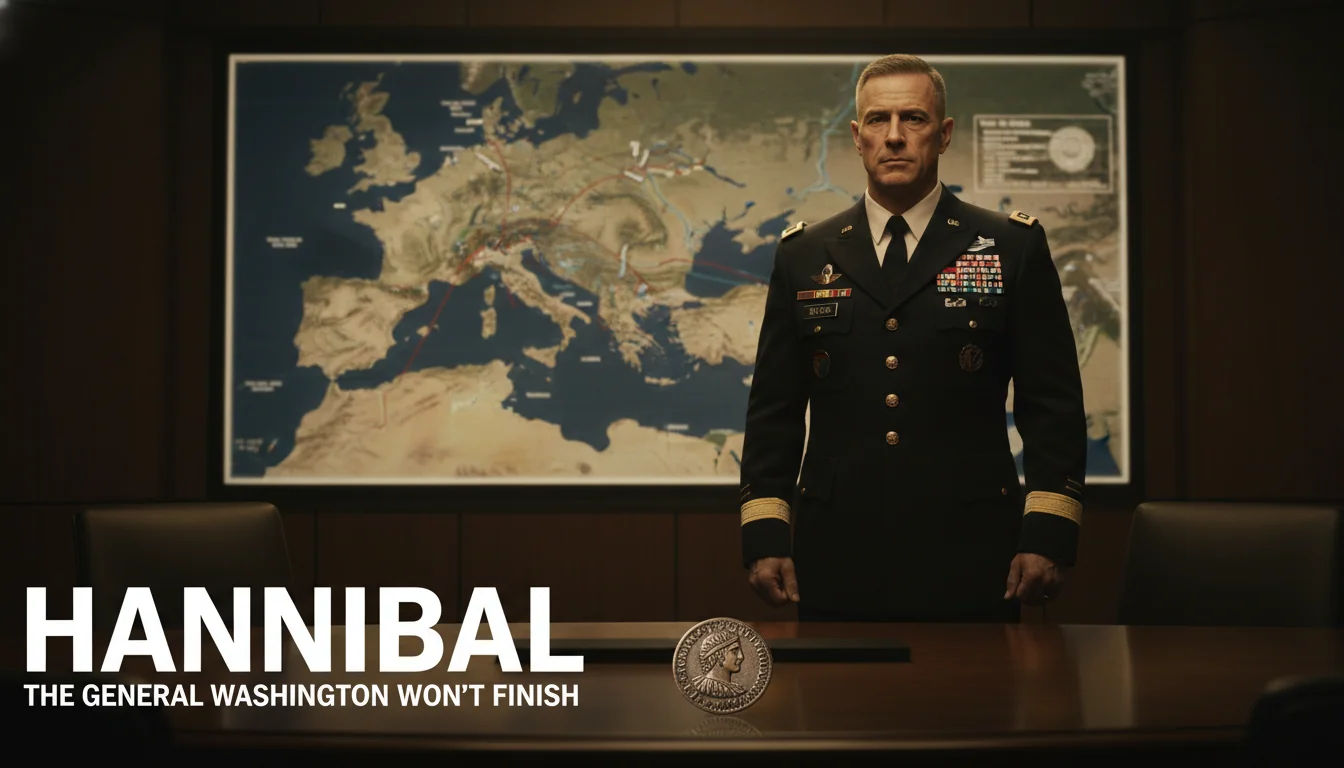
He comes from a military family - in modern terms, third-generation officer corps, West Point or Sandhurst, probably Annapolis given his evident facility with combined-arms operations that required naval integration. He accelerates through ranks with the kind of speed that generates both admiration and resentment in equal measure. He is the colonel given a brigade, then the brigadier given a division, on the grounds that waiting for the traditional tour sequence would waste something genuinely scarce.
His professional reputation rests on one campaign that everyone talks about. He is sent to a deteriorating situation - a theater where previous commanders have achieved nothing or made things worse - and produces a result. The result involves unorthodox intelligence use, speed of exploitation that his own logistics chain almost can't sustain, and the ability to coordinate allies who distrust each other enough to fight effectively under his direction.
After that campaign, he sits on a committee. Then another committee. The committee work is not accidental. His political enemies in the defense establishment - and he has genuine enemies, men who liked the previous arrangement and don't appreciate someone arriving to demonstrate that it was incompetent - have identified that committees are where credibility goes to dissolve. He is too famous to fire, too politically connected to ignore, and not quite controllable enough to give another theater command.
The skills that survive 2300 years
Scipio's military reputation rests on things that do not go out of date. He was an analyst before he was a commander: he studied opponents, identified the assumptions their plans depended on, and broke those assumptions rather than engaging on the terms his enemy preferred. At Carthago Nova, he didn't assault the walls until he understood the tidal pattern of the lagoon. At Ilipa, he ran the same approach march every morning for several days to make it look like a routine, then changed it completely on the day of battle.
He understood allies. The Numidian cavalry under Masinissa was the decisive weapon at Zama, and Masinissa was the decisive relationship Scipio built in Africa. The previous Roman commanders had lost that relationship. Scipio cultivated it. In 2026 this looks like someone who doesn't regard allied and partner-force management as a distraction from the real work. He understands that the partner-force relationship is often the real work.
He was also, for a Roman aristocrat of the 3rd and 2nd centuries BC, unusually concerned with what came after. He returned prisoners in Spain with their property when other Roman commanders would have sold them. He left Carthage intact when Cato wanted it rubble. This isn't sentimentality - it's the calculation that a defeated enemy who believes surrender is survivable will surrender faster, fight less hard, and provide more stable post-war arrangements than an enemy who expects annihilation. It's a lesson that military establishments rediscover approximately once per generation and then promptly forget again.
The contemporary peer
The historical figure he most resembles in 2026 is not a uniformed officer. It's the defense intellectual who has run something operational: the general who writes the doctrine that defines the next decade's war, gets sent to apply it, succeeds brilliantly, returns to Washington, and finds that the political ecosystem does not reward success in the way the press releases claimed it would.
He looks like David Petraeus before Iraq went wrong, like Helmuth von Moltke the Elder if you subtract the institutional respect the Prussian system afforded him. He is the person whose analysis of the problem is correct and whose execution of the solution is elegant and who discovers, at the moment of maximum vindication, that correct analysis and elegant execution are not the same thing as political capital.
The enemies are the same across 2200 years: smaller men who control the allocation of the next command and have every reason to ensure that someone who makes them look ordinary does not get another opportunity to make them look ordinary.
The inscription he'd put on his retirement house in the country, in the version that doesn't make the LinkedIn bio: "I cannot get an honest return out of this town, so I am leaving. I trust history to sort out who was right."
History, in his case, did. It took a few centuries, but it did.
Quick Answers
Common questions about this topic
Who was Scipio Africanus?
Publius Cornelius Scipio Africanus (236-183 BC) was the Roman general who ended the Second Punic War by defeating Hannibal Barca at the Battle of Zama in 202 BC. He previously cleared the Carthaginians from Spain with victories at Carthago Nova and Ilipa. Regarded as one of the greatest military commanders in history, he earned the agnomen 'Africanus' for his African campaign.
How did Scipio defeat Hannibal at Zama?
Scipio used Hannibal's own tactics against him. Rather than anchoring a rigid line, he arranged his maniples in lanes with gaps between them, allowing Hannibal's war elephants to be funneled harmlessly through the formation. He then timed the arrival of his Numidian cavalry to hit the Carthaginian rear at the decisive moment, collapsing the formation that had beaten Rome at Cannae and Trebia.
Why did Scipio die in exile?
Scipio was prosecuted by political enemies, particularly the Petillius brothers acting on behalf of Cato the Elder, on charges of bribery and misappropriation of funds from the campaign against Antiochus III. Rather than submit to a trial he considered an insult, he retired to his villa at Liternum in Campania and never returned to Rome. He died there around 183 BC, reportedly asking that his tomb bear the inscription: 'Ungrateful fatherland, you shall not have my bones.'
What made Scipio different from other Roman generals?
He combined strategic boldness with political sophistication and unusual clemency toward defeated enemies. He studied his opponents carefully, used deception and speed in ways unusual for Roman armies of his era, and treated conquered peoples with a respect that generated loyalty rather than resentment. He also had a flair for personal charisma and was one of the most famous men in the Mediterranean world during his lifetime.

Meet Them in Person
Chat with the historical figures behind these modern reimaginings.
Create your free account →No card required. Some figures and features require a paid plan.
Join the HistorIQly Club
Get smarter about the past.
Weekly stories, deep dives, and exclusive content straight to your inbox.