If Pericles Lived Today: The Infrastructure Politician Who Spent Everyone Else's Money
If Pericles lived today, he would run a European government, build monuments with EU funds, and keep Aspasia out of official summits - exactly as he did 2,500 years ago.
Read Wikipedia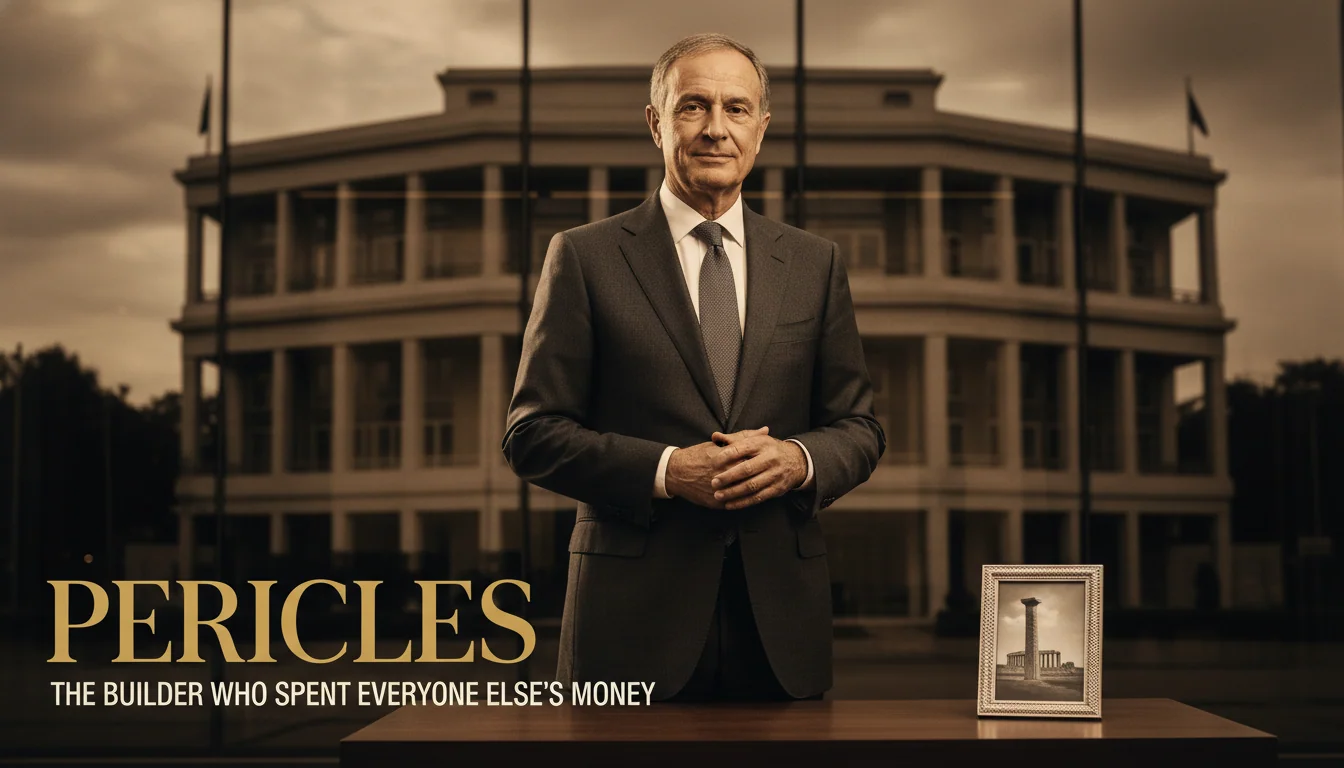
He held no permanent office, never claimed a title, and was technically just one of ten elected generals - a position you had to win again every year. For thirty years, he was the most powerful man in Athens anyway.
Pericles was the architect of the Athenian golden age: the Parthenon, the expansion of democratic participation, the transformation of an anti-Persian alliance into a tribute-paying empire whose funds he redirected into marble. He was also a man whose political opponents spent years prosecuting his friends and his partner because they could not get to him directly. He outlasted them all.
If Pericles lived today, the question is not whether he succeeds. It is which institution he inhabits, how long before the infrastructure spending produces a scandal, and whether the foreign-born partner is a tabloid problem or a feature.
The historical figure
Pericles was born around 495 BCE into one of Athens' most distinguished aristocratic families. His father Xanthippus had been an Athenian general. His mother Agariste was from the Alcmaeonid family, the same lineage as Cleisthenes, the man who had effectively invented Athenian democracy a generation earlier. He grew up with connections, education, and the kind of self-assurance that aristocratic Athenian families cultivated as a matter of course.
He first appears in political life in the 460s BCE as an associate of the reformer Ephialtes, who stripped the conservative Council of the Areopagus of most of its political powers and transferred them to the popular assembly and the courts. After Ephialtes was assassinated, Pericles carried on the democratic program and became its dominant voice.
What he built over the next three decades was not a tyranny - Athenian democracy remained real and functional - but a carefully managed political position that amounted to permanent influence. He was a superb orator and knew it. He was also careful about where he appeared. Ancient sources say he avoided dinner parties and social engagements that might cost him dignity or create obligations. He curated his public image with the attention of someone who understood that reputation was the only permanent asset in a democracy.
The building program is the most lasting evidence of his method. The Parthenon, dedicated to Athena and completed in 432 BCE, was financed substantially with tribute from Athens' allies in the Delian League - city-states that had originally contributed money and ships to a common defense against Persia and now found their contributions being spent on Athenian marble. His political opponents called this theft. Pericles called it the demonstration of Athenian excellence that justified Athenian leadership.
The citizenship law of 451 BCE - restricting citizenship to those with two Athenian parents - had an awkward personal consequence. His life partner was Aspasia of Miletus. She was Ionian Greek, brilliant by every ancient account, and ran what might fairly be called the most intellectually significant salon in Athens. Socrates went there. Anaxagoras went there. The comic poets called her "the new Omphale" and worse. Pericles' enemies tried to prosecute her for impiety. Pericles reportedly wept before the jury on her behalf - one of the few moments of public emotion the ancient sources record for him.
He died of plague in 429 BCE. His two legitimate sons had already died. The city he had dominated for thirty years had entered the Peloponnesian War on his strategic recommendation.
The modern role
Pericles in 2026 runs a country.
Not "leads a movement" or "controls a think tank" or "advises a government." Those are roles for people with his skill set but not his ambition. Pericles was fundamentally a ruler of a city-state, and the nearest modern equivalent is a head of government in a mid-size European democracy: Germany, France, the Netherlands, or a Scandinavian country. He would need a democratic system with genuine popular accountability - he was not a backroom operator but a platform politician - and he would need the institutional space to pursue long-term infrastructure and civic projects.
The most natural fit is a German-style chancellorship, perhaps in a coalition government. He would win the chancellery in his mid-forties, having spent a decade building alliances across the party structure, and he would keep winning re-election through a combination of visible achievement and careful management of who got credit for what.
His signature domestic program would be infrastructure spending on a scale that made critics uncomfortable: rail, public buildings, technology corridors, university expansion. He would frame each project in the language of national excellence rather than economic stimulus. The Parthenon speech would become a campaign slogan. "The capital of this country must be worthy of its people." Repeated until the opposition used it as evidence of grandiosity, then repeated some more.
The financing would be the source of friction. Pericles would find the EU structural funds, the common defense budget, or the next round of post-crisis solidarity transfers and redirect a percentage toward nationally visible projects. Allied partners would notice. There would be summits. He would give his best speech and the program would continue.
The partner problem
Aspasia would be a constant complication.
In the modern version, she is a professor of international relations or a foreign-born policy intellectual, born somewhere that makes her an easy target - Eastern European, perhaps, or Turkish, or Iranian. Deeply knowledgeable, genuinely influential in his thinking, and constitutionally unable to hold official office in a system where his own early career was built partly on citizenship restrictions he is now personally embarrassed by.
She would run an independent advisory organization with an anodyne name and a client list nobody can access. The tabloids would call her a shadow chancellor. His opponents would call her a conflict of interest. He would appear with her at cultural events and domestic occasions. She would not attend EU summits.
The hostile coverage would focus on her nationality, her intellect (presented as sinister rather than admirable), and the gap between his stated commitment to meritocracy and his domestic arrangement. He would absorb the coverage without visible effect. She would publish two books in the decade, both reviewed seriously in specialist publications and not at all in the tabloid press.
Persona and social media
Pericles was famous as an orator and nearly silent as an informal conversationalist. The social media equivalent is a politician who publishes extremely curated, formal text - long LinkedIn essays on European governance, occasional formal statements on foreign policy, no live video, no stories, no behind-the-scenes content.
His Instagram account would consist entirely of building dedications, state visits, and formal cultural events. The captions would be three sentences of careful prose. He would have several million followers and a comment section that would periodically flood with criticism of whatever his government had done that week, to which he would never respond.
He would not be on the platforms that reward impulsive engagement. His staff would occasionally post something they thought was warm and accessible. He would look faintly uncomfortable in it.
His speeches, delivered to parliament or to major public events, would be widely shared. The Funeral Oration equivalent - a speech to mark a state occasion, making the case for liberal democracy as the highest form of civic life - would be the text his political biography opens with.
The contemporary peer
The modern figure he most resembles is not a single person but a composite of a specific type: the long-serving European democratic leader who combines genuine intellectual seriousness with total comfort using the machinery of democratic legitimacy for personal and national aggrandizement. Angela Merkel's institutional patience. Emmanuel Macron's investment in civic symbolism. Willy Brandt's willingness to connect domestic democracy to an international order.
He would be deeply uncomfortable with any comparison to a demagogue. The distinction between leading a democracy and performing populism was the central axis of his political identity, and it would remain so.
He would be re-elected three times. Each time, the opposition would accuse him of converting the democratic alliance into an Athenian tribute empire. Each time, he would point at the buildings and win.
For the philosophers who flourished under Pericles and would have comparable modern careers, read If Aristotle lived today and If Socrates lived today - two figures whose relationship to power was the opposite of Pericles' comfort with it.
Quick Answers
Common questions about this topic
Who was Pericles?
Pericles (c. 495-429 BCE) was an Athenian general and statesman who dominated the politics of Athens for roughly thirty years. He expanded Athenian democracy, directed the building program that produced the Parthenon and the Propylaia on the Acropolis, and transformed the Delian League - an anti-Persian alliance of Greek city-states - into an Athenian empire whose tribute he used to fund his building projects. He died of plague in 429 BCE, near the beginning of the Peloponnesian War.
What made Pericles so powerful?
Pericles held no permanent office - he was elected annually as one of Athens' ten strategoi (generals) and kept winning re-election for decades. His power rested on oratorical skill, careful management of the popular assembly, and a long-term vision for Athens as the cultural center of the Greek world. He also extended paid jury service so that poor citizens could participate in the democracy, which built him a loyal base among the people who most benefited from his reforms.
Who was Aspasia?
Aspasia of Miletus was Pericles' life partner, a woman from the Ionian Greek city of Miletus who was therefore a metoikos (a foreign resident) in Athens. Under Pericles' own citizenship law of 451 BCE, which restricted citizenship to those with two Athenian parents, she could not legally marry him. Ancient sources describe her as highly educated and intellectually sharp, running a salon that attracted Socrates, Anaxagoras, and other leading thinkers. Pericles' political enemies attacked him repeatedly through her.
How did Pericles die?
Pericles died in 429 BCE from the Athenian plague, the devastating epidemic that struck Athens during the early years of the Peloponnesian War. He had himself argued for the defensive strategy that crowded Athenian countryside refugees into the city - a decision that almost certainly accelerated the plague's spread. He survived long enough to see his two legitimate sons, Paralus and Xanthippus, die of the same disease before he did. Aspasia's son, also named Pericles, was later legitimized as a citizen.

Meet Them in Person
Chat with the historical figures behind these modern reimaginings.
Create your free account →No card required. Talk to anyone in history with 8 free credits a day. Some features require a paid plan.
Join the HistorIQly Club
Get smarter about the past.
Weekly stories, deep dives, and exclusive content straight to your inbox.