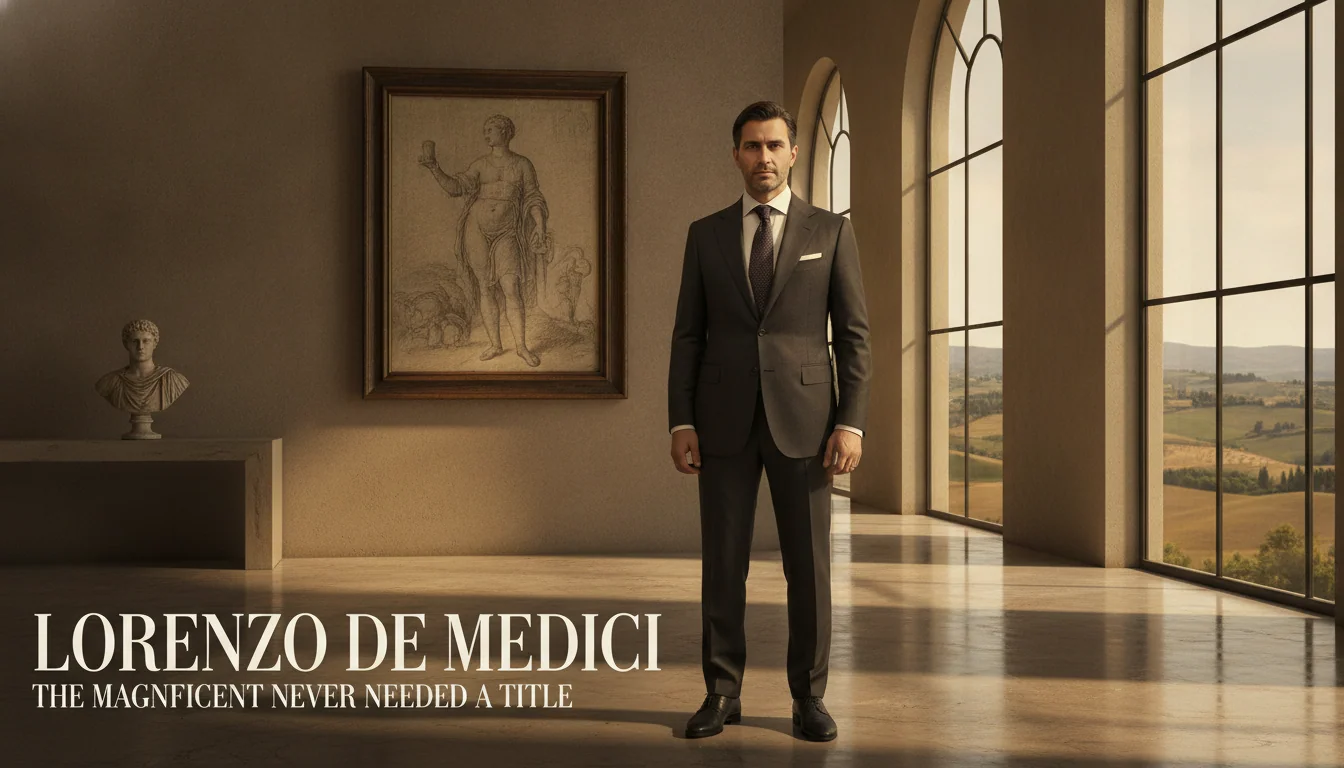
If Catherine de Medici Lived Today: The Dynastic Fixer Who Always Outlasted Everyone
If Catherine de Medici lived today, she would run the most indispensable advisory firm in whatever capital would have her - the operator who always outlasts everyone.
Read Wikipedia
Catherine de Medici was born in April 1519 and her parents were dead within weeks. Her mother, a French duchess, and her father, Lorenzo de Medici, duke of Urbino, both died of tuberculosis before she was a month old. She was handed to relatives, raised by nuns in Florence, and used as a diplomatic chip from the age of ten. When Pope Clement VII - her cousin - arranged her marriage to Henry, second son of the French king, in 1533, she was fourteen and going to a court that had no particular use for her.
The French thought of her as the banker's granddaughter. Merchants' blood in the royal family. They called her, behind her back, the Italian woman.
She spent her first decade in France largely invisible, producing no children and therefore no value. Henry had a mistress, Diane de Poitiers, who openly outranked the queen in affection and influence. Then the children came, ten of them between 1543 and 1556. And then Henry died, in July 1559, from a lance wound through the eye at a jousting tournament. And Catherine, forty years old and finally queen not consort, found herself the only adult in the room.
She would not leave it for thirty years.
The historical figure
Francis II, Catherine's eldest son, was fifteen when Henry died and already in poor health. He reigned for seventeen months and died of an ear infection in December 1560. Charles IX was ten. Catherine was regent.
The France she managed was coming apart. The Wars of Religion between the Catholic majority and the Calvinist Huguenot minority had begun in earnest, and the political factions behind each side - the Guise family leading the ultra-Catholics, the Bourbon princes leading the Protestant interest - were effectively rival governments looking for a moment of weakness to make their move. The monarchy that Catherine was holding on behalf of her sons was the institution that stood between France and civil dissolution.
Her method was negotiation. She traveled continuously through France, meeting faction leaders, negotiating truces, brokering the Edict of Amboise in 1563, then the Edict of Longjumeau in 1568, then the Peace of Saint-Germain in 1570, each of which gave the Huguenots a measure of religious toleration and each of which was soon violated by one side or the other. She arranged marriage alliances with the Bourbons and the Habsburgs simultaneously. She tried to hold the balance.
And then came the St. Bartholomew's Day Massacre of August 24, 1572, which collapsed the balance entirely. The Huguenot Admiral Coligny, whom Catherine had recently brought into Charles IX's council, was assassinated. Within hours, the Paris mob - encouraged by the Guise faction and, by most accounts, with at least the passive knowledge of the court - began killing Protestants in the streets. The killing spread to the provinces. The death toll was in the thousands. Catherine's precise role is still disputed, but she was in the Louvre when the decision was made and she did not countermand it.
The massacre destroyed her peace policy, inflamed Protestant Europe, permanently damaged the French monarchy's relationship with the Huguenot community, and gave Catherine the black legend she still carries. The wars continued for another twenty-six years.
Charles IX died in 1574, aged twenty-three, of tuberculosis. Henry III was thirty-seven when a Dominican friar named Jacques Clement stabbed him in the abdomen in August 1589. Catherine had died of pleurisy in January of the same year, at the age of sixty-nine. She had outlasted them all.
The modern role
In 2026, Catherine de Medici is the founding partner of Medici Group, a Brussels-registered political advisory firm with offices in Paris, Geneva, and Riyadh. The letterhead lists no practice areas. The website has a contact form and a phone number that goes to a very composed receptionist. Potential clients are seen by appointment only.
She does not take retainers from ideologically committed clients. She has worked with governments of the center-left and the center-right, with a sovereign wealth fund and a reformist opposition party in the same country at different times, and with the negotiating teams of three multilateral trade disputes. The consistent thread is the situation where multiple parties each think they are about to win and she understands that none of them are.
Her specific skill is the negotiation that cannot be admitted to in public. When two factions need to reach an accommodation but cannot be seen talking to each other, there is a particular category of intermediary who can move between them. She has done it often enough that she charges for access to the space rather than for the outcome.
The modern peer her clients privately compare her to varies by who is doing the comparing. European observers reach for Angela Merkel - the person who could stay in the room longer than anyone else without conceding anything essential. American clients think of Henry Kissinger without the sentimentality. Neither comparison is quite right. Kissinger had a philosophical system. Merkel had genuine convictions. Catherine de Medici has preferences, but she does not have a side.
The office, the wardrobe, the tells
Her Brussels office is a ground-floor suite in a converted 19th-century townhouse, three blocks from the European Parliament and equidistant between the Council building and the Commission. The location is not an accident. The furniture is good but not spectacular. There are two small Flemish still-life paintings on the wall that she bought at auction in the 1990s and that have doubled in value since. Clients who know about paintings notice them. Clients who don't notice that she does not have photographs of herself with powerful people, which is a different signal.
The wardrobe is Italian and correct. She has never understood the northern European fashion for business casual as a signal of sincerity. A well-cut suit is not pretension. It is the minimum courtesy you owe to a meeting.
She speaks French, Italian, English, and Spanish fluently and reads German well enough to understand what she is signing. In negotiations she prefers the language in which the other party is weakest.
The incident that follows her
The 1572 equivalent would be visible in her file, if you knew where to look. There would be a situation, probably in the mid-2010s, in which a peace process she had constructed collapsed spectacularly. A faction she had been managing turned on another faction she had also been managing, and people died who would not have died if the process had held. Her precise role would be contested. She would have known it was coming and not stopped it. She would have calculated that stopping it would cost more than allowing it, and that calculation would have been defensible by the standards of the situation and indefensible by any other standard.
She still takes the file. She has not stopped working.
The children question
She has children. They are successful in various directions - one in finance, one in law, one in something to do with international institutions that nobody at family dinners fully understands. She is proud of them in the particular way of a person for whom family was always an instrument as well as an affection. She remembers their birthdays without being reminded. She has never, in front of clients, mentioned them.
Her late husband, whom she married in her early thirties, was a lawyer from an old northern Italian family. He died fifteen years ago. She has not remarried. People who have known her a long time say that she was, within the marriage, genuinely warmer than the professional version of herself. People who have known her only professionally find this slightly implausible.
What she understands that her rivals don't
The contemporary fixer's great temptation is to become a partisan. To take a side seriously enough that you lose your value to the other side. Catherine de Medici spent thirty years understanding that the French monarchy's survival depended on being simultaneously acceptable to both parties in a conflict that neither side would abandon.
She failed at it in 1572, and that failure cost her everything her previous decade of work had built. But the basic instinct - that the arbiter's value lies in acceptability, and acceptability requires a neutrality that is genuinely uncomfortable to everyone - is correct. Most of her rivals don't last long enough to learn it.
She was still in the room in 1589 when her son was dying. She had been the only constant for thirty years of a war that had killed hundreds of thousands. Nobody else in that court had survived with any influence intact.
This is what she calls, when pressed, her methodology. In practice it is something simpler: she outlasts people. In 2026, she is still in the room.
For other historical power brokers reimagined in the present, see If Napoleon Lived Today and If Elizabeth I Lived Today.
Quick Answers
Common questions about this topic
Who was Catherine de Medici?
Catherine de Medici (1519-1589) was born into the powerful Florentine banking dynasty and became Queen of France as wife of Henry II. After his death in 1559, she served as regent for three of her sons who reigned as Francis II, Charles IX, and Henry III. She was the dominant political force in France for three decades, navigating the catastrophic Wars of Religion between Catholic and Huguenot factions. She is often blamed for the St. Bartholomew's Day Massacre of 1572, though her precise role is still debated by historians.
What was Catherine de Medici's greatest political skill?
Endurance combined with tactical flexibility. Catherine was not an ideologue. She was a pragmatist who tried to hold France together by offering concessions to whichever faction seemed most dangerous at any given moment, then withdrawing them when the balance shifted. She used marriage alliances, personal diplomacy, extended royal progresses through France, and occasional brutal force. She outlasted her enemies not by defeating them decisively but by being willing to negotiate in ways that ideologically committed opponents could not.
What was the St. Bartholomew's Day Massacre?
On August 24, 1572, beginning in Paris and spreading across France over several weeks, thousands of French Huguenots (Protestants) were killed by Catholic mobs and soldiers. The massacre began during the wedding celebrations of Catherine's daughter Margaret to the Huguenot leader Henry of Navarre - a marriage Catherine had arranged as a peace measure. The death toll is estimated between 5,000 and 30,000. Catherine's role in ordering or approving the massacre is historically contested; she certainly knew it was coming and did nothing to stop it.
Was Catherine de Medici really a poisoner?
Almost certainly not - or at least not to the degree her legend suggests. The poisoner reputation was a piece of anti-Italian and anti-Medici propaganda that accumulated over decades after her death. She was a foreigner in France, she outlasted her enemies conveniently, and Italian Renaissance courts had a historical association with poison in European popular culture. There is no reliable evidence she poisoned any specific person. The Black Legend of Catherine the poisoner says more about 16th-century French xenophobia than about her actual methods.

Meet Them in Person
Chat with the historical figures behind these modern reimaginings.
Create your free account →No card required. Talk to anyone in history with 8 free credits a day. Some features require a paid plan.
Join the HistorIQly Club
Get smarter about the past.
Weekly stories, deep dives, and exclusive content straight to your inbox.