If Tamerlane Lived Today: The Modernizer Who Leaves Towers of Receipts
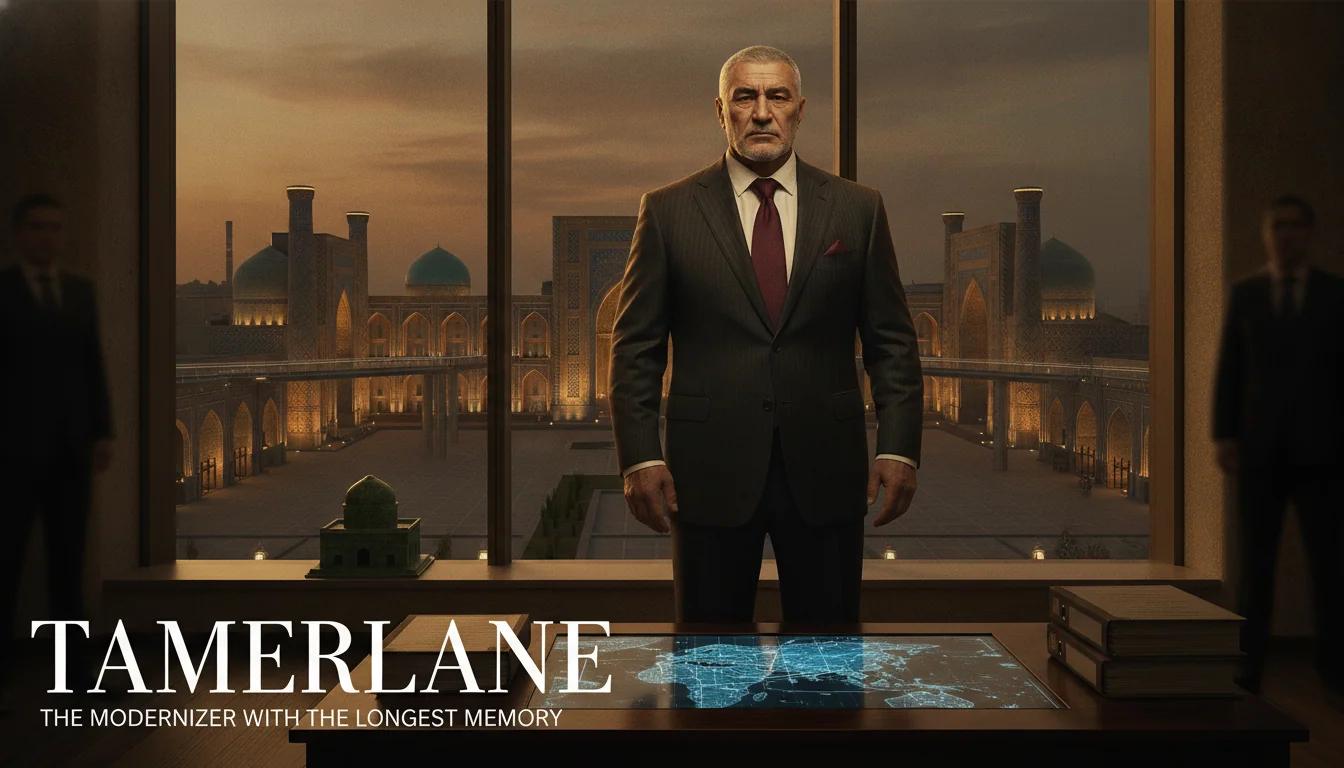
If Tamerlane lived today, the conqueror who built Samarkand's mosques and arranged skulls into towers would run an infrastructure firm no government wants to cross.
The standard introduction to Timur involves two facts in quick succession: that he was personally responsible for the deaths of perhaps 17 million people, and that he commissioned some of the most beautiful buildings in the medieval world. The reader's face, caught between these facts, tends to arrange itself into an expression of sincere confusion, and that is the correct expression. He was not a man whose contradictions resolve under closer inspection. They deepen.
Timur, born around 1336 near Shakhrisabz in Central Asia and known in European tradition as Tamerlane, a corruption of "Timur the Lame" (he walked with a permanent limp from an arrow wound), built an empire from his capital at Samarkand spanning from Anatolia in the west to India in the east, from the Russian steppe in the north to the Persian Gulf in the south. He defeated the Ottoman Sultan Bayezid I at the Battle of Ankara in 1402, temporarily halting Ottoman expansion into Europe. He sacked Delhi in 1398 so thoroughly that the city reportedly did not recover economically for a century. He arranged the skulls of those who resisted him into towers, in numbers ranging from thousands to, in some chronicles' accounting, nearly a hundred thousand in a single campaign.
He also brought Damascus's craftsmen to Samarkand to build him mosques. He personally supervised the aesthetics of the Bibi-Khanym mosque and is reported to have argued with the architects about the proportions. The beauty is real. The method of acquiring the craftsmen was forced migration.
Drop him into 2026 and the question is not whether he finds his footing - he finds his footing anywhere - but which industries and institutions give him the most room to operate.
The historical figure
Timur was born into a minor Turco-Mongol clan of the Chaghadaite realm, which had fragmented after the dissolution of the Mongol Empire. He rose through local politics and intermittent warfare, building a base of tribal alliances in Transoxiana through the 1360s. By 1370 he had consolidated control of the region and began expanding outward.
His political legitimacy had one structural weakness: he was not a Chinggisid. In the post-Mongol political world, genuine descendants of Genghis Khan were the only legal holders of the title of khan. Timur's solution was elegant: he married into the Chinggisid lineage, ruled formally through puppet Chinggisid khans while holding real power himself, and styled himself Amir - commander - rather than khan. He also claimed descent from Genghis Khan on his mother's side in documents that later historians have examined skeptically. The claim was believed by enough people at the time, and was enforced by enough military power, to function as a political reality regardless of its genealogical accuracy.
His military system was built on three foundations: mobile professional cavalry organized in the Mongol tradition but adapted for the conditions of Central Asia and the Middle East, siege engineering capable of cracking the major fortified cities of the era, and a systematic terror policy intended to reduce the cost of future sieges. The skull towers were not rage or sadism - or not primarily. They were strategic communications, designed to arrive at the next city before his army did and encourage its rulers to calculate correctly.
He also adapted to the cultures he conquered rather than erasing them. He employed Persian administrators to run the bureaucracy of his empire, Chinese protocol advisors after his campaigns in the east, and recruited the best engineers, architects, and craftsmen from every city he took. He did not want a Mongol steppe empire. He wanted a cosmopolitan imperial capital that would rival anything in the world. Samarkand was that project.
The modern role
In 2026, Timur's business address is Tashkent, though he maintains a suite in Istanbul, an office in Dubai, and a registered holding company in a jurisdiction that offers appropriate discretion. His formal title is Chairman of a privately held conglomerate with operations across energy, mining, infrastructure, and construction throughout Central Asia, the Gulf, and parts of Africa.
The conglomerate delivers. When he contracts to build a pipeline through difficult terrain on an accelerated schedule, the pipeline gets built. When he undertakes land acquisition for a government-sponsored industrial project, the land is acquired. The methods used during acquisition are not examined closely by clients, who have plausible deniability, or by international investors, who have returns to consider. His project completion rate is exceptional. His partner turnover rate is also exceptional, though in a different direction.
Several governments have hired him and then discovered that his definition of the project scope was larger than theirs. A few have attempted to renegotiate. The renegotiations have not typically gone well for the party that initiated them. He does not take renegotiation as an affront. He takes it as new information about a partner's reliability, and he responds accordingly.
He has been to Davos. He found it adequately useful and insufficiently serious. He prefers the bilateral meetings that happen before the formal sessions, in hotel suites, between people who have already established that they are willing to do what is necessary.
The skills that translate
The first is organizational intelligence. Timur managed a multi-ethnic empire across a territory stretching thousands of miles, coordinating military logistics, tax collection, diplomatic correspondence, and large-scale construction simultaneously. The modern equivalent is running a vertically integrated conglomerate across multiple regulatory environments and political systems. He does this with the same method as the 14th-century version: trusted lieutenants with defined accountability, immediate and severe consequences for disloyalty, and personal micromanagement of the three or four decisions that actually determine everything else.
The second is cultural adaptability. Timur was not the same ruler in Samarkand that he was in Delhi, not the same administrator in Persia that he was in dealing with the Golden Horde. He wore different political costumes in different contexts with total ease and without apparent sense of contradiction. In 2026 this reads as sophisticated cross-cultural intelligence. He is not the same person at an Astana investment forum that he is at a bilateral in Riyadh, and neither of those is the person who appears in Geneva. Observers who notice the difference are told he adapts to his audience. Observers who think about it longer recognize that adapting perfectly to every audience is its own kind of consistency.
The third is the Samarkand instinct - a genuine interest in building things that outlast him, in leaving a capital worth visiting after he is gone. This is real and separates him from purely extractive conglomerates. He funds cultural restoration projects across Uzbekistan. He has sponsored reconstruction of two UNESCO World Heritage sites through a foundation bearing a discreetly modified version of his name. The motivation is mixed. The buildings are not.
Where he lives and what he reads
The Tashkent residence is large and includes a library of primary-source histories in Persian, Arabic, and Russian translation. He has read Clavijo's account of Samarkand with annotations. He has opinions about Ibn Arabshah's characterization of him that he considers unfair, and he is correct about some of them.
The Istanbul apartment is for when he wants to be around a city that has been the center of something large, and knows it, without making a ceremony of it. He likes the Bosphorus for the same reason he liked the high plateau of Transoxiana: a defensible position with good sight lines in multiple directions.
He does not have public social media accounts. His name appears occasionally in financial press coverage, always in a formulation like "the conglomerate controlled by" or "the holding company associated with," never in anything that requires a direct quote. His communications team is small and excellent. His communications philosophy is that people who are paying attention already know what they need to know, and people who are not paying attention are not the audience he is concerned with.
The contemporary peer
The clearest modern parallel is a Gulf infrastructure sovereign fund chairman crossed with a Soviet-era Central Asian party secretary, but both analogies are incomplete because neither captures the aesthetic dimension. Timur built things that were genuinely beautiful and cared intensely which craftsmen built them. The contemporary figure who most closely matches is perhaps a Central Asian version of someone like Lee Kuan Yew reimagined with the patience replaced by urgency and the rule of law replaced by the rule of demonstrated capability.
The skull towers do not appear on any skyline in 2026. They appear in financial structures: in the dissolution of partnership agreements, in the sudden unavailability of banking relationships, in the inexplicable reversal of regulatory approvals. These are slower and less photogenic, but the message to the next potential counterparty is recognizably similar. Resistance is expensive. Cooperation is profitable. The math is not complicated.
The mosques are real, though. You can visit them. For the contemporary versions of other conquerors whose brutality and cultural ambition occupied the same body, the reimaginings of Genghis Khan and Attila the Hun both explore what happens when you drop a man whose entire worldview was shaped by steppe warfare into a world governed by contracts and quarterly earnings calls.
Quick Answers
Common questions about this topic
Who was Tamerlane?
Timur, known in European tradition as Tamerlane, was a Turco-Mongol conqueror born around 1336 near Shakhrisabz in Central Asia. He built an empire stretching from Anatolia to India and from the Caucasus to the Arabian Sea. He is remembered simultaneously for commissioning some of the most spectacular Islamic architecture of the medieval world and for orchestrating massacres on a scale that left entire cities in rubble.
Why are Tamerlane's conquests remembered as so brutal?
Timur used systematic exemplary violence as deliberate policy. When cities resisted and then fell, he typically ordered mass executions and arranged the skulls into towers outside the walls - intended as a message to the next city about the cost of resistance. Historical chronicles, including those of Ibn Arabshah and Ruy Gonzalez de Clavijo, document towers of thousands of skulls at multiple sites.
What did Tamerlane build?
Samarkand was his masterpiece. He filled it with mosques, madrasas, gardens, and bazaars, importing craftsmen from conquered cities across his empire. The Gur-e-Amir mausoleum and the Bibi-Khanym mosque were built under his direct patronage. The Registan complex was completed by his successors. These structures survive today as UNESCO World Heritage sites.
Was Tamerlane descended from Genghis Khan?
Timur claimed Chinggisid descent on his mother's side, which was politically necessary in the Mongol successor world, where only descendants of Genghis Khan could legitimately claim the title of khan. Modern historical analysis suggests he constructed or significantly embellished this genealogy. He ruled through puppet Chinggisid khans rather than claiming the title himself, a careful legal fiction that gave him power without a claim he could not fully substantiate.

Meet Them in Person
Chat with the historical figures behind these modern reimaginings.
Start the ConversationJoin the HistorIQly Club
Get smarter about the past.
Weekly stories, deep dives, and exclusive content straight to your inbox.