If Attila the Hun Lived Today: The Conqueror Who Still Gets Paid
If Attila the Hun lived today, he'd run a private security empire - the man every government wants to negotiate with and none dares to anger.
Read Wikipedia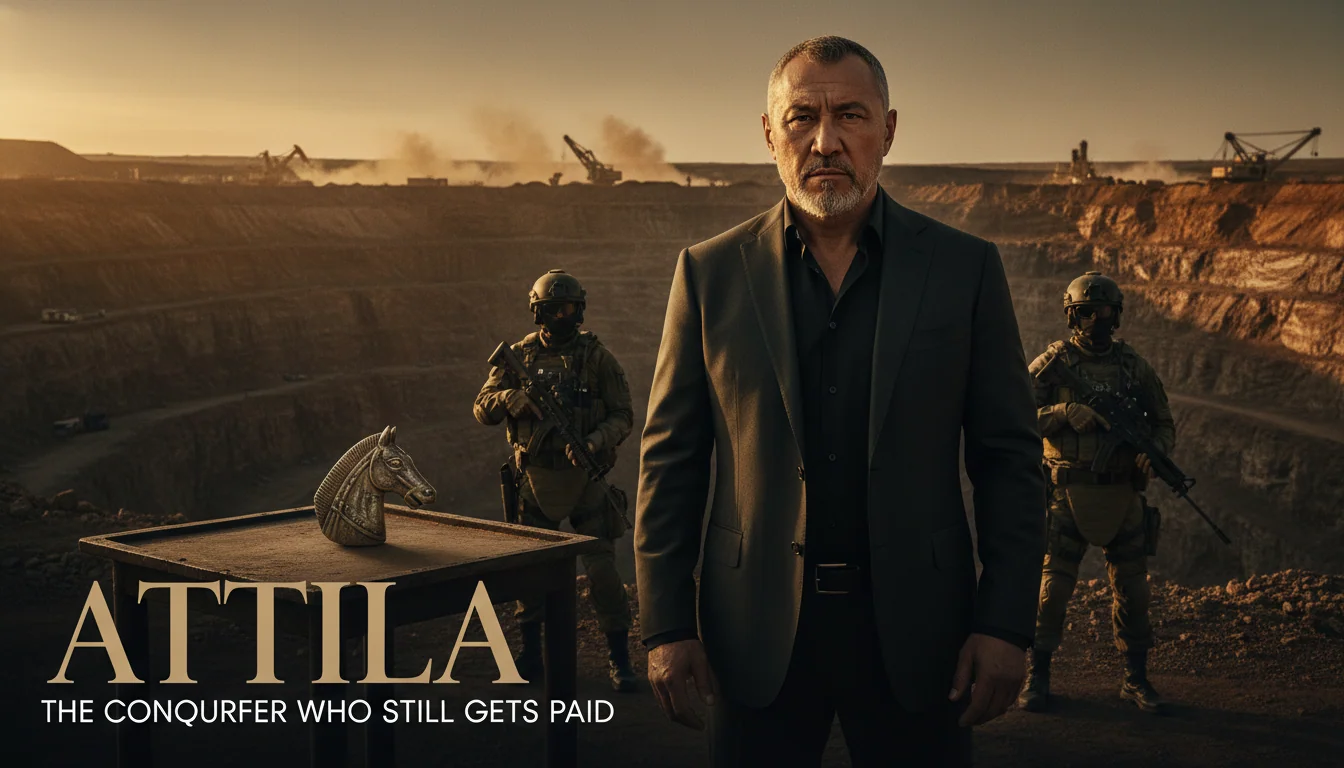
Two Roman empires paid him tribute. He devastated the Balkans three times, extracted more gold from Constantinople than that city's treasury could comfortably spare, turned back a coalition of Romans and Visigoths at the Catalaunian Plains, and marched to within striking distance of Rome before deciding, for reasons historians still argue about, not to finish the job. He died on his wedding night, drowning in his own blood while his new wife sat beside him in the dark.
The man the ancient sources describe was short, broad-chested, with a large head, small deep-set eyes, a flat nose, and a thin scattered beard. He was, by the accounts of Roman diplomats who actually met him, impressive in the way dangerous people are impressive: calm when you expected anger, decisive when you expected hesitation, indifferent to the things you brought to bribe him.
If Attila the Hun lived today, in 2026, you would not get a warmongering general. You get something more useful and harder to deal with: a principal who runs a private security and resource extraction enterprise, maintains his own militia, has governments on every continent quietly paying him not to be a problem, and has never been successfully prosecuted for anything.
The historical figure
Attila and his brother Bleda inherited leadership of the Hunnic confederation around 434 CE, taking over from their uncle Ruga. The confederation at this point was a massive, loosely organized collection of steppe peoples - Huns, various Germanic groups, and absorbed populations - held together by military dominance and the redistribution of plunder.
From 441 to 447, Attila launched systematic attacks on the Eastern Roman Empire. The campaigns were not random raids. They were calibrated pressure: move, devastate, extract tribute, return, increase the demand. The Eastern Romans paid. The amounts documented in contemporary sources ran into thousands of pounds of gold per year. Constantinople, caught between Persian threats in the east and Gothic instability in the west, had limited options.
The diplomatic record survives partly through Priscus of Panium, a Roman diplomat who visited Attila's court around 449 CE and left an account remarkable for its detail. Priscus describes a man who ate from wooden dishes while his subordinates ate from silver, wore no gold himself while encouraging its display among his followers, and received supplicants and ambassadors with an economy of expression more frightening than any show of temper would have been. The wooden dishes were almost certainly a performance, a calculated display of self-denial designed to make the surrounding wealth look like gifts given to others rather than possessions grasped for himself.
The Gallic campaign of 451 ended at the Battle of the Catalaunian Plains, where the Roman general Aetius and the Visigothic king Theodoric stopped the Hunnic advance. The Italian campaign of 452 sacked Aquileia and moved south. Why Attila turned back before taking Rome is a matter of ongoing debate - Pope Leo's intervention, disease and famine among the troops, a threatened Eastern Roman counterattack from the rear, or some combination of these.
He died in 453 at a wedding feast. The empire he had built died almost as fast. His sons could not agree on succession, the subject peoples revolted, and within a decade the Hunnic state had collapsed entirely.
The modern role
In 2026, Attila runs a company called Tenggeri Group, registered in the UAE, with offices in Dubai, Ankara, Belgrade, and a discreet operational presence in mining regions of central and sub-Saharan Africa.
The official business is infrastructure logistics and private security. The actual business is this: Tenggeri Group provides security services to governments and mining companies operating in unstable regions. The security services cost more than market rate. Non-clients in the same regions experience heightened insecurity. Attila does not threaten anyone directly. He explains, patiently and without visible emotion, what his clients receive and what happens in the absence of his firm's services. Governments understand immediately. Mining executives understand immediately. Aid organizations operating in the same areas understand slowly and then very clearly.
The arrangement is not blackmail, which requires a direct threat and is illegal in most jurisdictions. This is more like a protection premium - the modern form of the gold that Constantinople paid every year to keep the Huns on the far side of the Danube. The payment structure is sophisticated. Attila is not a crude man.
He sits on the boards of two holding companies and three industry associations, all of which give him legitimate access to government offices, business forums, and financial institutions. He has never been charged with a crime. He has been the subject of three investigations in two countries, all of which closed without charges. His lawyers are very good.
The skills that carry over
Tribute extraction. The Hunnic model was simple: make yourself valuable enough to pay and dangerous enough to fear, then calibrate the price. The modern version substitutes contract terms for cavalry. The mechanism is identical. Governments and corporations calculate whether the cost of dealing with Attila is lower than the cost of not dealing with him. It usually is.
Confederation management. Attila's genius was not simply violence. It was binding disparate groups - including Germanic peoples who had no natural loyalty to the Huns - into a functioning military and economic unit by making participation profitable. The modern Tenggeri Group operates the same way: local commanders, ethnic militias, political contacts, and financial intermediaries in every region, each given a piece of the arrangement, each bound more by profit than by loyalty. When profit stops flowing, the confederation loosens. Attila knows this and keeps the money moving.
Psychological economy. Priscus described a man who calibrated his demeanor to produce maximum effect with minimum expenditure. Rage was available when it served a purpose and withheld when it did not. The 2026 version is the same: quiet in meetings, decisive in crises, never requiring two phone calls when one will do. People who have sat across from him in negotiations remember the meetings as uncomfortable not because anything specific was said but because of what was not said - the gap where a threat would normally go.
The family
Attila had multiple wives in his own time, and the sources agree that managing this domestic situation was a subordinate concern to managing an empire. The modern version: one official wife, a Kazakh-German woman from a family with useful Central Asian government connections. Two sons who are being kept at some distance from the business - he is too experienced a succession planner to raise obvious heirs while still operating at full effectiveness. A daughter who works for a Geneva-based humanitarian organization, an arrangement that puzzles her colleagues and pleases her father considerably.
He lives primarily in Dubai, in a compound described, when description is unavoidable, as modest. It is not modest. It is discreet, which is a different quality entirely.
Where he lives and what he owns
The Dubai compound is operational. He also maintains a property in Montenegro, a villa in the hills above Budva with a clear view of the Adriatic. The Montenegro property is for summer, for certain conversations that are better had outside the jurisdiction of the UAE, and for the kind of entertaining that does not appear in any business diary.
He flies private almost exclusively - not for comfort, but for the absence of witnesses at departure and arrival points.
What goes wrong
Attila's empire dissolved within years of his death because its binding mechanism was entirely personal. The confederation held because of him and only because of him.
The modern version makes the same structural error. Tenggeri Group is, despite its paperwork and board seats, one man's instrument. The relationships, the informal agreements, the carefully calibrated arrangements with sixteen governments and dozens of mining companies - they are all predicated on the continued presence and personal authority of the person who built them.
He knows this. He has spent the past decade attempting to institutionalize the arrangements: training subordinates, formalizing tributary relationships into legal contracts, structuring the business so it could, in theory, survive him. It has worked less well than he hoped. The subordinates are capable but they lack the quality that made Priscus' account of the original man so striking: the calm certainty that the visitor sitting across from him had already, at some level, accepted the terms before the meeting began.
The modern Attila will be succeeded by a committee. The committee will hold the enterprise together for five years, perhaps seven. Then it will fragment, the components absorbed by rivals or governments, and the clients who once paid Tenggeri Group's rates will quietly redirect those payments to whoever occupies the position next.
He has read the history. He knows exactly how this ends. He has decided, every year for the past fifteen years, that this year he will finally solve the succession problem.
He has not yet managed to solve it.
Why it matters
Attila fascinates not because he was the most destructive figure of late antiquity - others were worse - but because he demonstrated something durable about how power works outside institutional structures. His empire had no bureaucracy, no written law code, no standing army in the Roman sense. It ran on personal authority, calibrated violence, and the efficient redistribution of extracted wealth. When the personal authority disappeared, there was nothing underneath it.
The modern world has many more institutional structures, and they provide more friction against purely personal power. But the dynamic Attila exploited - the willingness of wealthy, organized states to pay for quiet rather than fight for it - has not disappeared. It appears in different forms, wearing different legal costumes, registered in different jurisdictions.
The original Attila was buried in a secret grave somewhere on the Hungarian plain, its location known only to men who were then killed so they could not reveal it. The modern version has better estate planning. Whether it solves the same underlying problem is an open question, and not one anyone in his orbit will ask out loud.
For a comparable study in personal power built on military confederation rather than institutional structure, see how Genghis Khan might operate in the modern world.
Quick Answers
Common questions about this topic
Who was Attila the Hun?
Attila (c. 406-453 CE) was the ruler of the Hunnic Empire who, with his brother Bleda, seized control of the Hunnic confederation around 434 CE and had his brother killed by around 445 CE to rule alone. He launched devastating campaigns against the Eastern Roman Empire, extracted enormous tribute from Constantinople, led a major invasion of Gaul in 451 CE that was defeated at the Battle of the Catalaunian Plains, and invaded Italy in 452 CE before turning back without sacking Rome.
How did Attila the Hun die?
Attila died on his wedding night in 453 CE, found dead in bed next to his new wife Ildico with a severe hemorrhage. Ancient sources including Priscus and Jordanes suggest he choked on his own blood while intoxicated, dying from a nosebleed that could not be stopped. His followers mourned by cutting their own faces, so the greatest warrior would be mourned with blood rather than tears. He was buried in a secret triple coffin of gold, silver, and iron, with the graves of the men who dug his tomb placed above it to keep its location hidden.
Did Attila really meet Pope Leo I?
Ancient sources including Prosper of Aquitaine record that during the Italian campaign of 452 CE, Attila met with a delegation that included Pope Leo I near the River Po. The Huns withdrew from Italy without sacking Rome. Whether Leo's personal intervention was decisive, or whether a combination of disease, famine among the troops, and the threat of an Eastern Roman counterattack was the primary cause, historians continue to debate.
What was the Hunnic Empire like?
The Hunnic state was a confederation of nomadic and semi-nomadic peoples bound by military success and the distribution of extracted tribute. It had no cities and very little permanent infrastructure. Power rested on cavalry mobility, the composite bow, and the personal authority of whoever held the paramount position. After Attila's death the confederation collapsed within a decade, which suggests it was held together more by personal force than by institutional structure.

Meet Them in Person
Chat with the historical figures behind these modern reimaginings.
Create your free account →No card required. Talk to anyone in history with 8 free credits a day. Some features require a paid plan.
Join the HistorIQly Club
Get smarter about the past.
Weekly stories, deep dives, and exclusive content straight to your inbox.