If Themistocles Lived Today: The Strategist Who Saved the West and Got Fired For It
If Themistocles lived today, the strategist who saved Western civilization at Salamis would be a former national security advisor consulting for his former adversary.
Read Wikipedia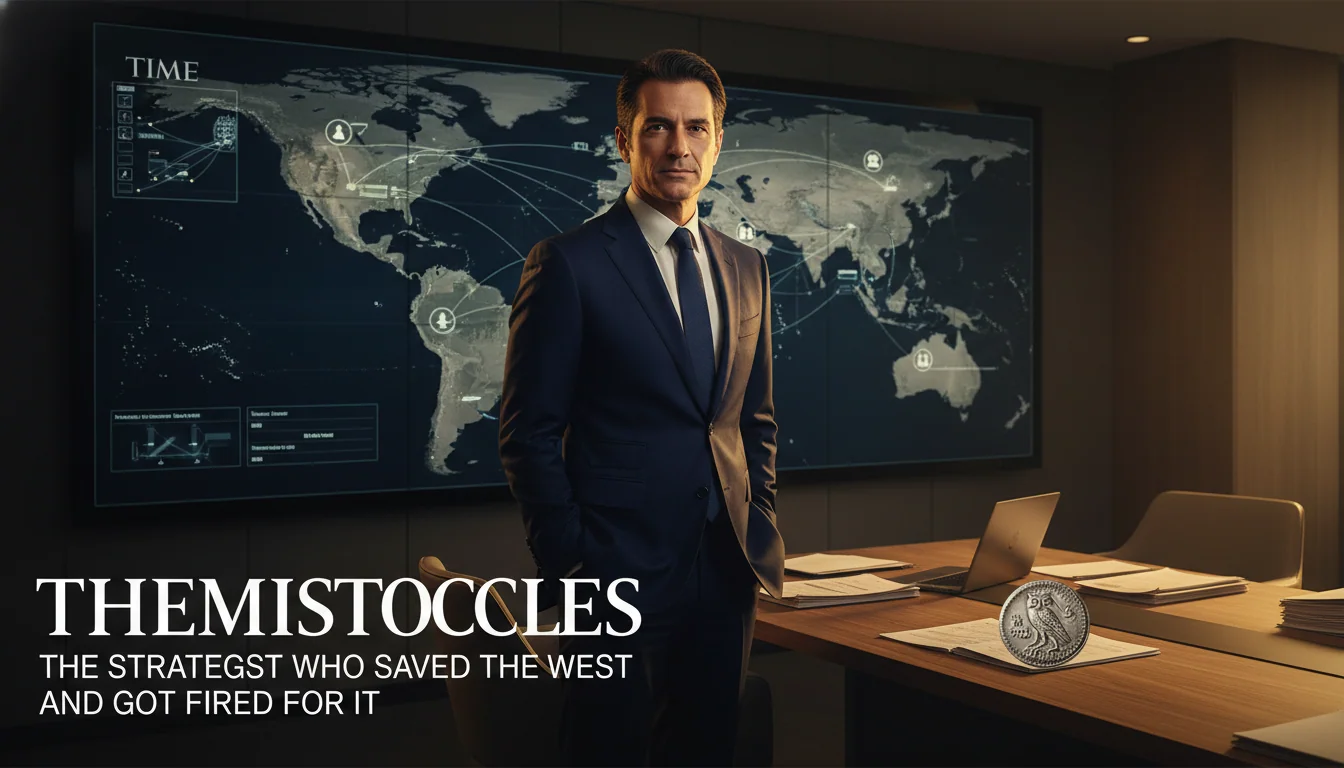
Every city, every era, produces the man who is right too early. Athens in 480 BC produced the most consequential version: a politician of relatively modest family origins who identified the single most dangerous enemy, built the military capability to fight it at a time when nobody believed it would be needed, won the decisive battle using intelligence manipulation and superior strategic positioning, and then got politically destroyed by the allies who owed him their survival.
Themistocles was not the best person Athens ever produced. He was arguably the most effective. Those are different categories, and the gap between them explains both why he saved the ancient Greek world and why Athens threw him out.
The historical figure
Themistocles was born around 524 BC. His father Neocles was an Athenian citizen; his mother's origins are disputed in the ancient sources, with some traditions suggesting she was not Athenian-born. This placed him outside the inner circle of the old landed aristocracy. He compensated with political intelligence and an instinct for public persuasion that his more distinguished colleagues consistently underestimated.
He served as archon, Athens' chief magistrate, around 493 BC. In that role, he began the fortification of the Piraeus, Athens' natural deep-water harbor. This was not the obvious pressing concern of the moment - Athens in 493 was absorbed by its own land politics and the aftermath of the first Persian invasion. Themistocles was already thinking about the second one.
The crucial moment came in 483 BC. Athens discovered a rich vein of silver at its mines in Laurion and faced the question of what to do with an unexpected windfall. The natural default was to distribute it directly to citizens as a democratic dividend. Themistocles persuaded the assembly to spend it instead on 200 new triremes. His stated enemy was the nearby island of Aegina, with whom Athens was at open war. His real calculation was Persia.
His interpretation of the Delphic oracle's "wooden walls" prophecy - that it meant the Athenian fleet rather than the literal wooden stockade around the Acropolis - was a masterpiece of strategic argument dressed as religious interpretation. He was probably not, himself, particularly devout. He understood that in a democratic city, major decisions require persuasive framing, and the oracle provided one.
The battle that mattered
In September 480 BC, with Xerxes' army burning Athens and the Persian fleet holding the Saronic Gulf in overwhelming numbers, Themistocles executed what is perhaps the most sophisticated act of strategic deception in ancient military history.
He sent a messenger - his household slave Sicinnus, according to Herodotus - to Xerxes with a false report: the Greeks were divided, planning to flee under cover of darkness, and Xerxes should commit his fleet to the straits of Salamis immediately to prevent their escape. The message was entirely fabricated. The Greeks were confused and argumentative, but they were not fleeing. By provoking Xerxes to commit his fleet to the narrow channel before dawn, Themistocles chose the battlefield.
Persian numbers, decisive in open water, became a liability in the confined straits where ships could not maneuver without colliding. The Greek fleet, smaller, lower, and crewed by men with everything to lose, destroyed the Persian naval force that day. Herodotus and Thucydides both identify Salamis as the turning point of the Persian Wars. The land battles at Thermopylae and Plataea were fought by Sparta. The naval engagement that actually decided the outcome was designed and won by Themistocles.
The modern role
Drop Themistocles into 2026 and he arrives as a former National Security Advisor. Not current - the ostracism happened, and in 2026 the ostracism was called a resignation amid allegations of unauthorized back-channel contacts that were never fully proved and never fully disproved. He lasted eighteen months in the role before the political enemies he had accumulated across two decades of being right about things they had dismissed maneuvered him out.
He is currently listed as Senior Fellow at a defense policy institute in Washington - a title that means nothing except that his phone still gets answered by people who matter. The actual work runs through a consultancy with four names on the door and no public client list. He has a small office in one city and a notional address in another.
He advised the government that built the capability he had recommended building years earlier - the program that had been called unnecessary, expensive, and strategically provocative - and which turned out, when the contingency everyone had been warned about materialized, to be exactly sufficient. His name appears in the relevant congressional testimony only in passing. The people in the room know.
After the resignation, three governments he had previously briefed against asked if he was available for consultations. He said yes to one of them. Predictably, it was the one that would have made his former colleagues most uncomfortable.
The skills that translate
The skill that made Themistocles dangerous in 480 BC was not military genius in isolation. It was the combination of strategic analysis with domestic political persuasion with operational deception - executed simultaneously, under pressure, with everything depending on getting all three right.
He could read an adversary's psychology well enough to predict that a message claiming Greek weakness would provoke exactly the response he needed. He could read a domestic political audience well enough to package a strategic capital allocation as a defensive measure against a local enemy while planning for a war nobody wanted to think about. He could implement a deception at the operational level while maintaining a public posture that revealed nothing.
In 2026, those three skills map cleanly onto strategic communication, adversary analysis, and influence operations. They are not unique to Themistocles. What was unique to him was the willingness to commit to a single decisive course of action before the threat was visible to the people he was trying to protect, and the political discipline to build the coalition that made it possible without revealing his actual reasoning until the fleet was already built.
He would be a poor social media presence - not because he lacks the instinct for it, but because everything he posted would be calculated to the millimeter, and that calculation would be visible, and visible calculation performs worse than visible emotion in the current environment. He has an account. He posts rarely. Every post is analyzed in graduate seminars on strategic communication, which he finds quietly satisfying.
The family
He marries for strategic advantage and makes no particular effort to disguise this. His partner is formidably competent in their own right, operates in an adjacent professional world, and finds the marriage useful for reasons symmetrical with his own. He is aware that domestic arrangement of this kind has a long classical precedent. He is aware that his children have opinions about his professional choices. He is also aware that his professional choices are not going to change.
He sees his family during the intervals between the international travel, the private consultations, and the appearances at conferences where his presence tells the audience something about who is still in the conversation. He is a better grandfather than he was a father, which is documented in the biographies of several historical strategists and is probably not a coincidence.
The ostracism
The classical ostracism was a formal Athenian mechanism: the assembly voted by scratching names on pottery shards, and the person who received the most votes left the city for ten years. The mechanism existed specifically to remove individuals considered too influential, whether or not they had done anything wrong. Themistocles was the most powerful man in Greece after Salamis. Athens could not tolerate that for long.
The 2026 equivalent is the inspector general referral that does not lead to prosecution, the congressional hearing that reveals nothing and implies everything, the reputation-management operation run by rivals who have finally accumulated enough political leverage. He knew it was coming. He had watched it happen to others. He arranged his departure before the final vote in a manner that allowed him to maintain, technically, that he had resigned on his own terms.
In the Persian parallel, he did not go to the adversary out of ideological sympathy. He went because that was where the most interesting remaining work was available, and because the people who had removed him had made it impossible to do interesting work anywhere else. Artaxerxes received him with evident satisfaction.
He was the most useful strategic asset Athens ever produced. Athens could not stop itself from throwing him away. This is not an unusual story. It happens in every era to the person who is right about the thing that everyone else wants to believe is wrong. The difference is that most of them do not end up governing a Persian city. Themistocles was, as in everything, an exceptional case. For related portraits of ancient strategists reimagined in modern terms, see Hannibal Barca and Napoleon.
Quick Answers
Common questions about this topic
Who was Themistocles?
Themistocles (ca. 524-459 BC) was an Athenian statesman and naval strategist who correctly identified Persia as Athens' existential threat, persuaded the Athenians to build a large fleet using silver windfall revenues, and engineered the Greek victory at the Battle of Salamis in 480 BC. He was later ostracized from Athens, convicted in absentia of treason, and died in exile as governor of a Persian-held city given to him by the Persian king Artaxerxes I.
Why was Themistocles ostracized?
Ostracism in Athens was not necessarily punishment for wrongdoing - it was a democratic mechanism for removing someone considered too powerful or dangerous. Themistocles' dominance after Salamis made him a target for rivals across the political spectrum, and he was ostracized around 471-470 BC. He was later convicted in absentia of treason with Persia, an accusation whose irony became complete when he subsequently fled to Persia and was welcomed there.
What made Themistocles an effective strategist?
Three things. First, he identified the correct long-term threat when Athenian politics was focused on different enemies. Second, he built the military capability to address it years before the threat fully materialized, persuading the Athenians to convert a silver windfall into 200 triremes. Third, at Salamis he combined deception operations with superior battlefield positioning to negate Persia's enormous numerical advantage in a single engagement.
What happened to Themistocles in Persia?
Themistocles was received by King Artaxerxes I, who was apparently delighted to have Athens' greatest strategist seeking asylum. He was given the city of Magnesia on the Maeander to govern, with revenues from two other cities as well. He reportedly learned Persian in a year. He died around 459 BC in Magnesia - Thucydides says of illness; later tradition holds he took poison rather than lead Persian forces against the Greeks he had spent his career defending.

Meet Them in Person
Chat with the historical figures behind these modern reimaginings.
Create your free account →No card required. Talk to anyone in history with 8 free credits a day. Some features require a paid plan.
Join the HistorIQly Club
Get smarter about the past.
Weekly stories, deep dives, and exclusive content straight to your inbox.