If Simon Bolivar Lived Today: The Liberator Who Would Lose the Peace
If Simon Bolivar lived today, he'd be the visionary populist who wins every campaign and can't govern any of them, the liberator of six countries who died broke at 47.
Read Wikipedia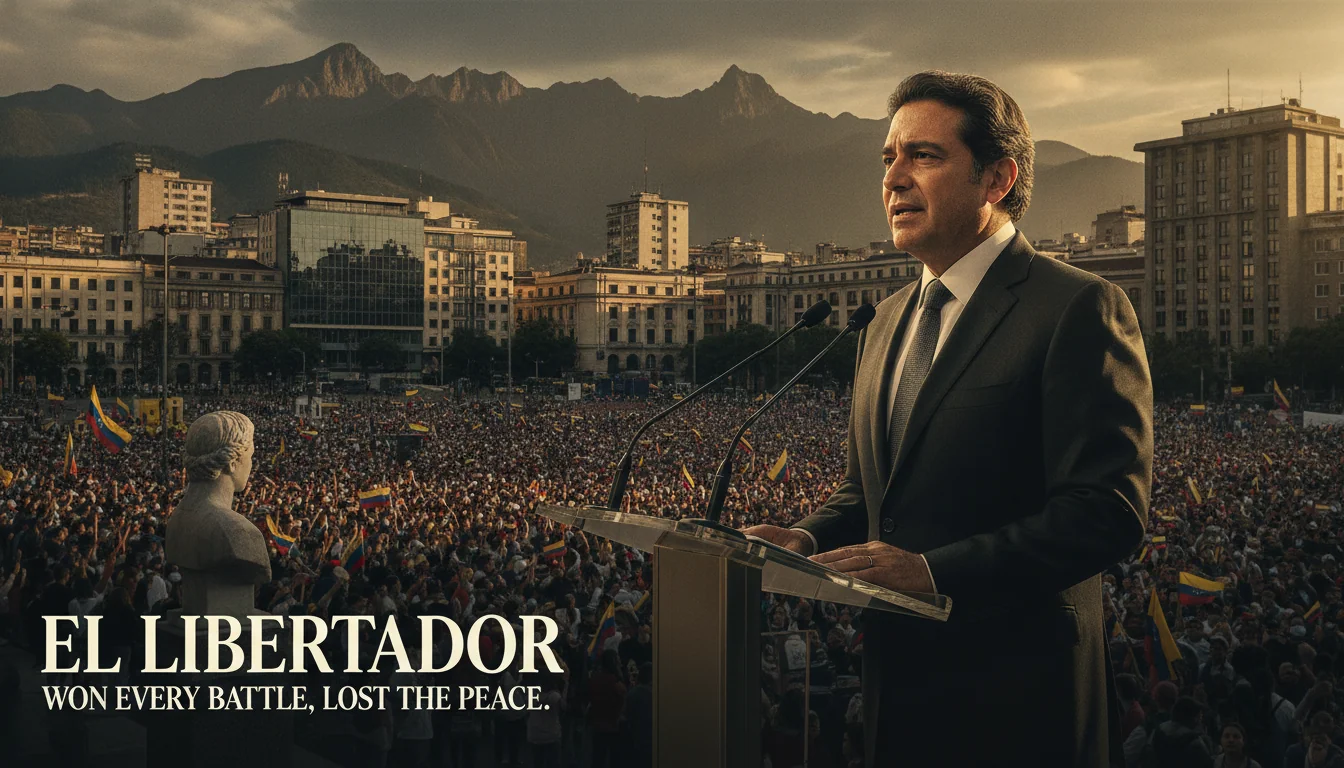
In the spring of 1830, Simon Bolivar wrote the sentence that has since become the most-quoted line in the biography of Latin American failure. He had just resigned the presidency of Gran Colombia, the transcontinental republic he had spent two decades building, after watching it begin to disintegrate. "America is ungovernable," he wrote. "Those who serve the revolution plow the sea."
He died eight months later, in a borrowed house in Santa Marta, Colombia. He was 47 years old. He had spent his family fortune on military campaigns, donated the lands he was granted as a national hero, and watched the five countries he liberated begin to splinter into competing factions within months of his stepping back. Bolivia, the country named in his honor, had already begun revising its constitution in ways he found intolerable. Venezuela had seceded from Gran Colombia. Several of the men he had trusted with armies had turned on him.
He was, in one of history's more specific ironies, correct about almost everything military and wrong about almost everything political.
The historical figure
Bolivar was born in 1783 in Caracas into one of the wealthiest Creole families in Venezuela. He was orphaned early - both parents dead before he turned nine - and raised by tutors and an uncle. One of his tutors was Simon Rodriguez, an eccentric intellectual who introduced him to Rousseau and the French Enlightenment. Bolivar absorbed these ideas with the intensity of someone who had the money, the social position, and the ambition to actually act on them.
He went to Europe in his late teens, married a Spanish noblewoman named Maria Teresa Rodriguez del Toro in 1802, brought her back to Venezuela, and watched her die of yellow fever within a year. He never remarried. Grieving, he returned to Europe and in Paris in 1804 watched Napoleon crown himself emperor, a spectacle that left him convinced monarchy was incompatible with republican principle. He later claimed he had sworn afterward to dedicate himself to the liberation of South America. This combination of personal grief and political ideology is too clean to be entirely trusted as biography - Bolivar was also a skilled self-mythologist - but the commitment itself was real.
What followed was one of the most sustained military campaigns in the history of the Western Hemisphere. Between roughly 1810 and 1826, Bolivar fought Spanish royalist forces across Venezuela, Colombia, Ecuador, Peru, and the territory that became Bolivia. He crossed the Andes with a ragtag army in 1819, emerged at the Battle of Boyaca to capture Bogota, and established Gran Colombia at the Congress of Angostura. He won at Pichincha in 1822 with his lieutenant Antonio Jose de Sucre doing much of the tactical work. The Battle of Ayacucho in 1824 - again largely Sucre's operational achievement - ended the formal Spanish military presence in South America.
He was not alone. Sucre did more of the actual battlefield command in the later campaigns than Bolivar's legend acknowledges. Francisco de Paula Santander administered Colombia competently while Bolivar campaigned. But Bolivar was the organizing vision, the political center, and the reputation that held the coalition together long enough for each campaign to succeed.
The problem became visible once the campaigns were over. Holding a coalition together to defeat a common enemy is a very different skill from holding one together once the enemy is gone and the only remaining question is who governs whom.
The modern role
If Simon Bolivar lived today, drop him into 2026 and he is a South American political leader who rose to continental prominence after a period of genuine instability - perhaps Venezuela, perhaps Colombia, most likely a country where the combination of resource wealth and political dysfunction created the conditions for a charismatic reformer to build an extraordinary coalition.
His election was real. His margin was large. His inaugural address was the best inaugural address in the region in a generation, quoted in European newspapers and circulated across Latin America on social media in dozens of translations. His program - continental economic integration, resource sovereignty, expansion of direct democracy, a new relationship between the state and the popular classes - won a mandate that looked, on election night, like a transformation.
Six months into his first term, the coalition is already showing its seams.
The Bolivar pattern, translated into contemporary politics, is consistent: he can build a coalition but cannot build an institution. He can win the campaign but cannot maintain the governing majority past the first crisis. His natural operating mode is crisis leadership - inspiring, decisive, capable of the dramatic gesture that holds disparate forces together when everything feels existential. In the ordinary pace of administration, his weaknesses become visible: impatience with procedure, irritation at criticism that he receives as betrayal, a tendency to solve institutional problems by concentrating power in his own hands rather than distributing authority downward.
He is not intellectually obtuse about this. He wrote constitutions for three different countries and understood theoretically what durable governance required. He knew the arguments for federalism, for separation of powers, for the institutional checks that make states last beyond their founders. He simply could not, in practice, subordinate his own judgment to structures that limited his ability to act quickly and decisively.
The gap between what he understood and what he did is one of the more poignant things about him.
What the modern Bolivar does wrong
His contemporary failures map directly onto his historical ones.
He alienates the federalists. His instinct is centralization: a strong executive, decisions made quickly at the top, implementation pushed downward. The regional power structures in his country - governors, local business interests, constitutional courts - want the opposite. He cannot find the synthesis, and when the normal channels resist him, his response is to work around them. Each executive decree that bypasses the legislature makes the next legislative confrontation harder. Each confrontation that he resolves by asserting presidential authority creates new opponents who were previously neutral.
He burns through allies. His relationship with his most capable lieutenants follows a recognizable pattern: intense collaboration during the campaign, growing tension as governing priorities diverge, eventual rupture that becomes personal and then public. He inspires loyalty and provokes envy in proportions that he does not manage skillfully, and the ambitious people who worked hardest to get him elected are often the first to decide that their future lies elsewhere.
He cannot leave. Bolivar resigned from public office three times in his career and returned each time because, he was told, only he could hold things together. The 2026 version does the same: announces retirements, accepts the calls to return, stays. This is not purely vanity. There is a genuine problem he is trying to solve. But the solution he reaches for - his own continued presence at the center - is exactly the solution that prevents the development of institutions capable of operating without him.
Where he lives and what he looks like
The 2026 Bolivar is in his early forties, physically striking, with the particular exhaustion of someone who has not slept adequately since the campaign began. He travels constantly across the continent, making the same speech in different registers to different audiences: reformer in Bogota, nationalist patriot in Caracas, continental visionary in La Paz. He adjusts the rhetoric without always noticing that the adjustments are being compared.
He gives extraordinary speeches. In genuine crisis his judgment is fast and often correct. The people around him - staff, allies, foreign observers who have spent time with him - consistently describe him as warm, genuinely curious, and capable of making every person he speaks to feel that their concern is the most important thing in the room.
He is also exhausting to work for. The standards are impossible and inconsistently applied. The gratitude, when it comes, is not proportionate to what has been asked. The criticism, when it arrives, is processed as disloyalty.
His most important relationship is with someone who manages his schedule, understands his enemies better than he does, and tells him things his official advisors will not. In the historical record this person is Manuela Saenz, the Ecuadorian revolutionary who traveled with him for the last eight years of his life and was present when an assassination attempt almost succeeded in Bogota in 1828. In 2026 the equivalent is a woman in a role with no formal title, whose judgment he trusts more than anyone else's and whose contributions are systematically undervalued by everyone around them.
What the famous line actually means
"Those who serve the revolution plow the sea." It is usually read as exhaustion or bitterness: a man who tried to build something and watched it come apart admitting, finally, that the project was impossible.
That reading is not wrong. But there is another way to hear it. Bolivar knew the sea would always need plowing. The question was whether the plowing produced anything - whether the effort, however futile in the specific political sense, changed the conditions for the people who came after. He believed, at the end, that it had. Gran Colombia collapsed almost immediately after his resignation. Venezuela, Colombia, Ecuador, and Bolivia were real countries that became functioning states, however imperfectly, in the decades and generations that followed.
The man who freed six countries and governed none of them successfully is not a simple failure. He is a specific kind of historical figure: someone whose skills were perfectly matched to the liberation phase and fundamentally mismatched to the consolidation phase. The revolution needed him and he won it. The republic needed something different and he could not provide it.
The 2026 version eventually publishes his memoirs. They are, by every account, brilliant and honest and too long. They do not resolve the central question, which is whether the man who wins the war has any business trying to win the peace.
He would say he did. He would probably be right about the war part.
For another figure whose spectacular political talents were matched to one precise moment and failed badly outside it, see if Alcibiades lived today, the Athenian general who mastered every situation except stability.
Quick Answers
Common questions about this topic
Who was Simon Bolivar?
Simon Bolivar (1783-1830) was a Venezuelan military general and statesman who is the most celebrated figure in South American independence from Spanish rule. He liberated present-day Venezuela, Colombia, Ecuador, Peru, and Bolivia - which was named after him - in campaigns spanning more than a decade. He served as president of Gran Colombia and briefly held simultaneous executive power in Peru and Bolivia.
Why did Bolivar fail politically?
Bolivar was a brilliant military commander and a genuine political visionary, but he could not translate either skill into durable governance. He centralized power in ways that alienated regional federalists, alienated allies who expected to share governance, and eventually imposed a quasi-monarchical Bolivian Constitution that scandalized the democrats who had fought alongside him. Gran Colombia fragmented during his lifetime and he resigned in 1830, deeply unpopular.
What was Gran Colombia?
Gran Colombia was the republic Bolivar established in 1819 at the Congress of Angostura, encompassing modern Venezuela, Colombia, Ecuador, and Panama. It was the most ambitious expression of his vision for a unified South American state. It lasted barely eleven years before Venezuela and Ecuador seceded in 1830, and Bolivar resigned before the dissolution was complete.
What modern figure does Simon Bolivar most resemble?
No single contemporary figure maps precisely, which is part of what makes Bolivar interesting. The failure mode - charismatic unifier who wins the liberation phase and cannot manage the governance phase - is not unique to him, but he lived it more completely than most. His career shadows certain 20th and 21st-century leaders who built transformational movements and found that the skills required to overthrow a system are not the skills required to run one.

Meet Them in Person
Chat with the historical figures behind these modern reimaginings.
Create your free account →No card required. Some figures and features require a paid plan.
Join the HistorIQly Club
Get smarter about the past.
Weekly stories, deep dives, and exclusive content straight to your inbox.