If Joan of Arc Lived Today: The Teenager Who Would Break Every Algorithm
What would happen if Joan of Arc lived today? A 17-year-old peasant girl who convinced a collapsing monarchy to give her an army - and used it to win.
Read Wikipedia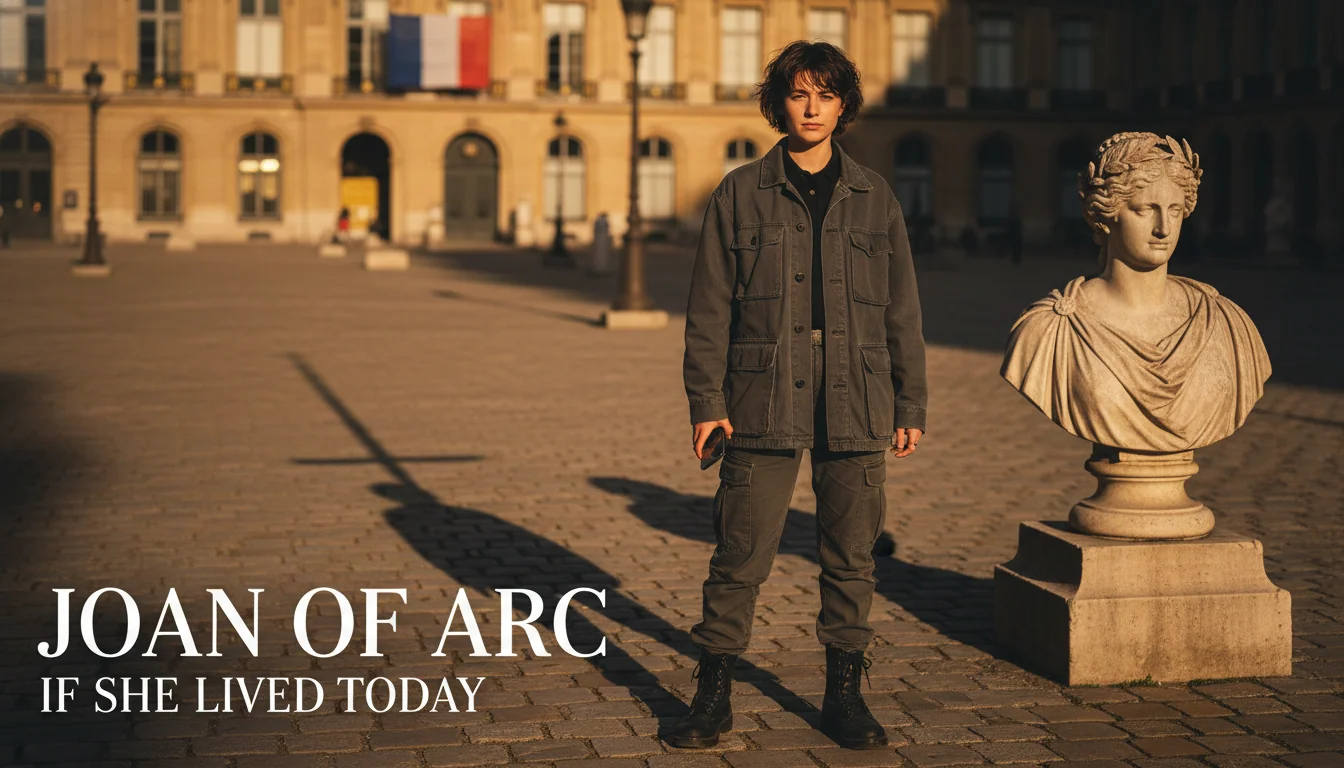
Jeanne Darc was born around 1412 in Domremy, a village in the Duchy of Bar on the eastern edge of France, to a farmer named Jacques d'Arc and his wife Isabelle. She was illiterate. She tended animals. She had never left her village for anything significant. She was approximately 17 years old when she walked into the castle at Chinon and told the heir to the French throne that God had instructed her to relieve the siege of Orleans and see him crowned.
He gave her the army. She lifted the siege in nine days. Seven weeks later, Charles VII was crowned King of France at Reims.
Drop that sequence into 2026 and every institution in the Western world fails her in the same order.
The historical figure
Joan began hearing voices at approximately age 13 that she identified as St. Michael, St. Catherine of Alexandria, and St. Margaret of Antioch. The voices grew more insistent as France's military situation deteriorated. By 1428, the English and their Burgundian allies had besieged Orleans, the last major city blocking their push into southern France. The Dauphin Charles, lacking a coronation and lacking an effective army, was widely expected to lose his kingdom.
Joan traveled to the royal court at Chinon in January 1429, was initially dismissed, and was admitted to Charles only after persistent requests. She reportedly said things to him in private - possibly relating to a prayer he had made, possibly a identification of him in a crowd while he disguised himself - that convinced him she had unusual access to divine information. He ordered a theological examination of her in Poitiers. The examiners found no heresy and recommended allowing her to proceed.
She was given armor, a horse, a banner, and a place in the relief army heading for Orleans. She arrived outside the city on April 29, 1429. By May 8 the English siege was broken. Joan had correctly identified and insisted on a direct assault on the main English fortification, the Tourelles, over the objections of experienced commanders who wanted a more cautious approach. The direct assault worked.
The Loire campaign that followed swept English positions from Jargeau, Meung-sur-Loire, Beaugency, and Patay in rapid succession. At Patay, the English archers who had devastated French cavalry at Agincourt fourteen years earlier were caught before they could plant their defensive stakes and were routed by a frontal cavalry charge. Joan had urged speed and pressure throughout. The experienced commanders, again, had wanted to wait.
Charles VII was crowned at Reims on July 17, 1429. Joan was there, holding her banner.
She was captured by Burgundian forces at Compiegne on May 23, 1430, sold to the English, and tried at Rouen under a bishop, Pierre Cauchon, who was politically aligned with the English occupation. The charges were primarily heresy and wearing men's clothes. She was burned at the stake on May 30, 1431, aged approximately 19. A second Church trial in 1456 found the original proceedings corrupt and reversed the verdict. She was canonized in 1920.
The 2026 version
She is born around 2007 in a village in the Vosges department, close to the original Domremy, to a family that is practicing Catholic in a region where active church attendance has become unusual. She grows up athletic, stubborn, and somewhat outside the social mainstream - not because she is awkward but because she finds most of the things her peers consider important transparently unimportant.
At 13 or 14 she begins experiencing what she calls voices, or something closer to an extremely strong, persistent inner conviction with a sensory dimension she finds hard to describe. The voices are not frightening. They are instructions.
Her parents take her to a GP. The GP refers her to a psychiatrist. The psychiatrist is careful, thorough, and noncommittal. The voices are consistent and purposeful, not fragmented or command-based in the clinical sense that would clearly indicate psychosis. She passes every structured mental status exam. She is not prescribed medication because there is no clear diagnosis to treat. She goes home with a follow-up appointment she does not attend.
The viral moment
By 16 she has an Instagram account and a TikTok account, both managed with the unselfconscious confidence of someone who is not thinking about metrics. She does not post makeup tutorials or dance challenges. She posts about French history, military history, the state of the French army, and what she believes is a specific calling she has received. The content is unusual enough to attract shares.
The viral moment comes when she posts a seven-minute video, filmed in a field near Domremy, laying out a detailed argument about the strategic situation facing France in a specific geopolitical context she will not fully explain. The video gets 4 million views in three days. The comments divide immediately into three categories: people calling her extraordinary, people calling her mentally ill, and people calling her a political operative for one faction or another. She is none of these things, which makes the situation worse.
French political parties attempt to claim her. She declines. Catholic institutions express guarded interest. She is polite. Secular journalists write pieces arguing that her certainty is dangerous. She ignores them with a serenity that reads as either profound self-assurance or spectacular dissociation, and historians who know her source material well will recognize the quality immediately.
What the establishment does with her
At 17 she requests a meeting with a senior government official. She is refused. She requests again. She is refused again. She finds a way through an intermediary - a local politician sympathetic to her views - and gets twenty minutes with someone in a position to act. She says something in that meeting, something specific and verifiable that the official had not made public, and the official authorizes the next step.
This is precisely what happened at Chinon. Charles tested her with a disguise. She passed. The mechanism of institutional adoption in 1429 was a private conversation in which she demonstrated she had information she could not have had by ordinary means. The 2026 equivalent is structurally identical, just faster.
She is not given an army. The French Republic does not give teenagers armies. But she is given access, and access in 2026 is power.
The skills that translate
Her tactical instinct was her most documented and least mystified quality. At Orleans, at Patay, in her insistence on moving quickly toward Reims rather than consolidating - she consistently advocated the aggressive option and was consistently right. Historians have speculated about whether she was receiving better intelligence than the established commanders (she was popular with the common soldiers and may have had better local information networks), or whether she had an intuitive grasp of the difference between what an army could do and what cautious generals imagined they could do.
In 2026, this translates to strategic directness in any institutional context: the refusal to confuse procedure with effectiveness, the ability to identify the key obstacle and address it rather than the peripheral concerns surrounding it. These are rare skills. They are not supernatural skills.
Her physical courage was documented repeatedly by contemporaries who watched her hold her banner above the fighting at Orleans while being wounded by an arrow to the shoulder and return to the field the same day. In 2026 she is probably athletic, physically capable, and unafraid of situations that would paralyze most people her age. This, combined with the strategic clarity, makes her genuinely useful in ways that are hard to explain to anyone who meets her first at a meeting.
What goes wrong
She is 19 when the institutional calculus shifts. The people who adopted her for their purposes have what they wanted. She has opinions that go beyond the original commission. She makes statements they cannot control. She does things without authorization because she believes the authorization was implicit in everything she was allowed to do earlier.
The Burgundians sold her to the English in 1430 because she had become an asset-turned-liability to everyone except the French common soldiers, who had no purchasing power. The 2026 equivalent is not a sale. It is abandonment. The calls stop being returned. The platforms that amplified her find new controversies. The official who gave her access is no longer in that position.
The trial in 2026 is not a heresy proceeding in a Rouen courtroom. It is a media cycle and a parliamentary inquiry. The charge is not wearing men's clothes. It is "making unsubstantiated claims" and "operating without appropriate institutional oversight." The framing is clinical rather than theological. The effect is the same.
Why it matters
Joan of Arc's story persists not because she was a saint - she was canonized five centuries after her death, which suggests the Church took its time on the evidence - but because she is the clearest example in Western history of what happens when an institution briefly allows someone outside the normal credentialing system to act on their actual capabilities.
She was right about Orleans. She was right about Reims. She was right about the urgency of pace when her commanders wanted to delay. She was burned at the stake anyway, because the institution that used her found her harder to manage than expected and the institution that opposed her found her dangerous.
The 2026 version would not be burned. She would be managed, archived, and occasionally cited in opinion pieces about the nature of conviction. Her Wikipedia page would be long and contested. The sentence about what she actually accomplished would be in the third paragraph.
For other historical figures reimagined in the modern world, see If Napoleon Lived Today and If Catherine the Great Lived Today.
Quick Answers
Common questions about this topic
Who was Joan of Arc?
Joan of Arc (c. 1412-1431) was a French peasant girl from Domremy who, at approximately age 17, convinced the French Dauphin to give her command of a relief force for the besieged city of Orleans. The siege was lifted in May 1429, and the Dauphin was crowned Charles VII in July. Captured by Burgundians in 1430, she was sold to the English, tried for heresy at Rouen, and burned at the stake in May 1431, aged approximately 19. She was rehabilitated posthumously in 1456 and canonized in 1920.
What made Joan of Arc historically extraordinary?
Three things in combination: she was female, illiterate, and a peasant who nonetheless convinced trained military commanders to follow her tactical decisions - and those decisions produced results. The siege of Orleans had resisted professional French forces for months before she arrived. She lifted it in nine days. The French Loire campaign that followed secured the coronation at Reims. Her impact was not rhetorical; it was operational.
Would Joan of Arc's voices be diagnosed as a mental illness today?
Modern psychiatrists have proposed various frameworks - including schizophrenia, epilepsy with religious hallucinations, and dissociative disorder - but several have also noted that her voices were consistent, purposeful, and gave her specific actionable instructions rather than incoherent commands. The debate is ongoing. What is documentable is that she passed multiple medieval Church examinations of her mental fitness before being given command. Her examiners found her clear-headed, not delusional.
Who is Joan of Arc's closest modern equivalent?
There is no clean modern equivalent because no contemporary figure combines her specific mix: teenage girl, rural background, religious conviction expressed as military strategy, institutional adoption followed by institutional betrayal, posthumous rehabilitation. The closest structural parallels are young women who drove institutional change against expert resistance - but Joan's case was military, not political or cultural, which makes it genuinely without precedent in modern life.

Meet Them in Person
Chat with the historical figures behind these modern reimaginings.
Create your free account →No card required. Some figures and features require a paid plan.
Join the HistorIQly Club
Get smarter about the past.
Weekly stories, deep dives, and exclusive content straight to your inbox.