If Empress Wu Zetian Lived Today
Wu Zetian modern: the only woman to rule China as emperor would now run a data platform, using the same information asymmetry and patron networks that worked in 690 AD.
Read Wikipedia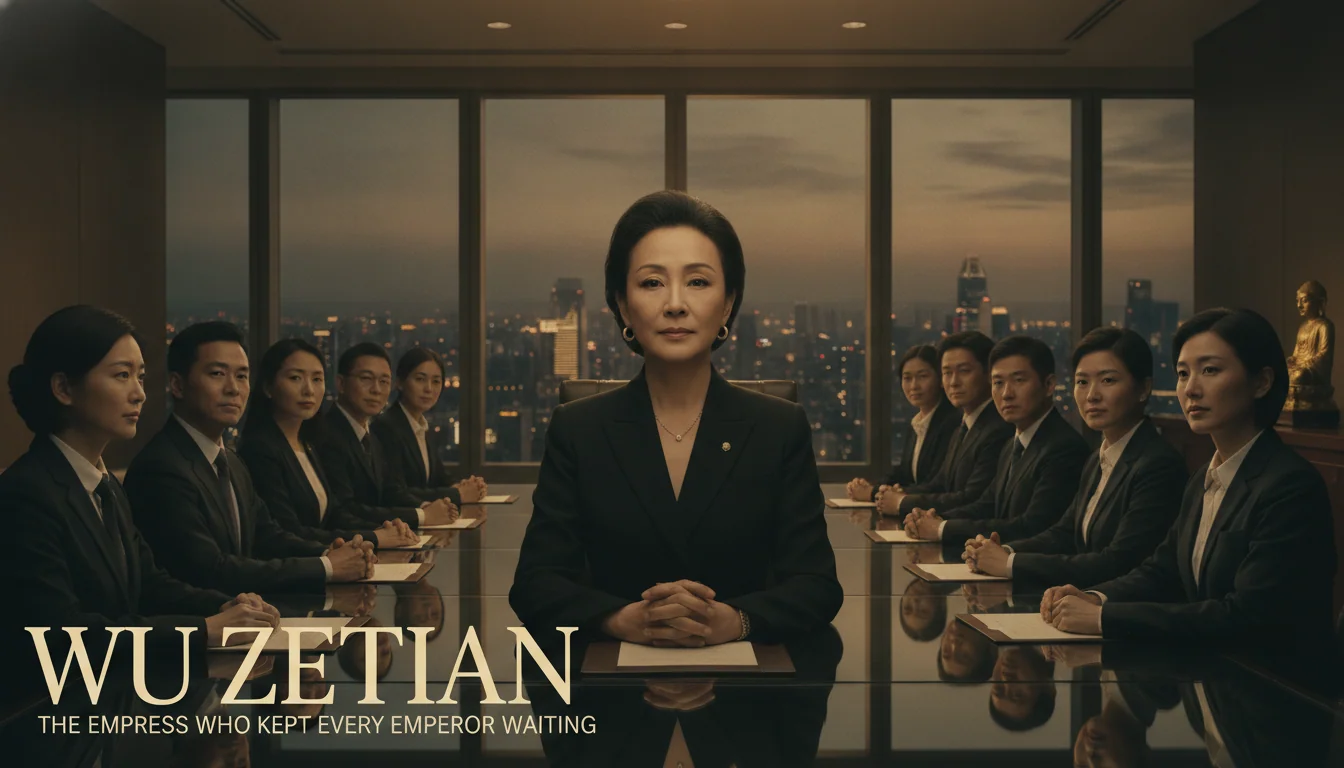
Wu Zetian entered the imperial court at fourteen as a concubine of the Tang emperor Taizong, which was by the conventions of 7th-century China approximately the ceiling of what a merchant's daughter could hope for. By the time she was eighty, she had outlasted four emperors, founded her own dynasty, and spent fifteen years as the unchallenged ruler of the largest empire on earth. She accomplished this through a combination of administrative genius, strategic patience, ruthless elimination of enemies, and a talent for information control that the 21st century has mostly just automated.
She would not find 2026 difficult to navigate. She would find it unusually well-suited to her skills.
For more figures who would thrive in 2026 for reasons that say something uncomfortable about 2026, see If Genghis Khan Lived Today and A Time Traveler's Guide to Tang Dynasty Chang'an, 750.
The woman who would not leave
The custom was straightforward. When an emperor died, his concubines went to a Buddhist nunnery for the rest of their lives. Wu Zetian had entered the court of Emperor Taizong probably around 638 AD. When Taizong died in 649, the 24-year-old Wu was supposed to disappear into religious seclusion and stay there.
Instead she had already developed a relationship with Taizong's son and successor, Emperor Gaozong - a breach of Tang propriety so serious it required genuine nerve to pursue. By 651, she was back at court. By 655, she had engineered the removal of the sitting Empress Wang and Gaozong's favorite consort, clearing the path to become empress consort herself. The means by which she accomplished this disposal were, in the historical accounts that followed, darkly contested: accusations of witchcraft, political manipulation, and perhaps worse. Her enemies wrote the accounts, so the darkness is partly their projection. The outcome, however, is documented.
She had decided the rules did not apply to her, assessed the cost of that decision, and concluded it was acceptable.
How she actually ran things
As Gaozong's health declined through the 660s and 670s, Wu took on more of the empire's administrative work. By the time Gaozong died in 683, she had been effectively governing for years. She ruled as regent for two sons in succession, deposing the first within months and managing the second into irrelevance. In 690, she declared herself emperor of a new Zhou dynasty.
The institutional innovation she used to consolidate power was genuinely important and is often underrated in accounts that focus on the court intrigue. Wu expanded the imperial examination system. This was China's system of competitive testing for government positions, a meritocratic counterweight to the aristocratic network of hereditary office-holders who otherwise dominated Tang governance. By giving more examinations, opening more categories, and elevating more scholars from common backgrounds, Wu built a bureaucracy that owed its positions directly to her patronage rather than to clan connections that predated her.
She also built a surveillance apparatus. The Secret Censor system recruited ordinary people to report suspicious behavior. Two officials in particular - Lai Junchen and Zhou Xing - became notorious for conducting investigations in which denunciations produced confessions and confessions produced executions. "Please enter the jar" is still a Chinese idiom: Zhou Xing reportedly invented the interrogation technique of placing someone near a jar of burning coals, and Lai Junchen eventually used the technique on Zhou Xing himself.
Wu used the apparatus and eventually dismantled its most egregious practitioners when they became liabilities. She was not sadistic. She was pragmatic, which in some circumstances is more dangerous.
The modern equivalent
In 2026, Wu Zetian does not run a country directly. That would be too visible, too exposed to the constraints of modern democratic accountability that she would find merely tactical rather than genuinely binding, but constraints nonetheless.
She runs a platform.
The analogy is not frivolous. The institution she actually built was an information asymmetry: she knew what everyone else was doing and they did not know what she knew. The examination system was a talent pipeline she controlled. The surveillance network was a threat she could activate selectively. The Buddhist temples she patronized - she commissioned magnificent construction projects including cave sculpture complexes at Longmen in Henan province - served simultaneously as genuine religious expression and as public legitimacy, the 7th-century version of high-profile philanthropic donations.
Modern Wu runs the kind of operation where she controls the infrastructure that other powerful people depend on, which means she has leverage over them without appearing to threaten them. She is perhaps the head of a data analytics company whose real clients are governments. She is perhaps the executive who built the software that every major institution now uses for internal communications. Whatever the specific business, the key feature is the same: she knows more about the people she deals with than they know about her, and she has built the knowledge advantage deliberately over decades.
She is based in Singapore, which offers the combination of rule of law, strategic geographic position, and political stability she would have recognized as optimal from the Tang dynasty's position in Central Asia. Possibly Beijing, if the political winds are right. Not a democracy. She finds the time horizons of democratic politics exhausting.
Social media and public presence
Minimal, managed, and terrifyingly effective.
Wu Zetian's public image during her own reign was carefully constructed around Buddhist piety and the rhetoric of good governance. She commissioned texts that identified her as a Bodhisattva. She gave herself a new personal character - a new written character to serve as her name, one she invented, meaning something like "radiance over the void." She controlled her own iconography.
Modern Wu has a sparse LinkedIn that has 50,000 followers without a single personal post. Her company's communications team produces a quarterly thought-leadership piece under her name that says nothing controversial and is nevertheless widely read. She gives one interview per year, always to a publication she has some relationship with, always staying on a message so tightly controlled that critics can find nothing to grab.
She has read everything the platforms know about influencing public opinion and has concluded that the most powerful position is slightly off the stage, close enough to be consulted, far enough to maintain optionality. The people she talks to in private are considerably more important than the people who know her name publicly.
The family arrangement
Her relationship history would generate articles. She was married once, to the Emperor Gaozong, a man who was considerably less politically astute than she was and who she appears to have genuinely cared for while also comprehensively outmaneuvering. She had children - four survived to adulthood - who occupied an uncertain position in the court, alternatively elevated and margined depending on what political situation required.
Modern Wu has a partner who is accomplished in a completely separate field and who has learned the exact right things to say at events and nothing else. Her children work in the family enterprise in positions that are real enough to be credible and not prominent enough to become targets. She is not sentimental about the arrangement in public. In private she is apparently considerably more complicated, but no one outside the immediate circle has ever confirmed this.
The peer she most resembles
The contemporary figure whose career arc most closely mirrors Wu Zetian's is not a woman. It is the type of person - regardless of gender - who enters an existing institution at a relatively low level, spends years making themselves indispensable to the person at the top, and then outlasts them through a combination of competence and patient positioning.
Wu Zetian's version of this involved concubinage and a Tang dynasty court, which are not replicated circumstances. But the underlying dynamic - the person who holds real power through knowledge, network, and institutional leverage rather than through the nominal position on the organizational chart - is recognizable in most organizations of significant size.
Her talent was that she was actually very good at the job. The empire she ran was, by most measures, competently administered. She had good generals, capable ministers, and a functional tax system. She was not only a political operator; she was also a genuine manager of a continent-scale enterprise. In the modern world, that combination - real operational competence combined with extraordinary political skill - is rare, and it is what distinguishes a genuine power player from a mere schemer.
The thing that would trip her up
Wu Zetian held power until 705 AD, when she was approximately eighty years old and a palace coup forced her to abdicate in favor of her son. The coup succeeded largely because she had aged into genuine incapacity, and the ministers and generals who had supported her concluded that the dynasty's stability required a transition before she died in power.
In 2026, she would face a version of the same problem slightly earlier. The modern business and political environment has shorter time horizons and more formal succession structures than a 7th-century imperial court. The examination system that she used to build loyal bureaucracy from commoners has been replaced by professional class norms that create their own aristocracy, one based on educational credentials rather than family lineage but no less self-perpetuating.
She would find that the meritocratic tools she invented have been absorbed into the system she was trying to circumvent. The platform she built would have a board. The board would eventually want a succession plan. And at some point, the information asymmetry she spent decades constructing would start to erode because the people around her would have had time to build their own.
She would handle the transition with characteristic control, departing on her own terms rather than anyone else's, having ensured that the structure she built would outlast the person who built it. That was always what she was actually building.
The garden in paradise would still be hers, even after she left.
Quick Answers
Common questions about this topic
Who was Wu Zetian?
Wu Zetian (624-705 AD) was the only woman in Chinese history to rule as emperor in her own name. She entered the court as a concubine of Emperor Taizong, eventually became empress consort under his son Emperor Gaozong, then regent, and in 690 AD declared herself the founding emperor of the Zhou dynasty. She held power until 705 AD.
How did Wu Zetian come to power?
Wu Zetian maneuvered her way from imperial concubine to empress through a combination of political intelligence, strategic alliances, and ruthless elimination of rivals. She cultivated relationships with Buddhist institutions, expanded the merit-based imperial examination system to build a loyal bureaucracy from commoners rather than aristocrats, and created a network of informants to monitor the court.
Was Wu Zetian a good ruler?
By most historical assessments, Wu Zetian was an effective ruler. She expanded the territory under Tang-Zhou control, modernized the bureaucracy, promoted able officials regardless of birth, and maintained political stability for decades. She was also capable of extreme violence against political rivals and used secret police extensively. Chinese historians have debated her legacy for centuries.
What dynasty did Wu Zetian found?
Wu Zetian declared herself the founding emperor of the Zhou dynasty in 690 AD, deliberately invoking the ancient Zhou dynasty to claim historical legitimacy. The Zhou dynasty lasted only as long as her reign. When she was forced to abdicate in 705 AD, the Tang dynasty was restored under her son.

Meet Them in Person
Chat with the historical figures behind these modern reimaginings.
Create your free account →No card required. Talk to anyone in history with 8 free credits a day. Some features require a paid plan.
Join the HistorIQly Club
Get smarter about the past.
Weekly stories, deep dives, and exclusive content straight to your inbox.