The Lake Lanier Curse: America's Deadliest Reservoir and the Town That Wouldn't Stay Buried
The Lake Lanier curse explained: beneath Georgia's deadliest reservoir sits a drowned town and a history of racial violence that TikTok turned into a ghost story.
Read Wikipedia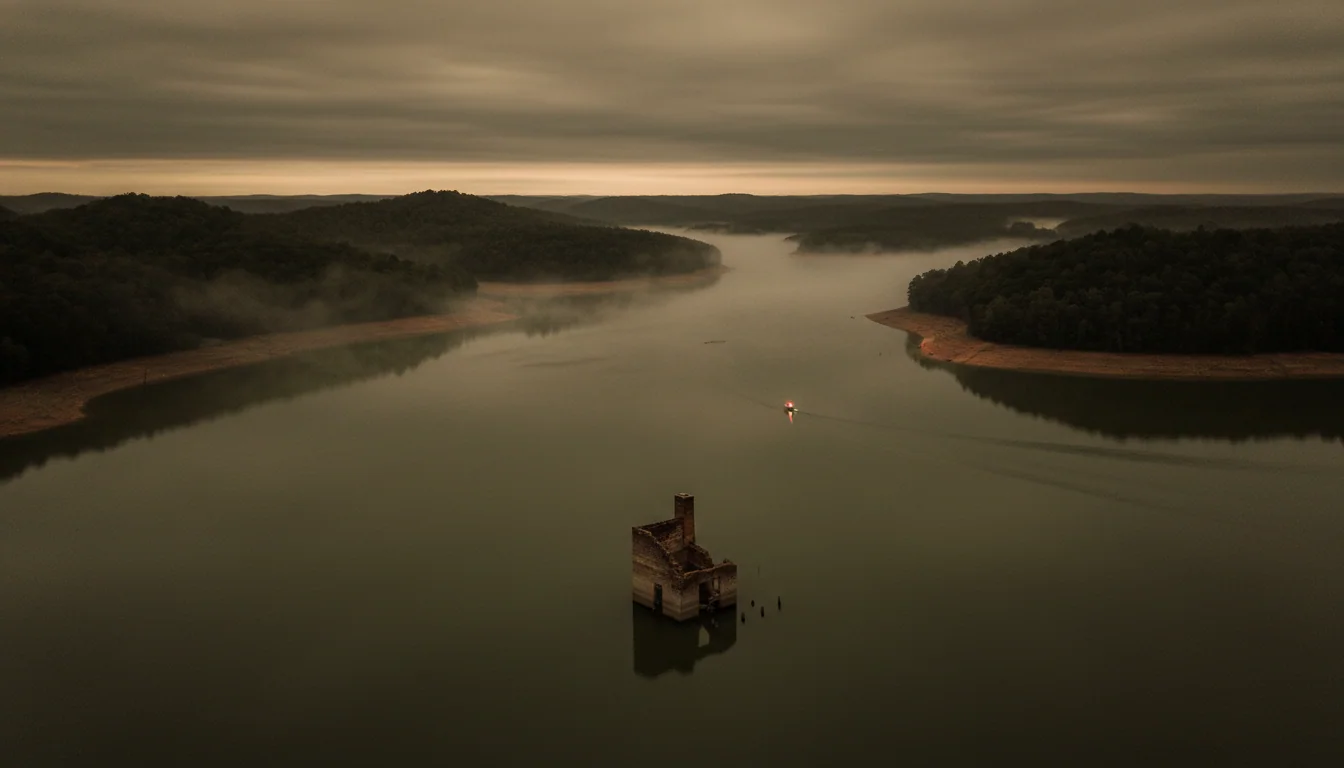
Lake Lanier is thirty-eight thousand acres of Georgia reservoir sitting in the foothills of the Blue Ridge Mountains, and it kills people with unusual consistency. The Army Corps of Engineers completed Buford Dam in 1956, the lake filled, and somewhere between ten and twenty people drown there every year - a toll that has kept it on lists of America's deadliest recreational lakes for decades. Since 2021, TikTok has added the word "curse" to every mention of it. The curse is a modern invention. The history underneath the water is real, and considerably darker.
The flooding
The Buford Dam project was authorized by Congress in 1946 and completed in 1956. Its stated purposes were flood control, hydroelectric power for the Atlanta metropolitan area, and water supply. What it required, as reservoir projects always do, was the displacement of everyone living in the flood zone.
The Chattahoochee River backed up behind the dam and slowly swallowed the bottomlands of Hall and Forsyth counties. Roughly 700 families were relocated. Roads, bridges, cemeteries, churches, and the remnants of several small communities went underwater. The lake was named after an antebellum resort called Lake Lanier, itself named after the 19th-century Georgia poet Sidney Lanier, who had no particular connection to the drowned communities.
The most historically significant of those communities was Oscarville, a small settlement in Forsyth County. What happened in Oscarville in September 1912 is not a ghost story. It is documented history.
Forsyth County, 1912
On September 9, 1912, an 18-year-old white woman named Mae Crow was found unconscious and badly injured near her home in Forsyth County. She died of her injuries on September 18. Two Black men, Ernest Knox and Oscar Daniel, were arrested, charged, and convicted in trials that lasted a matter of hours. Both were publicly hanged before crowds of hundreds in Cumming, Georgia.
The murder did not end the violence. It ignited it. Between September and November 1912, white mobs systematically drove out nearly every Black resident of Forsyth County - burning homes, threatening families, and attacking those who did not leave fast enough. A community of approximately 1,100 Black residents, some of whom had farmed Forsyth County land for generations, was effectively erased within weeks.
The county remained almost entirely white for the next seventy years. In 1987, civil rights organizer Hosea Williams led a march through Cumming to protest the county's continued demographic exclusion. The marchers were pelted with rocks and bottles by counter-protesters. A larger follow-up march, with some 20,000 participants including Coretta Scott King, completed the route. The event drew national attention and became a landmark in the later civil rights movement. Patrick Phillips documented the full history in his 2016 book Blood at the Root, drawing on local archives and family accounts that had largely been suppressed.
Oscarville, by the time the lake filled, was home to some of the same families - or their descendants - who had displaced the expelled Black community in 1912. The lake erased them in turn, impersonally and legally, for a federal infrastructure project.
What is actually underwater
The drowned communities included homes, barns, wells, road beds, and at least two dozen cemeteries, some of which were relocated before flooding and some of which were not. The Army Corps documented roughly 800 graves in the flood zone. How many were actually moved is disputed; some headstones were left in place and are visible in shallow water during drought years when the lake level drops.
This is the part that TikTok gets factually right, in the sense that it is not invented. There are structures underwater. There are old roads. Drought years occasionally expose foundations. Swimming over submerged building remnants, old fence posts, and tree stumps is not supernatural, but it is genuinely disorienting, and the submerged hazards are a documented contributing factor in drowning deaths.
The drowning statistics
Lake Lanier receives roughly 10 to 12 million visitors annually, making it one of the most visited lakes in the United States. That volume alone would produce a meaningful number of drowning incidents. What makes its statistics stand out is the particular combination of hazards the lake presents.
The lake reaches depths of up to 150 feet in its main channel but is shallow and irregular along much of its extensive shoreline. Drop-offs are abrupt and often unmarked. Water temperature stratifies sharply, with warm surface water sitting over significantly colder water below; a swimmer who capsizes or dives deep can experience cold-shock and incapacitation within seconds.
The submerged forest of drowned trees and building remnants catches boat propellers and, in some cases, entangles swimmers. Boating traffic is heavy enough to create genuine risk for swimmers who enter the water far from marked areas. And alcohol is involved in the majority of Lake Lanier drowning incidents - a statistic the Army Corps has documented repeatedly in public safety campaigns going back decades.
None of this requires a curse. It requires a very large, very busy lake with abrupt underwater geography, cold deep water, submerged hazards, heavy boat traffic, and seasonal visitors who are unfamiliar with any of the above.
The curse narrative's real effect
What the TikTok curse narrative does - and this is where it becomes worth examining - is both illuminate and obscure the actual history. The framing that Lake Lanier is "cursed because of what happened there" creates a causal link between the 1912 racial cleansing and the drowning deaths. That link is emotionally resonant but factually indefensible. People drown at Lake Lanier because of its physical characteristics, not because of retributive geography.
But the framing has an unintended consequence: it has introduced hundreds of thousands of people to the history of Forsyth County who would otherwise never have encountered it. The county's racial cleansing, the 1987 march, the enduring demographic imbalance - these stories circulated in academic and civil rights history and in Atlanta-area journalism, but they were not widely known nationally until TikTok attached them to a viral mystery.
Historians who study Forsyth County have noted this effect with some ambivalence. The attention is real. The mechanism is fictional. People who arrived looking for a ghost story sometimes stayed for the history.
What is not underneath
One persistent piece of Lake Lanier mythology holds that the lake retains drowned victims through underwater currents or structures, trapping bodies that never surface. The image is effective horror. It is not supported by evidence.
The Army Corps of Engineers and Georgia water-safety authorities have documented that the vast majority of drowning deaths at Lake Lanier result in recovered bodies, typically within days. The few unrecovered cases over the lake's history reflect incidents in very deep water during conditions that impeded search operations - not a systematic pattern of bodies detained by submerged geography.
The specific claim that drowned victims "rise up from the town" is anatomically backward. Drowning victims sink initially, then rise as decomposition produces buoyant gas - in most water temperatures within days to two weeks. There is no mechanism by which a submerged structure would hold a body down permanently. The drowned town does not collect the dead.
What remains
Lake Lanier is a beautiful reservoir in the Georgia mountains, heavy with recreational traffic on summer weekends, quiet and clear in winter. In a drought year, you might see a chimney foundation or a stone wall exposed near the waterline. If you swim in it, you should pay attention to drop-offs, temperature changes, and the distance back to shore.
Below the surface, there is genuinely a history of American racial violence, community displacement, and the bureaucratic indifference to what gets submerged when federal infrastructure is built. That history did not create the lake's drowning toll. But it is the actual reason the lake deserves more than a ghost story.
Mae Crow was murdered in 1912 and her murder was used to destroy a community. Ernest Knox and Oscar Daniel were executed for it in proceedings too thin to reconstruct reliably. The families driven out of Forsyth County in 1912 built lives elsewhere. Their former homes were eventually flooded by the same government that had failed to protect them from the violence in the first place.
The lake does not remember any of this. The historical record does, barely, because people like Patrick Phillips spent years finding it. That record is the reason to pay attention to Lake Lanier - not the drowning count, and not the curse.
For other American cold cases where geography and history intersect, see The Texas Killing Fields and the Smiley Face Killers Theory.
Quick Answers
Common questions about this topic
Why is Lake Lanier considered cursed?
Lake Lanier was created by flooding several Georgia communities in 1956, including the town of Oscarville, site of a 1912 racial cleansing in which Black residents of Forsyth County were violently expelled. The lake has a high annual drowning toll - sometimes among the worst in the United States per surface area - which TikTok and true-crime media have framed as a supernatural curse. Statistically, the deaths are explained by shallow drop-offs, submerged structures, heavy recreational traffic, and alcohol.
What town is under Lake Lanier?
Several communities were flooded when the Buford Dam backed up the Chattahoochee River in the mid-1950s, but the most significant was Oscarville, a small settlement in Forsyth County, Georgia. Oscarville was the site of a September 1912 racial cleansing following the murder of a white teenager, after which Forsyth County's entire Black population was driven out by violence and intimidation.
How many people have drowned in Lake Lanier?
From its opening in 1956 through the mid-2020s, Lake Lanier has recorded well over 700 drowning deaths, making it one of the deadliest recreational lakes in the United States. The annual toll typically runs 10 to 20 deaths, with spikes on holiday weekends when alcohol use is highest. The Army Corps of Engineers cites submerged hazards, temperature stratification, and lack of swimmer training as primary causes.
Was Forsyth County really all-white after 1912?
Yes. Following the 1912 expulsion, Forsyth County remained essentially all-white for roughly 75 years. A 1987 civil rights march organized by Hosea Williams to draw attention to the county's continued segregation was attacked by counter-protesters. A larger follow-up march with some 20,000 participants completed the route and became a landmark civil rights moment.

Want to Interrogate the Suspects?
Chat with historical figures and uncover the truth behind history's greatest mysteries.
Create your free account →No card required. Some figures and features require a paid plan.
Join the HistorIQly Club
Get smarter about the past.
Weekly stories, deep dives, and exclusive content straight to your inbox.