Black Death Florence 1348: How a City of 100,000 Buried Half Its People
The Black Death Florence suffered in 1348 killed roughly half the city. Boccaccio watched it happen, then turned the horror into the Decameron.
Read Wikipedia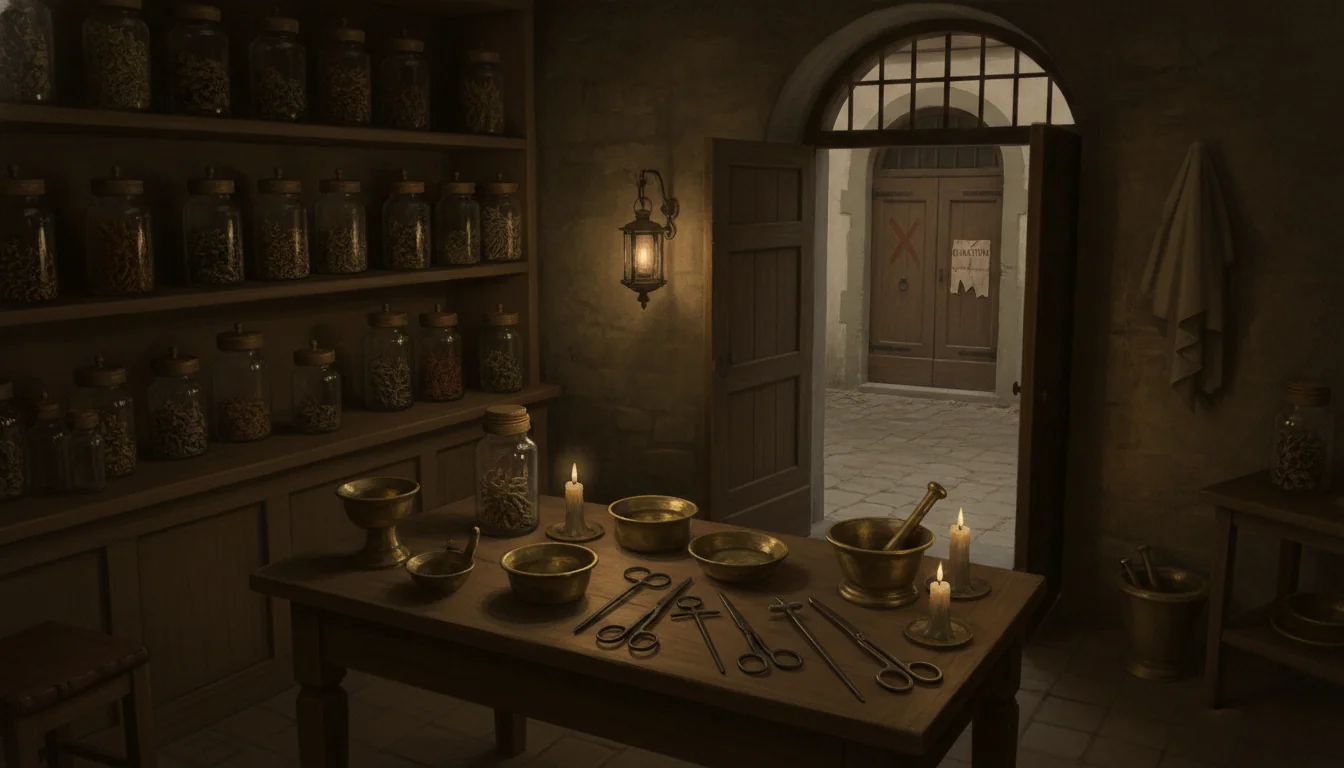
Giovanni Boccaccio spent the spring of 1348 in Florence watching his city empty out, house by house. By the time the worst of it passed, later that year, somewhere between half and three-fifths of the roughly 100,000 people who lived there were dead. The Black Death Florence endured that year ranks among the deadliest outbreaks any European city faced during the entire pandemic. Boccaccio survived, wrote it all down, and used what he saw as the frame for the most influential collection of short fiction in European literature.
The book was the Decameron. Ten young Florentines, seven women and three men, flee the dying city for a villa in the hills and pass the time telling a hundred stories over ten days, waiting for the plague to finish its work. The frame story is not a literary flourish bolted onto the front of the collection. It is reportage, or close to it, dressed as fiction, and it remains the single most detailed eyewitness account of what the Black Death did to a major European city.
Ships from the East
The disease that reached Florence in the spring of 1348 had traveled a long way to get there. Genoese trading galleys carried it out of the Black Sea region in the autumn of 1347, landing it first at the Sicilian port of Messina. From Messina it moved up the Italian peninsula fast, reaching Genoa and the Tuscan port of Pisa by January 1348. Pisa fed Florence's trade routes directly, and within a few months the sickness had followed the same roads that carried wool, wine, and grain into the city.
Nobody in Florence understood that fleas riding on black rats were doing the actual work of transmission, a mechanism that would not be identified for more than five hundred years. What they saw was a disease that seemed to leap from person to person and from house to house with no pattern anyone could predict, which made it more frightening, not less.
Bad Air and a Bad Conjunction
Florentine doctors worked from Galen, and Galen said disease came from an imbalance of the body's four humors, tipped over by something foul in the air. Miasma theory made intuitive sense of a plague that seemed to travel through stinking, crowded streets and spare the countryside. Learned opinion elsewhere in Europe added an astrological gloss: physicians at the University of Paris, consulted by the French crown, blamed a conjunction of Saturn, Jupiter, and Mars that had occurred in 1345, arguing the alignment had corrupted the atmosphere itself. Florence's own chroniclers leaned harder on an older explanation still, one that needed no university training: sin, and a God who had run out of patience.
The Florentine chronicler Giovanni Villani, who had spent decades recording the city's history year by year, was still writing when the plague reached him. He died of it in 1348, and his account breaks off unfinished, continued afterward by his brother Matteo, who would himself die of a later outbreak of the same disease in 1363.
What the Doctors Tried
Treatment followed straight from theory. If the humors were unbalanced, bloodletting and purging could restore them. If the air was corrupt, it had to be countered with stronger smells: physicians and the wealthy carried pomanders stuffed with herbs, burned aromatic wood indoors, and avoided bathing on the theory that open pores let bad air into the body. Buboes, the swollen lymph nodes in the groin, armpit, and neck that gave the disease its most visible symptom, were sometimes lanced or cauterized in the hope of releasing the corruption directly. Theriac, a compound remedy built from dozens of ingredients and prized since antiquity as a universal antidote to poison, was dosed out to patients who could afford it. It was hardly the last time people would knowingly risk their health chasing a remedy or a fashion, a pattern that shows up centuries later in the arsenic-laced cosmetics Victorian women wore despite knowing the risks.
None of it worked, and the physicians of Florence knew it better than anyone. Boccaccio noted flatly that the medical skill of trained doctors, applied faithfully, seemed to accomplish nothing against the disease. A number of physicians did what many of their patients' own family members would soon do too: they left.
Who Got Blamed
Blame in 1348 followed two very different tracks, and Florence sits closer to the less murderous of the two. Across Switzerland, the Rhineland, and parts of France, rumors spread that Jewish communities were poisoning wells and water supplies to cause the plague. Confessions extracted under torture, most notoriously at Chillon on Lake Geneva, were used to justify massacres in cities including Basel and Strasbourg, where hundreds of Jewish residents were burned in early 1349. These pogroms were among the worst violence Europe inflicted on itself in the entire medieval period, and they happened despite the disease killing Jewish and Christian communities in identical proportions.
Florence had only a small Jewish population in 1348 and left no record of comparable massacres inside the city. Blame there settled instead on people closer to hand. Gravediggers, called becchini, were accused by multiple chroniclers of exploiting the crisis: demanding extortionate fees to remove bodies, robbing the dead and dying, and in some accounts forcing their way into houses uninvited to claim payment before a victim had even died. Boccaccio's harshest judgment, though, fell on ordinary Florentines themselves. He described parents abandoning children, husbands abandoning wives, and brothers abandoning brothers, and treated the collapse of family loyalty as its own kind of catastrophe, one that said something ugly about what fear does to people.
Ten Storytellers and a City of Graves
It is in describing the burials that Boccaccio's account becomes hardest to read. Consecrated ground ran out fast, and the city dug enormous trenches instead, laying bodies down in layers with a thin covering of earth between each, the way a ship's crew stows cargo to make the most of the hold. Church bells that once tolled for every individual death stopped altogether, because tolling for each victim would have meant tolling constantly, and the sound itself had become unbearable.
Out of this, in the years just after 1348, Boccaccio built the Decameron. Ten young Florentines, most of them from families wealthy enough to have somewhere else to go, retreat to a country villa and agree on a set of rules to get through the crisis with their sanity and manners intact: no news from the city, a fixed daily routine, and a story after supper from each of them in turn, for ten days, a hundred stories total. Boccaccio himself put a number on it, claiming flatly that upward of 100,000 people died within Florence's walls between March and July alone, a figure most historians consider inflated since it may exceed the city's entire pre-plague population, but one that captures how total the destruction felt to someone living through it. Scholars still debate how much of the introduction is Boccaccio's direct memory of Florence in 1348 and how much is literary construction built around a genuinely lived disaster, but even skeptical historians treat it as the fullest surviving picture of how one Italian city experienced the plague's first and worst year.
What Finally Stopped It
By autumn 1348, the epidemic in Florence had largely burned out, and contemporaries had no idea why. The real explanation, involving fleas, black rats, and a bacterium now called Yersinia pestis, was not established until 1894, when the scientist Alexandre Yersin identified the organism during an outbreak in Hong Kong. Cooler weather that slows flea activity likely played a role in the seasonal retreat, but nobody in fourteenth-century Florence could have connected the two.
What did change, slowly, was civic response. Italian city-states began experimenting with organized public health measures in the plague's aftermath: Florence's government appointed officials to oversee burials and manage the sick during the outbreak itself, and within a few decades Mediterranean ports were isolating incoming ships and travelers for a fixed period before allowing them into the city, the practice that gave us the word quarantine. None of it cured anyone. It bought time, reduced exposure, and represented the first institutional acknowledgment that a city could organize against an epidemic rather than simply endure one. Later generations of Europeans would face the same choice again, most famously during the Great Plague of London more than three centuries afterward.
Florence's population would not fully recover for roughly two centuries. The immediate economic effect, though, cut the other way for the survivors: labor grew scarce, wages for artisans and farm workers rose, and some historians credit the demographic shock with helping loosen the rigid social structures that the coming Renaissance would eventually pull apart. Boccaccio, for his part, got a masterpiece out of it, one that opens not with plague statistics but with ten frightened, resourceful young people deciding that if the world was ending, they would at least tell each other good stories while it did.
Quick Answers
Common questions about this topic
What caused the Black Death in Florence?
Modern scientists identify the cause as Yersinia pestis, a bacterium spread mainly through fleas carried by black rats, though this was not established until 1894. In 1348, people blamed corrupt air and divine punishment for sin, while learned opinion elsewhere in Europe pointed to an unlucky planetary conjunction.
How many people in Florence died during the Black Death?
Giovanni Boccaccio's own estimate of 100,000 dead likely exceeded the city's actual population and was probably exaggerated for effect. Modern historians estimate that somewhere between half and three-fifths of Florence's roughly 100,000 residents died between spring and autumn of 1348.
Who did people blame for the Black Death?
Across parts of Switzerland, France, and the German lands, Jewish communities were falsely accused of poisoning wells and were massacred in cities including Basel and Strasbourg. Florence's own Jewish population was too small for comparable violence there; blame instead fell on profiteering gravediggers and, in Boccaccio's account, on the families and neighbors who abandoned their own sick.
What is the connection between the Black Death and Boccaccio's Decameron?
Boccaccio used the 1348 outbreak in Florence as the frame story for the Decameron, in which ten young Florentines flee to a country villa and tell a hundred stories over ten days to pass the time until the plague subsides. His introduction remains one of the most detailed eyewitness accounts of the epidemic in any Italian city.

Consult the Physicians
Chat with the healers and survivors who lived through history's outbreaks.
Create your free account →No card required. Some figures and features require a paid plan.
Join the HistorIQly Club
Get smarter about the past.
Weekly stories, deep dives, and exclusive content straight to your inbox.