Origins: When Hotels Were Invented
Who invented the hotel? Not the Romans. The private room with a lock is a 19th-century idea - the first true hotel opened in Boston in 1829.
Read Wikipedia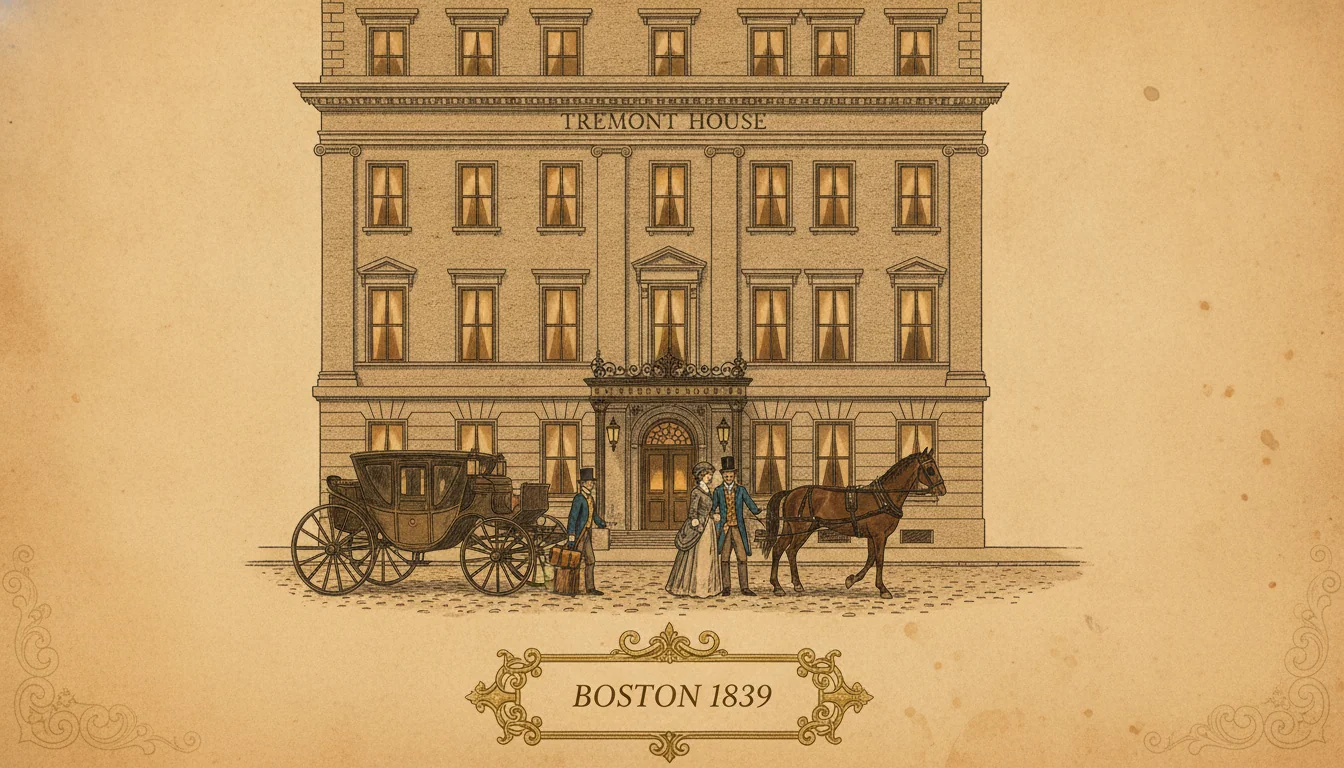
The idea that a traveler could arrive at a building, hand over money, and receive a private room with a locked door and someone to carry the bags seems so obvious that it is easy to assume it has always existed. It hasn't. For most of recorded history, travelers slept in conditions that a modern hotel guest would describe as a hostage situation.
The private room with the lock is a 19th-century invention. Everything before it was something else.
The myth of ancient hospitality
Ancient travelers had lodging options. What they did not have was privacy, consistent quality, or anything resembling a lock.
Rome built two systems of roadside lodging across its empire. The first was the mansio - a government-funded way station on the main road network, designed for official travelers, imperial couriers, and military units moving between posts. The mansio was not a commercial enterprise. It was infrastructure, like a post house. You needed credentials to use it. If you were an ordinary traveler without state connections, the mansio was not for you.
The second system was private and commercial: the taberna (tavern) and the caupona (inn). Both appear extensively in Roman literature and in the physical record from sites like Pompeii and Herculaneum, where excavations have exposed dozens of establishments with stone counters, ceramic vessels still in place, and graffiti advertising services and prices on the walls.
These were not comfortable places. Roman writers of every class described cauponae with consistent contempt. Horace wrote about the fleas and the dirty water. Petronius's Satyricon opens in a town that seems to consist almost entirely of low inns and con artists. The standard caupona offered a drinking area on the ground floor, a kitchen attached to it, and sleeping space either in a common room above or in small cramped chambers that were rented by the mat rather than by the room. Bedbugs appear frequently in Roman accounts of travel. Privacy did not.
What the Romans did have, for the wealthy, was the hospitium: the guest-friendship. If you were a member of the senatorial class with connections across the empire, you traveled by staying with social equals who owed you hospitality by the reciprocal norms of Roman elite culture. This was not a hotel. It was a social obligation, and it worked only if you had the right network. The traveler who lacked it slept above the tavern with the fleas.
The Islamic caravanserai: the closest ancient approximation
The caravanserai - the roadside lodging complex of the Islamic world - came closer to the modern hotel than anything the Roman or medieval European world produced, and it receives almost no credit in Western accounts of hospitality history.
Caravanserais were built along major trade routes from North Africa through the Middle East to Central Asia and China from roughly the 8th century onward, with the Abbasid caliphate funding systematic networks of them across the road systems of Iraq, Iran, and the Caucasus. A well-maintained caravanserai offered separate sleeping chambers rather than a common floor, a courtyard for animals and wagons, a well or cistern, food preparation facilities, and sometimes a bathhouse.
The architecture was deliberate: the courtyard was enclosed, the entrance was controlled, and the sleeping rooms opened off colonnaded interior galleries that gave travelers some separation from one another and from the noise of animals below. Some caravanserais near major commercial cities were large and elaborately decorated, the 11th and 12th-century examples in Anatolia in particular surviving in sufficient quantity to establish how sophisticated the type became.
This was not a hotel. The service model was different - travelers brought most of their own supplies - and the social mixing across rank and origin that a modern hotel assumes was limited by the realities of the caravan trade. But the physical logic of separate enclosed rooms around a controlled courtyard was far more hotel-like than anything European innkeeping produced until the 19th century.
Medieval Europe: pilgrims, monks, and shared beds
Medieval European lodging was organized around two parallel systems that served different populations.
The first was monastic hospitality. Monasteries across Europe maintained guesthouses - called xenodochia in early church Latin, hospitales in later usage - that offered accommodation to pilgrims, the poor, and the sick. The hospitale of Saint John in Jerusalem, established by the Knights Hospitaller in the late 11th century, could reportedly house up to a thousand pilgrims at a time and maintained medical staff. The model was charity rather than commerce: you were a guest of the community and God, not a paying customer in a transaction.
The word "hotel" descends directly from these institutions. Latin hospitale became Old French hostel (which gives English "hostel" and "hostelry" as well as "hospital"), which gave the grand French private house its name - the hotel particulier, the great townhouse of a noble or wealthy merchant. When French usage began to apply "hotel" to lodging establishments in the 18th century, it borrowed the prestige of the architectural term rather than the charity of the church term.
The second system was commercial innkeeping, and it was not comfortable. The coaching inn of the 14th to 17th centuries offered a common room, food, ale, and a place to sleep. The sleeping was usually communal: beds were large, guests who did not know each other shared them, and the division between a sleeping area and a drinking area was often nominal or nonexistent. The traveler who wanted a private room was welcome to rent the entire establishment, if they had the money.
The absence of locks was not an oversight. In a world where most travelers carried their valuables on their persons and slept in their clothes, a locked door was not the primary security measure. The primary security measure was sleeping with your money belt. Inns were also frequently associated with theft, violence, and prostitution in the literature of every European country that produced traveler memoirs before the 18th century.
The Grand Tour and the birth of expectation
The Grand Tour - the 17th and 18th century practice of wealthy young Europeans traveling through France, Switzerland, and Italy as a finishing education - began to change what lodging was expected to do.
Wealthy travelers who spent months in Florence, Rome, Naples, and Venice needed lodging that was comfortable, reliable, and extended. Italian locandas and Swiss gasthofs began to specialize in the long-stay foreign guest market. Swiss innkeeping in particular developed a reputation for cleanliness and order that distinguished it from French or English equivalents, and several 18th-century Swiss establishments - around Lake Geneva and in the Alpine passes - are sometimes cited as precursors to the modern hotel tradition.
But the decisive invention was American.
Boston, 1829: the first hotel
The Tremont House opened in Boston on October 16, 1829. It was designed by architect Isaiah Rogers, and it was built with a deliberate claim to being something new: not an inn, not a tavern with rooms, but a hotel.
The Tremont offered 170 rooms. Each room had a lock on the door - and the key belonged to the guest, not the proprietor. This sounds trivial. In 1829, it was genuinely novel. The assumption at every European inn was that the innkeeper had access to every room, that privacy was a courtesy rather than a right, and that "private room" meant only that you were not sharing with strangers that evening.
The Tremont also installed indoor plumbing: eight water closets in the basement, supplied by a rooftop cistern. Individual soap was provided in every room. A formal reception area separated the arrival experience from the tavern. Bellboys - called "rotunda men" - met guests at the door and carried luggage to rooms. A printed bill of fare established what meals cost in advance. There was a reading room and a separate ladies' parlor.
These features, bundled together for the first time, defined what a hotel was. The Tremont's influence was immediate: it was imitated within years in every major American city, beginning with New York's Astor House in 1836. European travelers who stayed there wrote home with something between admiration and puzzlement - it did not fit any category they had previously used for lodging.
American hotel development accelerated from there with a speed that surprised European observers. By the 1840s, American cities had hotels that were larger, more technically sophisticated, and more oriented toward middle-class guests than anything available in London or Paris. The hotel became part of American civic self-presentation in a way it was not in Europe for another generation.
The grand European hotels followed: the Hotel des Bergues in Geneva in 1834, the Hotel du Louvre in Paris in 1855, the Savoy in London in 1889, the Ritz in Paris in 1898. By 1900, the hotel was a global institution with a recognizable form. The private room, the locked door, the bellboy, the formal reception, the standardized service - all of it traced, with more or less directness, to a building on Tremont Street in Boston that opened in 1829 and charged a dollar and a half a night.
What the history tells us
So who invented the hotel? Not Rome, not the medieval church, not the Grand Tour. The hotel is not ancient. The desire to accommodate travelers is ancient; the commercial infrastructure for doing so without putting them in a common room with strangers and without locks on the doors is medieval and early modern at best. The private room as a standard feature of commercial lodging is less than two centuries old.
The comfortable mythology of ancient hospitality - Roman road houses, Greek xenia - collapses under examination into shared beds, shared fleas, and theft. The innovation that made modern travel possible was not ancient tradition. It was an architect in Boston and a proprietor willing to bet that travelers would pay for what they had always been told was an extravagance.
They did. They still do.
For other inventions whose origins are older than the popular myth suggests, see Origins: Who Invented the Umbrella and Origins: Who Invented the Toilet.
Quick Answers
Common questions about this topic
When were hotels invented?
The modern hotel - a commercial lodging with private rooms, a lock on every door, standardized service, and a formal reception area - was invented in the early 19th century. The Tremont House in Boston, which opened in 1829, is widely cited as the first true hotel by these standards. It was the first lodging to offer private rooms, indoor plumbing, individual locks, and bellboys to carry luggage.
What did people use before hotels?
Before the modern hotel, travelers used several different types of lodging: Roman travelers used mansiones (government way-stations) or cauponae (commercial taverns with shared sleeping). Medieval pilgrims used monastic hospices. Wealthy travelers on the Grand Tour used private arrangements or poorly regulated coaching inns. None of these offered private rooms with locks as a standard feature.
Where does the word hotel come from?
The word derives from French 'hotel,' which originally referred to a grand private townhouse or urban palace. That French word comes from Old French 'hostel,' from Medieval Latin 'hospitale' (a place for guests), ultimately from Latin 'hospes' (guest or host - the same word for both roles). The English language borrowed 'hotel' to mean a commercial lodging establishment around the mid-18th century.
Did ancient Rome have hotels?
Rome had several types of roadside lodging but nothing comparable to a modern hotel. Mansiones were government-funded stations for official travelers and imperial couriers. Cauponae were commercial taverns that usually offered sleeping space above or beside the drinking area - typically a shared room or a straw mat in a common space. Privacy was not a feature. Contemporary Roman writing describes cauponae as dirty, dangerous, and frequented by criminals.

Ask the Inventors Themselves
Chat with the people who were there when familiar things began.
Create your free account →No card required. Some figures and features require a paid plan.
Join the HistorIQly Club
Get smarter about the past.
Weekly stories, deep dives, and exclusive content straight to your inbox.