Origins: Who Invented Tattoos
Tattoos are at least 5,000 years old, proven by Otzi the Iceman's preserved skin markings, and the practice arose independently across Polynesia, Egypt, and Asia.
Read Wikipedia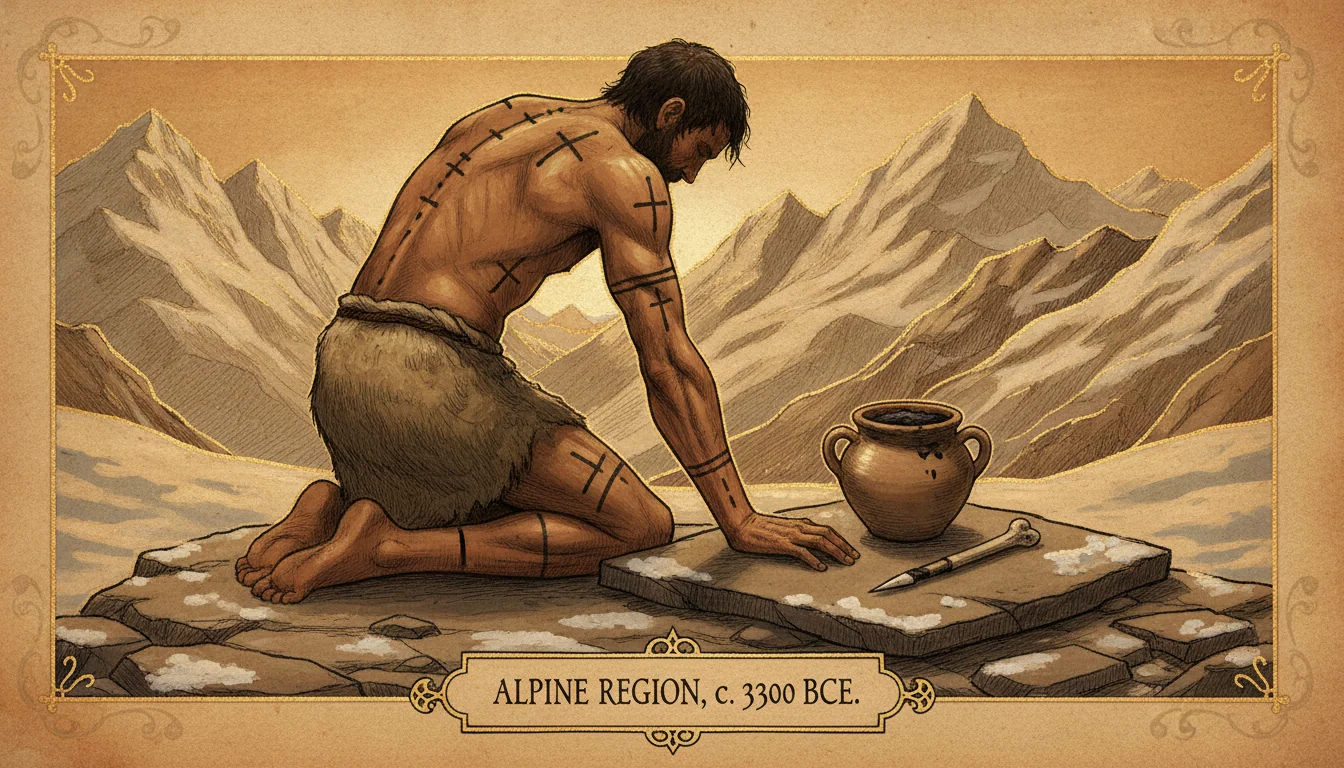
In September 1991, two German hikers in the Otztal Alps, on the border between Austria and Italy, spotted what they assumed was a discarded mannequin poking out of melting ice. It was a mummified human body, later named Otzi, that had lain frozen and remarkably preserved for roughly 5,300 years. When researchers examined his skin closely, they found something unexpected: 61 tattoos, simple parallel lines and small crosses, inked across his lower back, wrists, legs, and one ankle. Otzi did not invent tattooing. But his frozen skin gave archaeologists the oldest confirmed physical proof that humans were marking their bodies permanently millennia before anyone wrote the practice down.
No single inventor, many independent origins
Unlike inventions with a traceable single source, tattooing appears to have arisen independently in multiple parts of the world, a pattern that makes sense once you consider how little specialized equipment the practice requires. A sharp point, some soot or plant-based pigment, and skin are enough. Archaeological and ethnographic evidence points to at least three largely separate traditions: the Alpine and Eurasian tattooing represented by Otzi, the Polynesian tradition that gave the practice its modern name, and the ancient Egyptian tradition documented on mummified remains. These developed with little to no contact between them, which strongly suggests tattooing is one of those techniques humans arrive at repeatedly rather than one that spread from a single point of invention.
Otzi the Iceman: the oldest confirmed evidence
Otzi's 61 tattoos, dated by his body's own radiocarbon age to approximately 3300 BCE, consist entirely of simple geometric marks, groups of short parallel lines and a few small crosses, rather than any figurative imagery. Researchers created the marks using a technique that involved making small incisions in the skin and rubbing in charcoal-based pigment, producing tattoos still faintly visible after thousands of years frozen in ice.
What has fascinated researchers most is where on Otzi's body the tattoos appear. Many cluster around his lower spine, knees, and ankles, joints that later CT scanning and X-ray analysis revealed showed signs of degenerative wear, arthritis, and strain consistent with the physical demands of Alpine life. This spatial overlap between tattoo placement and joint damage has led many researchers to propose that Otzi's tattoos were not decorative but therapeutic, a form of ancient acupuncture-like pain treatment rather than a status symbol or artistic statement. If that reading holds, it suggests one of humanity's very earliest documented uses of tattooing was medicinal rather than aesthetic, a use case very different from how most people encounter tattoos today.
Egypt: figural tattoos on preserved mummies
Roughly contemporary with Otzi, ancient Egyptian tattooing left its own physical record. Mummified remains recovered from Gebelein in Upper Egypt, dated to approximately 3350 to 3100 BCE, bear tattoos considerably more sophisticated than Otzi's simple lines: images of a wild bull and a Barbary sheep on a male mummy, and a series of S-shaped motifs and a baton-like symbol on a female mummy from the same site. These are the earliest known figurative tattoos, images depicting recognizable animals or objects rather than abstract marks, anywhere in the archaeological record.
For much of the 20th century, Egyptian tattoos found predominantly on female mummies, most famously a priestess named Amunet from around 2000 BCE, were interpreted by some early archaeologists as marks associated with prostitution or low social status. Later scholarship has pushed back hard against that reading, noting that tattooed figurines and imagery associated with fertility, protection during childbirth, and religious devotion appear across Egyptian material culture in ways that suggest tattoos likely carried protective or ritual significance for the women who bore them, not a stigma. The Gebelein mummies' animal tattoos, discovered and analyzed using infrared imaging only within the past decade, pushed the confirmed record of figurative tattooing back further than researchers had previously documented, revising the picture yet again.
Polynesia: the word itself, and a living unbroken tradition
While Otzi and the Gebelein mummies represent the oldest physical evidence, the very word "tattoo" comes from a different tradition entirely: the Polynesian "tatau," referring to the sound made by the traditional tapping tools used to drive pigment beneath the skin. Captain James Cook's expeditions to Tahiti and the wider Pacific in the late 18th century introduced the word, and the practice, to a wide European audience for the first time, and Cook's own crew members returned to Britain bearing tattoos themselves, arguably kicking off tattooing's long association with sailors in Western culture.
Polynesian tattooing traditions, including Samoan tatau, Maori ta moko, and Marquesan patterns, represent an unusually well-documented and continuously practiced tradition rather than one reconstructed solely from archaeological fragments. Maori ta moko, applied historically using carved bone chisels rather than needles, carried deep genealogical and social significance, with facial patterns functioning as a kind of visible record of a person's lineage, rank, and achievements. Unlike the Egyptian or Alpine evidence, which had to be reconstructed from preserved remains after the fact, Polynesian tattoo traditions survived colonial suppression and persist today as living practices with direct lines of transmission back through generations of tattoo artists.
The gap between myth and record
Popular retellings of tattoo history sometimes compress this multi-origin story into a simpler, single-source narrative, most often crediting Polynesia alone as the source from which tattooing "spread" globally after European contact. The physical evidence from Otzi and the Gebelein mummies makes clear that tattooing was already thousands of years old in multiple regions well before any Polynesian-European contact occurred. The word came from the Pacific. The practice itself did not.
Another persistent misconception holds that tattooing has always carried the same social meaning wherever it appeared, whether reverence, rebellion, or punishment. The historical record instead shows the opposite: tattoos have served wildly different functions across cultures and eras, from Otzi's apparent pain relief, to Egyptian ritual protection, to Polynesian genealogical record-keeping, to the punitive tattooing of criminals and enslaved people practiced in ancient Rome and Japan, where forced facial or arm markings served as a permanent, visible punishment rather than a chosen adornment.
From criminal mark to fashion statement
That punitive association lingered for a very long time in the West. Through the 19th century and much of the 20th, tattoos in Europe and North America carried strong associations with sailors, circus performers, prisoners, and the working class, a stigma reinforced by 19th-century criminologists like Cesare Lombroso, who wrongly theorized that a propensity for tattooing correlated with criminal tendencies. Getting a visible tattoo through most of this period was, for a large share of the population, a genuine social and professional risk rather than a fashion choice.
The shift toward mainstream acceptance took hold gradually from the 1970s onward, as a new generation of tattoo artists began treating the practice as a serious visual art form rather than a crude trade, and accelerated sharply from the 1990s as public figures across sports, music, and entertainment made visible tattoos increasingly ordinary rather than transgressive. By the early 21st century, tattoos had completed one of the more striking reputational reversals in the history of body modification, moving from a mark of the outcast to, in many parts of the world, an unremarkable and widely embraced form of personal expression.
Tattooing's story mirrors other body adornment and perfume-and-appearance practices that carried very different meanings across the eras they touched, a pattern also visible in the origin of perfume, which likewise began tied to ritual and status before becoming an everyday consumer product.
Quick Answers
Common questions about this topic
Who invented tattoos?
No single culture invented tattoos. The practice arose independently in multiple regions, with the oldest confirmed physical evidence found on Otzi the Iceman, a mummified body from around 3300 BCE discovered in the Alps in 1991, bearing 61 simple line and cross tattoos across his body.
What is the oldest tattoo ever found?
Otzi the Iceman's tattoos, dated to roughly 3300 BCE, were long considered the oldest confirmed tattoos, though Egyptian mummies from Gebelein, dated to a similar period, roughly 3350 to 3100 BCE, bear figural tattoos of animals that some researchers argue may be comparably old or slightly older.
Did ancient Egyptians really have tattoos?
Yes. Mummified remains from ancient Egypt, including bodies found at Gebelein dating to roughly 3350 to 3100 BCE, bear tattoos of animals such as wild bulls and Barbary sheep. For centuries tattoos found on Egyptian women were misinterpreted by some early archaeologists as marks of low status, an assumption later scholarship has challenged.
Why did tattoos go from criminal marking to popular fashion?
In much of the West, tattoos carried associations with sailors, criminals, and the working class through the 19th and much of the 20th century. That perception shifted substantially from the 1970s onward as tattoo artistry professionalized, celebrities made visible tattoos fashionable, and a broader cultural embrace of body art as self-expression took hold by the early 2000s.

Ask the Inventors Themselves
Chat with the people who were there when familiar things began.
Create your free account →No card required. Talk to anyone in history with 8 free credits a day. Some features require a paid plan.
Join the HistorIQly Club
Get smarter about the past.
Weekly stories, deep dives, and exclusive content straight to your inbox.