Origins: Who Invented Perfume
Perfume began as smoke rising to the gods in Mesopotamia and Egypt, not as a scent for the skin. A Cyprus workshop from 2000 BC is the oldest perfumery ever found.
Read Wikipedia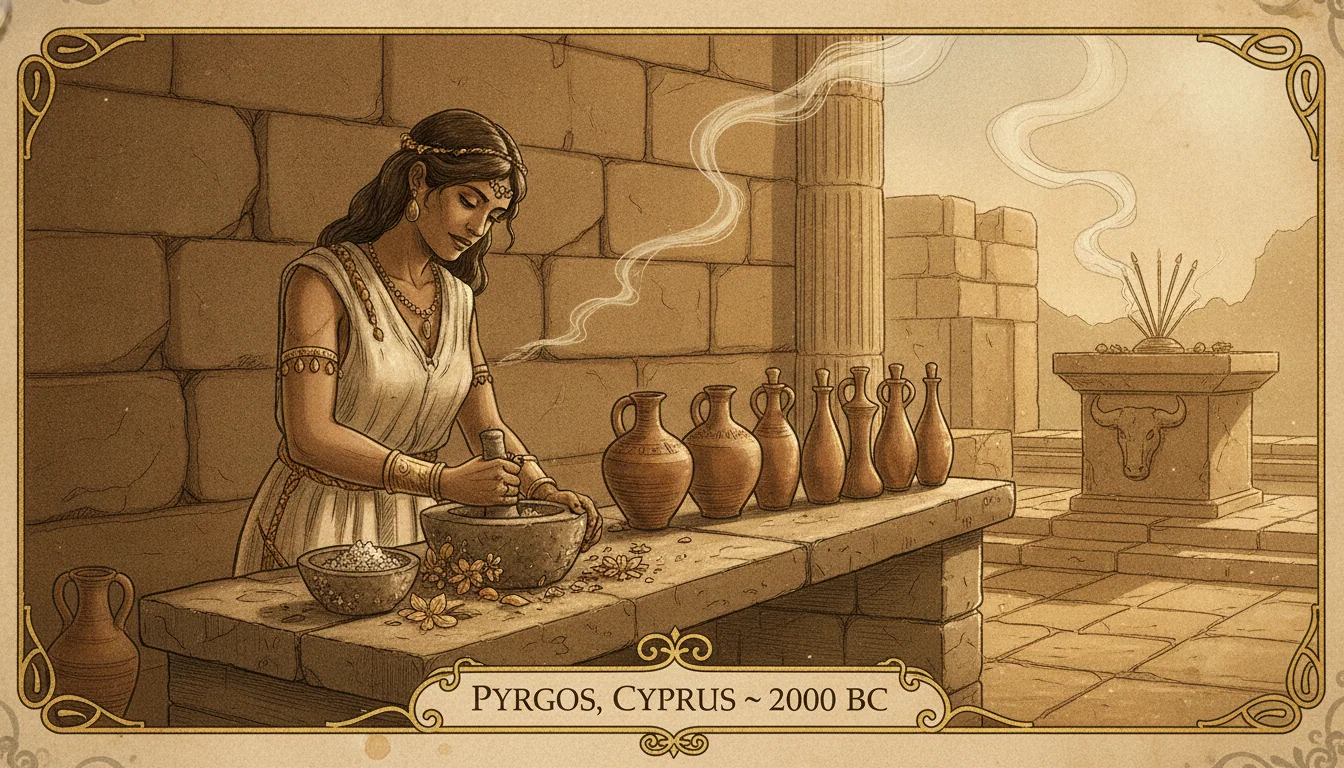
Long before anyone dabbed scent on a wrist, they burned it. The earliest perfumers were not chemists working for vanity or seduction. They were priests and temple attendants in Mesopotamia and Egypt, sending fragrant smoke upward because they believed the gods themselves wanted to smell it. The word perfume still carries that memory in its bones: it comes from the Latin per fumum, through smoke, a name that has outlived the ritual it was coined to describe by thousands of years.
The popular myth vs the archaeology
Ask most people where perfume comes from and you will hear some version of Cleopatra soaking the sails of her barge in scent to seduce Mark Antony, a story that comes from Plutarch and has been repeated in film and popular history ever since. It is a vivid image and probably contains a kernel of truth about how the Egyptian elite used fragrance as a tool of political theater, but it dramatically understates how old the underlying practice already was by Cleopatra's time in the first century BC. By the moment she was allegedly perfuming her sails, organized perfume production had already existed for roughly two thousand years.
The other common assumption is that perfume began as a French luxury good, a reasonable guess given how thoroughly France has dominated the modern industry since the 17th century. That version of the story is even further off. The archaeological and textual record points instead to the ancient Near East, where the practice of burning aromatic materials as a religious offering predates any written history of France by millennia.
Earliest evidence: incense before liquid scent
The earliest form perfume took was not a liquid at all but smoke from burned resins, gums, and woods, offered to deities in temples across Mesopotamia and Egypt starting in at least the third millennium BC. Frankincense and myrrh, both aromatic resins harvested from trees native to the Arabian Peninsula and the Horn of Africa, were burned in religious ritual across the ancient Near East and traveled enormous distances along incense trade routes to reach the temples that consumed them, a trade so valuable it helped build the wealth of ancient South Arabian kingdoms.
The most significant physical evidence for organized perfume production comes not from Egypt or Mesopotamia but from Cyprus. In the early 2000s, archaeologists excavating a site called Pyrgos on the island uncovered what researchers identified as the oldest perfumery ever found, dating to around 2000 BC. The site contained stills, mixing bowls, funnels, and perfume bottles, evidence of a genuine production workshop rather than isolated ritual burning, working with local ingredients including olive oil, anise, pine, coriander, and bergamot to produce scented oils on what appears to have been a commercial scale.
Egypt developed its own rich and well-documented tradition in parallel. Egyptian temple and tomb records describe kyphi, an elaborate incense blend combining resins, honey, wine, and raisins, burned as offerings and also used medicinally, with recipes recorded in temple inscriptions detailed enough that modern researchers have attempted to reconstruct them. Egyptians also produced infused oils, steeping flowers, herbs, and resins in fats to create scented preparations used in both religious ritual and everyday grooming, particularly among the wealthy, and archaeologists have recovered cosmetic containers and unguent jars from tombs confirming the practice reached back well into the Old Kingdom period.
The cuneiform chemist: Tapputi
Among the most striking pieces of textual evidence is a Mesopotamian cuneiform tablet, dated to roughly 1200 BC, that names a woman called Tapputi as a perfume maker, describing her use of techniques including distillation, filtering, and the combination of flowers, oil, and calamus to produce scented preparations. The tablet is fragmentary and the details of her exact process are debated among Assyriologists, but Tapputi is widely cited as the earliest named chemist of any kind in the historical record, predating most other individually named practitioners of any scientific discipline by centuries. Her existence is a reminder that perfume making in the ancient Near East was not an anonymous folk practice but a skilled trade specific enough to be recorded, named, and apparently respected.
The cultural and economic moment that made it spread
Perfume's spread from temple ritual to broader use tracks the spread of long-distance trade itself. The incense routes that carried frankincense and myrrh from southern Arabia north toward Mesopotamia and Egypt created wealthy intermediary kingdoms and, over centuries, normalized aromatic goods as a category of valuable trade commodity rather than a purely sacred one. As access to resins, oils, and exotic ingredients widened among the merchant and priestly classes, so did the range of uses: perfumed oils for anointing the dead, for royal ceremony, for medicine, and eventually for the ordinary vanity of anyone who could afford it.
The ancient Greeks and Romans inherited and expanded this Near Eastern and Egyptian tradition rather than inventing a new one. Greek writers including Theophrastus, a student of Aristotle, wrote treatises specifically on odors and scented oils, cataloging ingredients and their properties in a way that shows perfume had become a subject worthy of serious natural philosophy by the fourth century BC. Roman elites consumed scented oils and powders on a scale that later moralists complained about as decadent excess, and Roman trade networks pulled perfume ingredients from as far as India, expanding the ingredient list well beyond what Bronze Age Cyprus or Egypt had worked with.
The gap between myth and record
The popular narrative tends to compress this long, geographically wide story into a single origin point, usually Egypt or occasionally Cleopatra personally, because it is easier to remember one glamorous civilization than a distributed practice that developed across Mesopotamia, the Levant, Cyprus, Arabia, and Egypt more or less in parallel, each center trading ingredients and techniques with the others. The archaeological record resists a tidy single-inventor story. Cyprus has the oldest surviving dedicated perfumery. Mesopotamia has the oldest named individual perfumer. Egypt has the richest documented tradition of religious and cosmetic use. None of these claims cancels out the others, and the honest answer to "who invented perfume" is that no one civilization did, because the underlying idea, that burning or infusing aromatic material produces something valuable and sacred, appears to have occurred to multiple Bronze Age societies within a similar window of time, likely reinforced by trade contact between them rather than isolated invention.
From oil and smoke to alcohol
The perfume that most people recognize today, an alcohol-based liquid rather than an oil or a burned resin, is a considerably later development. Distillation technology advanced significantly during the Islamic Golden Age, when scholars including the 9th-century polymath Al-Kindi wrote treatises on distilling essential oils and refining fragrant extracts, building on earlier Greek and Egyptian techniques and improving the equipment and methods considerably.
In Europe, the conventional milestone is Hungary Water, a preparation said to have been made for a queen of Hungary in the 14th century by distilling alcohol infused with rosemary, often cited as the first true alcohol-based perfume in the Western tradition, though the exact circumstances of its creation rest on court tradition more than a firm contemporary document. From there, the craft migrated to Renaissance Italy and then to France, where the town of Grasse became a center of the industry by the 17th and 18th centuries, building the commercial and technical foundation for the modern perfume houses that still dominate the market today.
Modern legacy
Every bottle of perfume sold today, whatever its marketing suggests about French sophistication or modern chemistry, descends from a practice that began as smoke rising toward a god in a Mesopotamian or Egyptian temple, refined by a Bronze Age workshop on Cyprus, recorded by a named chemist in cuneiform, and only much later reinvented as a liquid meant for the skin rather than the sky. The word itself, through smoke, is the fossil record of that original purpose, sitting quietly inside a language most of its modern users never think to translate.
Quick Answers
Common questions about this topic
Who invented perfume?
No single person invented perfume. The practice grew out of incense burning in Mesopotamia and Egypt, where aromatic resins were burned as offerings to the gods starting in at least the third millennium BC. The oldest named perfumer known from written records is Tapputi, a chemist mentioned on a Mesopotamian cuneiform tablet from around 1200 BC, and the oldest surviving physical perfumery, complete with stills and mixing vessels, was excavated on Cyprus and dates to around 2000 BC.
What does the word perfume actually mean?
Perfume comes from the Latin phrase per fumum, meaning through smoke, a direct reference to its origin as incense burned in religious ritual rather than a liquid applied to skin. The word entered English through French in the 16th century, by which point liquid perfumes made with distilled alcohol were already established in Europe.
Did the ancient Egyptians really invent perfume?
Egypt developed one of the most sophisticated and best-documented ancient perfume traditions, using kyphi, a complex incense blend of resins, honey, and wine burned in temples, and infused oils used both in religious ritual and daily grooming. But archaeological evidence from Mesopotamia and Cyprus shows organized perfume production happening in parallel or even earlier, making Egypt one major center of the practice rather than its sole inventor.
When did perfume become an alcohol-based liquid instead of oil or incense?
The shift is generally credited to the Islamic Golden Age, when chemists including the 9th-century polymath Al-Kindi refined distillation techniques for extracting essential oils, and to 14th-century Hungary, where Hungary Water, made by distilling alcohol infused with rosemary, is often cited as the first true alcohol-based perfume in the European tradition.

Ask the Inventors Themselves
Chat with the people who were there when familiar things began.
Create your free account →No card required. Some figures and features require a paid plan.
Join the HistorIQly Club
Get smarter about the past.
Weekly stories, deep dives, and exclusive content straight to your inbox.