Origins: When the Newspaper Was Invented
The history of the newspaper spans 2,000 years: from Caesar's stone bulletins to Venice's handwritten avvisi to Strasbourg's first printed paper in 1605.
Read Wikipedia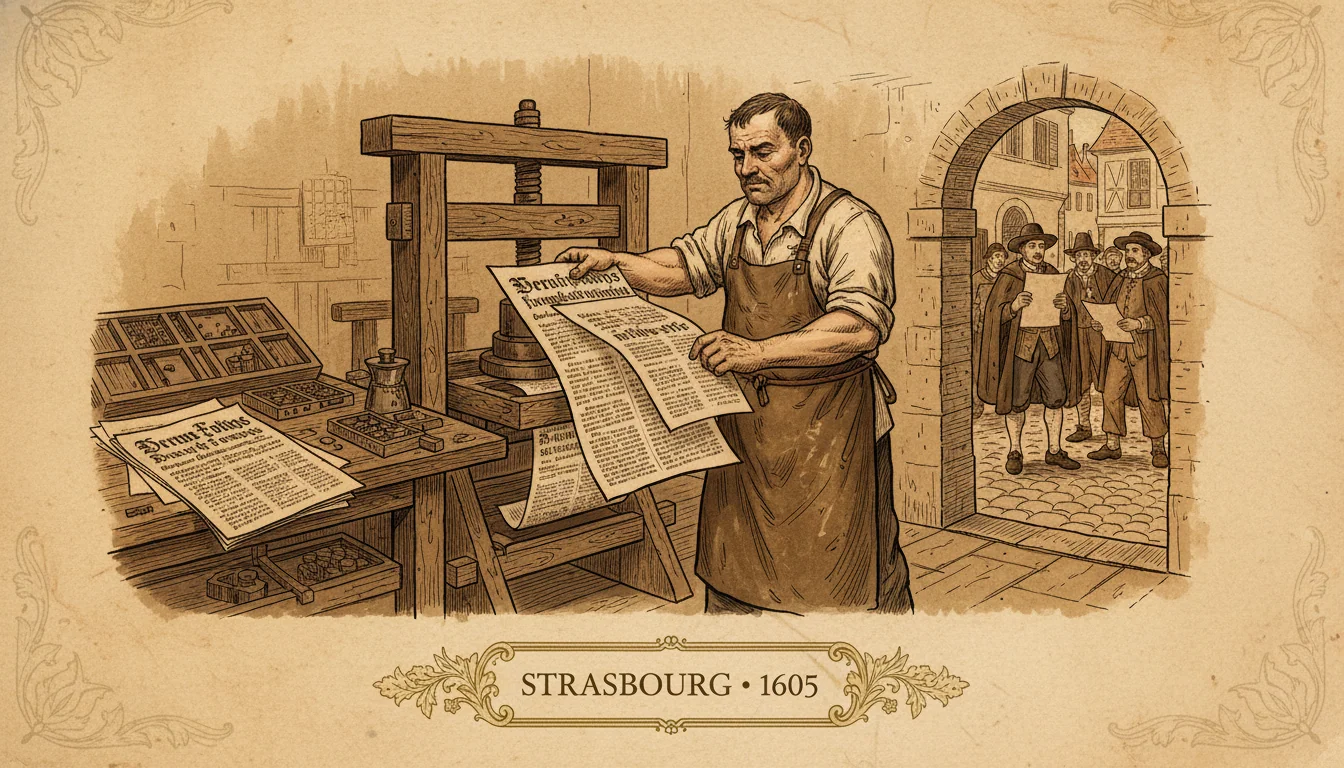
The popular history of the newspaper usually begins somewhere in the 15th century with Johannes Gutenberg and the movable type press. It is a reasonable starting point. The printing press was the enabling technology that made mass news distribution economically viable. But the newspaper as an institution - a regular, edited, multi-item account of current events produced for a paying public - took another 150 years to emerge after Gutenberg, and its roots stretch much further back than that.
The question of who invented the newspaper is complicated by the fact that "newspaper" conflates several distinct ideas: regular publication, multiple news items, public accessibility, and commercial independence. Different claimants to the title of "first" satisfy different combinations of these criteria. The history is not a single invention moment. It is a slow assembly of parts.
Rome: the bulletin board as proto-news
The oldest regular public information service in the historical record is Roman. In 59 BCE, Julius Caesar, newly appointed as consul, ordered the creation of the Acta Diurna - the "daily acts" or "daily proceedings." These were official summaries of Senate proceedings, public appointments, military dispatches, court decisions, births, deaths, divorces, and notable events, carved or painted on stone or whitened wooden boards and posted in prominent public spaces throughout Rome, typically in the Forum.
The Acta Diurna were produced daily when the Senate was in session and remained on public view before being archived in a location where citizens could request access. They were copied by private scribes called actuarii, who produced handwritten summaries (called acta or commentarii) for wealthy Romans living outside the city or in the provinces who paid for a subscription service delivering the news by courier. This is, remarkably, already close to a primitive circulation model.
What the Acta Diurna lacked was editorial independence. Caesar created them partly to break the Senate's monopoly on political information and extend his own populist messaging directly to the public. There was no editor selecting between competing stories, no commentary, no separation of official pronouncement from independent observation. The Acta were a government bulletin, not a newspaper. But they established something important: the idea that the public had a regular, legitimate claim to information about current events.
The Acta Diurna continued after Caesar's death and appear in Roman texts through at least the 4th century CE. When the Western Roman Empire collapsed, so did the infrastructure that produced them.
China: the court gazette
While Rome was posting stone bulletins, the Chinese imperial system was independently developing a different model of regular information circulation. The Di Bao, often translated as the "court report" or "imperial gazette," circulated written summaries of imperial edicts, official appointments, and court proceedings among government officials from at least the Tang dynasty, with evidence of similar practices possibly dating earlier.
The Di Bao was not a public newspaper. It was a restricted government publication circulated among officials who needed to know about imperial decisions relevant to their administrative duties. Ordinary people did not receive or purchase it. By the Song dynasty (960-1279 CE), private entrepreneurial printers had begun producing unauthorized copies and expanded summaries of the Di Bao for a broader literate audience, which generated official objections and periodic crackdowns.
This tension - between the official gazette circulated among the elite and the unofficial summary sold to anyone who would buy it - is one of the recurring dynamics in the early history of news media everywhere. Information is economically valuable. Someone will always find a way to sell it.
Venice: the handwritten news sheet
Sixteenth-century Venice was the most information-saturated city in Europe. Its position as the Mediterranean's premier trading hub meant that merchants and government officials needed reliable, current intelligence about conditions in every market they operated in - prices in Alexandria, political stability in Constantinople, naval movements in the Adriatic.
By the 1530s and 1540s, Venice had developed a network of professional news writers called novellanti or menanti who gathered information, wrote it up in manuscript form, and sold subscriptions to wealthy merchants, nobles, and foreign ambassadors. These handwritten news sheets circulated weekly or more often, covering commercial news, diplomatic developments, military events, and court gossip from across Europe and the Ottoman world.
The sheets were called notizie scritte or avvisi, meaning "written notices." The price of a single sheet was reportedly a gazetta - a small Venetian coin of low denomination - which is where the word "gazette" comes from. The first time the word appears in the English language, it is an Italian borrowing, carrying with it the memory of a Venetian news vendor haggling over a copper coin.
The Venetian avvisi were sophisticated. The better examples show clear editorial selection, consistent formatting across issues, and a mix of foreign correspondents sending dispatches by the postal routes that crisscrossed Italy. What they lacked was print. Every copy was handwritten, which limited circulation and introduced copying errors. They were expensive and difficult to scale.
Strasbourg, 1605: the first printed newspaper
Johann Carolus was a printer and news entrepreneur in Strasbourg who had been running a handwritten newsletter service for subscribers - exactly the Venetian model - for several years before 1605. The logistics of hand-copying were limiting his business. In late 1604 or early 1605, he converted his operation to print using his existing press and type.
The result was the "Relation aller Furnemmen und gedenckwurdigen Historien" - "Account of All Distinguished and Commemorable Stories" - published weekly beginning in 1605. The earliest surviving copy dates from that year. It contained news items gathered from multiple European cities, written in German, printed in a consistent format across issues, and sold publicly.
Carolus petitioned the Strasbourg city council in 1605 for a monopoly on newspaper publishing in the city, arguing that his innovation had created a new type of publication. The council's decision acknowledging his petition is one of the pieces of documentation that establishes the Relation as the first printed newspaper.
A competing claim attaches to the Avisa Relation oder Zeitung, published in Wolfenbüttel or Augsburg around the same time (exact dating remains disputed among press historians). Both publications represent the same moment: the conversion of the existing manuscript news service into a printed, regularly scheduled product available to any buyer.
The spread and the bans
Once the model existed, it replicated rapidly. By 1620, printed newspapers were operating in multiple German and Dutch cities. The first English-language newspaper appeared in Amsterdam in 1620, aimed at expatriate merchants. London got its first domestic paper in 1621.
The pattern that followed was familiar from the coffeehouse bans of the same era. Rulers attempted to suppress newspapers almost as soon as they appeared. Monopolies, censorship offices, licensing requirements, and outright bans were tried in most major European states at various points in the 17th century. The Dutch Republic was the notable exception, tolerating press freedom more consistently than its neighbors - which is partly why Amsterdam became the newspaper capital of Europe in the mid-1600s, producing papers for foreign markets that their home governments had banned.
England's Licensing Act, which required government approval for all publications, expired in 1695 and was not renewed - less from principled commitment to press freedom than from parliamentary indifference and the practical impossibility of enforcement. The result was a rapid expansion of London's newspaper market in the early 1700s. By 1750, London had more than a dozen newspapers; the city's coffee houses served as unofficial reading rooms where a single copy passed through dozens of hands.
The myth of the single inventor
Every account of the newspaper's origins eventually runs into the problem that no single person invented it. Carolus codified an existing service into a new format. The Venetian avvisi writers developed the editorial model before print made it scalable. Caesar institutionalized the public's claim to information before either. The Chinese Di Bao established the technology of regular written publication centuries before Europe.
What 1605 Strasbourg represents is not invention but crystallization - the moment when enough components (a printing press, an urban literate market, established postal routes, and a news-gathering network) came together in one place to produce something recognizably modern. The word "newspaper" is a 17th-century English coinage. The thing itself was assembled over two thousand years.
For related origins stories, see Origins: The Invention of the Printing Press and Origins: The History of the Clock.
Quick Answers
Common questions about this topic
What was the first newspaper?
The first printed newspaper is generally identified as the 'Relation aller Furnemmen und gedenckwurdigen Historien,' published by Johann Carolus in Strasbourg in 1605. It appeared weekly, covered news from multiple cities, and had a consistent format across issues. Earlier candidates, including Roman stone bulletins and Venetian handwritten news sheets, lack one or more of the defining features that distinguish a newspaper from a notice board or a private letter service.
What were the Acta Diurna?
The Acta Diurna were official daily Roman bulletins ordered by Julius Caesar in 59 BCE. Carved or painted on stone or wood and posted in public places in Rome, they covered Senate proceedings, court decisions, military dispatches, public appointments, births, deaths, and notable events. They were not newspapers in the modern sense - they had no editor, no circulation, and no editorial selection - but they established the principle of regular public information dissemination.
When did England get its first newspaper?
The first English-language newspaper appeared in Amsterdam in 1620, printed for an English-speaking expatriate audience. The first newspaper actually published in England was the Weekly Newes, issued in London in 1621. The London Gazette, which began as the Oxford Gazette in 1665, is the oldest continuously published newspaper in the English-speaking world still in operation.
Why was the newspaper invented in Europe and not China?
China had the Di Bao, a court gazette circulated among officials, from at least the Tang dynasty (7th-10th centuries CE), making it the oldest regular information publication in the world. But the Di Bao was not a public newspaper - it circulated among government officials only and was not sold or made available to ordinary readers. The public newspaper as we understand it - commercially sold, independently edited, available to any buyer - emerged from the intersection of the printing press, urban commercial culture, and a literate merchant class that Europe developed in the 16th and 17th centuries.

Ask the Inventors Themselves
Chat with the people who were there when familiar things began.
Create your free account →No card required. Talk to anyone in history with 8 free credits a day. Some features require a paid plan.
Join the HistorIQly Club
Get smarter about the past.
Weekly stories, deep dives, and exclusive content straight to your inbox.