Origins: Who Really Invented the Printing Press
Who invented the printing press? Gutenberg gets the credit, but Bi Sheng built movable type four centuries earlier. The real story is about what makes a technology change civilization.
Read Wikipedia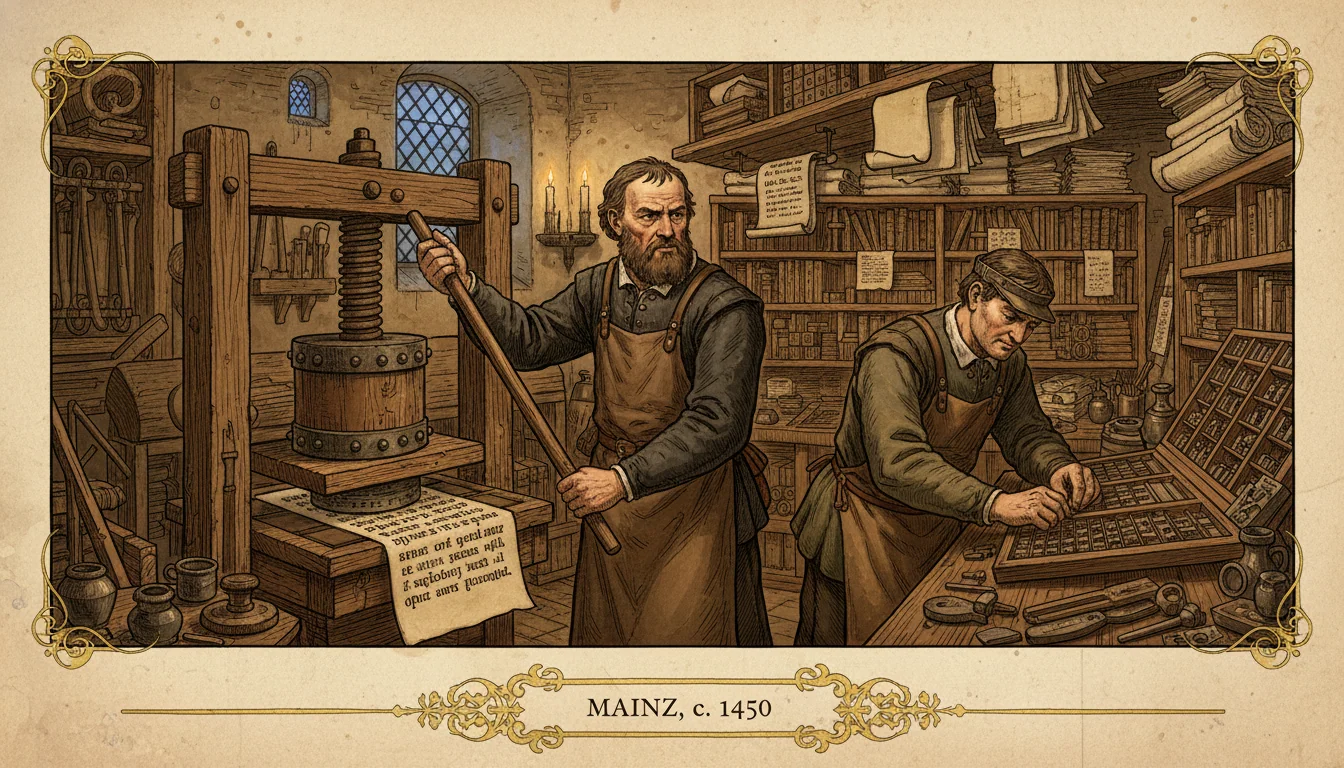
Johannes Gutenberg is one of the most reliably credited inventors in Western history, which is unusual because almost nothing about his life is reliably documented. The workshop, the financing, the legal disputes, the specific design of his press - all of it is reconstructed from court records, a few surviving artifacts, and an enormous amount of subsequent inference. The man himself left no surviving letters, no workshop notes, no memoir. He is known almost entirely through other people's accounts of him.
What is not disputed is the effect. The printing press that Gutenberg operated in Mainz around 1450 produced a change in European civilization so rapid and so total that historians still argue about its precise contours. Literacy rates, the Reformation, the Scientific Revolution, the standardization of European languages, the concept of the author as a legal entity with property rights in their own words - all of these are downstream of Gutenberg's workshop.
The more interesting question is why. Bi Sheng had invented movable type in China around 1040 CE, four centuries earlier. Why didn't that invention change China the way Gutenberg's changed Europe?
The Chinese invention
Bi Sheng's movable type was made from baked clay. Each character was carved into a small block of clay, fired until hard, and stored on iron plates organized by phonetic rhyme category. To set a page, a printer would select the needed characters from the storage cases, arrange them in an iron frame, heat the frame to soften an adhesive base that fixed the characters in place, print the page, and then heat the frame again to release the characters for reuse.
The account of Bi Sheng's invention comes from a single primary source: a passage in the Dream Pool Essays written by the polymathic scientist Shen Kuo around 1088 CE. Shen Kuo describes the process in technical detail that appears accurate to later reconstructions, and the clay type system he describes is plausible and functional. There is no archaeological evidence of Bi Sheng's original type pieces, but the historical account is treated as reliable.
Clay type had limitations. The characters were fragile, and cracks would mar the print. Subsequent Chinese inventors improved on the material. Wang Zhen, a Yuan dynasty official writing around 1298, developed a movable type system using carved wooden blocks arranged on a rotating circular table organized by rhyme category - a practical workaround for the problem of finding the right character quickly among thousands of options. Later still, the Korean court developed bronze movable type in the early 13th century, about two centuries before Gutenberg, and Korean metal type is the earliest metal movable type for which physical evidence survives.
The alphabet problem
None of this diminished the impact of Chinese printing on Chinese civilization. China had woodblock printing from at least the 7th century CE, and the mass production of Buddhist texts, almanacs, and government documents by woodblock printing was a genuine technological achievement. But movable type did not achieve in China what it achieved in Europe, and the reason is linguistic.
The Chinese writing system uses thousands of distinct logographic characters. A working Chinese printer needed a type case of at minimum 5,000 to 6,000 characters to set most common texts, and a scholarly or literary text might require 30,000 or more. Organizing, storing, retrieving, and returning these characters to their cases after each print run required skilled labor at a scale that made the economic advantages of movable type less clear-cut than it might appear.
By comparison, European languages using the Latin alphabet required somewhere between 200 and 400 type pieces to set any text whatsoever. A printer who mastered a few hundred characters and their common ligatures could set any book in any Latin-alphabet language. The combinatorial simplicity of alphabetic writing gave European printing an inherent economic efficiency that Chinese printing could not replicate.
This is not a failure of Chinese ingenuity. It is a structural consequence of the relationship between the writing system and the printing technology. Woodblock printing, in which an entire page is carved as a single unit, was in many Chinese contexts more economical than movable type precisely because the setup costs for movable type were so much higher. Woodblock printing remained dominant in China long after Gutenberg's press transformed Europe.
Gutenberg's actual invention
When European historians call Gutenberg the inventor of the printing press, they are being imprecise in a revealing way. What Gutenberg invented was not the concept of movable type - that was Bi Sheng's - and it was not even the screw press, which had been used to press olives, grapes, and cloth in Europe for centuries. What Gutenberg invented was a system.
The system had three integrated innovations that together created something none of them could achieve alone.
The first was a metal alloy for casting type. Gutenberg used an alloy of lead, tin, and antimony with specific properties: it melted at a low enough temperature to be manageable, it set quickly in the mold, it was hard enough to withstand the mechanical pressure of the press, and it expanded very slightly on cooling, filling the mold precisely and producing a clean, uniform type piece. The exact formula was a trade secret in Gutenberg's lifetime and is reconstructed by modern metallurgists from the surviving type impressions in early printed books.
The second was an oil-based ink that adhered to metal. Earlier European inks were water-based and suitable for quill on parchment. They beaded on metal type. Gutenberg's formulation - possibly using linseed or walnut oil with lampblack pigment - adhered properly to metal and transferred cleanly to paper or parchment under the press.
The third was the press itself, adapted from existing screw-press designs. The critical feature was the ability to apply even, controlled pressure across an entire page simultaneously - something a hand-rubbed block print could not achieve at scale. The press Gutenberg developed could produce several hundred impressions per day with a two-person crew.
These three elements formed a self-reinforcing economic system. The metal type was durable enough to print thousands of copies before wearing. The ink produced clean, legible, consistent impressions. The press applied pressure evenly enough that the type could be set once and printed many times. The cost per copy dropped to a fraction of what a hand-copied manuscript required.
Mainz, 1450
Gutenberg began serious work on his press around 1440, probably in Strasbourg, and moved it to Mainz around 1448. His primary financial backer was a businessman named Johann Fust, who lent Gutenberg substantial sums secured against the press and the type. In 1455, before the Gutenberg Bible was finished, Fust sued for repayment. Gutenberg lost, surrendered the press and type to Fust, and was ruined.
The Bible itself - approximately 180 copies, printed on paper and vellum in a two-column Latin text of 42 lines per column - was completed largely by Fust and Gutenberg's apprentice Peter Schoeffer. It is one of the most beautiful books ever printed and was immediately recognized as such. When a Mainz Bible arrived in Paris in 1455, a correspondent of Pope Pius II described buyers marveling that the text was so clear and correct that one could read it without glasses. This was not merely aesthetic admiration. It was the first time European readers had encountered mass-produced text that matched the quality of fine manuscript work.
Gutenberg himself received little benefit from his invention after the Fust lawsuit. He continued to work in Mainz under an obscure arrangement and may have been involved in printing other books, but he died around 1468 without having recovered his financial position.
The spread
Within thirty years of the Mainz Bible, printing had reached every major European city. By 1500 there were printing establishments in over 250 cities across Europe, and the total number of books in circulation had increased from an estimated few million manuscripts to somewhere between 10 and 20 million printed volumes. The drop in the cost of producing a book was so steep that texts that had previously existed in a dozen copies were suddenly available in thousands.
The structural consequences were not immediate but they were inexorable. Martin Luther's 95 Theses in 1517 spread across Germany within weeks, not because of anything Luther did but because printers reproduced them. The scientific correspondence of the 16th and 17th centuries traveled at speeds that made international intellectual communities possible for the first time. Grammarians standardized spelling and syntax because, for the first time, there was an economic reason for consistency.
What Gutenberg actually got credit for
The story of Gutenberg versus Bi Sheng is less a story about who invented what and more a story about what it takes for a technology to change the world. Bi Sheng's movable type was a genuine invention. It improved Chinese printing in specific contexts. It did not catalyze a transformation.
Gutenberg's press catalyzed a transformation because it matched a technology - the Latin alphabet - to an economic structure - Western European book markets already primed by scriptoria, universities, and literate merchant classes - to a mechanical solution that lowered costs fast enough to open entirely new markets rather than merely serve existing ones more cheaply.
The printing press was not one thing. It was three things in the right combination at the right moment. Bi Sheng built the concept. Gutenberg built the system. The difference between those two accomplishments is the difference between an interesting artifact and a changed world.
For more on the origins of technologies that changed civilization, see our histories of the alphabet and the calendar.
Quick Answers
Common questions about this topic
Who really invented the printing press?
Johannes Gutenberg of Mainz is credited with inventing the mechanical movable-type printing press in Europe around 1440-1450, which produced the transformative effect on European civilization. However, movable type itself was invented by Bi Sheng in Song dynasty China around 1040 CE, roughly four centuries earlier. The two inventions were independent, and the Chinese version had less immediate impact for structural reasons related to the Chinese writing system.
Why didn't Chinese printing spread as fast as Gutenberg's?
Chinese is written with thousands of logographic characters, while the Latin alphabet uses about 26 letters. A European printer needed roughly 300 to 400 type pieces to set any text in any language using the Roman alphabet. A Chinese printer needed thousands of individual characters, making the setup labor-intensive enough that skilled hand copying remained competitive in many contexts. The alphabet's structure gave European printing an economic efficiency advantage that Chinese printing could not match.
What did Gutenberg actually invent?
Gutenberg's innovation was not the concept of movable type, which existed in China, but a system: a durable metal alloy for casting uniform type pieces, an oil-based ink that adhered to metal, and a screw press adapted from wine and olive presses that could apply even pressure across a full page. The combination of these elements created a self-reinforcing economic system that could produce books cheaply enough to transform the market.
When was the Gutenberg Bible printed?
The Gutenberg Bible, also called the 42-line Bible, was printed between approximately 1452 and 1455 in Mainz. Around 180 copies were produced, of which approximately 49 survive in whole or in part. It is considered the first major book produced in the West using mass-production printing with movable type.

Ask the Inventors Themselves
Chat with the people who were there when familiar things began.
Create your free account →No card required. Talk to anyone in history with 8 free credits a day. Some features require a paid plan.
Join the HistorIQly Club
Get smarter about the past.
Weekly stories, deep dives, and exclusive content straight to your inbox.