Origins: How Auctions Were Invented
The origins of auctions are often traced to a single Herodotus anecdote about Babylon, but the documented record runs through Roman spear-sales to 18th-century London.
Read Wikipedia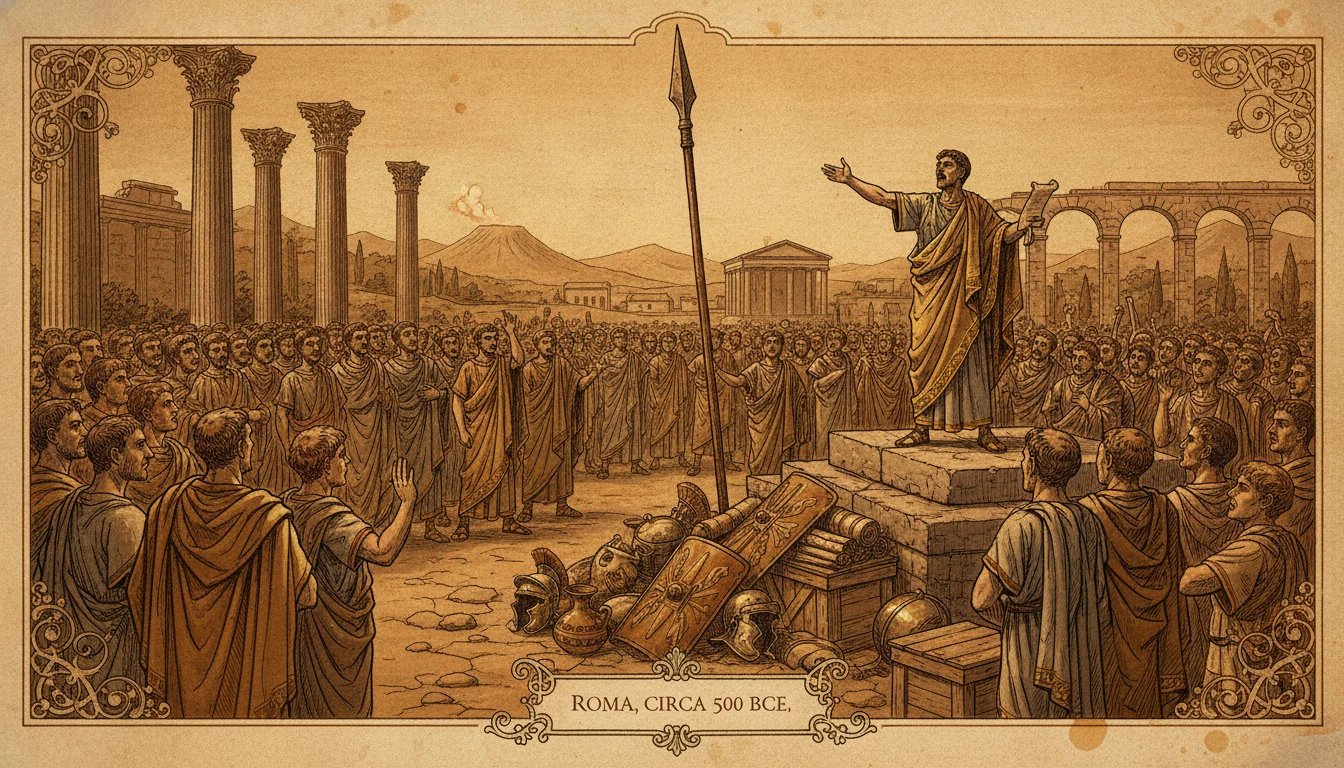
Ask most people about the origins of auctions and you get some version of the same tidy story: an ancient marketplace, a raised hand, a falling gavel, a lineage running straight back to antiquity. It sounds inevitable, as though bidding against strangers for the highest price is simply how humans have always traded valuable things. The real record is messier, thinner in places than people assume, and considerably more interesting once you separate what was actually written down from what got repeated because it made a good story.
The Babylonian claim, and why historians hedge on it
The oldest story attached to auctions comes from Herodotus, the Greek historian writing around the middle of the 5th century BCE. In his Histories, he describes a custom he says took place once a year in Babylonian villages: all the young women of marriageable age were gathered in one place, and an auctioneer worked through them one at a time, starting with the most desirable. Wealthy men bid the price up for the women considered most attractive, and the money raised was used to provide dowries so that less-desired women could also be married off, sometimes to men willing to accept a payment along with a wife.
It is a vivid scene, and it gets cited constantly as the "first auction." It should not be taken as settled fact. Herodotus is a fascinating source but an unreliable one on matters far from Greece; he is known to have relayed secondhand travelers' accounts, and modern historians and Assyriologists have found no corroborating Babylonian text, legal code, or archaeological record describing this practice. Herodotus also had a rhetorical habit of using foreign customs, real or embellished, to make points about wisdom and folly for a Greek audience. The Babylonian bride market may be a genuine, if idealized, description of a real custom, a garbled account of something smaller and more local, or an invention shaped to fit his narrative. Treat it as a claim from one ancient author, not as documented history, because that is what it is.
If bidding-based exchange existed even earlier than Herodotus's account, in Mesopotamia or elsewhere, no surviving written record describes it in enough detail to call it an auction in the modern sense. The genuinely documented history of auctions as an institution, with rules, officials, and a continuous record, starts later and elsewhere.
Rome: the spear, the crier, and the word itself
The word "auction" itself is Roman, and it tells you something true about how auctions worked there. It comes from the Latin auctio, a noun built from the verb augere, "to increase." An auction was, definitionally, a sale where the price only went up. That etymology has survived essentially unchanged into English, French, and most other European languages.
Roman auctions were a routine instrument of the state, not a novelty. When Roman armies took spoils of war, cities, livestock, captives, and household plunder, the goods were often sold off collectively rather than divided item by item among soldiers. These sales were conducted sub hasta, "under the spear": a spear was planted upright in the ground at the sale site as a mark of public authority, a practice tied to the idea that the property had passed to the Roman state through conquest and was now being lawfully redistributed. Over time, "to sell under the spear" became a general expression for auctioning something off, even when no actual battlefield was involved.
Auctions also handled far less dramatic Roman business: bankruptcy sales, the disposal of estates after a death, and confiscated property seized for unpaid debts. A licensed official called a praeco acted as the crier, calling out bids in public, while a magister auctionis or similar official oversaw the sale's legality. Buyers were often professional dealers, coactores, who fronted the cash and later collected from the eventual purchaser, an early form of auction-house credit. None of this involved a raised hand and a gavel in the way people picture today; it was closer to a licensed public sale with a crier working a crowd, embedded in ordinary Roman commercial and legal life for centuries.
The long gap and England's candle
Between the fall of the Western Roman Empire and the emergence of recognizable European auction houses, the documented trail thins considerably. Public sales of goods, debt settlements, and estate liquidations continued in various forms across medieval Europe, but they were local, often informal, and rarely left the kind of continuous written record that lets historians trace an unbroken institutional lineage.
One vivid English practice does survive in detail: the candle auction. By at least 1641, English sales, including sales of ships and merchant goods, were sometimes conducted "by inch of candle." A candle stub, often marked to burn down roughly an inch, was lit, and bidding continued until the flame went out; the last bid entered before that moment won the lot. The diarist Samuel Pepys describes watching a candle auction of naval ships in 1660 and later notes a trick used by an experienced bidder, who had learned that a candle wick flares briefly right before it dies, and used that flash as his cue to shout the winning bid. It is a small, well-documented detail, but it shows that by the mid-17th century, English auctions already had established customs, tricks, and a recognizable public culture around them, well before any of the houses that now dominate the word "auction" existed.
The 18th century: Sotheby's, Christie's, and the founding myths
The auction houses that gave the practice its modern, glamorous image were founded in London within a generation of each other, and neither began the way its later reputation suggests.
Samuel Baker held his first documented auction on March 11, 1744, dispersing several hundred books from a private library, an event now treated as the founding sale of what became Sotheby's. Baker was a bookseller by trade, and for its first decades the firm auctioned libraries, manuscripts, and printed matter almost exclusively. It only broadened into fine art, furniture, and the wider luxury categories associated with the Sotheby's name much later, after the business passed through several generations of partners.
James Christie opened his London auction rooms in 1766, and his first recorded sale that December was not a parade of masterpieces. It was a mixed lot of household furniture, jewelry, silver plate, firearms, and ordinary domestic items. His first sale devoted entirely to paintings, held the following year, was by most accounts a modest disappointment, with several works going unsold and some of the attributions disputed. Christie's reputation as an arbiter of fine art grew gradually, helped along by his personal friendships with painters and by turbulent political events later in the century that pushed large collections of Continental art onto the London market.
The gap between the founding myth and the founding record is instructive. Popular retellings tend to picture Sotheby's and Christie's springing into existence as temples of connoisseurship, gavels falling on Old Masters from their first day. The actual paperwork describes a bookseller selling a private library and a young auctioneer clearing out somebody's chamber pots and firearms alongside the furniture. Both houses became what they are now through decades of reputation-building, not from an inaugural sale that already looked like a modern art auction.
What the record actually supports
Strip away the embellishment and the documented history of auctions looks like this: a contested single-source claim about Babylon that historians treat with real caution; a well-attested, centuries-long Roman institution built around the spear and the crier, which also gave the practice its name; a documented English custom of candle-timed bidding by the 17th century; and a pair of 18th-century London businesses, founded selling books and household junk respectively, that only later became synonymous with glamour and record prices. The rising bid, meanwhile, the actual mechanism at the heart of the word "auction," is the one constant that connects the Roman forum to the modern saleroom. Everything else, from spears to candles to marble auction floors, is packaging that changed with the century.
For more on how familiar institutions trace back to surprisingly improvised beginnings, read our explorations of the origins of the stock market and how banks were invented.
Quick Answers
Common questions about this topic
Did Babylonians really auction off brides?
The claim comes from a single passage in Herodotus, a Greek historian writing in the 5th century BCE, and it describes a custom he says took place in Babylonian villages. Most modern historians treat it as unverified: there is no surviving Babylonian text or archaeological record that confirms it, and Herodotus is known to have repeated secondhand stories about places he may never have visited.
Where does the word 'auction' come from?
It comes from the Latin auctio, a noun built from augere, meaning 'to increase.' The word describes exactly what happens at a sale: the price keeps rising as bidders compete, and English adopted the term directly in the late 16th century.
What does 'sub hasta' mean in Roman auctions?
It means 'under the spear.' Roman authorities sold war spoils and confiscated property at public sales marked by a spear planted in the ground, a symbol of state authority, and a licensed official called a praeco called out the bids.
Which came first, Sotheby's or Christie's?
Sotheby's, by about 22 years. Samuel Baker held his first documented auction, a sale of books, in London on March 11, 1744. James Christie opened his auction rooms in 1766, initially selling household goods rather than fine art.

Ask the Inventors Themselves
Chat with the people who were there when familiar things began.
Create your free account →No card required. Some figures and features require a paid plan.
Join the HistorIQly Club
Get smarter about the past.
Weekly stories, deep dives, and exclusive content straight to your inbox.