The Disappearance of Park Ranger Paul Fugate: A Chiricahua Cold Case
The Paul Fugate disappearance: an NPS ranger who vanished in Arizona's remote Chiricahua backcountry, with no public resolution after decades. One of the least-publicized cold cases in national park history.
Read Wikipedia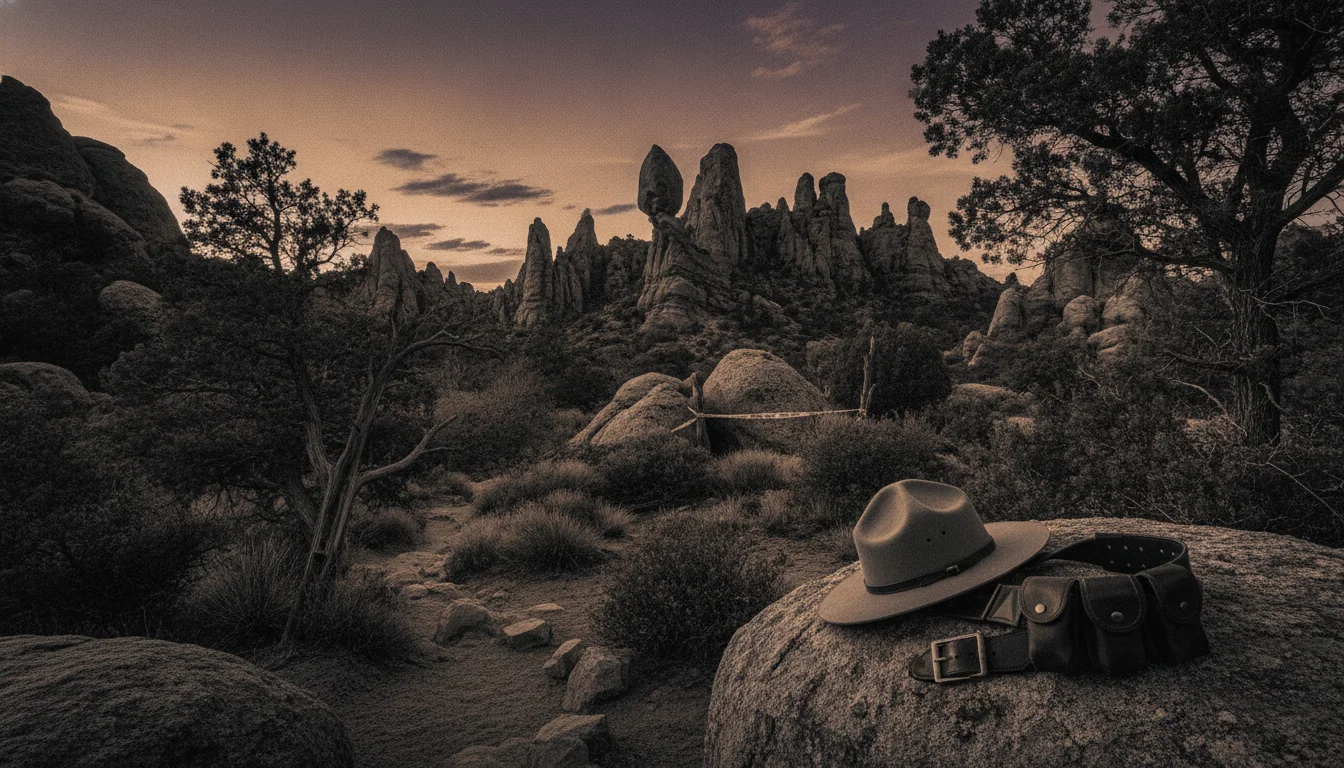
The Chiricahua Mountains rise out of the floor of southeastern Arizona like an island from a sea of grassland. The sky-island forests begin at around 5,000 feet and climb past 9,000, sheltering black bears, mountain lions, whitetail deer, and the bright-plumaged trogons that birders drive hours to see. Below the forest line the rocks begin, thousands of volcanic spires and balanced formations shaped by an ancient eruption and tens of thousands of years of frost and rain. The National Park Service protects about 12,000 acres of this landscape as Chiricahua National Monument, a place so remote that some of its trails see fewer than ten visitors on a given weekday.
It is also a place where, at some point in the monument's history, a man who worked as a ranger there vanished, and where the full accounting of what happened to him has never been publicly resolved.
A wilderness that demands respect
The monument sits in Cochise County, in the corner of Arizona that touches both New Mexico and the Mexican border. The nearest town of any size is Willcox, about 30 miles to the northwest. Tucson is two hours by road. The isolation is not metaphorical. Cell service is absent through most of the monument's backcountry. Radio communication from the canyon bottoms is unreliable. The terrain mixes dense oak-pine-juniper woodland with vertical rock faces, sudden drop-offs, and narrow canyon passages that can flood in minutes during monsoon season, typically July through September.
The Chiricahua Apache knew this country in ways that no NPS employee since has matched. Cochise and his band used the mountains as a stronghold for more than a decade, evading and defeating U.S. Army columns that had every resource advantage. The terrain was the weapon, as surely as any rifle. When Cochise's successor Geronimo finally surrendered in 1886, it was not because the mountains had been mastered but because the political and supply situation of his band had become untenable. The mountains themselves remained as difficult as ever.
The National Monument was established in 1924, long after the Apache Wars had ended, to protect the Bonita Canyon area and its extraordinary rock formations. For most of its history it has been staffed by a small crew of NPS rangers and seasonal employees who balance visitor services, trail maintenance, law enforcement patrols, and natural resource work across terrain where the line between a work day and a survival situation can shift without warning.
The ranger
Paul Fugate was among the people who did that work. The Paul Fugate disappearance case sits in that unusual category of cases where the subject's professional role should have guaranteed sustained investigative attention but where the public record remains thin. The details of his service at Chiricahua that have made it into public record are sparse, which is itself a measure of how little the case has been examined. He worked as an NPS ranger in the monument, a role that in a small unit like Chiricahua would have required him to be comfortable with extended solo patrol in the backcountry, trail assessment in remote areas, and the kind of independent decision-making that comes when the nearest backup is forty-five minutes away.
He disappeared. The available public record does not clearly establish the precise date or full circumstances. What is documented is that the case was not closed, that it moved into the category of unsolved NPS cold cases, and that it attracted virtually no national attention.
The scarcity of coverage is itself notable. Cases involving law enforcement personnel, rangers, or public servants in an official capacity tend to receive sustained investigative attention that private-citizen cases often do not. When those investigations remain open for years, the absence of a resolution suggests either a genuine absence of usable evidence or a set of circumstances complicated enough to resist resolution despite effort.
The Chiricahua backcountry makes both outcomes plausible.
What the terrain does to an investigation
Search and rescue in the Chiricahua Mountains operates under compounding difficulties. The rock formations that make the monument visually spectacular also make it topographically nightmarish. The rhyolite spires and balanced rocks create a three-dimensional maze of passages, overhangs, and blind canyons. Ground search teams can cover a sector carefully and still miss an area tucked behind an eight-foot rock formation ten feet off the trail.
Monsoon season is the critical variable. The mountains receive dramatically more rainfall than the surrounding desert, and that rain arrives fast and concentrated, funneling into narrow canyons in powerful flash floods. Anyone caught in a canyon bottom during an August storm faces water that can rise three feet in minutes. The same floods redistribute debris, erode soil, and reroute drainage channels from one season to the next. Evidence left in a wash in one year may not exist as recognizable evidence the next.
Air search in the monument is constrained by the terrain as well. The spires and ridges create dense radar shadows, and helicopter operations in canyon systems carry real hazard. The dense tree canopy on the upper slopes, a mix of ponderosa pine, Apache pine, Arizona cypress, and oaks, blocks aerial observation of everything below.
Add to this the monument's proximity to the Mexican border, roughly 30 miles south at the nearest point. The border region of Cochise County has seen decades of cross-border movement, both legal and illegal. Any criminal investigation in the area has to account for a population of transient individuals who may have been in a given area without documentation, witnesses who had reasons not to speak to law enforcement, and evidence that may have moved across an international boundary.
The cold case record
The National Park Service has not published a centralized accounting of all unsolved employee disappearances. Its Missing Persons program focuses primarily on visitor cases. When an employee goes missing, the investigation is typically conducted by the monument's regional office in coordination with the county sheriff and, when potential federal crime is suspected, the FBI. The records that result are distributed across multiple agencies, not consolidated in any single public archive.
Chiricahua National Monument itself keeps a low public profile. It receives well under 100,000 visitors a year, a fraction of the traffic at Saguaro or Grand Canyon. Its ranger staff has historically been small enough that turnover and institutional memory are genuine challenges. Cases that were actively worked in one decade may have lost their primary investigators to retirement or transfer by the next.
Paul Fugate's case exists somewhere in that scattered record. The absence of a resolution, and the absence of substantial media attention, suggests a case that has not been publicly litigated in the way that high-profile missing persons cases are. Whether new evidence has ever emerged, whether any persons of interest have been identified or cleared, whether his fate has been determined in ways that have not filtered into public reporting, is not established from what is publicly available.
Why it matters
Low-coverage cold cases are, in a specific way, the most unresolved of all. High-profile cases accumulate amateur investigators, journalists, podcasters, and documentary filmmakers who collectively generate enormous secondary research pressure. Witnesses who might not speak to police sometimes speak to journalists. Documents that move slowly through official channels get FOIA'd and published. New forensic techniques get applied to cases with sufficient public interest to warrant the administrative effort.
Cases with minimal coverage receive none of that secondary pressure. They exist primarily in official files, in the memories of the investigators who worked them, and in the experience of any family members who are still alive and still waiting.
Chiricahua National Monument is a beautiful place. The formations called Pinnacle Balanced Rock and Cochise Head are among the most striking natural structures in the American Southwest. The bird life in the canyon is extraordinary. The silence is real, the kind that exists only where human infrastructure genuinely thins out.
It is also a place where a man who worked there disappeared, and where the complete account of what happened has not been told. Low-coverage cold cases of this kind are the hardest to move forward - for a comparison with a disappearance that attracted far more attention and still took decades to resolve, see Amelia Earhart's disappearance, and for a case where wilderness terrain created similar investigative obstacles, the Dyatlov Pass incident illustrates how remote terrain limits what evidence can survive.
Quick Answers
Common questions about this topic
Who was Paul Fugate?
Paul Fugate was a National Park Service ranger assigned to Chiricahua National Monument in southeastern Arizona. He disappeared while working in the monument's rugged backcountry and the case was never resolved. It remains one of the least-publicized NPS cold cases.
What is Chiricahua National Monument?
Chiricahua National Monument is a remote protected area in Cochise County, southeastern Arizona, preserving thousands of acres of volcanic rock spires, sky-island forest, and canyons in the Chiricahua Mountains. It was the homeland of the Chiricahua Apache people for generations, including the band led by Cochise.
Why are national park disappearances so hard to investigate?
National parks cover millions of acres with limited staffing, minimal cell coverage, and complex jurisdiction shared between NPS rangers, county sheriffs, and FBI depending on what crime may have occurred. Bodies and evidence can go undetected for years in dense backcountry. Several hundred people remain missing from national parks and federal lands in the United States.
Are there other unsolved NPS ranger disappearances?
Yes. Several NPS personnel have disappeared under unexplained circumstances over the decades. The Chiricahua region in particular presents investigative challenges given its remoteness from urban centers, extreme terrain, and the fact that significant areas were poorly mapped and lightly staffed for much of the 20th century.

Want to Interrogate the Suspects?
Chat with historical figures and uncover the truth behind history's greatest mysteries.
Create your free account →No card required. Talk to anyone in history with 8 free credits a day. Some features require a paid plan.
Join the HistorIQly Club
Get smarter about the past.
Weekly stories, deep dives, and exclusive content straight to your inbox.