Newton vs. Leibniz: Who Really Invented Calculus
Two mathematicians, working an ocean apart, developed calculus independently within a decade of each other. Newton's own Royal Society then rigged the verdict.
Read Wikipedia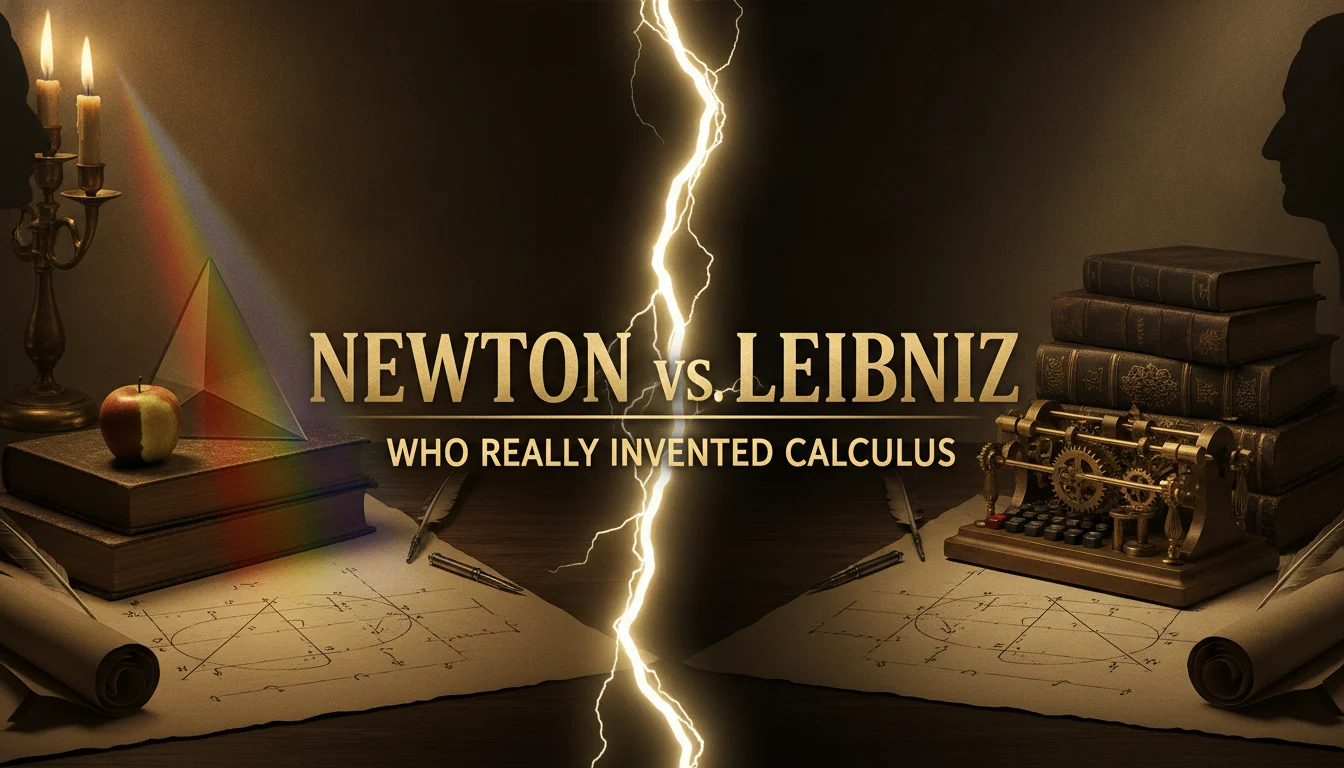
By 1712, the two men who had each independently invented one of the most powerful tools in the history of mathematics were no longer speaking, if they ever really had been. Instead, they were fighting through proxies, pamphlets, and a supposedly neutral Royal Society committee that its own president, Isaac Newton, had quietly staffed and directed. The prize was priority: who got there first, calculus, the mathematics of change itself. Both men, it turns out, got there fairly, and on their own. That did not stop one of history's ugliest and most consequential academic feuds.
The Stakes: What They Were Actually Fighting About
Calculus, in its two branches of differentiation and integration, gave mathematicians for the first time a systematic way to calculate rates of change and areas under curves, tools essential to physics, engineering, and eventually most of quantitative science. Whoever was credited as its inventor would claim one of the largest prizes in the history of mathematics. Isaac Newton, a reclusive genius at Cambridge, had developed his version, which he called the method of fluxions, in the mid-1660s but left most of it unpublished for decades, circulating it privately among a small circle of English mathematicians. Gottfried Wilhelm Leibniz, a German philosopher, diplomat, and polymath working in Paris and later Hanover, developed his own version independently in the 1670s and published it first, in 1684, years before Newton's own systematic account appeared in print.
That gap, publication versus private development, became the entire fight. Newton had it first by years. Leibniz published it first by years. Whether priority belonged to the man who discovered it or the man who told the world about it was never a question either side was prepared to concede.
Newton's Case
Newton's claim deserves to be heard on its own terms. His fluxions, developed during the mid-1660s while Cambridge was closed due to plague outbreaks and Newton had retreated to his family home at Woolsthorpe, emerged from his work on physics and planetary motion, a context that gave his calculus an immediate and profound application: it became the mathematical language of his Principia Mathematica, published in 1687, which laid out the laws of motion and universal gravitation that reshaped physics for centuries. Newton could reasonably argue that he was not merely first but that his calculus was inseparable from one of the greatest scientific achievements in history.
Newton had also, by his own account and that of his circle, shared his methods with English mathematicians including Isaac Barrow and John Collins well before Leibniz's 1673 visit to London, and some of that material had circulated, however informally, among mathematicians on the continent through Collins's correspondence. Newton's defenders argued that Leibniz could plausibly have seen enough of this circulating material during his travels to have been influenced by it, even if Leibniz never directly copied a finished method.
Leibniz's Case
Leibniz's claim rests on an independently reconstructable path to the same destination. A trained philosopher and lawyer rather than a career mathematician, Leibniz taught himself advanced mathematics largely during a diplomatic posting to Paris beginning in 1672, working closely with the Dutch mathematician Christiaan Huygens, who tutored him extensively. Leibniz developed his differential and integral calculus through a distinct route, rooted in his interest in infinite series and the geometry of curves, and he built for it a notation, the integral sign and the dy over dx expression for a derivative, that was considerably more elegant and usable than Newton's dot notation for fluxions.
Leibniz did visit London in 1673 and again in 1676, and he did see some unpublished Newtonian material during those visits, a fact his critics later seized on. But Leibniz's surviving notebooks and draft papers, which historians of mathematics have examined closely over the past century, show him developing his method through his own notation and his own conceptual route, arriving at the general rules for differentiation and integration on a timeline that does not require access to Newton's specific unpublished work to explain. He published his results first, in a 1684 paper in the journal Acta Eruditorum, years before Newton's own systematic account, the 1704 treatise De Quadratura Curvarum, appeared, and well over two decades before Newton's Principia if you count only the parts of that earlier work that explicitly used and explained fluxional notation.
The Clashes
For years, the relationship stayed cordial, even collegial. Newton and Leibniz exchanged letters through intermediaries in the mid-1670s, including two carefully worded letters Newton sent via Henry Oldenburg, secretary of the Royal Society, that hinted at his methods in coded anagrams without revealing full details, a common practice among mathematicians of the era protecting priority without publishing. Leibniz responded with genuine mathematical respect. Neither man accused the other of anything at this stage.
The dispute ignited later, driven substantially by supporters on both sides rather than by the principals themselves at first. In 1699, a Swiss mathematician named Nicolas Fatio de Duillier, a friend of Newton's, published an accusation that Leibniz had derived his calculus from Newton's work, the first open charge of plagiarism. Leibniz responded in print, and the exchange escalated through the following decade into a genuinely nasty international pamphlet war, with supporters on the continent defending Leibniz and members of the English mathematical establishment, egged on and eventually directed by Newton, defending their countryman.
Matters came to a head in 1711, when Leibniz, increasingly alarmed at the accusations circulating in England, formally requested that the Royal Society investigate and clear his name. Newton, who was by then the Society's president, appointed the investigating committee himself, packed it with his own allies, and modern scholarship examining the surviving drafts has established that Newton anonymously wrote substantial portions of the committee's final report himself. That report, published in 1712 as the Commercium Epistolicum, found decisively in Newton's favor and accused Leibniz of plagiarism. Newton then went further, anonymously authoring a favorable review of the report in the Society's own journal, effectively grading his own exam a second time under a different name.
Leibniz died in 1716, his reputation in England still under a cloud the Royal Society's report had cast, and largely without the vindication his own scientific standing on the continent might otherwise have secured for him. Newton, by contrast, lived until 1727, President of the Royal Society for the last twenty-four years of his life and by then one of the most celebrated men in Europe, with every institutional lever available to make sure his version of events became the official one.
The Verdict: Who Won, and What It Cost
By the standard Newton himself set up, a supposedly impartial Royal Society verdict, Newton won completely, and that verdict stood as the official English position for generations afterward. But the verdict was rigged by the very man it favored, and it has not survived serious historical scrutiny. The modern consensus among historians of mathematics, built up over the past century of careful study of both men's notebooks and correspondence, is that Newton and Leibniz developed calculus independently, arriving at broadly equivalent results through genuinely different conceptual paths within about a decade of each other, a case of near-simultaneous discovery that shows up more than once in the history of science when a field is ripe for a breakthrough, the same pattern behind Tesla and Edison's rivalry two centuries later.
There is, however, a second and quieter verdict, decided not by any tribunal but by two centuries of working mathematicians voting with their pens. Leibniz's notation, the integral sign and the differential expressions still taught in every calculus classroom on Earth, won decisively over Newton's fluxional dot notation, which faded into a specialized notation used mainly in classical mechanics. British mathematicians, partly out of national loyalty to Newton and partly due to the intellectual isolation that followed the priority dispute, largely stuck with Newton's clumsier notation for roughly a century, a choice historians of science generally agree held back British mathematical progress relative to the continent, where Leibniz's more workable notation let mathematicians like the Bernoulli family and Leonhard Euler push the field forward faster.
So the verdict splits cleanly down the middle. Newton won the fight that happened in his own lifetime, using the full weight of his institutional power to make sure of it, and he kept the popular credit as calculus's sole inventor for a long time afterward in English-speaking memory. Leibniz won the argument that actually mattered to the practice of mathematics, since it is his symbols on every chalkboard today, and history has quietly restored him to equal billing as co-inventor. The price of Newton's victory was a hundred years of British mathematics working with an inferior toolkit out of stubborn loyalty to its own champion. The price of Leibniz's loss was dying under a cloud his own country's mathematicians never fully accepted, in a dispute rigged from the start by a judge who was also the plaintiff.
Quick Answers
Common questions about this topic
Who actually won the Newton vs. Leibniz calculus dispute?
By the verdict of Newton's own Royal Society in 1712, Newton won, since the committee that investigated the priority claim was effectively packed and directed by Newton himself. Modern historians of mathematics, however, regard both men as independent inventors of calculus, working from different starting points and reaching the result within roughly a decade of each other.
Did Leibniz really steal calculus from Newton?
No credible modern historian believes Leibniz stole his calculus from Newton. Leibniz developed his version through a distinct notational and philosophical approach during and after a 1673 visit to London and Paris, and while he did see some of Newton's unpublished work in that period, the two men's methods and notation differ enough that independent development is the consensus view.
Whose calculus notation do we actually use today?
Leibniz's. The integral sign and the dy/dx notation for derivatives, both Leibniz's inventions, are the standard notation taught in classrooms worldwide, while Newton's dot notation for fluxions, his term for rates of change, survives only in specialized areas of physics and mechanics.
Did Newton and Leibniz ever meet in person?
No. Despite decades of correspondence and a shared circle of mathematical contacts across Europe, the two men never met face to face, and their entire relationship, from early cordial letters to the bitter dispute, played out entirely through intermediaries and written correspondence.

Hear Both Sides
Chat with history's fiercest rivals and decide who was right.
Create your free account →No card required. Some figures and features require a paid plan.
Join the HistorIQly Club
Get smarter about the past.
Weekly stories, deep dives, and exclusive content straight to your inbox.