Alexander Hamilton vs. Aaron Burr: The Duel That Ended a Founding Father
Two brilliant New York lawyers, one grudge over a decade in the making, and a pistol duel at Weehawken that killed a Founding Father and ruined a Vice President.
Read Wikipedia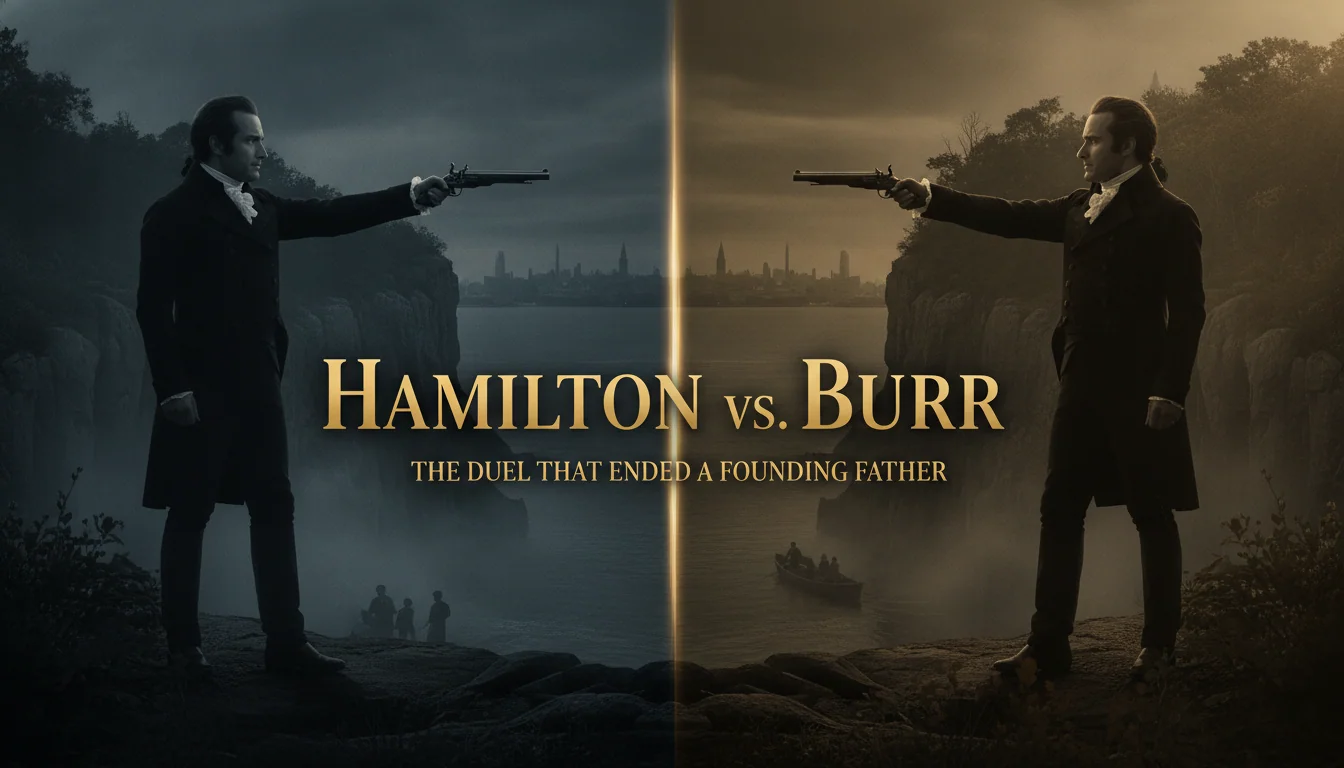
Every few years a Broadway soundtrack convinces a new generation that Founding Fathers rapped, and every few years that same generation discovers that the underlying story needs no embellishment at all. Two ambitious New York lawyers, over a decade of mutual contempt, and a dueling ground in Weehawken, New Jersey add up to one of the few American political rivalries that actually ended with a body, the kind of fatal ending Elizabeth I and Mary, Queen of Scots would have recognized two centuries earlier.
Lin-Manuel Miranda's musical did not invent the drama between Alexander Hamilton and Aaron Burr. It just put it back on stage. The real feud was a slow-burning grudge between two of the most talented men of the founding generation, and it is worth separating what they actually fought about from what a catchy hip-hop number compresses into three minutes.
The stakes
Hamilton and Burr were never fighting over an abstraction. They were fighting over the same small pond: elite New York law and politics in the 1780s and 1790s, when the city's bar had only a handful of top attorneys and its politics ran through a few powerful families. Both men were self-made in different ways, both were Revolutionary War veterans, and both wanted to be the dominant political force in New York and, by extension, the young republic.
Hamilton had an ideological project. He believed in a strong federal government, a national bank, and an alliance with commercial and financial interests, and he treated the Federalist party as an instrument for building that vision. Burr, by most contemporary accounts including Hamilton's own letters, had no comparable fixed program. He moved between factions, built his own following inside the Democratic-Republican coalition, and struck Hamilton as an operator without a compass, brilliant but unanchored to any principle beyond his own advancement.
That difference, real or exaggerated, became the engine of the rivalry. Hamilton did not just disagree with Burr. He came to view him as genuinely dangerous, a man whose ambition, in Hamilton's words, made him unfit for power of any kind.
Hamilton's case, argued fairly
Hamilton's side deserves a real hearing before it gets flattened into "sore loser." He arrived in New York from the Caribbean with nothing, fought through the Revolutionary War as an artillery officer and aide to George Washington, wrote most of the Federalist Papers, built the Treasury Department from scratch, and created the financial architecture, funded debt, a national bank, and a customs system, that let the new republic actually function. He had every reason to believe his judgment about who deserved power carried weight.
His grievance against Burr was not simply personal jealousy. In 1791 Burr defeated Hamilton's father-in-law, Philip Schuyler, in a U.S. Senate race, a result Hamilton took as both a family insult and a warning sign about Burr's coalition-building skill. Through the 1790s Hamilton wrote letter after letter to allies describing Burr as unprincipled and dangerously effective, someone who would say whatever was needed to whichever room he was in. Then came 1800, when the electoral college produced a tie between Thomas Jefferson and his own running mate, Burr, throwing the presidency to the House of Representatives. Hamilton despised Jefferson's politics, but he lobbied Federalist congressmen to make Jefferson president rather than Burr, arguing that Jefferson at least had convictions Burr lacked. It worked, and Burr became vice president under a man who never fully trusted him either.
By 1804, when Burr ran for governor of New York, Hamilton campaigned against him again, and Burr lost badly. Hamilton's defenders can fairly argue he was consistent for over a decade: he opposed Burr's rise at every turn because he sincerely believed Burr's ambition unmoored from principle was a genuine threat to the republic he had helped build.
Burr's case, argued fairly
Burr's side is just as defensible. He was a veteran officer of the Quebec expedition and the Battle of Monmouth, a skilled trial lawyer who regularly out-argued Hamilton in New York courtrooms, and a politician who built a genuinely effective local machine, the Tammany-adjacent networks that helped Democratic-Republicans win New York City in 1800, arguably tipping the entire national election toward Jefferson. Whatever Hamilton said about his lack of principle, Burr's organizing skill directly helped defeat the party Hamilton had spent his career building.
From Burr's vantage point, Hamilton was not a disinterested guardian of republican virtue. He was a rival who had spent thirteen years attacking Burr in private letters that eventually circulated, undermining him with Federalist allies, and campaigning against him in three separate contests, the 1791 Senate race, the 1800 presidential contingency election, and the 1804 governor's race. By Burr's own account, and by the account of allies who saw Hamilton's letters, the criticism went well past policy disagreement into repeated, specific attacks on his character. A man who has been called dangerous and unprincipled in writing for over a decade has a reasonable claim to feeling targeted rather than merely outmaneuvered.
The clashes, in order
The rivalry moved through a clear sequence of confrontations. The 1791 Senate defeat of Schuyler opened the breach. The 1800 election crisis, in which Hamilton actively worked to deny Burr the presidency he had tied for, deepened it into real enmity. The 1804 New York governor's race, another Hamilton-backed defeat for Burr, brought it to a head.
The final spark was almost absurdly small next to the buildup. An Albany newspaper published a letter from a Dr. Charles D. Cooper reporting secondhand that Hamilton had voiced a "still more despicable opinion" of Burr at a private dinner, without specifying what that opinion actually was. Burr, freshly humiliated in the governor's race and evidently unwilling to absorb one more slight from Hamilton, demanded a full accounting. Hamilton refused to disavow or specify anything, insisting he could not be held responsible for vague secondhand gossip about a thirteen-year political rivalry. Under the code duello, that refusal to give satisfaction left only one path.
They met at dawn on July 11, 1804, on a rocky ledge above the Hudson at Weehawken, the same spot where Hamilton's eldest son Philip had died in a duel in 1801. Nathaniel Pendleton served as Hamilton's second, William Van Ness as Burr's. Accounts differ on exactly what happened in the exchange of fire, historians still debate whether Hamilton deliberately threw away his shot as he had told friends he intended to, but Burr's ball struck Hamilton in the abdomen. He was rowed back to Manhattan and died the next afternoon at the home of William Bayard, with his wife Eliza and several of their children present.
The verdict: who won
Judged purely on the morning of July 11, 1804, Burr won in the most literal way a rivalry can be won. He walked off that ledge and Hamilton did not.
Everything after that morning reversed the verdict. Burr was indicted for murder in both New York and New Jersey, and although he was never tried, his political career was effectively over. He finished his term as vice president under a cloud, then became entangled in a scheme in the western territories that led to a 1807 treason trial, where Chief Justice John Marshall's narrow reading of the Constitution's treason clause secured his acquittal. He spent the rest of his life in reduced circumstances and public disgrace, dying in 1836 largely remembered as the man who killed Alexander Hamilton.
Hamilton, by contrast, won the argument history actually cares about. His financial system still underpins the American economy, his face is on the ten-dollar bill, and a hip-hop musical about his life ran for years on Broadway and turned Weehawken into a minor pilgrimage site for tourists who had never opened a biography of either man before 2015.
The price of that long-term victory was everything Hamilton actually had: a life not yet fifty years old, cut short over a dispute about words nobody can even fully reconstruct today. Burr paid in reputation what Hamilton paid in years. Measured by who actually got what they wanted, the honest answer is that neither man did. Hamilton wanted Burr permanently discredited and got it, at the cost of his own future. Burr wanted vindication and got a bullet's worth of it, followed by a lifetime as history's designated villain. The only party that came out ahead, in the end, was the story itself, which is still being told more than two centuries later.
Quick Answers
Common questions about this topic
Who won the rivalry between Hamilton and Burr?
By the only measure that matters in the moment, Burr won: he survived and Hamilton did not. But Hamilton won the long game. He became a mythologized Founding Father on the ten-dollar bill and the subject of a hit Broadway musical, while Burr spent the rest of his life as the man who shot him.
Why did Hamilton and Burr duel?
The duel was triggered by a newspaper letter reporting that Hamilton had voiced a 'still more despicable opinion' of Burr at a dinner party, but it capped over a decade of political and professional rivalry between the two New York lawyers, including Hamilton's repeated efforts to block Burr's career.
Were Hamilton and Burr ever friends?
They were cordial professional acquaintances for years, both practicing law in New York and occasionally on the same side of a case, but the surviving record shows no real friendship, only a rivalry that hardened over time.
Did Hamilton die instantly at Weehawken?
No. Hamilton was shot on the morning of July 11, 1804, was rowed back across the Hudson to Manhattan, and died the following afternoon, July 12, at the home of a friend, with his wife and several of his children present.

Hear Both Sides
Chat with history's fiercest rivals and decide who was right.
Create your free account →No card required. Some figures and features require a paid plan.
Join the HistorIQly Club
Get smarter about the past.
Weekly stories, deep dives, and exclusive content straight to your inbox.