Elizabeth I vs. Mary Queen of Scots: The Rival Queens Who Never Met
One throne, two queens, a rivalry fought entirely by letter: Elizabeth I vs Mary Queen of Scots, and how they destroyed each other without ever meeting.
Read Wikipedia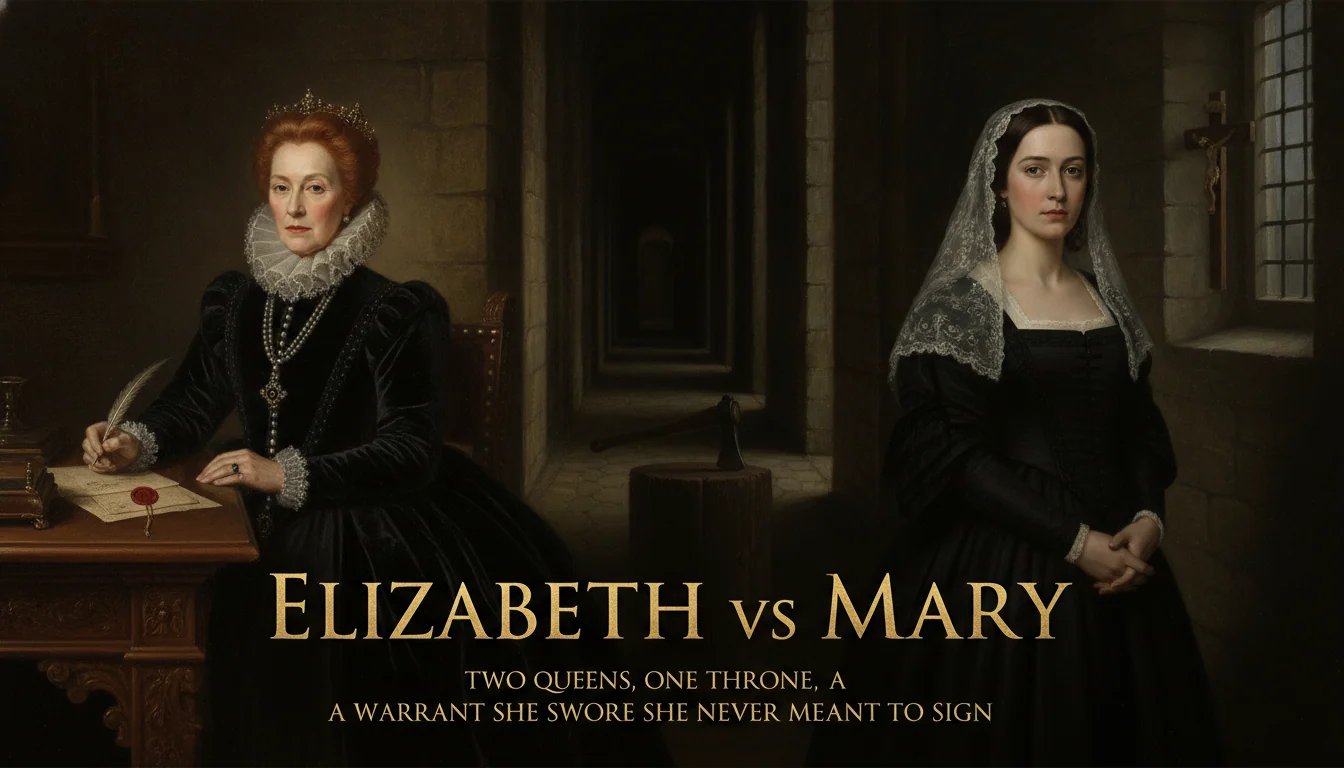
Two queens shared the same island for nearly thirty years, corresponded constantly, plotted against each other by proxy, and never once stood in the same room. That absence is the strangest part of the story. Everything else, the rebellions, Mary's three husbands, the ciphered letters, the scaffold at Fotheringhay, happened across a distance neither woman ever closed.
Elizabeth Tudor and Mary Stuart were cousins once removed, both descended from Henry VII, both raised to rule, and both convinced the other was, on some level, illegitimate. For most of their acquaintance they addressed each other in letters as "sister," a courtesy that survived plots, imprisonment, and eventually a death warrant. One of them would die of it.
The Stakes
On paper, the fight was over a single chair: the throne of England. Elizabeth had held it since 1558, but to Catholic Europe she was the daughter of an unlawful marriage, and therefore no queen at all in the eyes of Rome. Mary, whose grandmother Margaret Tudor was Henry VIII's own sister, was for many Catholics the legitimate heir, and to some the legitimate queen already.
Underneath the succession question sat the sharper one: religion. Elizabeth had settled England, uneasily, as a Protestant realm. Mary had been raised at the French court as a devout Catholic and returned to Scotland in 1561 as a queen surrounded by a Protestant nobility that trusted her only conditionally. Every plot, every foreign alliance, every marriage proposal either woman entertained over the following decades was really a move in the same argument: whose church, and whose bloodline, would hold the island.
Neither woman had the luxury of treating the other as an abstraction. Mary was, for most of Elizabeth's reign, the person a Catholic assassin or invading army would most plausibly crown in Elizabeth's place. Elizabeth was the jailer standing between Mary and both her freedom and her claim.
There was also a quieter, more personal stake that both queens understood without ever saying aloud: succession. Elizabeth refused for decades to name an heir, fearing, with good reason, that naming one would give every ambitious faction in England a rival court to plot around while she still lived. Mary, whether she intended it or not, was the closest thing England had to an obvious answer to a question Elizabeth was determined never to answer.
Elizabeth's Case
Elizabeth's position, argued sympathetically, is the position of a woman who spent her entire reign one plot away from losing everything. She had watched her own mother executed as a child, had been imprisoned in the Tower of London by her sister Mary I on suspicion of treason, and came to the throne knowing exactly how quickly a queen's fortune could turn. She had no wish to set a precedent for executing an anointed monarch, cousin or not, and she resisted doing so for years even as her council pushed her toward it.
She also, by her own account, never wanted the fight in the first place. When Mary fled to England in 1568 after losing her own throne, Elizabeth had a plausible, sympathetic case for taking her in as a fellow queen in distress. Instead she found herself holding a magnet for every Catholic conspiracy in Europe, unable to free Mary without risking her own crown and unable to execute her without setting a precedent that could just as easily be turned on Elizabeth herself one day. Her caution, which frustrated her ministers for two decades, reads less like weakness than like a woman doing the math on how few good options she actually had.
Mary's Case
Mary's position is no less sympathetic. She became Queen of Scots six days after birth and Queen consort of France as a teenager, and by her mid-twenties had lost a husband, a French crown, and then her own Scottish throne through a chain of disasters that were only partly her doing. Her second marriage, to the erratic Lord Darnley, collapsed into violence, and after Darnley was murdered at Kirk o' Field in 1567, Mary's swift remarriage to the Earl of Bothwell, a man widely suspected in the killing, gave her enemies among the Scottish nobility the pretext they needed. Whatever the truth of her role, which remains genuinely disputed, it was enough to turn her own lords against her. Forced to abdicate in 1567 in favor of her infant son and driven out by rebellion, she crossed into England in 1568 expecting Elizabeth's protection as a fellow sovereign and a kinswoman.
What she got instead was nineteen years of house arrest in a rotating set of English castles, without ever being formally charged with a crime for most of that time. From Mary's side, this looked less like justice and more like indefinite detention of an inconvenient rival dressed up as hospitality. It is not hard to see why a woman held for nearly two decades on the suspicion of what she might do, rather than anything proven she had done, eventually let herself be drawn into correspondence with people promising to free her. Whatever she ultimately agreed to, she did it from inside a cage she had not been sentenced to.
Elizabeth I vs Mary Queen of Scots: The Clashes
The two queens fought through intermediaries almost from the start. A planned face-to-face summit in the early 1560s collapsed amid the religious wars in France, and it was the closest they ever came to meeting. After that, the rivalry ran on letters, ambassadors, and plots.
The Ridolfi Plot of 1571, a scheme to marry Mary to an English Catholic duke and depose Elizabeth with Spanish help, ended with the duke's execution and Mary's confinement tightening. The Throckmorton Plot of 1583 raised the same alarm again. By 1584, Elizabeth's council had pushed through the Bond of Association, a pledge by English nobles to hunt down and kill anyone who benefited from a plot against the queen, Mary included, whether or not Mary herself had known of it. Elizabeth reportedly hinted to Mary's longtime keeper, Amias Paulet, that he might find a quieter way to end the problem without a trial at all; Paulet refused, unwilling to take a life without lawful order to do so.
The decisive clash came in 1586. Francis Walsingham, Elizabeth's spymaster, had been intercepting and decoding Mary's smuggled correspondence for months, and the Babington Plot handed him what he needed: a letter in which Mary appeared to approve of a plan to assassinate Elizabeth and place herself on the throne. Mary was tried at Fotheringhay Castle that October and convicted of treason. Elizabeth agonized for months afterward, in a way that exasperated her own councilors, before finally signing the death warrant, which was sent to Fotheringhay in February 1587. Mary Stuart was executed there, reportedly composed and defiant to the last, dressed for the occasion in a way that turned her death into its own piece of political theater.
The Verdict
Elizabeth won the rivalry in the only sense that mattered while both women were alive. She kept her throne, kept her head, and reigned another sixteen years after the execution, presiding over the defeat of the Spanish Armada and a golden age of English culture that still carries her name. Mary, by contrast, lost her freedom, her reputation, and finally her life at Fotheringhay, having spent the better part of two decades as a prisoner for a crown she never got to sit on.
But the win cost Elizabeth more than she wanted to pay. She insisted afterward that she had never meant the warrant to be carried out so quickly, blamed her secretary William Davison for sending it without her explicit final word, and had him imprisoned in the Tower of London, his career finished, as a public scapegoat for a decision that was unmistakably her own to make. Catholic Europe was outraged, Scotland and France registered furious protests, and Elizabeth spent the rest of her reign managing the fallout of a killing she publicly mourned and privately ordered.
And Mary, in the end, won the argument that actually decided England's future. Elizabeth never married and died childless in 1603. The throne passed to Mary's son, James VI of Scotland, who became James I of England and united the two crowns his mother had spent her life fighting to hold. Every English and British monarch since has descended from Mary Stuart, not from Elizabeth Tudor. Elizabeth won the reign. Mary won the bloodline. Two rival queens who never shared a room ended up sharing, in the most literal way possible, the same throne.
Elizabeth's own mother met a similar fate at Henry VIII's order; see the final hours of Anne Boleyn and the downfall of Catherine Howard, another queen the Tudor court destroyed.
Quick Answers
Common questions about this topic
Did Elizabeth I and Mary Queen of Scots ever meet in person?
No. Despite nearly three decades as rival queens and cousins, and years of correspondence addressing each other as sister, the two women never met face to face. A proposed summit in the early 1560s fell through, and after 1568 Mary was in custody in England, which made a meeting politically impossible for Elizabeth to grant.
Why was Mary Queen of Scots executed?
Mary was convicted of treason after letters intercepted by Francis Walsingham's spy network showed she had approved of a plot, known as the Babington Plot, to assassinate Elizabeth I and put herself on the English throne. She was tried at Fotheringhay Castle in October 1586 and executed in February 1587.
Did Elizabeth I really not mean to sign the death warrant?
Elizabeth signed the warrant in February 1587 but afterward insisted she never intended it to be sent immediately, and she blamed her secretary William Davison for dispatching it without her final word. Davison was imprisoned in the Tower of London and his career ended, while Elizabeth publicly professed grief and anger over the execution.
Who won the rivalry between Elizabeth I and Mary Queen of Scots?
Elizabeth won in her own lifetime, keeping her crown and her head. But Mary won the longer game: her son James VI of Scotland inherited the English throne when the childless Elizabeth died in 1603, and every subsequent English and British monarch descends from Mary Stuart, not from Elizabeth Tudor.

Hear Both Sides
Chat with history's fiercest rivals and decide who was right.
Create your free account →No card required. Some figures and features require a paid plan.
Join the HistorIQly Club
Get smarter about the past.
Weekly stories, deep dives, and exclusive content straight to your inbox.