Muhammad Ali vs. Joe Frazier: Boxing's Bitterest Trilogy
Ali vs Frazier was three fights and one shattered friendship: how Ali's cruelty toward Frazier turned a boxing rivalry into the sport's deepest wound.
Read Wikipedia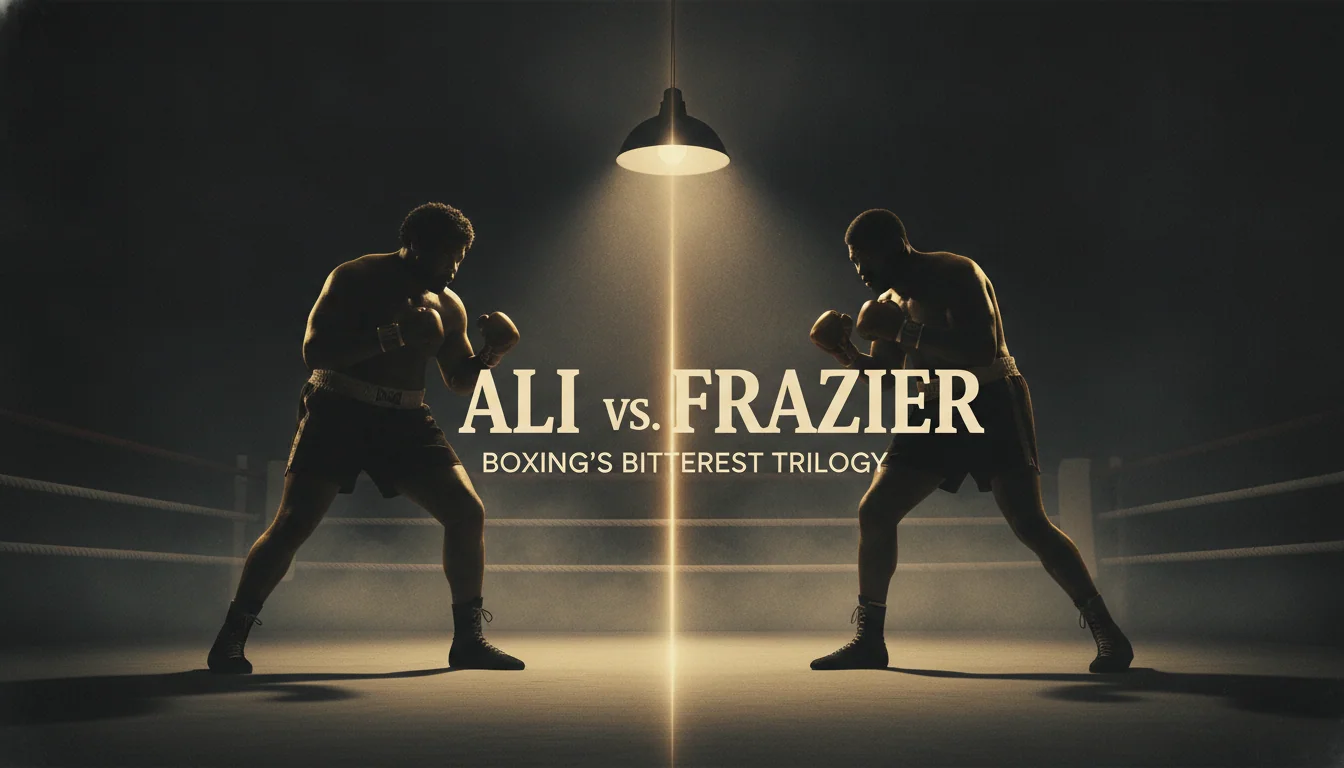
Three times between 1971 and 1975, in what fight fans still call Ali vs Frazier, two undefeated heavyweight champions climbed into a ring and tried to take each other apart. Boxing has produced bigger paydays and stranger characters, but it has never produced a feud that combined this much real violence with this much real cruelty outside the ropes. Muhammad Ali and Joe Frazier fought a trilogy that is still cited, without much argument, as the high point of the sport. What makes it endure isn't just the punches. It's the fact that one man spent years humiliating the other in public, and the other man spent years hating him for it while quietly having done nothing to deserve it.
What They Were Actually Fighting Over
On paper, the stakes were simple: the heavyweight championship of the world, the only title that mattered in the sport's biggest era. Underneath that, the stakes were tangled up with Vietnam, race, and religion in ways neither man fully controlled.
Ali refused induction into the US Army in 1967, citing his religious objections as a Muslim and his famous line that he had no quarrel with the Viet Cong. He was convicted of draft evasion, stripped of his title, and denied a boxing license in every state for roughly three and a half years, the physical prime of his career. When the Supreme Court unanimously overturned his conviction in 1971, he was already back in the ring, but the years he lost were gone for good. Frazier, meanwhile, had become heavyweight champion in Ali's absence, and by the time of their first fight in 1971 both men held a legitimate claim to being undefeated champions with something to settle.
There was serious money involved too. The first fight alone reportedly guaranteed each man a purse in the neighborhood of $2.5 million, an enormous figure for the era, and Madison Square Garden was packed with celebrities, including Frank Sinatra, who worked the fight ringside as a photographer for a magazine assignment because he could not get a ticket any other way. Closed-circuit broadcasts carried it to arenas around the world. This was not a niche sporting grudge. It was, briefly, the biggest event in American entertainment.
That is the plain version. The uglier version is that Ali, whose entire public persona ran on provocation, decided Frazier made a useful foil, and cast him as the establishment's fighter against Ali's own image as the defiant outsider. It was a role Frazier had never auditioned for and did not deserve.
Ali's Case
Ali's supporters have a genuinely strong argument, separate from the insults. He lost three and a half prime years of his career and his title not for anything he did in the ring but for a political and religious stand that the country's highest court eventually vindicated. He came back after that exile and had to re-earn everything, starting essentially from scratch against a man who had inherited his throne. From Ali's side, some of the pre-fight theater was simply what he did to every opponent: he had needled Sonny Liston and Floyd Patterson with similar routines. Trash talk sold tickets, and Ali, better than anyone before him, understood that a fight promoted like a morality play made more money than one promoted as a sporting event.
Ali also fought Frazier three times when he did not have to, including a non-title rematch in 1974, and by most accounts he respected Frazier's toughness more than he respected almost any other opponent's. Even late in life, by several accounts, Ali expressed regret for how far he had taken the taunting.
Frazier's Case
Frazier's case is simpler and, to most observers who have looked at the record since, more sympathetic. He grew up the child of South Carolina sharecroppers, moved to Philadelphia as a teenager, and worked at a meatpacking plant while training in local gyms. He won Olympic gold in the heavyweight division at the 1964 Tokyo Games, reportedly fighting through an injured thumb to do it. He built himself into a heavyweight champion through a grinding, disciplined style, the opposite of Ali's improvisational flash, and by his own account he never asked to be anyone's political symbol.
What made Frazier's grievance so lasting was not the boxing. It was that he had genuinely helped Ali during the exile years, lending him money and publicly supporting his right to fight again, only to be mocked by Ali afterward as ugly, ignorant, and an Uncle Tom, a phrase loaded with implications about racial authenticity that Frazier, a Black man from the segregated South who had built his own life without any of Ali's advantages, found unbearable. In the buildup to their third fight, Ali repeatedly called him a gorilla and staged mock fights with a small rubber toy, coining the line that it would be "a killa and a chilla and a thrilla when I get the gorilla in Manila." Frazier, by his own later account, carried real hatred for Ali for years afterward, at one point saying pointedly cutting things about him around the time of the 1996 Atlanta Olympics, where Ali lit the torch.
Three Fights, in Order
Fight one, March 1971, Madison Square Garden. Both men were undefeated, both had legitimate claims to the championship, and the bout was billed, accurately for once, as the Fight of the Century. Frazier dropped Ali with a left hook in the fifteenth round and won a unanimous decision, handing Ali the first defeat of his professional career.
Fight two, January 1974, Madison Square Garden. By this point Frazier had lost his title to George Foreman in a lopsided 1973 upset, so the rematch was a non-title bout. Ali won a unanimous decision in a fight that lacked the drama of the first, but it set up the trilogy's finale by evening the record.
Fight three, October 1975, Quezon City, Philippines. Ali had reclaimed the heavyweight title from Foreman in Zaire the year before, so the Thrilla in Manila was a genuine championship fight, and it remains the standard against which brutal, sustained boxing is measured. Both men fought in punishing heat, absorbing the kind of sustained punishment few fighters could withstand. By the fourteenth round Frazier's eyes were swelling shut, and his trainer, Eddie Futch, refused to let him answer the bell for the fifteenth, ending the fight. Ali, by his own account, was nearly finished as well and later said the fight felt like the closest thing to death he had experienced.
The Verdict: Who Won, and What It Cost
In the ring, the record is unambiguous: Ali won the trilogy two fights to one. In the larger cultural argument, Ali also won decisively. He is remembered as boxing's defining figure, a man whose politics were eventually vindicated and whose talent was matched by his instinct for spectacle. Frazier, for decades, was remembered mostly as the opponent, the man Ali beat twice and humiliated in the buildup to a third fight that nearly killed them both.
But the price of that verdict fell unevenly, and not in the direction the record suggests. Frazier paid an emotional cost that never fully resolved. He had been a loyal, generous man toward Ali during the hardest years of his career, and he spent much of his life bitter about the public cruelty he received in return, a grievance that historians and sportswriters have increasingly treated as fully justified rather than sour grapes. Ali paid a physical cost. The trilogy, and especially the fourteen unrelenting rounds in Manila, is widely cited among the cumulative damage behind the Parkinson's disease that slowly took his voice and mobility in the decades that followed.
There was some late reconciliation. The two men's relationship warmed somewhat in later years, and Ali attended Frazier's funeral in Philadelphia after Frazier died in 2011. It came after Frazier had spent most of his life feeling like the answer to a question nobody had bothered to ask him: not who won the fights, but who had actually been the better man outside the ring. On the evidence, that verdict runs the other way from the one boxing history handed down for so long.
For other rivalries that curdled into something personal, see Tesla vs. Edison and Stalin vs. Trotsky.
Quick Answers
Common questions about this topic
Who won the rivalry between Muhammad Ali and Joe Frazier?
Ali won the trilogy two fights to one, taking the second and third meetings after Frazier won their first encounter in 1971. Ali also won the larger cultural battle, remembered as boxing's transcendent figure, but the trilogy cost both men heavily: Frazier carried real resentment for years, and the punishment Ali absorbed in Manila is widely cited among the accumulated damage behind his later Parkinson's disease.
What did Muhammad Ali say about Joe Frazier that caused so much anger?
Ali repeatedly called Frazier ugly, ignorant, and an Uncle Tom, and mocked him as a gorilla in the buildup to their third fight. Frazier took the insults personally because, by his own account, he had quietly supported Ali during his exile from boxing, including lending him money, which made the public mockery feel like a betrayal rather than mere promotional theater.
Why is the Thrilla in Manila considered the greatest fight ever?
Both men fought past the point most fighters quit, trading heavy punishment for fourteen rounds in extreme heat until Frazier's trainer, Eddie Futch, stopped the fight before the fifteenth round because Frazier's eyes had swollen shut. Ali later said it was the closest he ever came to dying in the ring.
Did Ali and Frazier ever reconcile?
Only partially. Frazier remained openly bitter for much of his life, including pointed comments around the 1996 Olympics, but the two men had warmer exchanges in later years and Ali attended Frazier's funeral in 2011.

Hear Both Sides
Chat with history's fiercest rivals and decide who was right.
Create your free account →No card required. Some figures and features require a paid plan.
Join the HistorIQly Club
Get smarter about the past.
Weekly stories, deep dives, and exclusive content straight to your inbox.