Stalin vs. Trotsky: The Rivalry That Ended With an Ice Axe
After Lenin's death, Stalin and Trotsky fought for control of the Soviet Union. Stalin won total power; Trotsky was exiled, then killed in Mexico in 1940.
Read Wikipedia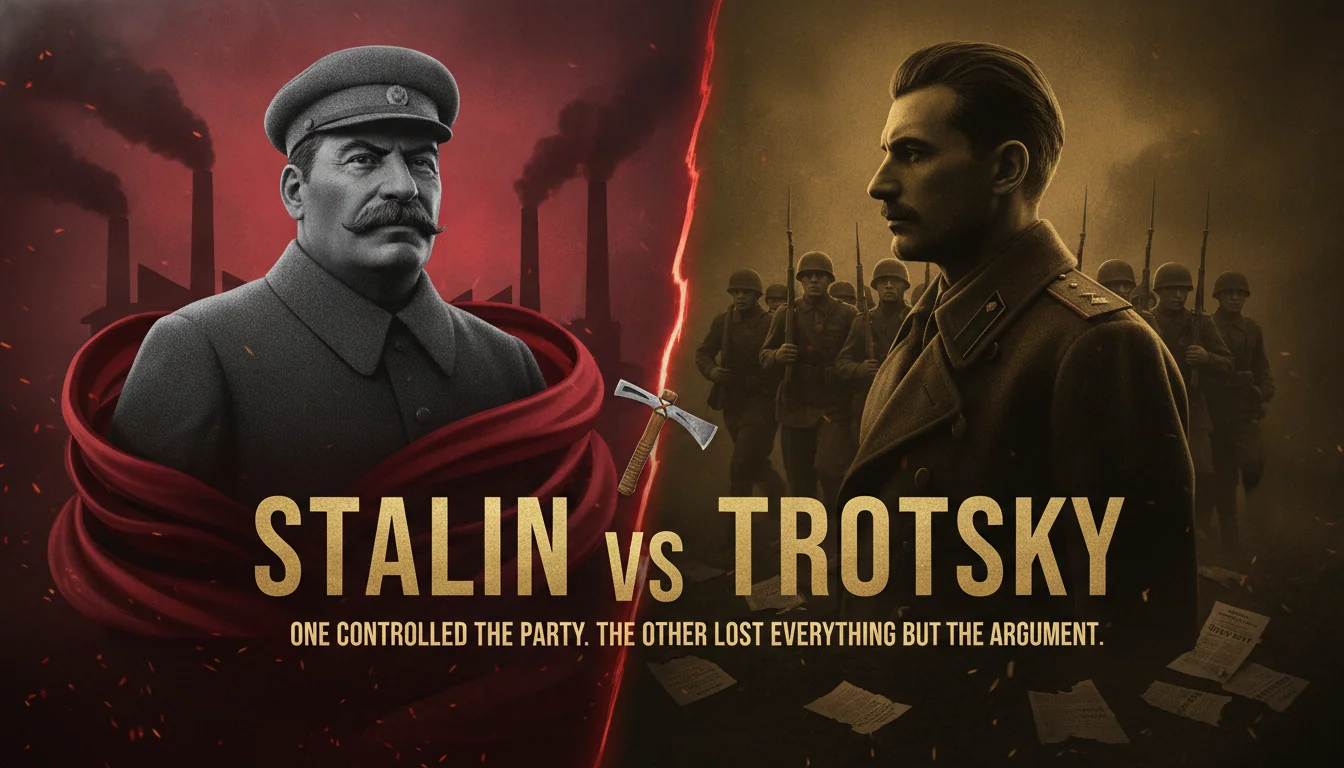
When Vladimir Lenin suffered the stroke that would eventually kill him, he left behind a revolution with no agreed successor and two men who each believed, with genuine conviction, that they were the one meant to carry it forward. Joseph Stalin controlled the party machine from the inside. Leon Trotsky commanded the Red Army's reputation and the intellectual respect of much of the international left. Their rivalry over the following sixteen years reshaped the Soviet Union, and it ended not in a parliamentary vote or a battlefield but with a modified mountaineering ice axe in a walled garden in Mexico City.
The Stakes
The question was simple to state and enormous in consequence: who would lead the Soviet Union after Lenin, and whose reading of Marxism-Leninism would define the revolution's next phase. This was not an abstract debate. Whoever won would control the party apparatus, the security services, the direction of the economy, and the fate of everyone who had backed the losing side. Lenin had never designated a successor, and the Bolshevik party had no real mechanism for choosing one beyond internal maneuvering, alliance-building, and, eventually, force.
Both men had genuine claims. Trotsky had organized the October Revolution's insurrectionary committee and then built the Red Army essentially from nothing, leading it to victory in the Civil War. Stalin had spent years running the party's internal machinery as General Secretary, a job that looked administrative and dull from the outside but that gave him control over appointments, records, and the levers that actually moved a bureaucracy. Historians still debate how much of the coming struggle was ideology and how much was simply two ambitious men and their allies fighting for survival in a system where losing meant more than losing an argument.
Stalin's Case
Stalin's supporters, and Stalin himself, framed his rise as the triumph of patient organization over showmanship. As General Secretary, a post he took in 1922, Stalin built a network of loyal appointees throughout the party structure, a position Trotsky and others reportedly underestimated at the time as too bureaucratic to matter. Stalin argued that Trotsky's vision of permanent revolution was a dangerous gamble, tying the Soviet Union's fate to uprisings abroad that might never come. His own doctrine, socialism in one country, held that the Soviet Union could and should build a socialist economy on its own resources first, without waiting on revolutions in Germany or elsewhere that had already failed to materialize after the war.
This was not merely opportunism, even if it also happened to suit Stalin's position. To many party members exhausted by civil war, famine, and foreign intervention, the promise of consolidating what they already had felt more realistic than betting the country's survival on international revolution. Stalin also benefited from being seen, at least initially, as a moderate, unifying figure compared to the mercurial and often abrasive Trotsky. He built alliances with other senior Bolsheviks, notably Grigory Zinoviev and Lev Kamenev, and used the party's own disciplinary machinery, rather than open confrontation, to isolate Trotsky one procedural step at a time.
Trotsky's Case
Trotsky's case rests on a genuinely formidable record. He had been the chief organizer of the October Revolution's seizure of power and had then, as Commissar of War, built the Red Army into a force capable of winning the Civil War against multiple White armies and foreign interventions, often traveling the front lines in an armored train to rally exhausted troops. He was also, by most accounts, the more original and forceful thinker of the two, a prolific writer whose theory of permanent revolution held that a socialist state in one country, especially a relatively underdeveloped one like Russia, could not survive indefinitely surrounded by capitalist powers unless the revolution spread.
Trotsky's supporters argued that Stalin's rise reflected bureaucratic maneuvering rather than genuine leadership, and that Stalin had cynically adopted whichever position, including borrowing pieces of Trotsky's own arguments at times, best served his accumulation of power. Trotsky also carried real intellectual standing among Marxists internationally in a way Stalin, whatever his organizational skill, did not. By Trotsky's own account, he underestimated how much day-to-day party control mattered compared to revolutionary credentials and public argument, a miscalculation he would later describe with some bitterness in his own writing from exile.
The Key Clashes
Lenin's declining health forced the question early. In late 1922 and early 1923, he dictated a series of notes, since known as Lenin's Testament, assessing the party's senior figures. Historians debate the precise wording and Lenin's full intent, but the notes reportedly criticized Stalin's rudeness and excessive concentration of power and suggested he be removed from his post as General Secretary, while also raising doubts about Trotsky's temperament and administrative instincts. After Lenin's death in January 1924, the party leadership, including Kamenev and Zinoviev, chose to keep the document largely out of wide circulation rather than let it detonate the leadership question outright.
With Lenin gone, Stalin, allied with Kamenev and Zinoviev in a ruling troika, spent the following years outmaneuvering Trotsky through party congresses and committee votes rather than open confrontation. Trotsky's own faction, weakened by his failing health at key moments and by his rivals' control of the party apparatus, steadily lost ground. Stalin then turned on his former allies once Trotsky was sufficiently isolated, absorbing much of their support in turn. By 1927, Trotsky had been expelled from the Communist Party's Central Committee and then from the party itself. In 1929, two years later, he was expelled from the Soviet Union entirely, beginning an exile that took him through Turkey, France, and Norway before he settled in Mexico in 1937.
Trotsky spent his exile years writing prolifically, most notably "The Revolution Betrayed," a sustained critique arguing that Stalin's Soviet Union had abandoned genuine socialism for a bureaucratic dictatorship. Back in the USSR, Stalin's consolidation of power hardened into the Great Terror of the later 1930s, a wave of purges, show trials, and executions whose precise death toll historians still dispute, though most estimates run into the hundreds of thousands executed and far more sent to labor camps. Many of Trotsky's former allies and even former enemies who had once sided with Stalin were swept up in the same purges. On August 20, 1940, at his guarded home in Coyoacán, Mexico City, Trotsky was attacked by Ramon Mercader, an agent recruited by Soviet intelligence who had spent months gaining his household's trust. The weapon is described in different sources as an ice axe and, less precisely, an ice pick; it was in fact a mountaineering ice axe with its long handle sawed down so it could be hidden under a coat. Trotsky died of his wounds the following day.
The Verdict: Who Won, and What It Cost
By any practical measure, Stalin won, and won completely. He controlled the party, the state, and the machinery of Soviet life for roughly three decades after Trotsky's expulsion, while Trotsky ended his life stateless, guarded, and ultimately murdered on the other side of the world from the revolution he had helped make. There is no meaningful sense in which the power struggle itself was close by the time it concluded.
But the victory came at a staggering price, one Stalin himself imposed on his own side as much as on Trotsky's. The purges that secured and then re-secured Stalin's grip on power consumed not only real and imagined Trotskyists but much of the old Bolshevik leadership, military officer corps, and party rank and file who had helped Stalin win in the first place. Total power, once achieved, appears to have bred a permanent suspicion that made the winning nearly indistinguishable from a continuing war against phantom enemies.
Trotsky, for his part, lost everything material: his party, his country, his safety, and eventually his life at the end of an ice axe wielded by a man he had briefly trusted. Yet his critique of Stalinism, the argument that a bureaucratic dictatorship had betrayed the revolution's original promise, outlived him as a distinct current of Marxist thought, one that persisted in various Trotskyist movements long after Stalin's own system had been discredited from within by his Soviet successors. Stalin won the rivalry. Whether he won the argument is a different question, and it is one that history has left considerably more open.
Quick Answers
Common questions about this topic
Who won the rivalry between Stalin and Trotsky?
Stalin won in every practical sense. He controlled the Soviet Union outright by the early 1930s, while Trotsky was expelled from the party in 1927, exiled from the USSR in 1929, and assassinated in Mexico City in 1940. Stalin's victory came at the cost of the purges that followed, which consumed millions of lives, including many of the same Bolsheviks who had helped him win.
What was Lenin's Testament and why did it matter?
It was a dictated note from late 1922 and early 1923 in which Lenin assessed the party's leading figures, reportedly criticizing Stalin's rudeness and concentration of power and suggesting he be removed as General Secretary. Its exact wording and Lenin's precise intent are still debated, but the party leadership largely suppressed it after Lenin's death in January 1924.
How and when was Trotsky assassinated?
Trotsky was attacked on August 20, 1940, at his fortified home in Coyoacán, Mexico City, by Ramon Mercader, an agent working for Soviet intelligence, and died of his injuries the next day. Sources differ on whether the weapon is best called an ice axe or an ice pick; it was a modified mountaineering ice axe with the handle shortened for concealment.
What was the actual disagreement between Stalin and Trotsky?
Trotsky championed permanent revolution, the idea that socialism in one country would fail unless the revolution spread internationally. Stalin backed socialism in one country, arguing the Soviet Union could and should build socialism on its own first. The doctrinal fight was inseparable from a personal struggle over who would lead the party after Lenin.

Hear Both Sides
Chat with history's fiercest rivals and decide who was right.
Create your free account →No card required. Some figures and features require a paid plan.
Join the HistorIQly Club
Get smarter about the past.
Weekly stories, deep dives, and exclusive content straight to your inbox.