Michelangelo vs. Leonardo da Vinci: Florence's Bitter Rivalry
In 1504, Florence pitted Michelangelo vs. Leonardo da Vinci on facing walls in the same room. Neither finished. Here is how the rivalry played out, and who won.
Read Wikipedia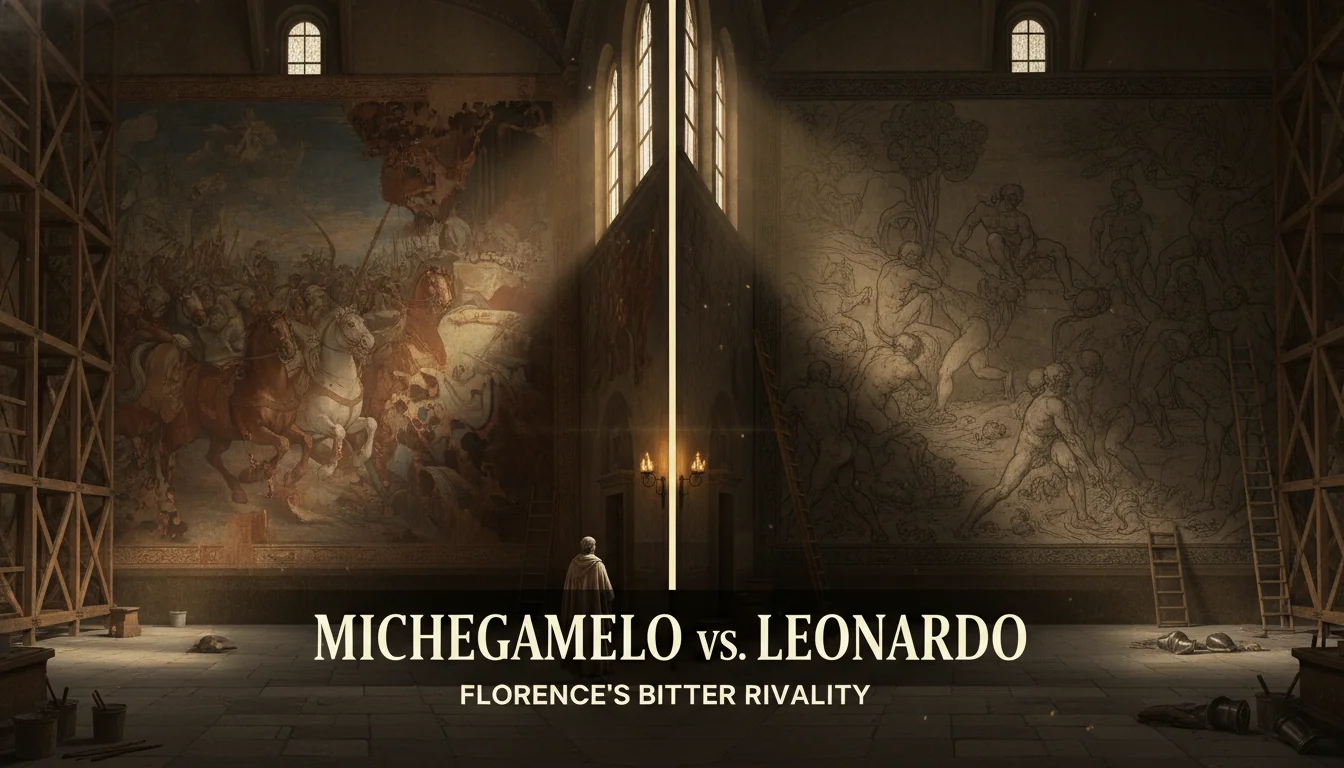
Florence in 1504 was not a large city, and it was not a patient one. It had just watched Piero Soderini's republic survive Cesare Borgia's ambitions and Savonarola's bonfire-fueled theocracy, and it wanted, more than almost anything, to look magnificent again. So when the Signoria needed two enormous battle scenes for the walls of its new council chamber, it did not settle for a single competent painter. It hired both of the most famous artists alive and put them in the same room, on facing walls, to commemorate two different Florentine military victories. It was, in effect, Michelangelo vs. Leonardo da Vinci staged as a government-funded grudge match, and the two men did not need much encouragement to treat it that way.
The Stakes: Two Walls, One Room, One City's Boast
The room was the Sala del Gran Consiglio, the Hall of the Five Hundred, inside the Palazzo Vecchio, built to house the republic's enlarged citizen assembly after the fall of the Medici. Soderini wanted its walls to broadcast Florentine martial glory to every foreign ambassador who walked through. Leonardo da Vinci received the commission first, in the autumn of 1503, for the Battle of Anghiari, a 1440 rout of Milanese forces. Michelangelo Buonarroti was brought in not long after for the Battle of Cascina, a 1364 victory over Pisa. Each man would get one long wall and total creative freedom to make the other look ordinary.
It is hard to overstate how loaded this was. Leonardo, in his early fifties, was already the most admired painter in Italy, fresh off the fame of the Last Supper and quietly at work on what would become the Mona Lisa. Michelangelo, not yet thirty, had just finished the David, a sculpture so overwhelming that a committee including Leonardo himself had been convened to decide where in Florence it should stand. Putting these two men on facing walls was not an accident of scheduling. Florence wanted a spectacle, and for a while, it got one.
Leonardo's Case: The Elder Genius Who Never Finished Anything On Time
Leonardo's defenders, then and now, have a strong argument: nobody before or since has combined that range of curiosity with that level of technical skill. By 1504 he had already produced the Last Supper in Milan, filled notebooks with studies of anatomy, hydraulics, flight, and fortification, and cultivated a reputation as the most cultured man in Italy. He dressed elegantly, kept a household of assistants, and was, by most contemporary descriptions, personally gracious even to rivals.
His weakness was equally well documented, and Florence knew it going in. Leonardo finished very little. Patrons across Italy had learned to expect brilliant beginnings and vanishing endings, as commissions dissolved into research on flight or optics or the mechanics of water. When he took up the Anghiari wall, he approached it as an experiment rather than a straightforward fresco, mixing an oil-and-wax technique on the plaster that he hoped would let him work slowly and revise as he went, the way he liked to paint on panel. It was an ambitious idea from a man who had earned the right to try ambitious ideas. It was also, as things turned out, a mistake.
Michelangelo's Case: The Prodigy Who Despised the Old Master's Airs
Michelangelo's case is the case of youth impatient with reputation. He had none of Leonardo's polish and did not want it. Contemporaries describe him as solitary, unkempt, and prickly, living more like a stonecutter than a courtier even after the David made him famous. He regarded himself first and foremost as a sculptor, and by his own account he took less pride in painting, a craft he considered secondary to carving marble.
What Michelangelo did have was an almost frightening will to finish things and to prove himself against anyone put in front of him. He had spent much of his short career being compared, unfavorably at times, to the giants of the previous generation, and he seems to have regarded Leonardo's fame as inflated by decades of unfinished promises rather than earned by completed work. Where Leonardo treated the Anghiari commission as a chance to experiment, Michelangelo treated the Cascina commission as a chance to settle an argument about who could actually deliver.
The Clashes: An Insult in the Street and Two Ruined Masterpieces
The most quoted flashpoint between the two men has nothing to do with painting at all. An early biographical account describes a public run-in near the Santa Trinita bridge, where a group of Florentines had stopped Leonardo to ask him to help settle a point about a passage of Dante. Leonardo reportedly spotted Michelangelo passing and, perhaps hoping to defer to a fellow expert, suggested he answer instead. According to the same account, Michelangelo took it as mockery, not courtesy, and shot back a jab at Leonardo's most famous unfinished project: a colossal bronze horse commissioned by the Duke of Milan that Leonardo had designed for years and never cast. "You made a design for a horse that could not be cast," he is said to have snapped, "and gave up on it in shame." Leonardo, by most retellings, went red and said nothing. The story survives in only one early source and should be read as testimony to how the two men were perceived, not as a verified transcript, but it is telling that Florentines who lived through the period believed it of them.
The real damage, though, happened on the two walls of the Hall of the Five Hundred. Leonardo got further along than Michelangelo, completing a monumental preparatory cartoon and beginning to paint directly on the wall using his experimental wax-based method. It did not work. Contemporary accounts describe the colors running and the paint failing to set properly even as Leonardo tried to force it to dry with braziers of hot coals. He abandoned the mural, unfinished and already deteriorating, and left Florence for Milan not long after.
Michelangelo never got that far. He completed a cartoon showing Florentine soldiers surprised while bathing in the Arno and scrambling for their armor, a composition prized for its display of the male nude in violent motion. Then, in the spring of 1505, Pope Julius II summoned him to Rome to build his tomb, and Michelangelo left the Cascina fresco unstarted. His cartoon, meanwhile, became one of the most studied objects in Florence. Benvenuto Cellini is said to have called it "the school of the world," and younger artists including Raphael are said to have queued to sketch from it. It was eventually cut into pieces and scattered, reportedly through the rivalry and carelessness of the artists who were allowed to study it, and no fragment is known to survive today.
Neither wall was ever finished as planned. Leonardo's ruined mural was eventually painted over decades later when Giorgio Vasari redecorated the hall, and modern researchers have periodically searched behind Vasari's fresco for traces of what Leonardo left behind, so far without a confirmed find. The room that was meant to hold Florence's two great masterpieces side by side ended up holding neither.
Verdict: Who Won?
If the question is narrowly about the 1504 commission, Michelangelo won it. His cartoon, though physically lost, was by contemporary testimony the more influential work, studied and copied by a generation of painters who shaped the High Renaissance. Leonardo's technical gamble failed in a way that was visible to the whole city, a public humiliation for a man whose fame rested partly on seeming infallible.
But widen the lens and the verdict gets more complicated, and the cost of winning becomes the real story. Michelangelo's victory in the Hall of the Five Hundred bought him nothing but a summons to Rome and decades chained to Julius II's tomb project, a commission so tortured he later called it "the tragedy of the tomb." He spent much of the rest of his life laboring under demanding, often ungrateful patrons, his body wrecked by the marble dust and scaffolding of St. Peter's and the Sistine ceiling. Leonardo, having lost the specific battle, left Florence for a gentler stretch of life in Milan and then France, ending his days as an honored guest of King Francis I at the Clos Luce, sketching to the end without needing to finish anything for anyone.
So call it a split decision. Michelangelo won the argument in the room, and time has largely vindicated his side of it: he went on to paint the Sistine ceiling and reshape the Vatican's dome, output that arguably makes the stronger claim to the title of the era's supreme artist. Leonardo, denied that specific vindication, nonetheless walked away with the more comfortable life and a reputation as the mind that could do anything, even if he rarely bothered to finish proving it. Florence got its spectacle. It just never got either wall.
It's a shape shared by other great historical rivalries, from Newton and Leibniz's fight over who invented calculus to Scott and Amundsen's race to the South Pole, where being right and being remembered turn out to be two different prizes.
Quick Answers
Common questions about this topic
Who won the rivalry between Michelangelo and Leonardo?
By the measure of the specific contest, Michelangelo's cartoon for the Battle of Cascina was more admired and more influential on other artists than Leonardo's failed mural experiment. By the measure of a whole career, both men became titans, though Michelangelo's late run of the Sistine ceiling and St. Peter's arguably gave him the larger long-term claim on the title 'greatest of the age.'
What were Michelangelo and Leonardo actually fighting about?
Mostly temperament and status. Leonardo was in his fifties, courtly, slow to finish work, and consumed by science alongside art. Michelangelo was in his twenties, driven, and contemptuous of what he saw as an older man's unfinished promises. The Florentine government sharpened the rivalry by commissioning both to paint facing battle murals in the same civic hall.
Did Leonardo and Michelangelo ever work together or get along?
Not by most contemporary accounts. They are not recorded as friends, and the surviving anecdotes describe public friction rather than collaboration. They worked in Florence at the same time on several occasions but there is no reliable record of a warm relationship.
What happened to the murals they were supposed to paint?
Neither mural survives as originally intended. Leonardo's experimental technique failed while he was still painting, and the wall was later reworked by Giorgio Vasari. Michelangelo never began his fresco at all; he was called to Rome, and his celebrated preparatory cartoon was later cut up and dispersed.

Hear Both Sides
Chat with history's fiercest rivals and decide who was right.
Create your free account →No card required. Some figures and features require a paid plan.
Join the HistorIQly Club
Get smarter about the past.
Weekly stories, deep dives, and exclusive content straight to your inbox.