Society of the Snow vs. History: How Accurate Is the Andes Crash Film?
Our Society of the Snow accuracy verdict: Bayona's 2023 Netflix film earns a 9/10 for its unflinching, respectful portrayal of the 1972 Andes crash survivors.
Read Wikipedia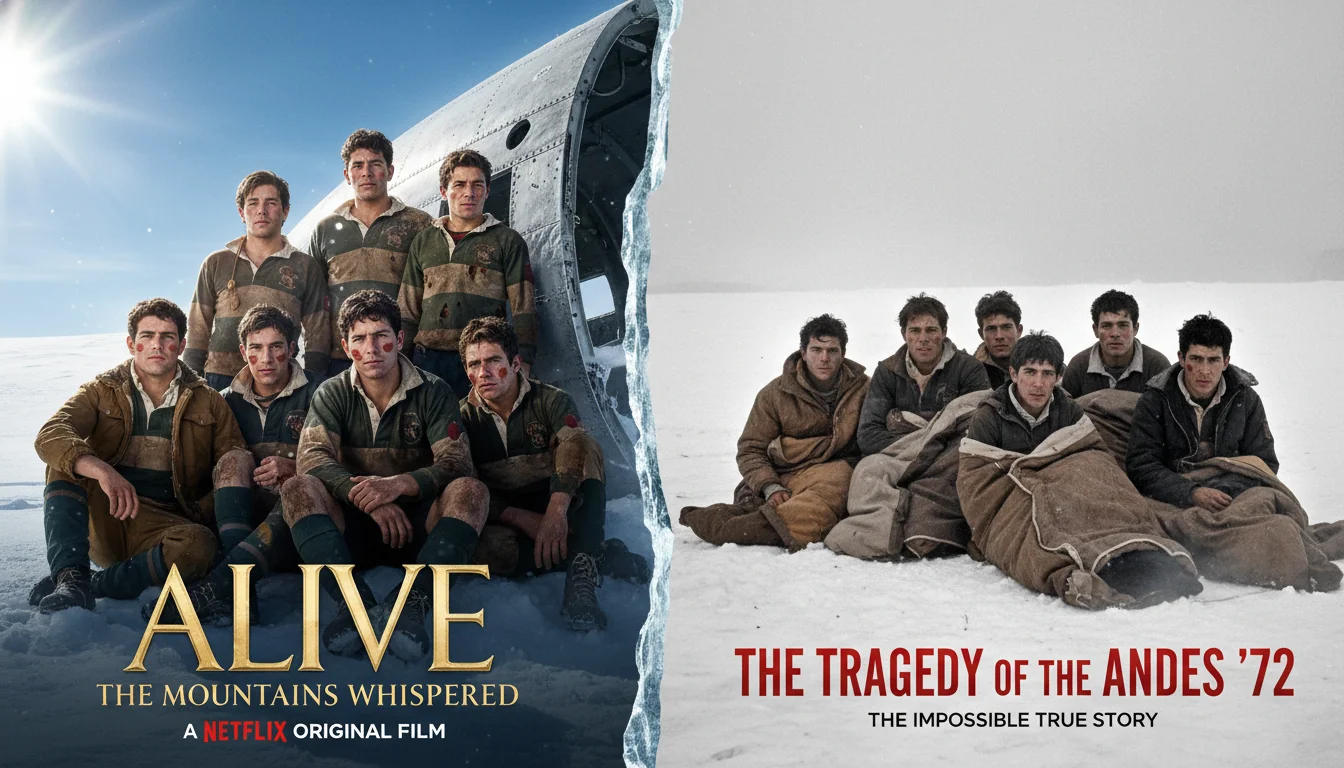
On October 13, 1972, Uruguayan Air Force Flight 571 took off from Montevideo carrying forty-five passengers and crew, most of them members of the Old Christians Club, a Montevideo rugby team traveling to a match in Santiago. The aircraft clipped a mountain ridge in the Andes and broke apart at high altitude. What followed was seventy-two days of survival in one of the most hostile environments on earth.
J.A. Bayona's 2023 Netflix film has been called the definitive account of those days. Unlike the 1993 Hollywood film Alive, which the survivors largely disliked for its dramatized excesses, Society of the Snow was made in close collaboration with the sixteen people still living, shot on location at altitude, and received with genuine emotion by the people it depicted. It won the GOYA Award for Best Film and was nominated for the Academy Award for Best International Feature Film.
So how does Society of the Snow accuracy hold up? Let's check the history against the record.
What Hollywood Got RIGHT
The crash and immediate deaths
The film's opening sequence, in which the aircraft breaks apart and slides down a snowfield, is harrowing and largely accurate in its physical staging. Flight 571 did clip a peak and lose both engines and its tail section before the fuselage came to rest at roughly 3,600 meters in a remote section of the Andes straddling the Argentina-Chile border.
The death toll in the initial crash and the hours immediately following it matches the historical record. Twelve people died on impact or within the first day. The survivors used the intact fuselage as a shelter, packed the gaps with luggage, and faced temperatures that dropped far below zero each night.
The decision to eat the dead
The film handles this with the gravity and collective weight that the survivors themselves have described in interviews and memoirs. The decision to consume the bodies of those who had died was not made by one person or in a single dramatic moment. It was a group discussion, arrived at slowly and painfully over several days, framed within a Catholic theological argument that the dead would want the living to survive.
Bayona does not sensationalize the act. He keeps it in medium shot, shows the hesitation, and treats it as the desperate measure it was. Survivors have consistently said this handling was respectful. The 1993 Alive was criticized for how it depicted the same scenes; the Spanish-language production clearly learned from that criticism.
The avalanche
On October 29, 1972, sixteen days after the crash, an avalanche buried the fuselage in the night. Eight more people died. The survivors dug themselves out over hours, some of them buried for a day before being found.
The film depicts this accurately, including the disorientation, the slow suffocation of those who could not free themselves, and the physical and psychological devastation of losing nearly a third of the remaining group in a single night. It is the film's most devastating sequence and corresponds closely to survivor accounts.
The radio discovery
Survivors found a working transistor radio among the wreckage and eventually picked up a broadcast confirming that the official search for Flight 571 had been called off after eight days. The searchers had concluded there could be no survivors.
This moment, which the film depicts accurately, was psychologically decisive. The group now understood that no one was coming for them. Survival depended entirely on their own initiative. The scene in the film, in which the group absorbs this news in silence, matches descriptions survivors have given in published memoirs.
Parrado and Canessa's trek
The film's climax follows Fernando Parrado and Roberto Canessa as they undertake an improvised ten-day crossing of the Andes in December 1972. The two men carried makeshift equipment - a sleeping bag constructed from seat covers and insulation, climbing equipment fashioned from crash debris - and climbed peaks their training had not prepared them for.
They reached a Chilean muleteer named Sergio Catalan on December 21. Catalan provided food and sent word ahead; Chilean authorities dispatched helicopters the following day. All sixteen survivors were airlifted out by December 23.
The film's depiction of the trek is accurate in its essential geography and duration. The improvised equipment, the physical collapse of Canessa at moments, and the final descent into the valley all correspond to what the men have described in their own accounts.
The narrator who did not survive
The film's most significant structural choice is its narrator: Numa Turcatti, a 25-year-old passenger who died eleven days before the rescue. Turcatti was not part of the rugby team but traveled as a guest. He is shown in the film as thoughtful, morally serious, and quietly devoted to helping the group survive. He died of an infected wound on December 11, 1972.
His selection as narrator is an artistic decision, not a historical one, but it is grounded in real character. Survivors have consistently described Turcatti as one of the most admirable people in the group - gentle, selfless, and deeply missed. Using him as the voice of the dead is the film's most deliberate departure from the linear survival narrative, and it is one the survivors have publicly endorsed.
What Hollywood Got WRONG (or Simplified)
The timeline of the cannibalism decision
The film compresses the time between the crash and the first act of consumption. In the historical record, the decision took approximately ten days of anguished deliberation. The film moves through this period more quickly than the reality, partly for narrative pacing. Survivors have noted this compression without strong objection, since the emotional weight is preserved even if the calendar is not.
Individual character complexity
With sixteen survivors and multiple dead to account for, the film inevitably simplifies some individual arcs. Several passengers who were significant figures in the actual group's social dynamics receive limited screen time or are somewhat flattened for the sake of the ensemble narrative. Pablo Vierci's source book, which the film adapts, deals with this more granularly because it can give each survivor a chapter. The film cannot.
The physical conditions
Several survivors, speaking after the film's release, noted that the cold at night was actually more severe than the film conveys. Temperatures regularly fell to minus 30 or lower. The film shoots the cold atmospherically but necessarily stops short of recreating an experience that would have been impossible to film authentically.
The accuracy verdict
Society of the Snow earns its reputation for fidelity. The essential facts of the crash, the survival strategy, the avalanche, the radio discovery, and the rescue trek are all rendered accurately. The emotional decisions made by the group, including the discussions around the consumption of the dead, reflect what survivors have described in decades of public testimony.
The film's departures are largely structural: a compressed timeline, the choice of a posthumous narrator, and the inevitable simplification that comes with adapting 72 days and 45 people into two hours.
The 1993 Alive scored around 5 out of 10 for historical accuracy. Society of the Snow earns a 9 out of 10. The small deductions are for compression and character simplification, not fabrication.
The film's success in Uruguay and across Latin America was notably different from its reception as a prestige streaming title elsewhere. For Uruguayan viewers, many of whom knew the survivors personally or through family, it functioned as something closer to a national historical document than a film. That dual identity - an art object for international audiences, a memorial for the communities that lived through the events - is part of what makes it the most complete treatment of the 1972 Andes disaster that cinema has yet produced. For other survival-under-impossible-circumstances films tested against the historical record, see our reviews of Apollo 13 and First Man.
Historical accuracy score: 9/10
Quick Answers
Common questions about this topic
What is Society of the Snow based on?
The 2023 Netflix film is based on 'La Sociedad de la Nieve,' a 2009 book by Uruguayan journalist Pablo Vierci who interviewed all sixteen survivors extensively over many years. It is distinct from the earlier 1993 Hollywood film 'Alive,' which was based on Piers Paul Read's 1974 book of the same name.
How many people survived the 1972 Andes crash?
Sixteen people survived out of 45 passengers and crew. Twelve died in the crash or within the first day. Eight more were killed by an avalanche on October 29, 1972. The sixteen survivors spent 72 days in the Andes before rescue on December 22, 1972.
Who were Fernando Parrado and Roberto Canessa?
Parrado and Canessa were the two survivors who undertook the final ten-day mountain trek that reached Chilean civilization and triggered the rescue. Parrado had lost his mother and sister in the crash. Canessa was a medical student. Both became the public faces of the survival account in subsequent decades.
Who is Numa Turcatti and why is he the narrator?
Numa Turcatti was a passenger who died eleven days before the rescue, on December 11, 1972. Society of the Snow chose him as its narrator deliberately, to center the perspective of those who did not make it out rather than the survivors who wrote bestsellers and gave interviews. It is the film's most significant artistic departure from the historical record.

Debate the Accuracy with the Real Figures
Ask the real people what Hollywood got wrong about their lives.
Create your free account →No card required. Talk to anyone in history with 8 free credits a day. Some features require a paid plan.
Join the HistorIQly Club
Get smarter about the past.
Weekly stories, deep dives, and exclusive content straight to your inbox.