The Murder of Suzanne Jovin
Yale senior Suzanne Jovin was stabbed to death four blocks from campus in 1998. Her own thesis adviser was named a suspect and cleared, and the case is still open.
Read Wikipedia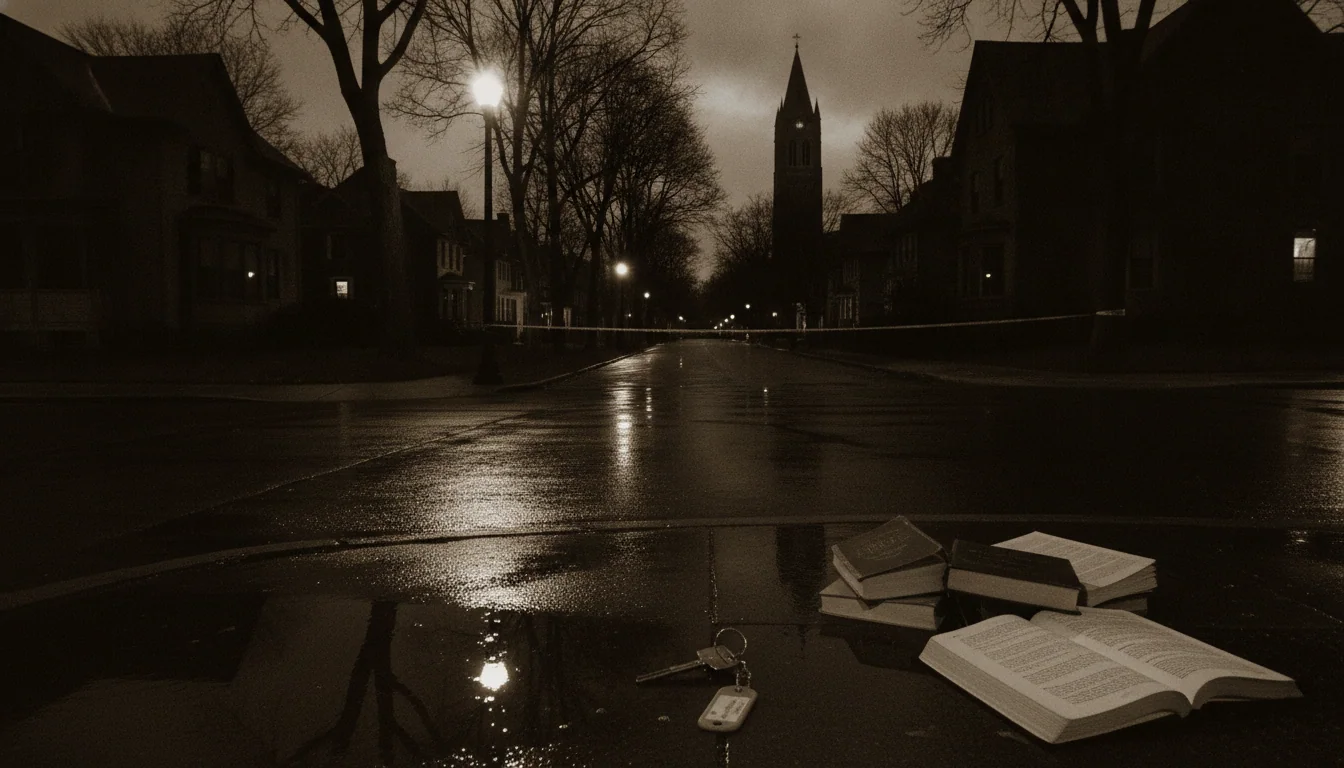
On the evening of December 4, 1998, a Yale senior named Suzanne Jovin returned a rented van to a campus parking lot, dropped off two friends who had just finished a pizza dinner, and told them she was heading home to finish some work. About ten minutes later, at the intersection of East Rock Road and Edgehill Road, roughly two miles from where she had left her friends, a passing motorist found her lying in the street. She had been stabbed repeatedly in the back, neck, and head, and her throat had been slashed. She died before paramedics could get her to the hospital. The gap between where she was last seen and where she was found has never been explained, and neither has anything else about who killed her.
An ordinary Friday, until it wasn't
Jovin was 21, an exchange student from Gottingen, Germany, majoring in international studies and political science, and by every account a serious, well-liked presence on campus. She volunteered with Best Buddies, a mentoring program for young people with intellectual disabilities, and that Friday evening she had attended a holiday pizza party for the program before returning the van the group had used. Friends who saw her that night described her as normal, unhurried, in good spirits. She had recently turned in her senior essay, a research project on the terrorist financier Osama bin Laden, three years before the September 11 attacks would make that subject a matter of obvious public interest rather than an obscure academic exercise.
Her essay adviser was James Van de Velde, a Yale political science lecturer, residential college dean, and former Navy reservist in his mid-thirties. He had supervised her research and, according to some classmates, the two had a normal, professional student-adviser relationship. Within weeks, that relationship would become the center of the entire investigation.
The turning point: a name leaked to the press
New Haven police moved quickly, and within days word reached local reporters that investigators considered Van de Velde a suspect. He was never arrested and never charged, but the label stuck immediately and permanently. Yale placed him on administrative leave and later declined to renew his teaching contract, a decision the university has always maintained was unrelated to any admission of guilt, though the timing devastated Van de Velde's academic career regardless of the outcome of any criminal investigation.
Van de Velde has spent more than two decades publicly and consistently denying involvement, arguing that police fixated on him because he fit a profile, a lone unmarried man who knew the victim, rather than because the physical evidence pointed his way. He passed a polygraph administered by his own expert. He sued the city of New Haven and individual police officials for defamation and violation of his civil rights, a case that dragged through the courts for years before ending in settlements and dismissals that left no formal finding of guilt or innocence on the underlying murder.
What the evidence actually says
The forensic picture has always cut against a quick resolution. Jovin was stabbed at least seventeen times, a level of violence investigators have described as suggesting rage or personal fury rather than a random robbery, and nothing was taken from her. DNA recovered from beneath her fingernails and from other evidence at the scene has been profiled and entered into national databases, and New Haven police have said repeatedly, including in updates as recent as the 2010s, that the profile does not match Van de Velde. It also has not matched any other named person of interest, and no database search has returned a hit.
That mismatch is the single fact that has kept the case from resolving in either direction. If the DNA belongs to the killer, then whoever New Haven detectives spent years scrutinizing was very likely not the person who held the knife. If it does not belong to the killer, for reasons investigators cannot rule out, then the case still lacks any physical evidence connecting a suspect to the crime scene at all.
Competing theories
Beyond Van de Velde, investigators and journalists who have examined the case over the years have floated several other possibilities, none of which have produced an arrest. Some point to the unexplained gap in Jovin's route home, a two-mile detour from a direct walking path, and ask whether she arranged to meet someone or was picked up by a car. Others have raised the possibility of a stranger attack, a theory that gets some support from the sheer brutality of the wounds but struggles to explain why nothing was stolen and why there were no reported witnesses to an assault happening on a residential street.
A minority of researchers who have studied the case, including a retired Yale professor who spent years compiling his own investigative file, have pushed back hard on the idea that Van de Velde was ever a serious suspect, arguing that New Haven police effectively closed off other leads once they settled on him publicly, and that the resulting tunnel vision cost the investigation its best early window for finding the real killer. Police officials involved in the original investigation have disputed that characterization, maintaining Van de Velde was one lead among several pursued at the time, though the public record shows he received disproportionate attention from the moment his name leaked.
A case that outlived a career
Whatever happened at the corner of East Rock and Edgehill, the aftermath reshaped at least one life beyond recognition. Van de Velde went from a rising young academic with a Yale deanship to a man whose name is, for many people, permanently attached to an unsolved murder he says he did not commit and was never charged with. He has continued working in academia and government-adjacent roles in the years since, and has periodically given interviews reiterating his innocence and criticizing how New Haven police and the media handled the case in its earliest days.
Jovin's family, meanwhile, has spent decades pressing for renewed attention to the physical evidence rather than the persistent public fixation on a single named individual. Her parents relocated their advocacy efforts toward keeping the DNA profile active in law enforcement databases, on the theory that genetic genealogy techniques that have cracked other decades-old cases, including the identification of the Golden State Killer in 2018, might eventually do the same here if the right familial match ever surfaces.
Where the case stands today
More than 25 years after Suzanne Jovin's death, the New Haven Police Department and Connecticut's Cold Case Unit still list the investigation as open. The DNA profile from the crime scene sits in the Combined DNA Index System, waiting on a match that has not yet come. No one has ever been arrested. Van de Velde remains, by his own repeated public statement, cleared in every sense except the one that matters most to him: he has never received a formal, official statement from police that he is no longer considered a person of interest.
The case sits in the same uncomfortable category as other cases where an early named suspect absorbed years of public suspicion without ever facing charges, a pattern that shows up in the JonBenet Ramsey case, where intense public suspicion of family members likewise outran the physical evidence for years. Jovin's file remains active, her DNA evidence remains unmatched, and the intersection where she was found has become, for New Haven, a permanent unanswered question about what actually happened during those unaccounted-for minutes on a cold December night in 1998.
Quick Answers
Common questions about this topic
Who was Suzanne Jovin?
Suzanne Jovin was a 21-year-old Yale senior, an exchange student from Gottingen, Germany, who was completing a double major and volunteering with a New Haven youth mentoring program when she was murdered on December 4, 1998.
Was James Van de Velde ever charged with her murder?
No. Van de Velde, Jovin's senior essay adviser, was informally named a suspect by New Haven police within weeks of the killing but was never arrested or charged. He has always denied any involvement, and DNA recovered from the scene has never been linked to him.
What did the DNA evidence show?
New Haven police say DNA recovered from underneath Jovin's fingernails and elsewhere at the scene belongs to an unidentified male profile that has been run against national databases without a match. It does not match Van de Velde or any other named suspect.
Is the Suzanne Jovin case still open?
Yes. More than 25 years later, the New Haven Police Department and the Connecticut Cold Case Unit still list the case as active, and the DNA profile remains on file awaiting a match.

Want to Interrogate the Suspects?
Chat with historical figures and uncover the truth behind history's greatest mysteries.
Create your free account →No card required. Talk to anyone in history with 8 free credits a day. Some features require a paid plan.
Join the HistorIQly Club
Get smarter about the past.
Weekly stories, deep dives, and exclusive content straight to your inbox.