A Time Traveler's Guide to Iron Age Ireland 300 BC
Iron Age Ireland 300 BC survival guide: hillforts, druids, La Tene metalwork, and what to expect from a society that left no writing but stunning craftsmanship.
Read Wikipedia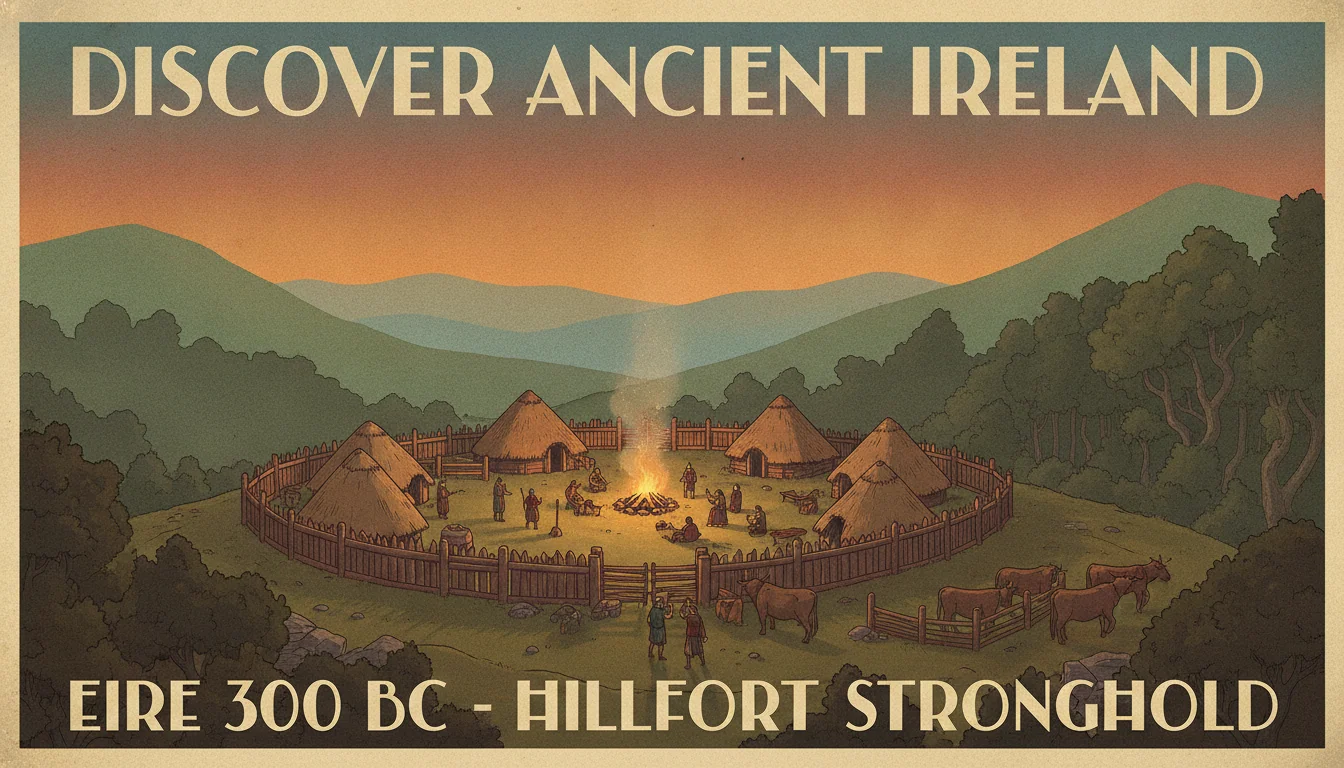
Set your dial for Iron Age Ireland 300 BC, a green, damp, densely wooded island with no writing, no coins, and no cities, but a surprisingly sophisticated web of farmsteads, hillforts, and trade contacts stretching across the Irish Sea and beyond. This is not the Ireland of high crosses and monasteries; Christianity is still six centuries away. This is Iron Age Ireland at the height of what archaeologists call the La Tene period, and it rewards a visitor who understands that its wealth is measured in cattle, its status in craftsmanship, and its politics in obligation rather than law.
First, know what kind of place you're entering
There is no unified "Ireland" to visit in any political sense. The island is divided among dozens, possibly hundreds, of small kin-based territories, each centered on a ruling lineage and its dependents, with boundaries that shift with marriages, raids, and alliances rather than fixed borders. Later Irish literary tradition, written down centuries afterward by Christian monks working from oral material, describes a landscape of competing tuatha, or petty kingdoms, and while that later material cannot be read as a direct transcript of Iron Age political reality, archaeology confirms a landscape of scattered, locally organized power rather than centralized rule.
Most people live on individual farmsteads rather than in villages, often enclosed by a circular earthen bank and ditch, structures archaeologists call ringforts or raths, though the great majority of Ireland's surviving raths actually date somewhat later than 300 BC. In this earlier Iron Age period, expect simpler enclosed farmsteads and, at the top of the social order, hillforts: larger hilltop enclosures ringed with banks and timber palisades, serving as the residences and rallying points of important lineages, along with ceremonial sites of deep and evidently long-standing significance, like the Hill of Tara, already an ancient and important place by this date.
Getting around
There are no roads in any Roman sense, but do not expect pure wilderness either. Trackways of laid timber, remarkably well preserved in Ireland's peat bogs, cross wetland areas, and well-worn paths connect farmsteads, hillforts, and ritual sites across the drier ground. Travel by dugout canoe or hide-covered boat along rivers and the coast is common and often faster than walking, and Ireland's position at the edge of the Atlantic world means coastal contact with Britain and, indirectly, the wider Celtic world of continental Europe is well established, carrying trade goods, ideas, and artistic styles across the sea.
Bring sturdy footwear and expect to get wet. Ireland's climate in this period is broadly similar to today's, mild, damp, and green year-round, with extensive oak, hazel, and elm woodland covering far more of the island than in later centuries, after millennia of subsequent clearance.
What to wear
Wool is your fabric, dyed where affordable in blues, reds, and yellows from plant sources like woad and madder, though undyed and lightly dyed cloth is more typical for everyday wear. Cloaks fastened with a decorative pin or brooch signal status, and the finer your pin's metalwork, the more seriously you will be taken. Leather shoes or simple hide wrappings cover the feet. If you can acquire even a modest bronze or iron ornament, a torc-style neck ring, an armlet, a decorated pin, wear it visibly; personal ornament here is not vanity so much as a legible signal of who you are and who you answer to.
Do not attempt an elaborate gold collar like the Broighter hoard's famous example unless you are prepared to be treated as extremely important, and possibly extremely suspicious. Objects of that quality belong to the highest tier of society or to ritual deposits, not casual visitors.
What to eat
Cattle are the center of the economy and the diet both, valued as much for milk, in the form of curds, soft cheeses, and buttermilk, as for meat, which is more often reserved for feasts and important occasions than daily eating. Pork, mutton, and a range of grains, barley, wheat, and oats, ground and baked into flatbreads or cooked as porridge, round out the ordinary table. Hazelnuts are abundant and heavily relied upon, along with wild greens, berries, and honey as the primary sweetener. Feasting, when it happens, is a serious social institution: a chance to display a lineage's wealth, cement alliances, and reinforce the obligations that hold this stateless society together, and a visitor invited to one should treat the invitation as a meaningful gesture worth reciprocating.
Danger and etiquette
The single most common form of organized violence you are likely to encounter is cattle raiding between rival kin groups, a practice that functions less like modern crime and more like a recognized, even prestige-generating, contest between young men proving themselves, echoed centuries later in the epic cattle-raid narratives of early Irish literature. Approach any settlement, especially a hillfort, openly and unarmed if possible, and bring something to offer, a useful tool, an interesting foreign object, anything that signals you come as a guest rather than a threat. Hospitality obligations run deep in this culture, and a guest properly received is generally safe; the danger comes mainly from being mistaken for a raider or an unaccounted-for stranger.
Religious specialists, later remembered as druids in classical Greek and Roman accounts and in medieval Irish texts, likely hold real authority here as keepers of law, ritual knowledge, and possibly a body of oral learning too important to entrust to Ireland's still-absent writing system, though caution is warranted: no Iron Age Irish source survives to confirm specifics, and much of what later writers claimed about druids reflects Roman anxiety and medieval Christian reinterpretation as much as lived Iron Age practice. Treat any figure who seems to hold ritual or legal authority with careful respect, and do not disturb what looks like a votive offering, a deposited weapon, cauldron, or ornament left in a bog or river; these are not litter, they are likely deliberate religious acts, and Ireland's bogs have preserved a remarkable number of them for archaeologists to find millennia later.
What not to miss
Seek out a skilled metalworker if you can find one; Ireland's Iron Age craftsmen have adapted the continental La Tene artistic style, itself the successor to the earlier Hallstatt culture of central Europe, all flowing spirals, trumpet curves, and stylized plant and animal forms, into a distinctive local variant, visible on weapons, horse gear, and ornaments of real sophistication. The workshops producing this material represent some of the most technically accomplished craft production anywhere in contemporary Europe, achieved without writing, without cities, and largely without direct Roman contact, since Rome's conquests never reach this island. A visit to a major hillfort at a moment of assembly or feasting, or to a significant ritual site during a seasonal gathering, will show you a society that is neither the romanticized wild druid-land of later legend nor a primitive backwater, but something more interesting: a confident, artistically ambitious culture organized entirely on its own terms, three centuries before Rome ever seriously considers crossing the Irish Sea, and never quite manages to.
The seasonal calendar
If your timing is flexible, plan around the great seasonal gatherings that later Irish tradition remembers as Samhain, Imbolc, Bealtaine, and Lughnasadh, quarter points in the agricultural year marking the transitions between the dark and light halves of the year, lambing and calving season, the start of summer grazing, and the harvest. While the detailed rituals attached to these festivals in later medieval texts should be treated with real caution as evidence for this earlier period, the underlying agricultural rhythm they track, moving livestock to summer pasture, gathering kin groups for major decisions and disputes, marking the harvest, almost certainly shaped communal life in 300 BC in some recognizable form, since the practical demands of cattle farming in this climate do not change quickly.
A word on the language
Do not expect to understand much without effort. The language spoken across the island at this point is an early form of Celtic, ancestral to what later developed into Old Irish, and entirely unwritten in any script during this period, ogham inscription being still several centuries in the future. Learn a friendly gesture, a willingness to share food, and patience; hospitality, not fluency, is what will actually get you through your visit to Iron Age Ireland intact, more than a thousand years before the longships and trading towns of Viking Dublin reshape the island entirely.
Quick Answers
Common questions about this topic
What was daily life like in Iron Age Ireland around 300 BC?
Most people lived in small, dispersed farmsteads centered on roundhouses of wattle and daub with conical thatched roofs, raising cattle, sheep, and pigs and growing grains like barley and wheat. Life revolved around the agricultural calendar, cattle wealth, and kin-based social obligations rather than towns or writing.
Did Iron Age Ireland have druids?
Almost certainly some form of learned religious and legal class existed, described in later, less reliable classical and early medieval sources as druids, though no contemporary Irish written record survives from this period to confirm specific details. What we know is inferred from archaeology, later Irish literature, and comparisons to continental Celtic societies.
What is La Tene metalwork and why does it matter?
La Tene is the name for a distinctive continental European Iron Age art style, featuring flowing curvilinear designs, spirals, and stylized animal and plant motifs, that reached Ireland and was adapted into a striking local variant seen on weapons, jewelry, and ceremonial objects like the Broighter gold collar.
Is it dangerous to visit Iron Age Ireland?
Moderately, mainly from cattle raiding between rival kin groups, which functioned as a recognized and even prestige-bearing form of low-level warfare, and from the general hazards of a society without formal police or centralized authority. Approaching a hillfort or ringfort peacefully and with an obvious gift is your safest strategy.

Need Advice from Someone Who Lived There?
Get firsthand accounts from people who actually lived through these moments in history.
Create your free account →No card required. Some figures and features require a paid plan.
Join the HistorIQly Club
Get smarter about the past.
Weekly stories, deep dives, and exclusive content straight to your inbox.