Time Traveler's Guide to Anuradhapura, 300 BC
Ancient Anuradhapura in 300 BC is one of South Asia's oldest capitals: organized, prosperous, and two generations from the Buddhist transformation that will define it.
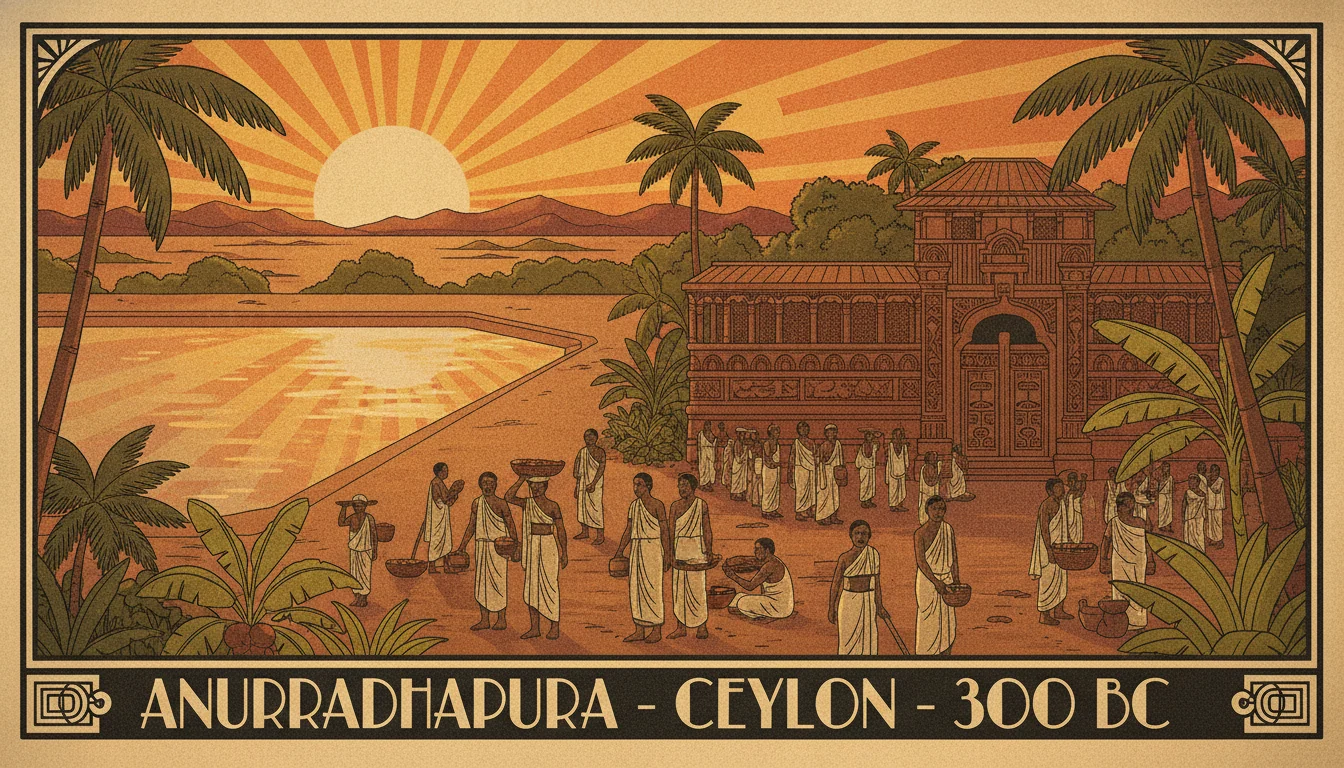
In 300 BC, Anuradhapura is not yet the city that will make it famous. The great white dagobas that will one day rank among the tallest structures on earth are still two or three generations in the future. Buddhism - the faith that will define this city for twelve centuries - has not yet arrived on the island. The monk who will bring it, Mahinda, the son of the Indian emperor Ashoka, is not yet born.
What you are arriving at is a city in its becoming: organized, prosperous, politically sophisticated, and standing on the edge of a transformation it does not yet know is coming. That is what makes it worth visiting.
Getting there and first impressions
Sri Lanka's north-central plain is hot, flat, and almost hypnotically green in the wet season, cracked and dust-pale in the dry one. Anuradhapura sits on this plain at an elevation barely above the surrounding countryside, which means it is visible from a distance primarily through the scale of its activity: market noise, cattle, water buffalo, the movement of people along ceremonial roads leading toward the royal compound.
The city is built around water. The Basawakkulama tank to the northwest is one of the oldest functioning reservoirs in the region, and the engineering behind it - a large earthen embankment holding back monsoon water for the dry months - represents genuine civic ambition. Navigating toward either the tank or the main market district is a reliable way to orient yourself on arrival.
Entering the city from the north, you will pass through a ceremonial gate district. The guards are armed. They will want to know your business. The safest answer, in gestures if not language, is that you are a merchant from the coast or from southern India. Trade contacts with the subcontinent are frequent enough to explain an unfamiliar face. There are traders from the eastern and western coasts of India present in the city at most times.
Do not try to explain where you are from beyond that. Answers that do not fit any known geography will be treated as evasion.
What to wear and what to carry
Linen is northern and marks you as foreign in a way that attracts scrutiny. Cotton or simple silk, draped in the manner of northern Indian merchants, will attract less attention than anything structured or tailored. Light colors - undyed cotton, pale cream or muted yellow - are appropriate for a traveling trader. Bright dyes signal status; wearing the wrong color for your apparent rank will invite questions from the wrong people.
Do not carry metal you cannot explain. Iron tools read as craftsman goods and cause no concern. Copper or bronze jewelry is a universal social signal and will not be questioned at the gate. Gold reads as wealth, which makes you worth taxing or worth robbing, depending on who stops you. Distribute it invisibly.
Sandals are essential. The main ceremonial roads are maintained, but the lanes between residential districts turn to treacherous red mud when the monsoon comes. Bare feet will mark you as either very poor or a religious ascetic. Either identity comes with expectations you probably cannot sustain.
What to eat
The agricultural base of the kingdom is rice, and in Anuradhapura in 300 BC you will eat a great deal of it. The market districts near the reservoir sell cooked rice with various accompaniments: dried fish, tamarind preparations, coconut in multiple forms, lentils, and seasonal vegetables. Coconut oil is used for cooking at most social levels. Black pepper and turmeric appear in food throughout the city.
Fresh fruit is abundant depending on the season: mangoes, jak fruit, wood-apple, plantain. Water from the reservoir systems supplies most of the city. If you have any concern about its condition, stick to coconut water, which is widely available at market stalls and is reliably safe.
Meat is available but is not the dietary center it might be in contemporary Mediterranean or Northern European cultures. Cattle are primarily working animals. Fish, both fresh and dried, is a primary protein source given the island's coastline and inland waterways.
Do not expect to eat alone without being noticed. Sharing food in a group setting from common vessels is normal practice. Eating alone in public marks you as either suspicious or grieving. Neither serves you well.
The royal city and what you cannot approach
The palace compound is not accessible to travelers without escort and purpose. Do not approach the ceremonial avenue leading to the royal enclosure without both. The guards are serious and their authority is real.
What you can observe from the outer districts is already impressive: a multi-story timber construction with carved gate panels, the movement of officials, soldiers, and servants in and out at all hours, and the administrative infrastructure of a kingdom managing irrigation, taxation, military coordination, and diplomacy from a single compound. These functions are carried out here with the bureaucratic complexity that is only possible in a city that has been organized for generations.
The religious landscape of Anuradhapura in 300 BC is not Buddhist - that is the crucial point. What you will find instead is a mixture of yaksha propitiation (the island's indigenous spirit religion, centered on local deities of rivers, trees, and boundary points), brahmanical practices brought by settlers from the Indian subcontinent, and various popular rituals connected to agricultural cycles. Flower and food offerings appear at tree shrines throughout the city. Do not disturb them. Do not touch them. Shrine vandalism will not be treated as a cultural misunderstanding.
Practical dangers
Wild elephants are a genuine hazard. The forests surrounding Anuradhapura contain elephants in significant numbers, and the boundary between the city and the forest is not always clearly marked. If you are on foot near the tree line and hear elephants that you cannot see, move toward open ground and wait. An elephant that feels it cannot retreat will charge.
Snakes: the island supports several venomous species active in dry scrubland and around the edges of cultivated areas. The Russell's viper is particularly common. Watch where you sit and where you place your hands near stone walls and agricultural field edges.
Political dangers are subtler but more likely to affect your stay. Anuradhapura in 300 BC is an active political center, and the succession dynamics within the court are not stable. Faction disputes occasionally produce violence that moves from the royal compound into the streets. If you observe a rapid, purposeful movement of armed men in any direction, move in the other one without pausing to investigate.
A city two generations from transformation
The Anuradhapura you are visiting in 300 BC does not look like the Anuradhapura that archaeologists excavate and pilgrims visit today. Those white dagobas, the monks in saffron robes circumambulating the Sacred Bodhi Tree, the relic chambers and the prayer circuits - none of that exists yet.
Within two generations, the son of the most powerful ruler in South Asian history will walk up Mihintale hill, a modest rocky outcrop a few kilometers east of the city, and begin a conversation with the king that will change the island's religious identity for the next two thousand years. The tree he plants - or rather, the cutting of the tree grown from the original under which the Buddha achieved enlightenment - will still be alive in the 21st century AD.
For now, the city is simply one of the oldest continuously inhabited urban centers in South Asia: organized, watered by reservoirs that will outlast the dynasty that built them, conducting the business of a functioning kingdom, and entirely unaware of what is coming.
That is, genuinely, the best time to arrive anywhere. For earlier South Asian civilizations and the Mauryan empire that would send Buddhism to Sri Lanka just two generations after this visit, the guide to time-traveling to Mauryan Pataliputra in 250 BC covers the world Ashoka built. For an even older South Asian city, visiting Harappan Mohenjo-daro in 2000 BC shows what urban sophistication looked like on the subcontinent two millennia before Anuradhapura.
Quick Answers
Common questions about this topic
What was Anuradhapura like in 300 BC?
In 300 BC, Anuradhapura was the capital of one of the oldest established kingdoms in South Asia, a well-organized city with a royal palace complex, functioning reservoirs, markets, and administrative districts. Buddhism had not yet arrived on the island - that would happen around 250 BC when the monk Mahinda, traditionally identified as the son of the Indian emperor Ashoka, came to Sri Lanka and converted the king.
When did Buddhism arrive in Sri Lanka?
According to the Mahavamsa chronicle, Buddhism was introduced to Sri Lanka around 250 BC during the reign of King Devanampiya Tissa, when the monk Mahinda arrived on Mihintale hill and began a conversation with the king that transformed the island's religious life. This makes 300 BC the generation just before the transformation that would define Anuradhapura's history for twelve centuries.
What language was spoken in ancient Anuradhapura?
An early form of Sinhalese, related to the Prakrits of northern India and ultimately to Sanskrit, was the dominant language of the Anuradhapura court and educated population. The island also had indigenous populations speaking other languages, and maintained trade contacts with southern India where Tamil-related languages were current. Pali became the language of Buddhist scholarship after 250 BC.
What are the most impressive surviving ruins at Anuradhapura today?
The most significant surviving structures are the great dagobas built during the later Buddhist period: the Ruwanwelisaya, the Jetavanaramaya, and the Abhayagiri dagoba, which was among the tallest structures in the ancient world. The Sri Maha Bodhi - a sacred fig tree grown from a cutting of the original Bodhi Tree - was planted around 250 BC and is still alive, making it one of the oldest documented trees in the world.

Need Advice from Someone Who Lived There?
Get firsthand accounts from people who actually lived through these moments in history.
Ask Them YourselfJoin the HistorIQly Club
Get smarter about the past.
Weekly stories, deep dives, and exclusive content straight to your inbox.