A Time Traveler's Guide to Norman Palermo
Your guide to Norman Palermo in 1170, where Latin knights, Arab viziers, and Greek bishops served the same king in one of the medieval world's most cosmopolitan courts.
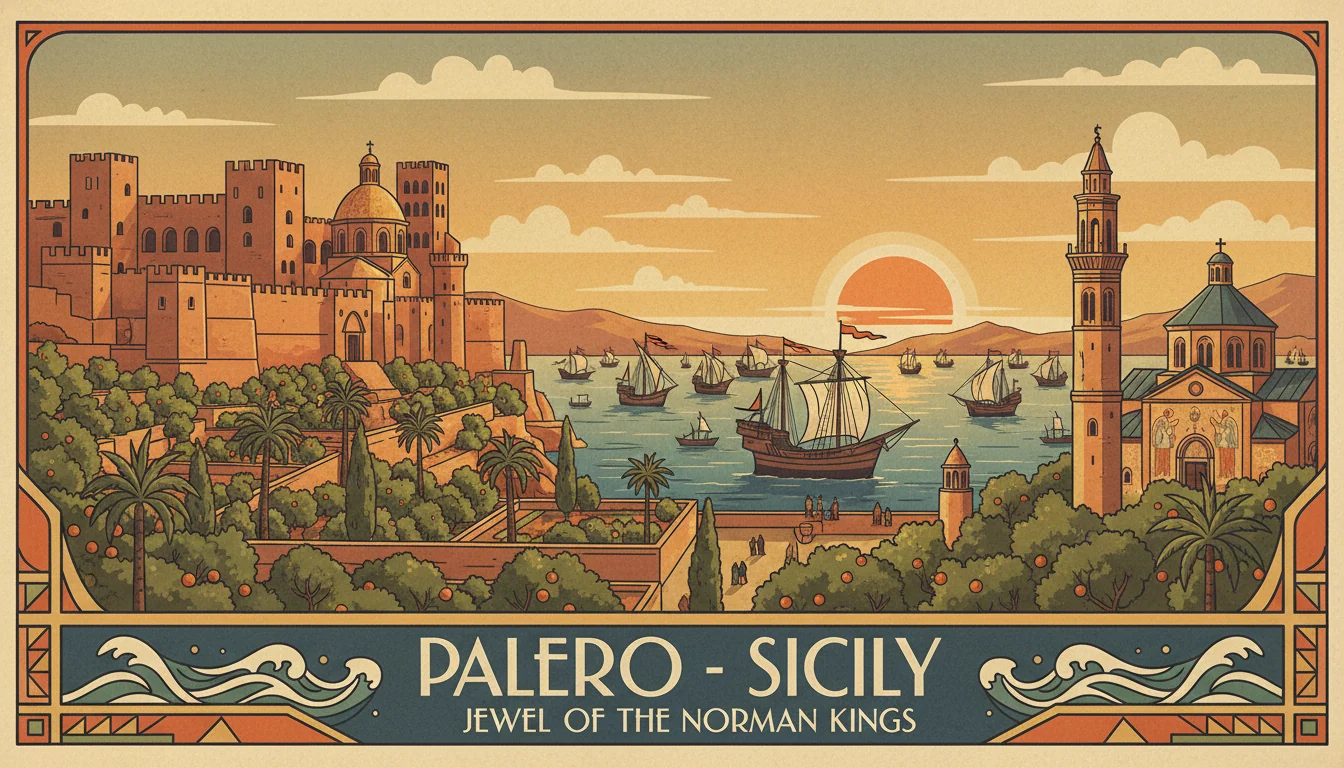
Set your time machine for the spring of 1170 and arrive at the harbor of Palermo, the capital of the Kingdom of Sicily and one of the strangest, richest, most cosmopolitan cities in Europe. The reigning king is William II, called the Good, a teenager whose court is run by ministers who speak Greek, Arabic, Latin, and Norman French interchangeably. The streets are filled with the call to prayer from minarets, the chime of Greek Orthodox church bells, and Latin masses sung in churches built by Saracen craftsmen. You will not see anything like it again in European history.
For two centuries the Normans of Hauteville have built something nobody on the continent thought possible: a Catholic Mediterranean kingdom that uses Arab administrators, Greek bishops, Jewish doctors, and Latin lawyers on the same payroll. By 1170 the project is at its peak. It will not last.
Where you've landed
The Kingdom of Sicily in 1170 covers Sicily, all of southern Italy up to the Papal States, the Maltese islands, and parts of the African coast. Palermo, on the northwestern shore of Sicily, is its capital, with perhaps 100,000 residents, making it one of the four or five largest cities in Europe and roughly twice the size of Paris.
The Cassaro, the main avenue from the royal palace down to the harbor, is paved and wide. The city is encircled by walls inherited from the Arab emirate. The Royal Palace, built on the foundations of an emir's residence, sits at the highest point of the inner city. The waterfront, called the Cala, is choked with ships from Genoa, Pisa, Tunis, Constantinople, Alexandria, and the Holy Land ports.
Your safest cover story is a merchant from the Crusader port of Acre, attached to a Pisan shipping house, trading silk, sugar, and citrus for woolens and tin. Do not pretend to be Genoese unless you can speak the dialect, Byzantine unless you can read Greek, or a Norman knight under any circumstances.
Dress for a hot, formal city
Palermo is hot most of the year and rains hard in winter. Dress is influenced by all three of the city's overlapping cultures. The wealthy of any background dress in styles that would have looked at home in Cairo or Constantinople ten years earlier.
For men: a long linen tunic to mid-calf, a sleeveless silk overrobe, soft leather shoes or sandals, a turban or felt hat (never both), and a belt with purse and knife (no swords in the city).
For women: a long linen shift, an outer silk or wool gown embroidered at hem and neck, a light silk head veil (most women cover their heads in public, with style varying by community), and soft shoes or wooden pattens.
The expensive thing about Norman Sicilian dress is the silk itself. The royal silk factories in the basement of the Royal Palace, the Tiraz, produce some of the finest brocades in the known world. A garment of Palermitan silk identifies you instantly as a person of substance.
Currency and markets
The kingdom mints the Tarì, a small gold coin circulating from Genoa to Aleppo. Larger transactions use the Augustale, daily marketing the copper Follari. Negotiate politely; Sicilian bargaining is slower and more decisive than the Italian style.
The food markets are open every morning. The largest is the Vucciria, near the harbor. The Ballarò market in the Albergheria quarter is older and more obviously Arab in layout, with covered alleys and water sellers shouting in three languages.
Where to stay and how to behave
A Pisan merchant lodges in a fondaco, the trading cities' caravanserais clustered near the Cala. They provide a courtyard, stable, kitchen, locked storage, and private chapel. Without a fondaco letter, the city has a dozen public inns, mostly run by Greek or Arab Christian families, that take traveling merchants for a daily rate paid in advance.
Public behavior in Palermo is notably restrained by the standards of medieval Europe. The crown has worked hard to keep the three religious populations from one another's throats. Open religious provocation and street brawling are punished sharply. Royal halberdiers patrol the major streets in pairs.
Three sights you absolutely must see
The Palatine Chapel
The Cappella Palatina, inside the Royal Palace, is the single most extraordinary room in 12th-century Christendom. Roger II of Sicily commissioned it in 1132. The walls are covered in Byzantine gold-ground mosaics, made by Greek artisans imported from Constantinople. The ceiling is a wooden muqarnas built by Arab craftsmen, painted with Quranic-style honeycomb panels showing scenes of court life: musicians, dancers, hunters, drinkers. The floor is Roman-style cosmatesque tile.
You are looking at the only room in human history where a Greek Orthodox dome, a Latin Catholic apse, and an Islamic stalactite ceiling cover the same Christian altar in the same building. Visit on a quiet weekday morning, when the chapel is open for the king's private mass and a small number of guests are admitted.
The Martorana
The Church of Santa Maria dell'Ammiraglio, founded in 1143 by the king's Greek admiral George of Antioch, is the Greek Orthodox jewel of the city. Its interior is a smaller and more intimate version of the Palatine, with mosaics showing Christ flanked by the apostles, and one of the most famous mosaic portraits of Roger II being crowned directly by Christ.
Visit during a Greek liturgy. The chants, the incense, and the gold mosaics in candlelight produce an atmosphere closer to Constantinople than to anything in Italy.
The Zisa
The Zisa, just outside the city walls to the west, is a royal pleasure palace begun by William I in the 1160s and being completed by William II during your visit. It is built in the Fatimid Egyptian style: a tall rectangular block of pale stone with a central audience hall, fountains running through carved channels in the floor, and a cooling system based on flowing water and shaded courtyards.
The Arabic inscription over the entrance, dedicating the building to the king and praising God, is meant to read identically to a Cairene palace inscription of fifty years earlier. This is a Latin Catholic king's summer house. It is also indistinguishable, architecturally, from any Saracen emir's villa anywhere in the Mediterranean.
How to talk to people
Sicilian, the local Romance language, is recognizable to anyone who knows Italian or Latin but full of Arabic loanwords. Norman French is the prestige language at court, Greek the church language for the Orthodox, and Arabic the first language of half the population.
A few phrases will get you through. Pace a voi works as a greeting in the Christian quarters. As-salamu alaykum works in the Muslim quarters. Eirene works at the church doors. Use signore or madonna for anyone of unknown rank.
Manners differ by community. Latins shake hands. Greeks bow slightly with hands at the chest. Arabs bow with right hand to the heart. The trick of Norman Palermo is that everyone, all day, is constantly translating themselves into someone else's expectations.
What to eat
Sicilian cuisine in 1170 is already most of what it will remain for the next thousand years. The fundamentals are bread, pasta (in noodles, not yet ravioli), olive oil, citrus, almonds, sugar, and fish. Rice has arrived from Egypt. Sicilian sugar is being sold up the trade routes to England.
Safe choices for a visitor:
- maccaruni (early pasta), boiled and dressed with olive oil and herbs
- grilled tuna or swordfish, fresh from the harbor
- couscous, especially in the Trapani style with fish broth
- panelle (chickpea fritters), eaten warm from a street stall
- caponata, the sweet-sour eggplant salad
- citrus, oranges and lemons
To drink, watered local wine, almond milk, and spiced water with honey and citrus juice. Coffee will not arrive in Sicily for another four hundred years.
Politics you should know about
In 1170 William II is 17 years old. His mother, Margaret of Navarre, has just stepped back from the regency. Within a few years there will be palace intrigues and the slow erosion of the trilingual balance. None of this concerns the casual visitor. The court is stable, the king is popular, the harvest is good.
Avoid all conversation about the Pope's authority over Sicily, the Arab and Greek populations, or any rivalry between bishops. Praise the king in vague terms. Comment on the silk, the food, and the weather.
What not to do
A short list:
- do not enter a mosque or synagogue without invitation
- do not openly draw a sword anywhere in the city
- do not insult any of the three religions even in jest
- do not wear visibly expensive items at night
- do not refuse hospitality bluntly (refuse with three formal apologies, in any of the city's languages)
Most importantly, do not treat the trilingual culture as a tourist novelty. The people of Palermo have built this balance over a hundred years and they treat it as a serious daily practice.
The experience you should not miss
If you have one day in Palermo, take it on a Friday. Begin at the Palatine Chapel for the king's morning mass. Walk down the Cassaro through the morning markets. Cross the Albergheria quarter as the muezzin calls noon prayer. Eat couscous in the Vucciria. Walk out to the Zisa in the late afternoon, when the western light angles into the audience hall and the fountains are at full flow.
You will have moved, in a single day, through the four civilizations that built this city. They are not blended. They are stacked, side by side, each visible and audible and holding its own ground. Norman Palermo in 1170 is the only place in medieval Europe where this is true at this scale. The arrangement will not survive the century.
If the Mediterranean crossroads stays in your imagination, our guide to Fatimid Cairo in 970 shows the Egyptian capital that taught Palermo's architects, and our guide to Byzantine Constantinople in 540 shows the older imperial capital whose mosaicists still travel west in the 12th century.
Quick Answers
Common questions about this topic
Who ruled Norman Palermo in 1170?
William II, called William the Good, ruled the Kingdom of Sicily from Palermo from 1166 until his death in 1189. He was a teenager in 1170 with his mother Margaret of Navarre as regent until shortly before, but the court itself was managed largely by trilingual administrators (Greek, Latin, and Arab) who had served his father William I. The political balance in 1170 is unusually stable for the period.
What languages did people speak in Norman Sicily?
Norman Palermo was officially trilingual. Royal decrees were issued in Latin, Greek, and Arabic, often on the same parchment. The court spoke Norman French, the bureaucracy spoke Greek and Arabic, the church spoke Latin and Greek, and the streets spoke Sicilian (a Romance language with heavy Greek and Arabic influence). A traveler could go an entire afternoon without hearing the same language twice.
Was Palermo really an Arab city under the Normans?
Partly. The Normans took Palermo from the Kalbid emirate in 1072, but they did not expel the Arab population. In 1170, the city had perhaps 100,000 residents, of whom roughly half were Muslim, with substantial Greek Orthodox, Latin Christian, and Jewish populations. The royal court used Arab tax officials, Arab architects, and Arab poets without hesitation, while officially Latin Christian.
What happened to Norman Sicily?
The Norman line ended in 1194 when William II's heir, his aunt Constance, brought the kingdom to her German husband Henry VI of Hohenstaufen. Their son was Frederick II, who continued some of the Norman tolerance but gradually consolidated the kingdom on more European lines. The Arab population was expelled in stages over the 13th century, ending with the deportations of the 1240s. The trilingual world of Norman Palermo lasted barely 120 years.

Need Advice from Someone Who Lived There?
Get firsthand accounts from people who actually lived through these moments in history.
Ask Them YourselfJoin the HistorIQly Club
Get smarter about the past.
Weekly stories, deep dives, and exclusive content straight to your inbox.