Time Traveler's Guide to Unified Silla Gyeongju, 900
Time travel to Gyeongju in 900 AD, when the Silla kingdom still ruled Korea from its gilded Buddhist capital - magnificent, stratified, and beginning its long decline.
Read Wikipedia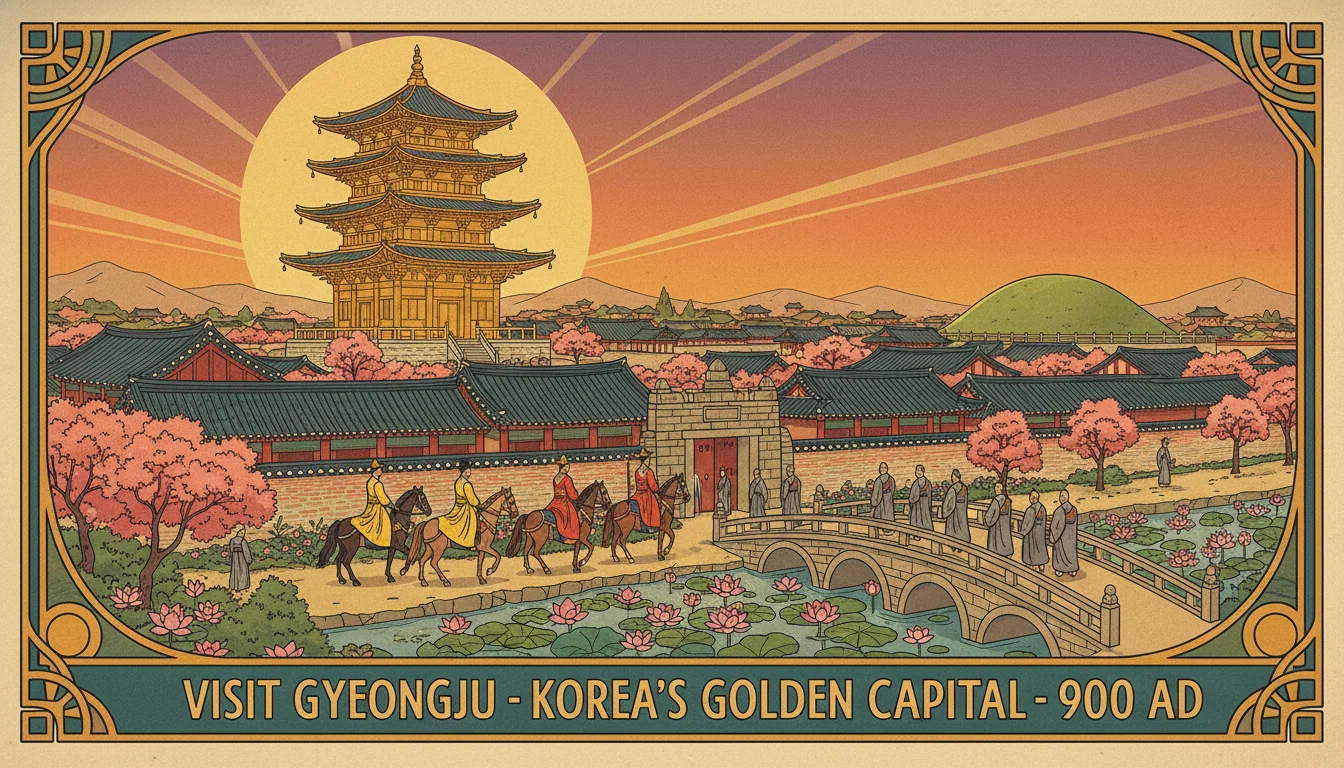
Pack light. You are visiting a city that has been the center of the world, at least of its world, for nearly three hundred years, and is beginning, in ways its inhabitants cannot quite name, to feel the pull of gravity that precedes a fall. The Silla Kingdom in 900 AD still commands the Korean Peninsula from its gilded capital. The temples are magnificent, the rice wine is better than you expect, and the rigid social hierarchy will kill you if you step into the wrong lane of traffic without understanding whose lane it is.
Gyeongju - called Seorabeol by its residents, sometimes Geumseong, the Golden City, in formal address - sits in a wide basin ringed by low mountains in what is now southeastern South Korea. In 900, it is one of the largest cities on earth, a Buddhist capital of somewhere between half a million and a million people depending on which scholar's estimate of the household records you trust. The streets are laid out with geometric precision. Burial mounds of ancient kings rise from empty lots in the city center like enormous green hills, because nobody has yet developed the land around them. This is less urban planning than accumulated reverence.
You are arriving at a hinge point. Out west, a rebel lord named Gyeon Hwon declared his own state this very year. In the north, another warlord is massing. The kingdom the Silla rulers built from a small southeastern polity into an empire of the peninsula is fraying at its edges. The capital does not know it yet, or knows it and does not say.
Getting in
The city has no formal walls in the European sense. It is vast and open, organized by districts and wards. Arrive from the east if you can - the main roads from the port at what will one day be called Pohang bring trade goods and travelers in steadily, and foreign visitors, while unusual, are not unknown. Tang Chinese merchants and diplomats have been crossing into Silla for centuries. Buddhist monks from India and Central Asia have made pilgrimages here. You will attract attention. You will not attract arrest, as long as you do not attract it by behaving above your apparent station.
The critical thing to understand immediately is the bone rank system - kolpum - because it governs everything. The Jingol, the True Bone aristocracy descended from the old Silla royal clans, are the people who run this city. You can identify them by their silk clothing, their elaborate hairpins and ornaments, the deference of everyone around them, and the fact that they travel on horseback or in covered palanquins while others walk. Do not make eye contact in a way that implies equality. Do not step in front of them. Do not occupy their space in a market or a road. The penalties for violations of rank are not theoretical.
You, as a foreign visitor of ambiguous origin, will be granted a kind of courteous neutrality by most people you meet. Use this while it lasts.
What to see
Cheomseongdae. The cylindrical stone tower in the palace district is the oldest surviving astronomical observatory in East Asia, built about 250 years ago under Queen Seondeok. It is 9.5 meters of precisely fitted granite, tapered slightly toward the top, with a square opening at the south face partway up. Court astronomers use it to track celestial movements that inform the agricultural calendar and the king's decisions. You may look at it. You may not climb it.
Hwangnyongsa. The great state temple north of the palace district is among the most impressive buildings you will see in your life. The nine-story wooden pagoda at its center rises about 80 meters - eight centuries before anyone builds a structure this tall in Europe, this tower is a daily fact of life in Gyeongju. It was built in the mid-600s and is still structurally sound in 900, though portions have been repaired. The main hall houses a massive gilt bronze Buddha. Monks in gray robes move through the courtyards continuously. Visiting is permitted; the monks are accustomed to lay visitors seeking merit.
Bulguksa Temple. A half-day walk southeast of the city center, on the lower slopes of Mount Toham, is the most beautiful Buddhist temple complex you will see. It was rebuilt in 751 and features two stone staircases - Cheongungyo and Baegungyo - representing the bridge between the human world and the Pure Land. The stone pagodas flanking the main courtyard, Dabotap and Seokgatap, are masterworks of Silla stonecraft. The monks here operate the complex with the quiet efficiency of a functioning religious institution, not a tourist site.
Seokguram. Above Bulguksa, cut into the granite of the mountain, is a domed granite grotto containing a seated Buddha about two and a half meters tall. It was carved from single granite blocks in the 8th century and the engineering is extraordinary - the dome creates a dry interior through passive ventilation without mortar. In 900 the grotto is still in excellent condition and considered a sacred site of high rank.
Anapji Pond. Inside the palace complex, the pleasure garden built by King Munmu in 674 is a formal pond surrounded by three artificial islands and pavilion buildings. Lotus flowers in season. Waterfowl. State banquets are held here. You will not be invited unless you have made very powerful friends very quickly.
What to eat
Millet and barley form the bulk of the diet for most residents. Rice exists but is associated with aristocratic households; at common stalls in the market you are more likely to receive grain porridge, dried fish, fermented vegetables that foreshadow what the world will one day call kimchi without the chili, and river fish from the tributaries that run through the basin. Dog meat is available and common as a protein source. Beef is less frequent, as cattle are primarily working animals. Makgeolli - unfiltered rice wine, milky white and slightly sweet - is the universal social drink, available at every market stall and inn. Soju does not exist yet; that comes with the Mongols centuries later.
If you have the opportunity to eat with an aristocratic household, the food is substantially better. The kitchens of Jingol families process game, dried abalone, preserved sea vegetables, and rice in quantities that mark the table as a place of status. Accept the invitation. Eat carefully. Compliment the food but not excessively - excessive praise from an unknown visitor reads as flattery with an agenda.
What to wear
You will stand out regardless. If you are trying not to, undyed hemp or ramie in muted tones is the correct dress for a person of common or ambiguous status. Bright colors - especially red, purple, or elaborate patterned silk - are rank-coded for the Jingol and their households. Wearing them without the ancestry to support them invites consequences. The shoes that will cause you the least trouble are simple straw sandals or wrapped cloth shoes. Leather footwear exists but implies a level of material comfort that will invite questions you may not want to answer.
Dangers
The political situation is the primary danger you will not see coming. In 900 the city is still largely at peace, but the provinces are not. Roads beyond the immediate vicinity of the capital carry risk from the forces of Gyeon Hwon's new state to the west, and from the general breakdown of central authority in the countryside. If you are traveling out of the city, ask about current road conditions first, and ask someone who has recently been on that road.
Inside the city the danger is mostly social. The bone rank system is enforced through accumulated social pressure, legal structures, and the violence that powerful people can commission at low personal cost. Offending a Jingol aristocrat through ignorance of rank protocols will not be forgiven on the basis of foreignness. The expected response is deference, and the expected duration of that deference is indefinite.
The Buddhist monks are the safest people in the city to approach with questions. Their role places them slightly outside the bone rank apparatus in daily practice, they are accustomed to travelers seeking instruction, and the better-educated monks in the larger temples have broad knowledge of the wider world.
The atmosphere
What you will notice, before anything else, is the scale. Gyeongju in 900 is enormous by any measure you carry with you. The burial mounds of the old Silla kings rise in the middle of residential neighborhoods, grass-covered tombs the size of small hills. The skyline is defined by the great pagodas of the temple complexes. The streets near the market are dense with traffic at midday - merchants, monks, soldiers, servants, craftsmen, the occasional Jingol official moving with retinue through a crowd that parts reflexively.
It is also a city that has been at the center of something for a very long time, and that centrality shows. The craftsmanship in the stonework, the bronze casting, the lacquerware in the market stalls - it is the work of a civilization at high confidence in its own aesthetic standards.
That confidence will not survive the next thirty-five years intact. The Later Three Kingdoms are coming. The old aristocratic families will fight among themselves, the regional lords will consolidate, and by 935 the last Silla king will hand his kingdom to Wang Geon of Goryeo in a ceremony both parties will have the grace to call a voluntary union.
But in 900, none of that is visible in the streets. The pavilions are lit at night. The monks ring the bells at dawn. The great pagoda of Hwangnyongsa is still standing. Go see it before it is gone.
Quick Answers
Common questions about this topic
What was Gyeongju like in 900 AD?
Gyeongju, then called Seorabeol, was the capital of the Unified Silla Kingdom and one of the largest cities in the world at its height - the Samguk Yusa records nearly 180,000 households in the city at peak. By 900, the kingdom was entering a period of fragmentation, with regional lords breaking away, but the city itself was still a functioning, magnificent capital with major Buddhist temples, royal palaces, and an active market economy.
What is the bone rank system of Silla?
The kolpum, or bone rank system, was Silla's hereditary social hierarchy. At the top were the Jingol (True Bone) aristocracy, the only group eligible to become king by 900 AD after the Seonggol (Sacred Bone) rank died out. Below them were head ranks 6, 5, and 4, each with defined limits on the offices they could hold, the clothes they could wear, and the size of their houses. The system was among the most rigid hereditary hierarchies in East Asian history.
What happened to Silla after 900 AD?
In 900, rebel lord Gyeon Hwon established Later Baekje in the southwest, and Gung Ye established the state of Taebong in the north in 901, beginning the Later Three Kingdoms period. The Silla king controlled only the southeast. By 935, the last Silla king surrendered his kingdom peacefully to Wang Geon of Goryeo. Gyeongju retained ceremonial importance under Goryeo but lost its status as a national capital after nearly a thousand years.
Is the Cheomseongdae observatory still standing?
Yes. Cheomseongdae, built during the reign of Queen Seondeok around 634-647 AD, still stands in Gyeongju today and is the oldest surviving astronomical observatory in East Asia. Its cylindrical granite tower, about 9.5 meters tall, is one of the most recognized symbols of ancient Korean civilization. In 900, it was already over two centuries old and still in active use.

Need Advice from Someone Who Lived There?
Get firsthand accounts from people who actually lived through these moments in history.
Create your free account →No card required. Talk to anyone in history with 8 free credits a day. Some features require a paid plan.
Join the HistorIQly Club
Get smarter about the past.
Weekly stories, deep dives, and exclusive content straight to your inbox.