Time Traveler's Guide to the Kingdom of Benin, 1600
Survive the Kingdom of Benin at its height, where bronze court art rivals Europe's finest metalwork, wide avenues put Lisbon to shame, and the Oba's word is absolute.
Read Wikipedia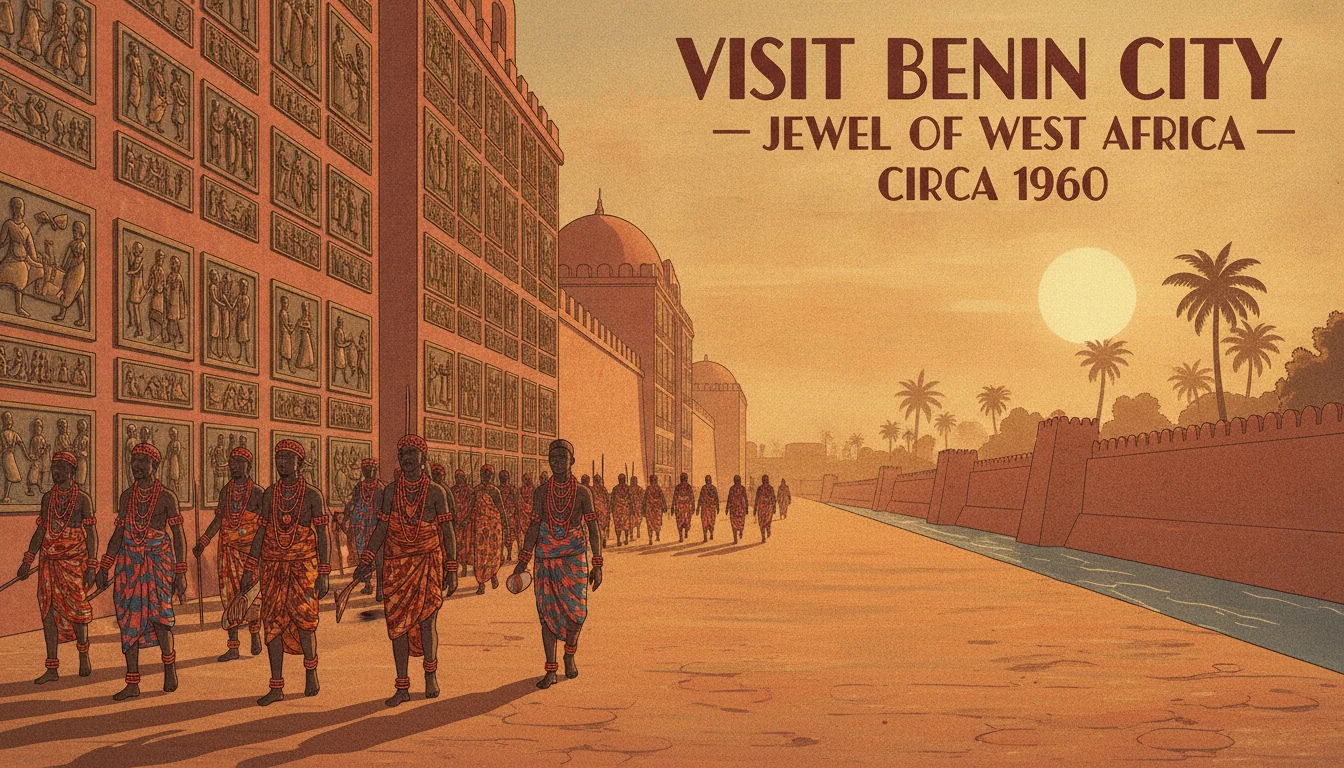
You arrive at the edge of a moat cut so deep and wide it looks less like a defensive ditch than a small canyon, part of an earthwork system that will one day be recognized as among the largest man-made structures on earth. Beyond it rises a wall of packed red earth, and beyond that, a city laid out with a precision that will startle you if you are used to the cramped, winding streets of contemporary European towns. Welcome to Benin City, capital of the Kingdom of Benin, at the height of its power around 1600.
Where (and When) You Are
You are in the Edo-speaking kingdom of Benin, in what is now southern Nigeria, ruled by an Oba whose court sits at the center of a sophisticated, centralized state controlling trade routes across a wide swath of the region. The kingdom has been trading with Portuguese merchants since the late fifteenth century and, by 1600, also deals regularly with Dutch traders arriving along the coast, exchanging pepper, ivory, cotton cloth, and other goods, while the Oba's court carefully regulates which goods leave the kingdom and on what terms.
Benin City itself is the kingdom's beating heart: a planned capital of broad, straight avenues wide enough for large processions, surrounded by earthwork walls and moats that visitors, both African and eventually European, will describe for generations as astonishing in scale. The Oba's palace complex dominates the city's center, a maze of courtyards, ceremonial halls, and residences for the various palace societies that manage the kingdom's administration.
What to Wear
Status is read instantly through cloth and ornament here, so dress with intention.
For men of rank: Wrapped cloth garments, often in richly patterned textiles obtained through trade or woven locally, paired with coral bead necklaces and bracelets that signal proximity to the Oba. Coral is not decorative alone; it is a marker of political rank, and wearing more of it than your actual status permits is a serious offense.
For women: Wrapped cloth skirts and beaded ornaments, with hairstyles and jewelry that similarly communicate age, marital status, and standing within the household or palace hierarchy. Married women of standing may wear more elaborate coral and brass ornamentation.
Everyone: Bare feet or simple sandals are common outside the most formal court settings. If you're granted an audience anywhere near the Oba, cover yourself modestly and remove any footwear before entering the most sacred precincts of the palace, following the lead of whoever escorts you.
What to Eat
Benin's cuisine draws on yams, palm products, and the bounty of a well-watered tropical environment.
Staples: Pounded yam and cassava-based dishes form the backbone of most meals, served with rich soups thickened with ground melon seeds, palm oil, and a variety of leafy vegetables. Expect pepper, and plenty of it. The kingdom's pepper trade with Europe exists precisely because the crop is already central to the local diet.
Protein: Bushmeat, fish from the rivers and coastal waters, and domesticated goats and chickens supplement the diet. Palm wine, tapped fresh from palm trees and mildly fermented, is the everyday drink of choice, served at gatherings both casual and ceremonial.
Court feasts: If you're fortunate enough to witness or participate in a royal ceremony, expect elaborate feasts featuring large quantities of meat, palm wine, and kola nuts, the latter offered as a mark of hospitality and respect at the start of nearly any formal visit or negotiation.
Customs That Will Save Your Life
The Oba is not merely a king. He is treated as a figure with a sacred, semi-divine role connecting the living kingdom to its ancestors and spiritual order. Approach any mention of him, let alone an actual audience, with the gravity that status demands. Direct eye contact, casual posture, or careless words in his presence are not minor lapses.
Palace societies run daily administration. The court is organized into distinct societies, the Iwebo handling regalia and external affairs, the Iwoguae managing the Oba's personal household, and the Ibiwe overseeing the royal wives and domestic matters. Knowing which society you're dealing with, and addressing its title-holders correctly, will determine whether your business gets done at all.
Coral beads are political, not fashionable. Never wear more coral than your actual rank entitles you to, and never accept coral ornaments as gifts without understanding what obligation or status claim they imply. Getting this wrong reads as either ignorance or, worse, presumption.
The brass casters are untouchable specialists. The Igun Eronmwon guild produces bronze and brass work exclusively for the Oba's court, commemorating ceremonies, royal ancestors, and historical events on cast plaques and sculptures. Their craft is a closely guarded hereditary profession. Do not treat their work as ordinary metalwork available for casual purchase; it belongs to the palace.
Trade moves through official channels. European merchants dealing with Benin quickly learn that the kingdom, not the trader, sets the terms. The Oba's administration regulates which goods may be exported and restricts trade in certain items according to its own priorities. Attempting to bypass official channels is a fast way to be shut out of trade entirely.
The Dangers
Disease. The tropical climate carries malaria and other fevers that hit newcomers, particularly Europeans unused to the region, especially hard. If you're not acclimated, expect illness within weeks of arrival regardless of precautions.
Court politics. Succession disputes and rivalries among titled nobles are a persistent undercurrent at any African court of this scale and complexity, and an outsider who is perceived as favoring one faction over another can become a target without ever intending to take sides.
Military obligations. Benin's military strength, built on a well-organized system of levies and professional warriors, has expanded the kingdom's territory considerably. Regional conflicts and tributary disputes are ongoing, and travel outside the capital's immediate vicinity carries real risk during periods of unrest.
Ritual restrictions. Certain sites, ceremonies, and objects connected to ancestor veneration and the Oba's spiritual role are strictly off-limits to casual observation. Trespassing on ritual space out of curiosity, rather than through proper invitation, is treated as a serious transgression.
What to See
The Oba's palace complex. A vast compound of courtyards and halls at the city's heart, its walls and columns adorned with cast bronze plaques depicting historical events, royal ceremonies, and the kingdom's military campaigns, a visual archive of Benin's history maintained by the palace itself.
The city walls and moats. An extraordinary earthwork system, built up over centuries, encircling the capital and its surrounding settlements. Later surveys will estimate the combined length of Benin's earthworks at many times the scale of comparable European fortifications of any single city.
The brass casters' quarter. Watch, from a respectful distance and ideally with an invitation, as the Igun Eronmwon guild practices lost-wax casting techniques passed down through hereditary lines, producing the plaques and sculptures that document the kingdom's history in metal.
The broad avenues. Visitors from Europe who eventually record their impressions of Benin City will describe its streets as wider and better planned than those of many contemporary European capitals, a detail worth experiencing directly rather than taking anyone's word for.
Practical Matters
Money and trade. Cowrie shells circulate widely as currency, alongside barter in cloth, metal goods, and other valued commodities. European traders bring copper and brass manillas, a currency of sorts prized as raw material for the court's casters as much as for its exchange value.
Language. Edo is the language of the court and the capital. Traders dealing with the Portuguese or Dutch may pick up fragments of Portuguese, which has functioned as an early trade language along this coast for over a century by 1600.
Lodging. As an outsider, expect to be housed according to your perceived status and the nature of your business, likely under the oversight of officials tied to whichever palace society is managing relations with visitors like you.
Getting around. The capital's avenues make walking straightforward, but travel beyond the city into the wider kingdom requires local guides familiar with regional politics and the terrain.
Parting Thoughts
Benin City in 1600 sits at a rare equilibrium: a sophisticated, centralized kingdom trading confidently with European powers on its own terms, its palace producing metalwork that will one day be recognized among the finest artistic traditions in world history. That confidence will not last forever, and the bronzes cast in the Igun Eronmwon's workshops during your visit will, centuries later, become the subject of an international debate over ownership and restitution after they are dispersed far from the city that made them. For now, though, walk the broad avenues, watch the casters at work, and understand that you are witnessing a kingdom operating at the height of its own power, on its own terms, answerable to no one.
Quick Answers
Common questions about this topic
What was the Kingdom of Benin like around 1600?
It was one of West Africa's most powerful and organized states, ruled by an Oba from a large, planned capital known for its wide avenues, defensive earthworks, and a royal court renowned for bronze and brass artwork produced by a dedicated guild of casters serving the palace exclusively.
Why is Benin City famous for bronze sculptures?
The kingdom maintained a guild of brass and bronze casters, the Igun Eronmwon, working exclusively for the Oba's court using the lost-wax casting technique. Their plaques and sculptures documented royal history, ceremonies, and the court's political structure, and are now recognized as among the finest metalwork traditions in world history.
Did Europeans visit Benin City in this period?
Yes. Portuguese traders had established contact with Benin by the late 1400s, and by 1600 the kingdom traded regularly with Portuguese and Dutch merchants, exchanging pepper, ivory, and cloth, while restricting or regulating other forms of trade according to its own interests rather than European terms.
What happened to Benin City's famous bronzes?
Long after the period described in this guide, a British military expedition in 1897 looted thousands of the palace's bronzes and artworks, which were dispersed to museums and private collections across Europe and North America, a dispersal that remains the subject of active restitution debates and negotiations today.

Need Advice from Someone Who Lived There?
Get firsthand accounts from people who actually lived through these moments in history.
Create your free account →No card required. Some figures and features require a paid plan.
Join the HistorIQly Club
Get smarter about the past.
Weekly stories, deep dives, and exclusive content straight to your inbox.