A Time Traveler's Guide to Aotearoa, 1350
Aotearoa 1350 survival guide: what to wear, eat, and understand about the Polynesian voyagers settling the last major landmass on Earth, moa hunting, and early kumara gardens.
Read Wikipedia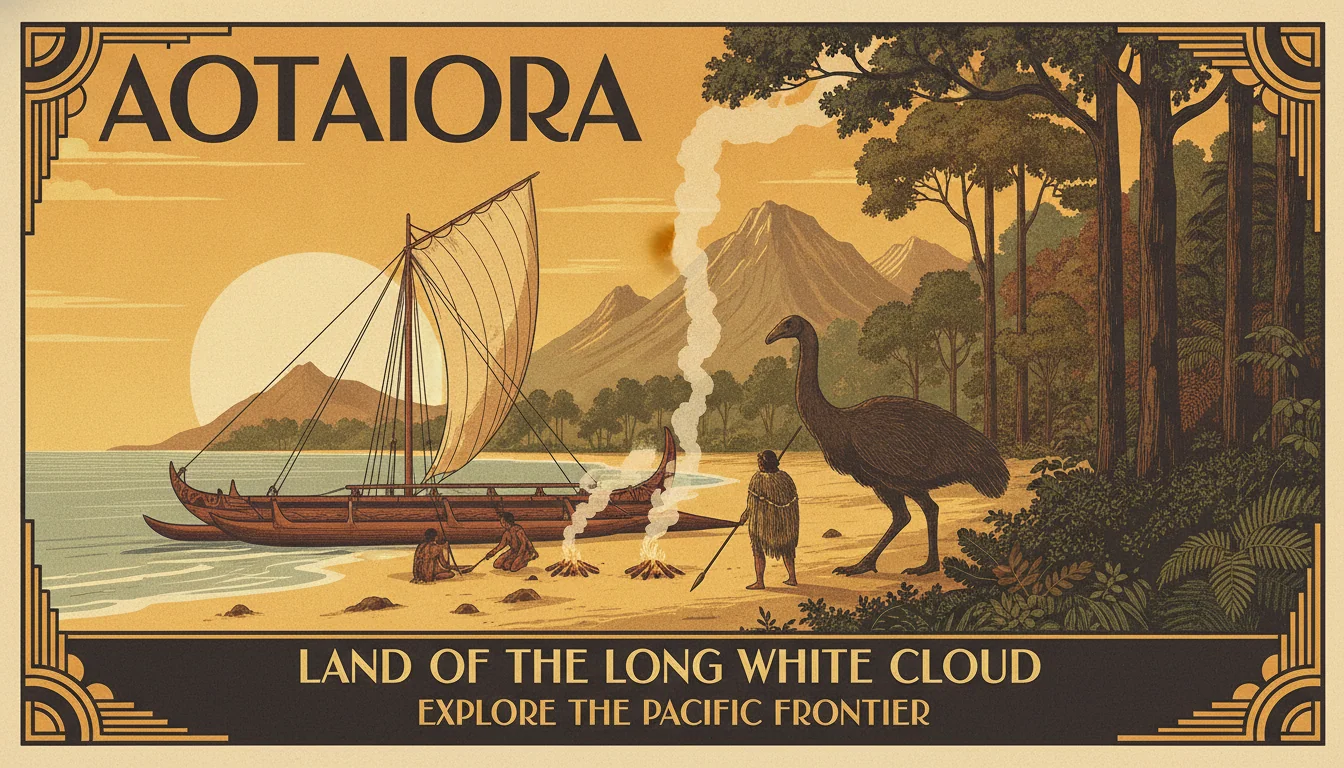
Set your dial for Aotearoa around 1350, a land more commonly known today as New Zealand. This is one of the great frontiers of human history: the last major landmass on Earth to be settled by people, reached only a few generations before your visit by Polynesian voyagers who crossed open ocean in double-hulled sailing canoes with no charts, no compass, and nothing but the stars, currents, and birds to guide them.
What you will find on arrival is not a finished civilization but one still actively figuring out how to live in a genuinely new environment: strange giant birds nobody's ancestors ever hunted before, a climate colder and more variable than the tropical islands most settlers came from, and gardens of transplanted Polynesian crops that only sometimes cooperate with local soil and seasons.
Know what kind of place you're entering
The people you'll meet are descendants of Polynesian voyagers who arrived, by the best current archaeological estimates, sometime in the 1200s, making 1350 still relatively early in the story of human settlement here. Communities are small, concentrated along coasts, river mouths, and areas with reliable food resources, and connected to each other by shared ancestry, ongoing voyaging knowledge, and trade in valued stone, particularly greenstone and obsidian, that some communities travel considerable distances to obtain or trade for.
This is not yet the densely fortified, intensively gardened landscape later visitors would associate with Maori society. Large defensive pa settlements are only beginning to appear in some regions and will not become widespread for another century or more. What you're witnessing instead is an earlier, more exploratory phase: people mapping an unfamiliar country, working out which of their traditional crops and techniques transfer to a colder climate and which don't, and adapting quickly to resources, like the giant moa, that exist nowhere else their ancestors ever traveled.
Dress for a colder climate than you'd expect
If your mental image of Polynesia is light tropical dress, adjust it immediately. Aotearoa's climate, especially in the South Island and inland areas, is noticeably cooler than the tropical Pacific homelands most voyagers left behind, and clothing here reflects that.
Expect to see and wear:
- garments woven from native flax fiber, prepared through labor-intensive stripping, scraping, and softening
- layered cloaks for warmth, an increasingly important local innovation as communities adapt to the cooler climate
- dogskin, or occasionally dog-hair, trim and cloaks among people with access to kuri, the dogs brought by the original voyagers
- minimal ornament by later standards, since the elaborate feather and carved-ornament traditions of later Maori culture are still developing
Do not show up in bright, obviously foreign fabric. A stranger in unfamiliar cloth invites exactly the kind of scrutiny you want to avoid. Flax-woven garments in natural, undyed tones will help you blend in far better.
Food: moa, fish, and an unreliable garden
Food in 1350 draws on both what voyagers brought with them and what they've since learned to hunt, gather, and catch in this new land. Expect a diet built around:
- moa, the large flightless birds unique to Aotearoa, hunted in significant numbers during this period, a resource that will not last, since moa populations are already declining under sustained hunting pressure and will be gone entirely within a few more centuries
- fish and shellfish, abundant along the coasts and a dependable staple in a way that imported crops are not yet
- fern root, a starchy, filling wild food that requires processing but grows reliably across much of the country
- kumara, the sweet potato brought from tropical Polynesia, grown successfully in warmer northern areas but struggling or failing entirely farther south, where the growing season is too short and the soil too cold
If you're offered food, accept it graciously and follow the lead of your hosts on portions and manner. Refusing hospitality outright is a poor way to make friends in any small, resource-conscious community.
Social customs and what matters here
Communities in this period are organized around kinship, shared descent from named ancestors and voyaging canoes, and practical cooperation in hunting, fishing, and gardening. A few points of etiquette will serve you well:
- show visible respect to elders and to anyone who speaks with evident authority in a group
- follow local protocol around sacred or restricted places and objects rather than approaching or touching anything freely; the concept of tapu, a state of sacred restriction, governs a great deal of daily behavior even in this early period
- accept hospitality when offered, and reciprocate where you reasonably can
- do not casually handle valued stone tools, ornaments, or weapons belonging to someone else without invitation
Oral tradition and genealogy carry enormous social weight. Do not claim false ancestry, false knowledge of voyaging routes, or false skill with tools and weapons. In a small community built on trust and known lineage, a fabricated claim will unravel fast and will cost you any goodwill you've built.
Dangers you should take seriously
Isolation is the single biggest risk of this destination. There is no larger regional network to fall back on if something goes wrong, no nearby city, no passing trade ship on a fixed schedule. Injuries, exposure, and simple bad luck carry more weight here than in almost any other era on this guide's list.
The natural environment itself carries real hazards: volcanic activity in parts of the North Island, unpredictable weather even in summer, and terrain that is often steep, densely forested, and unfamiliar even to relatively recent arrivals still learning its patterns. Moa, despite being flightless and non-predatory, are large and can deliver a serious kick if cornered or startled, worth remembering if you get close enough to observe one.
Must-see aspects of this moment in history
A moa hunt. If you can observe one from a respectful distance, take the chance. You are watching people hunt a bird species that will not exist for a future visitor to see, using techniques adapted specifically to a creature none of their Polynesian ancestors ever encountered.
A waka under construction or in use. The voyaging canoes that brought people here, and the coastal craft used for fishing and travel along the coast, represent an extraordinary tradition of maritime engineering built entirely without metal tools.
A kumara garden. Watching gardeners work out, sometimes through trial and real failure, which techniques successfully coax a tropical crop through a colder growing season is a rare window into a civilization actively adapting its inherited knowledge to a genuinely new environment in real time.
Greenstone or obsidian being worked or traded. The value placed on these stones, and the distances people will travel to acquire them, says a great deal about how quickly trade networks have formed across a landscape settled only a few generations earlier.
What not to do under any circumstances
Do not:
- touch or approach anything that appears sacred or set apart without explicit invitation
- claim skills, ancestry, or knowledge you do not have
- travel alone into unfamiliar interior terrain without a local guide
- mention anything about the centuries after your visit, including the arrival of later voyagers, the decline of the moa, or the fortified pa era still to come. None of it exists yet from where you're standing, and speculating aloud about any of it will only unsettle your hosts
Most importantly, remember that you are watching the earliest chapters of a society still working out how to live somewhere no human being had ever lived before. Treat that as the rare privilege it is, not a curiosity to gawk at.
The experience you should not miss
If you have one moment in Aotearoa in 1350, make it a clear evening on the coast, watching a waka return from a fishing run as cooking fires are lit along the shoreline. Somewhere inland, a kumara garden is being tended against a growing season nobody's ancestors ever had to plan for. The entire scene is a civilization still writing its first chapter in a brand new land, one moa hunt and one garden season at a time.
Keep your questions about the future to yourself, respect tapu without needing it fully explained to you, and watch closely. Few destinations on this list offer a clearer view of people meeting an unfamiliar world for the very first time.
For another society adapting inherited traditions to a brand new island environment, see our guide to Toltec Tula, 1100. For another culture whose military and social structures were reshaping an entire region within living memory, see our guide to the Zulu Kingdom, 1820.
Quick Answers
Common questions about this topic
When did people first settle Aotearoa?
Archaeological and genealogical evidence points to Polynesian voyagers settling Aotearoa, now New Zealand, sometime in the 13th century, making it one of the last major landmasses on Earth to be permanently settled by people. By 1350, the population is still concentrated in early coastal and river settlements only a few generations deep.
What did early Maori communities eat in this period?
Diet centered on moa and other native birds, fish and shellfish, fern root, and kumara, a Polynesian-introduced sweet potato that could only be grown successfully in the warmer parts of the North Island during this era, since the South Island's cooler climate limited tropical crops the voyagers had brought with them.
Were pa fortifications already built by 1350?
Not extensively. Large, heavily fortified pa settlements became widespread later, from roughly the 15th century onward. In 1350, defensive earthworks are only beginning to appear in some areas, and most communities still live in smaller, less fortified coastal or riverside settlements.
Is it safe to visit Aotearoa in 1350?
Physically, yes, if you respect local custom and keep a low profile. The larger risks are practical: extreme isolation, an unfamiliar landscape with real hazards like large flightless birds and volcanic activity, and the total absence of any way to summon help if something goes wrong.

Need Advice from Someone Who Lived There?
Get firsthand accounts from people who actually lived through these moments in history.
Create your free account →No card required. Talk to anyone in history with 8 free credits a day. Some features require a paid plan.
Join the HistorIQly Club
Get smarter about the past.
Weekly stories, deep dives, and exclusive content straight to your inbox.