Time Traveler's Guide to Toltec Tula, 1100 CE
A toltec tula time travel guide for 1100 CE: warrior temples, obsidian workshops, and feathered-serpent ceremony on the Mexican plateau at the city's peak.
Read Wikipedia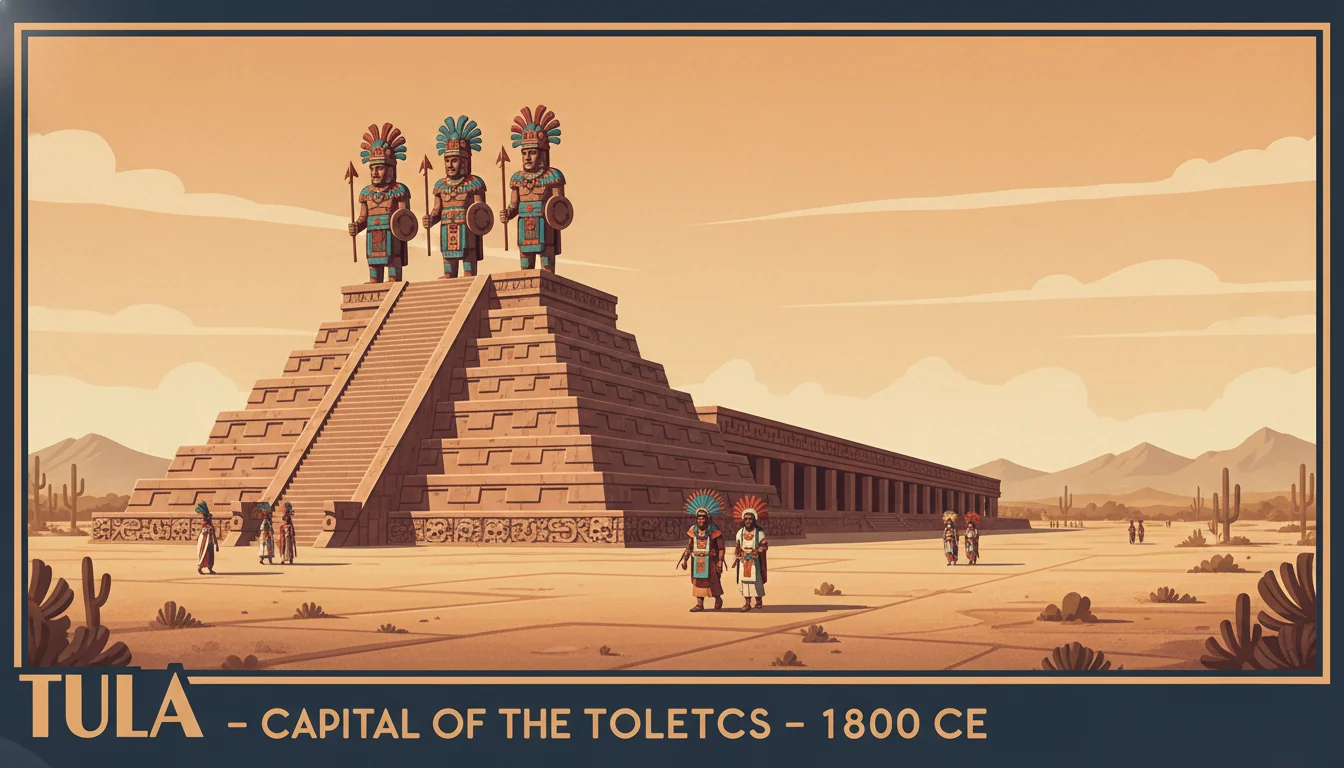
Before the Aztecs told their origin stories, before Tenochtitlan rose from the lake, there was Tollan. The name means something like "Place of Reeds" or "Place Where the People Dwell," and in the religious imagination of later Mesoamerica it had the same weight that Rome carried for medieval Europe: the great city, the civilized origin, the standard against which everything else was measured.
In 1100 CE, Tollan-Xicocotitlan - the site archaeologists now call Tula - is a real city on a real plateau, not a myth. It occupies a defensible ridge above the Tula River in what will become the state of Hidalgo, and it is close to its peak. Population estimates run from 30,000 to 60,000, which makes it one of the largest urban centers in the Western Hemisphere. The pyramid-temples are complete. The markets are busy. The obsidian trade that funds the whole enterprise flows out in every direction.
You will want to plan carefully before arriving.
Arriving in a high-altitude city
The site sits at roughly 2,000 meters above sea level on the central Mexican plateau. The air is noticeably thinner than coastal Mesoamerica. The climate is dry, with wide temperature swings between day and night. Summers bring rains that briefly green the surrounding scrubland; the rest of the year the plateau is dusty and sere.
The city is not walled in the formal sense, but the ridgetop position and the surrounding ravines provide natural defense. Main access routes descend from the north along the ridge and approach from the river valley to the south. You will enter through what is effectively an open landscape of residential compounds, smaller shrines, and workshops before reaching the ceremonial center.
Arrive during the dry season if you can. Mud turns the approaches to the lower districts into a negotiation.
What to wear
Cotton is the fabric of daily life here, and lightweight white or undyed cotton is the appropriate choice for anyone who does not want to stand out as either a noble or a target. Woven sandals of agave fiber are standard footwear. Bare feet in the city's lower districts are common; going shoeless in the ceremonial precinct is the norm rather than the exception.
What you must not wear: featherwork, jade ornaments, or the elaborate warrior regalia visible on the Pyramid B summit columns. The jaguar warrior and eagle warrior costumes - feathered helmets, painted cotton armor, coyote-skin cloaks - belong to the military orders and their associated ritual specialists. Wearing them without standing is a very quick way to become the center of attention in the wrong sense.
A plain cloak or mantle for the cool evenings is advisable. The plateau drops sharply in temperature after dark.
What to eat and drink
The staple diet is corn in several forms: tortillas cooked on clay griddles, tamales wrapped in corn husks and steamed, and atole, a warm maize gruel that serves as the baseline meal across all social levels. Beans and squash are grown everywhere on the terraced fields surrounding the city and appear in almost every preparation. Chili peppers, both fresh and dried, season everything.
Protein comes from turkey, dog - specifically the hairless xoloitzcuintli breed raised for consumption - venison, and small game. The city's proximity to trade routes means dried fish from the coast and various preserved goods reach the market quarter.
Cacao is available but expensive. The drink made from it here is nothing like what later centuries will do with the bean: it is usually mixed with water, ground corn, chili, and sometimes achiote for color, and consumed cold or at room temperature. It is bitter and savory rather than sweet. It is also a genuine stimulant. If offered a small bowl at a gathering of any importance, drink it; refusing is rude. If offered a large quantity unprompted by a stranger, be cautious about where you are and why.
Pulque - fermented maguey sap - is widely available and extremely popular. It has roughly the alcoholic strength of beer, goes sour quickly, and is consumed in quantity at festivals. Public drunkenness is regulated by sumptuary customs that vary by occasion; what is acceptable at a harvest festival is not acceptable during a military ceremony.
Water from the city's storage cisterns and the nearby river is the daily standard. The river is somewhat reliable. Drink anything that has been boiled when the option exists.
The ceremonial center
The main plaza is the organizing axis of the city and everything worth seeing is arranged around or approached from it. The scale is designed to impress, and it does.
Pyramid B - the Temple of Tlahuizcalpantecuhtli, the Morning Star deity identified with the Feathered Serpent Quetzalcoatl - is the most visited monument and the one visible from most of the city. Its four terraced stages support a temple chamber whose roof was held up by the figures now standing on the summit: four Atlantean warriors of basalt, roughly twice human height, carved in full military dress with butterfly-shaped pectorals and the distinctive feathered headdress of the Toltec military orders. They are simultaneously architectural columns, ritual guardians, and the city's visual signature. Do not attempt to climb the pyramid without observing who else is doing so first, and under what circumstances.
The colonnaded halls running along the south side of the main plaza are large enough to shelter several hundred people and are used for everything from warrior-order meetings to civic gatherings. The carved friezes along the interior walls show processions of jaguars, coyotes, eagles, and the recurring image of a feathered serpent consuming a human figure. The effect at torchlight, which is when most significant use occurs, is deliberate.
The Coatepantli, the Serpent Wall on the north side of Pyramid B, is carved with intertwined rattlesnakes in the act of consuming human skeletons. It marks the boundary between the open civic precinct and the restricted sacrificial area to the north. Paying attention to which side of this wall you are on, and why, is genuinely important.
The ball courts are active. The game played here is tlachtli, using a solid rubber ball that must be kept off the ground and returned through stone rings mounted high on the court walls using only the hips, knees, and elbows. The symbolism involves celestial mechanics - the ball is the sun, the rings are its passage through the horizon. The outcome of formal matches has ritual significance and is sometimes determined before the game begins. Do not bet unless you understand how the outcome was predetermined and are comfortable with that knowledge.
Religion and the danger of visibility
The Toltec religious calendar involves regular sacrifice. Heart extraction is practiced here, as it will be practiced throughout Mesoamerica for centuries afterward. The victims are primarily war captives, though other categories exist. Sacrifice takes place at the summit temples and on the platforms adjacent to the main pyramid.
The practical warning is this: do not be in the wrong place at the wrong time and do not be the most unusual person visible in the immediate vicinity. Foreigners are known here - Tula trades over long distances and the market quarter contains people from far away - but a stranger who wanders into a restricted area during a ritual occasion, or who is found alone in the wrong part of the city after dark, is in a difficult position to explain themselves.
The Chacmool figures - reclining stone sculptures with a bowl or receptacle carved into the stomach - that appear at temple entrances are not decorative. They are sacrificial staging platforms. Note their locations and plan your movements accordingly.
The obsidian workshops and markets
One reliable destination that does not carry sacrificial risk is the market and workshop zone in the city's lower districts. Tula sits near significant obsidian deposits, and the processing and trading of obsidian - the volcanic glass used for blades, projectile points, and mirrors throughout Mesoamerica - is one of the city's primary industries. Watching craftsmen knap obsidian with extraordinary precision is genuinely worth the time; the finished prismatic blades are sharper than most modern surgical instruments.
The market carries cotton, featherwork, ceramics, dried foodstuffs, and luxury goods arriving via trade networks that reach the Gulf Coast, the Pacific coast, and the Maya-speaking areas to the south and east. Cacao beans function as a medium of exchange. Jade is rare and signals status clearly. Copper bells from distant northwestern sources are common enough to appear in the market.
Leaving
Tula's decline begins within the next fifty years of your visit. The city will be burned and largely abandoned by approximately 1150 to 1200 CE. The cause remains debated - internal political fracture, pressure from northern groups moving into the region, or some combination - but the monuments will survive in damaged form and will eventually be recognized by the Aztecs as the remains of a legendary civilization.
You do not need this information to navigate the city in 1100. But it is useful context for appreciating what you are seeing: a city near its maximum extent, its temples intact, its military orders operational, its trade networks functioning, and its sixty thousand people going about their lives in complete ignorance of what comes next. The Atlantean warriors on Pyramid B will still be standing in 2026. They have seen longer things than any individual traveler's visit.
Quick Answers
Common questions about this topic
Where was the Toltec capital Tula?
Tula, known in Nahuatl as Tollan-Xicocotitlan, was located in what is now the state of Hidalgo in central Mexico, about 65 kilometers north of present-day Mexico City. At its peak around 950-1150 CE it was one of the largest cities in Mesoamerica, with a population estimated at 30,000 to 60,000.
What was Tula famous for?
Tula is best known for its Pyramid B, the Temple of the Morning Star, whose summit is crowned by four massive basalt Atlantean warrior columns about 4.6 meters tall. The city was the capital of the Toltec state, a major obsidian-trading center, and the likely origin of architectural and religious ideas that spread as far as Chichen Itza in the Yucatan.
What religion did the Toltecs practice?
The Toltecs worshipped a pantheon that included Quetzalcoatl (the Feathered Serpent, associated with the planet Venus as the Morning Star), Tlaloc (the rain deity), and various warrior-cult deities. Their religious practice included bloodletting ritual, human sacrifice, and the ball game. The cult of the Feathered Serpent spread across Mesoamerica partly through Toltec influence.
What happened to Tula?
Around 1150 to 1200 CE, Tula was burned and its major temples defaced. The cause is debated - internal conflict, invasion by northern peoples, or a combination - but the city was largely abandoned. The Aztecs later venerated the Toltecs as the founders of civilization and claimed descent from them. For the civilization that inherited the Toltec legacy, see the guides to [Tenochtitlan in 1500](/blog/visiting-aztec-tenochtitlan-1500) and [Tlatelolco in 1521](/blog/visiting-aztec-tlatelolco-1521).

Need Advice from Someone Who Lived There?
Get firsthand accounts from people who actually lived through these moments in history.
Create your free account →No card required. Talk to anyone in history with 8 free credits a day. Some features require a paid plan.
Join the HistorIQly Club
Get smarter about the past.
Weekly stories, deep dives, and exclusive content straight to your inbox.