What If Lincoln Wasn't Assassinated?
What if Lincoln wasn't assassinated? His death handed Reconstruction to Andrew Johnson. A grounded look at what Lincoln's own plans and Congress's mood suggest.
Read Wikipedia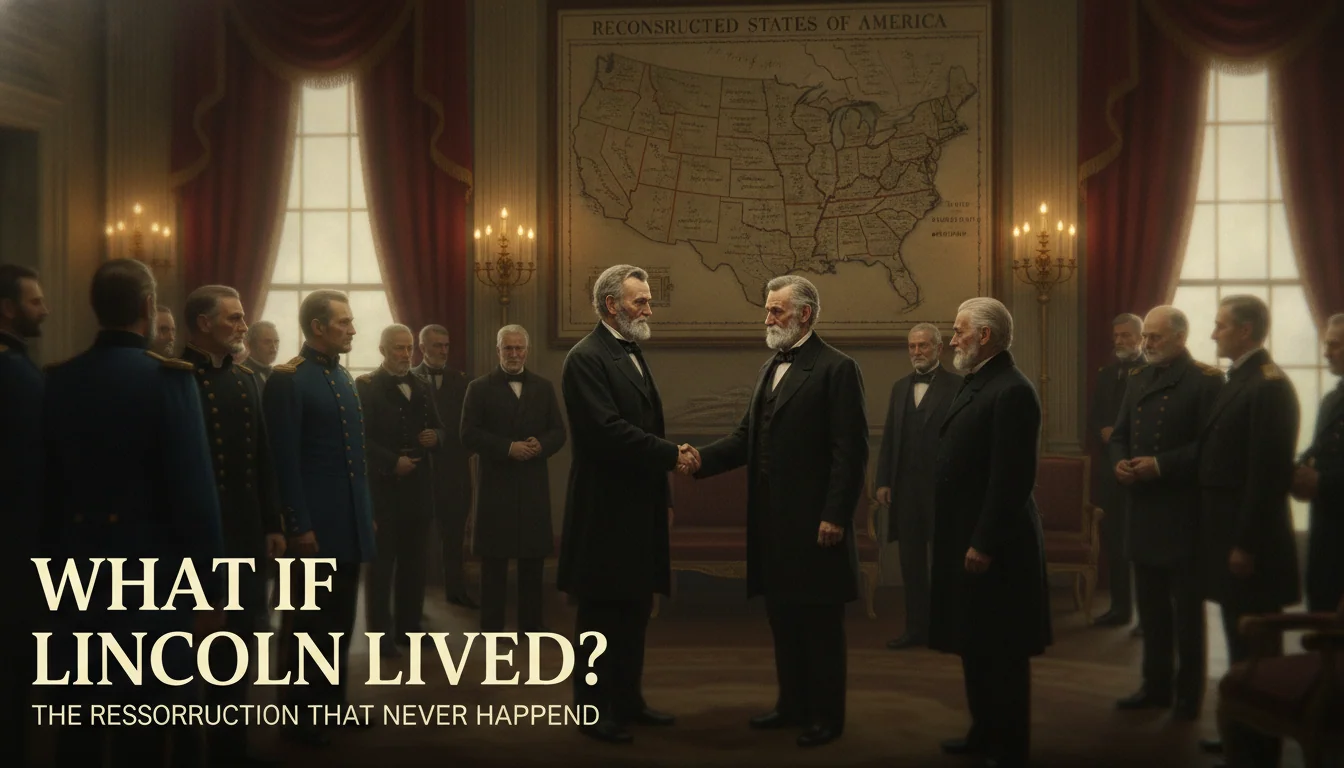
Five days after Robert E. Lee surrendered at Appomattox, with the Civil War effectively over and the country's hardest question, what to do with four million newly freed people and eleven defeated states, still entirely unanswered, John Wilkes Booth shot Abraham Lincoln in the back of the head during the final hours at Ford's Theatre. Lincoln died the next morning. What followed was Andrew Johnson's presidency, a Congress that impeached him, and a Reconstruction that collapsed into decades of disenfranchisement and violence against Black Southerners. The question of what if Lincoln wasn't assassinated is one of the most argued-over what-ifs in American history, and it deserves to be, because the documented record shows both real reasons for hope and real limits on how much difference one surviving president could have made.
What actually happened
The war itself had just ended. Lee's surrender at Appomattox Court House on April 9, 1865, effectively closed the fighting in the war's main theater, though scattered Confederate forces would not formally give up for weeks afterward. Lincoln had spent four years holding together a fragile wartime coalition of Republicans, War Democrats, and border-state Unionists, and by the war's end he had developed a reputation, even among political rivals, for a rare kind of patience and tactical flexibility, willing to delay a decision, change a general, or soften a public position when the moment called for it, while never losing sight of the war's central aims.
By April 1865, Lincoln had already begun sketching a Reconstruction policy, sometimes called the Ten Percent Plan, that would allow former Confederate states back into the Union once ten percent of their 1860 voting population swore a loyalty oath and the state abolished slavery. It was a deliberately lenient framework, aimed at ending the war and rebuilding the Union quickly rather than punishing the South at length. Congress's Radical Republican wing, led by men like Thaddeus Stevens and Charles Sumner, thought this far too soft, and had already clashed with Lincoln over the issue before his death, most notably when Congress passed the tougher Wade-Davis Bill in 1864 and Lincoln let it die with a pocket veto. In his last public speech, delivered from a White House window on April 11, 1865, Lincoln spoke in favor of limited Black suffrage in Louisiana, a position notable enough that Booth, in the crowd that night, reportedly told a companion it would be the last speech Lincoln ever gave.
Booth's plot was broader than the single shot that killed Lincoln. Conspirator Lewis Powell attacked Secretary of State William Seward with a knife the same night, wounding him badly but not fatally, while George Atzerodt, assigned to kill Vice President Andrew Johnson, lost his nerve and never attempted the attack. Johnson was sworn in as president within hours of Lincoln's death, and Reconstruction proceeded under a man with none of Lincoln's political standing, none of his relationship with the Radical Republicans in Congress, and a much more punitive attitude toward Black civil rights than either Lincoln or the Radicals held.
Johnson, a Tennessee Democrat who had stayed loyal to the Union and been added to Lincoln's ticket in 1864 largely to broaden its appeal, proved a poor fit for the office he inherited. He pardoned large numbers of former Confederate officials and officers, resisted efforts to guarantee freed people's civil rights, and vetoed the Civil Rights Act of 1866 and the extension of the Freedmen's Bureau, both of which Congress then passed over his veto, an escalating standoff that culminated in his impeachment by the House in 1868 and a Senate acquittal that fell just one vote short of removal. Historians across the political spectrum have generally rated Johnson's presidency as one of the least effective in American history specifically because of how badly he managed the Reconstruction question Lincoln left behind.
The point of divergence
The plausible change here is narrow and specific: Booth's shot misses, is deflected, or simply never happens, perhaps because Lincoln's bodyguard does not step away from his post that evening as he reportedly did, or because Lincoln and his wife choose a different night at the theater. Nothing about this requires imagining away the war, the assassination conspiracy's existence, or any large structural change; it only requires one gunshot, at close range in a dark box, to fail, the same kind of narrow hinge point that shows up in other single-event counterfactuals, like a driver's wrong turn setting off the First World War.
The consequence chain
Had Lincoln lived, he would have entered his second term with enormous political capital from having won the war, a genuine relationship with key Congressional Republicans built over four years, and a stated, if still incomplete, willingness to extend at least limited suffrage to Black Southerners. It is reasonable to think he would have used that standing to negotiate a Reconstruction settlement somewhere between his own lenient instincts and the Radical Republicans' demands, since he had already begun moving toward their position on suffrage before his death and had a demonstrated pattern of adjusting his public stance as the war's realities changed. A Lincoln-led Reconstruction plausibly avoids the specific catastrophe of Johnson's presidency: the wholesale pardons Johnson granted to former Confederate leaders, his open hostility to the Freedmen's Bureau and civil rights legislation, and the impeachment crisis of 1868 that consumed nearly two years of Congressional energy that might otherwise have gone toward enforcing Reconstruction on the ground.
It is also plausible that Lincoln's death, and the martyrdom that followed it, hardened Northern public opinion against the South in ways that a living Lincoln, seen negotiating and compromising, would not have. Some historians argue this cuts against a rosier reading: a still-living Lincoln, working to reconcile quickly with the South as his public statements suggest he wanted to, might have produced a settlement that was politically stable but weaker on protecting freed people's rights than what Congress, angered by the assassination, eventually imposed on Johnson from outside.
The limits
What Lincoln could not have changed is the underlying will of white Southerners to resist Black civil and political equality by whatever means were available, a resistance that produced the Black Codes, the rise of the Ku Klux Klan, and eventually the violent overthrow of Reconstruction governments across the South regardless of who sat in the White House. Congress, not the president alone, held the constitutional power over Reconstruction legislation and the admission of states, and the same Radical Republican majority that fought Johnson to a standstill might well have fought a Lincoln they judged too accommodating to the defeated South, given his own public record of leniency. It is also worth noting that Lincoln's health and political fortunes were not guaranteed; a second term carried its own uncertainties, and no counterfactual should assume a full eight years of Lincoln's steady hand. Lincoln was fifty-six in April 1865, and while nothing in the documented record suggests his health was failing, the presidency had visibly worn on him across four years of war, and any counterfactual that imagines a fully healthy Lincoln governing without interruption through 1869 is making an assumption the record cannot fully support.
There is also a harder version of the pessimistic case. Some historians argue that Lincoln's own public statements in early 1865, favoring quick reconciliation and only limited Black suffrage, suggest he might have pursued a settlement that satisfied Northern war-weariness and Southern white elites well enough to hold together politically, but that left freed people with considerably less protection than what Radical Republicans, reacting to Lincoln's murder with outrage, eventually forced onto Johnson from the outside through the Fourteenth and Fifteenth Amendments. On this reading, Lincoln's death, while a personal and national tragedy, may have paradoxically hardened Congress's resolve in ways a surviving, conciliatory Lincoln would have blunted.
An informed guess, not a claim
None of this can be known. What the documented record supports is a narrower claim: Lincoln entered April 1865 with more political capital, more Congressional trust, and a more forward-leaning position on Black suffrage than Andrew Johnson ever had, and a Reconstruction led by Lincoln plausibly avoids Johnson's specific failures even if it could not have overcome the deeper structural resistance that eventually undid Reconstruction anyway. The most honest verdict is that Lincoln's survival probably changes the shape and the timeline of Reconstruction's failure, not necessarily its ultimate outcome.
Quick Answers
Common questions about this topic
What actually happened when Lincoln was assassinated?
On the night of April 14, 1865, just five days after Robert E. Lee's surrender at Appomattox, John Wilkes Booth shot President Abraham Lincoln at Ford's Theatre in Washington. Lincoln died the next morning, April 15. Booth's wider conspiracy also targeted Secretary of State William Seward, who survived a knife attack, and Vice President Andrew Johnson, whose assigned attacker lost his nerve and never made an attempt.
What was Lincoln's plan for Reconstruction?
Lincoln favored a comparatively lenient approach, sometimes called the Ten Percent Plan, that would readmit former Confederate states once ten percent of their 1860 voters swore loyalty oaths and the states abolished slavery. He clashed with Radical Republicans in Congress, who wanted firmer guarantees for freed people and harsher terms for former Confederate leaders, and the two sides had not resolved that disagreement by the time he died.
Could Lincoln have prevented the failures of Reconstruction?
It is plausible but far from certain. Lincoln's political skill and standing gave him leverage Andrew Johnson never had, but the same Radical Republican Congress that fought Johnson also disagreed with Lincoln's own lenient instincts, and the underlying resistance of white Southerners to Black political and civil rights would have remained a powerful obstacle regardless of who occupied the White House.
What happened to Andrew Johnson after he became president?
Johnson clashed repeatedly with the Republican-controlled Congress over Reconstruction policy, vetoed civil rights legislation that was then passed over his veto, and was impeached by the House of Representatives in 1868, though the Senate acquitted him by a single vote. His presidency is widely regarded by historians as a period of drift and failure in enforcing Reconstruction.

Debate the Timeline
Chat with historical figures about how differently it could have gone.
Create your free account →No card required. Some figures and features require a paid plan.
Join the HistorIQly Club
Get smarter about the past.
Weekly stories, deep dives, and exclusive content straight to your inbox.