What If Franz Ferdinand's Driver Hadn't Taken the Wrong Turn?
The most cited butterfly-effect story in history: a stalled car and a wrong turn put the archduke in front of his own assassin. What a right turn would change.
Read Wikipedia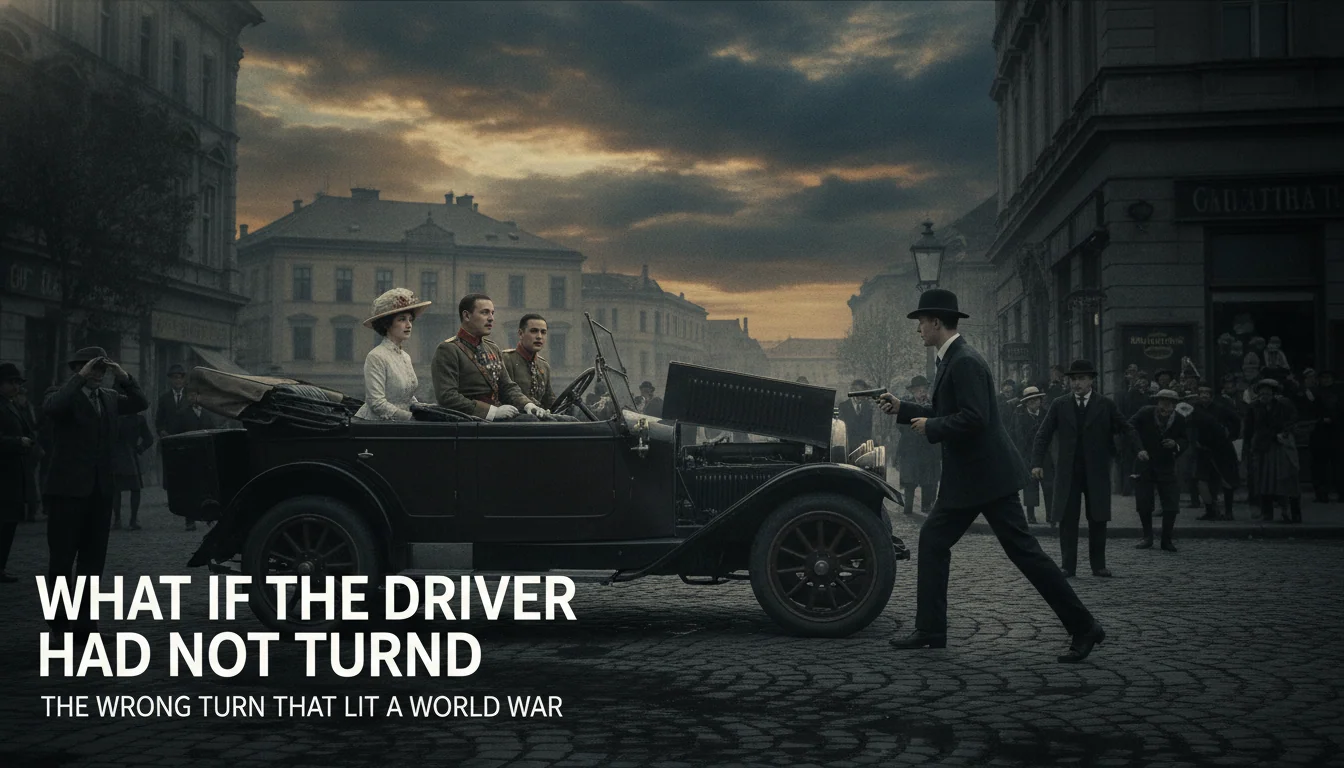
Every argument about whether history turns on great impersonal forces or on plain bad luck eventually arrives at the same exhibit: a chauffeur in Sarajevo who turned onto the wrong street, stalled the engine at exactly the wrong curb, and parked the heir to the Austro-Hungarian throne within arm's reach of the one conspirator in the city who still had a clear shot. No single moment gets cited this often as proof that history can pivot on an accident. That popularity is worth taking seriously enough to ask a harder question: what would a correct turn actually have bought the world?
What actually happened
June 28, 1914 was Vidovdan, a Serbian national commemoration, when Archduke Franz Ferdinand and his wife Sophie, Duchess of Hohenberg, toured Sarajevo as guests of the Austro-Hungarian military governor, General Oskar Potiorek. Six or seven young conspirators tied to the Serbian nationalist network known as the Black Hand had positioned themselves along the planned route on the Appel Quay. The first to act, Nedeljko Cabrinovic, threw a bomb at the archduke's open car. It bounced off the folded roof and exploded under the following vehicle, wounding several officers and bystanders but leaving Franz Ferdinand untouched.
Rather than cut the visit short, Franz Ferdinand continued to a reception at Sarajevo's city hall, then insisted on visiting the wounded at the garrison hospital before returning to Vienna. That decision, and not the original published itinerary, is what actually put him back on the street.
The hospital visit required staying on the Appel Quay the whole way rather than turning onto Franz Josef Street as originally planned. Somewhere in the chain of officials, that change failed to reach the driver, usually identified as Leopold Lojka. He turned the car onto Franz Josef Street out of habit or old instructions. Potiorek, or an aide near him, realized the error and the car stopped, then began reversing, directly in front of Moritz Schiller's delicatessen. Gavrilo Princip, another of the conspirators, had by most accounts already concluded his own chance was gone for the day and happened to be standing at that exact corner. He stepped toward the stalled car and fired twice at close range, hitting Sophie in the abdomen and Franz Ferdinand in the neck. Both died within the hour. The detail that Princip had just bought a sandwich is a popular flourish with no solid contemporary sourcing; what the record actually supports is narrower and stranger, that the car ended up in front of him purely by mistake.
The killing gave Austria-Hungary, backed by Germany's assurance of support, the pretext it wanted for a reckoning with Serbia. Vienna's ultimatum in July was written to be rejected, war on Serbia followed on July 28, and the alliance system did the rest within about a week: Russian mobilization on Serbia's behalf, German declarations against Russia and France, the invasion of Belgium, and Britain's entry into what became a general European war.
What If Franz Ferdinand Wasn't Assassinated?
Suppose the message about the changed route reaches Lojka, or he simply reads the new instructions correctly. The motorcade proceeds along its revised path to the hospital, never turns onto Franz Josef Street, and never stops within reach of the corner where Princip happened to be standing. Franz Ferdinand visits the wounded, returns to Vienna, and lives. That is the whole divergence: not a foiled plot, not conspirators who lose their nerve, just one correctly executed turn.
It is worth noticing how easily this could have gone the other way. The revised route reached some officials in the party and apparently not the driver. The car itself struggled to reverse quickly, which is what gave Princip his opening rather than a clean escape. Small procedural failures, not any grand historical inevitability, put the archduke in front of him.
The consequence chain
If Franz Ferdinand survives Sarajevo, the specific mechanism that produced the July Crisis loses its trigger. Germany's backing of Vienna was explicitly framed as a response to the murder of an heir to the throne. A foiled bomb attack with no royal death is a diplomatic scandal, not a casus belli that European publics, or the general staffs weighing continent-wide mobilization, would accept on the same timetable.
A surviving Franz Ferdinand also remains the most persistent brake on war with Russia inside the Austro-Hungarian court. He had argued, reportedly including directly to Kaiser Wilhelm II, that any war against Serbia would likely become a war against Serbia's patron and should be avoided. It is reasonable to think he continues resisting Chief of Staff Conrad von Hötzendorf's long-standing push for a preventive strike on Serbia, at least for as long as the elderly Franz Joseph remains emperor.
None of that erases the pressure building underneath this one event. The arms race among the great powers, the aftermath of the Balkan Wars that left Serbia larger and more confident, Austria-Hungary's chronic anxiety about its own South Slav populations, and an alliance system that turned regional disputes into continental ones, were all in place regardless of what happened on the Appel Quay. A plausible near-term future without this particular assassination looks like more of the crisis diplomacy Europe had already survived twice in the preceding years, the Bosnian annexation crisis and the Balkan Wars, rather than an immediate slide into general war.
There is also a narrower, more mechanical point worth holding onto. The alliance treaties that turned an Austro-Serbian quarrel into a five-power war, Russia's commitment to Serbia, Germany's commitment to Austria-Hungary, France's commitment to Russia, did not require this specific killing to exist. They required some Austro-Serbian crisis serious enough that Vienna felt compelled to press it and St Petersburg felt compelled to answer. A surviving Franz Ferdinand plausibly pushes that threshold further out, since he is on record wanting to avoid exactly this kind of confrontation, but he does not repeal the treaties themselves.
The limits
This is where honesty about the counterfactual has to take over. Most historians who study the July Crisis treat the underlying causes of a European war as heavily overdetermined; a spark was plausibly going to arrive from somewhere within a few years even without Sarajevo, whether through another Balkan flashpoint, a colonial dispute, or an internal crisis inside Austria-Hungary's multi-ethnic structure. Franz Ferdinand himself hoped to defuse that internal pressure through some version of trialism, elevating the empire's South Slavs to a status closer to that of Austrians and Hungarians. Hungarian elites bitterly opposed those plans, and there is no confident way to say they would have succeeded, or that they would have calmed Serbian nationalism rather than provoking a different confrontation.
We also cannot know how long a surviving Franz Ferdinand would have remained a moderating voice once he actually held power. Franz Joseph was elderly and visibly failing by 1914. Had Franz Ferdinand succeeded him within a year or two, as was widely expected, the same court factions who resented his caution would have kept pushing for a harder line, and nothing guarantees he would have held it indefinitely once the crown, and the pressure that comes with it, was his.
Why this one keeps getting cited
The Sarajevo assassination earns its place as the standard butterfly-effect story because the chain of small failures behind it, the missed message, the wrong turn, the stalled reverse gear, the conspirator who happened to be standing at exactly that corner, is unusually well documented and unusually tight in time. Most historical hinge points involve years of drift toward an outcome; this one turns on roughly ninety seconds on a single street. That does not mean the war which followed can be laid entirely on one corner in Sarajevo. It means the specific shape and timing of the war that did happen owed something real to an accident, layered on top of tensions that were likely to produce some kind of crisis regardless.
For two other single points where a small delay reshaped a much larger outcome, see what if the Mongols hadn't withdrawn from Europe in 1242 and what if Hitler had died in World War I.
None of this is a claim about what actually happened. It is an exercise in testing one of history's favorite anecdotes against the real constraints, standing armies, treaty obligations, and court politics, that would have shaped any alternative June in Sarajevo. The honest answer is also the least satisfying one: a correct turn probably delays the reckoning and changes its shape. It does not obviously cancel it.
Quick Answers
Common questions about this topic
What actually happened during the assassination of Franz Ferdinand?
On June 28, 1914, Archduke Franz Ferdinand and his wife Sophie were shot and killed in Sarajevo by Gavrilo Princip, part of a Serbian nationalist conspiracy linked to the Black Hand network. Their car had taken a wrong turn after an earlier bomb attempt failed, then stalled directly in front of Princip while trying to reverse back onto the planned route.
Did the driver really take a wrong turn before the shooting?
Yes. The route had been changed after the morning's failed bomb attack so Franz Ferdinand could visit the wounded at the hospital, but the driver, usually named as Leopold Lojka, was not properly informed and turned onto the old route. When an official realized the mistake and the car stopped to reverse, it stalled directly in front of Gavrilo Princip.
Would World War I have happened anyway without the assassination?
Historians are divided, but most agree the underlying pressures, the arms race, the alliance system, and Austro-Hungarian anxiety about Serbian nationalism, made some European crisis likely within a few years regardless. Far less certain is whether that crisis would have escalated into a general war on the same scale, timetable, or alliance lines as the one that actually followed Sarajevo.
Was Franz Ferdinand really about to visit the wounded when he was shot?
Yes. After the morning's bomb attack injured members of his entourage, Franz Ferdinand insisted on visiting the injured at the hospital rather than continuing the official program as scheduled. It was this last-minute change of route, not the original itinerary, that put his car on the street where the assassination happened.

Debate the Timeline
Chat with historical figures about how differently it could have gone.
Create your free account →No card required. Some figures and features require a paid plan.
Join the HistorIQly Club
Get smarter about the past.
Weekly stories, deep dives, and exclusive content straight to your inbox.