What If the Mongols Hadn't Withdrawn From Europe in 1242?
A Mongol army that had crushed Hungary and Poland turned back for Karakorum after Ogedei Khan's death. What if the succession news had waited a season?
Read Wikipedia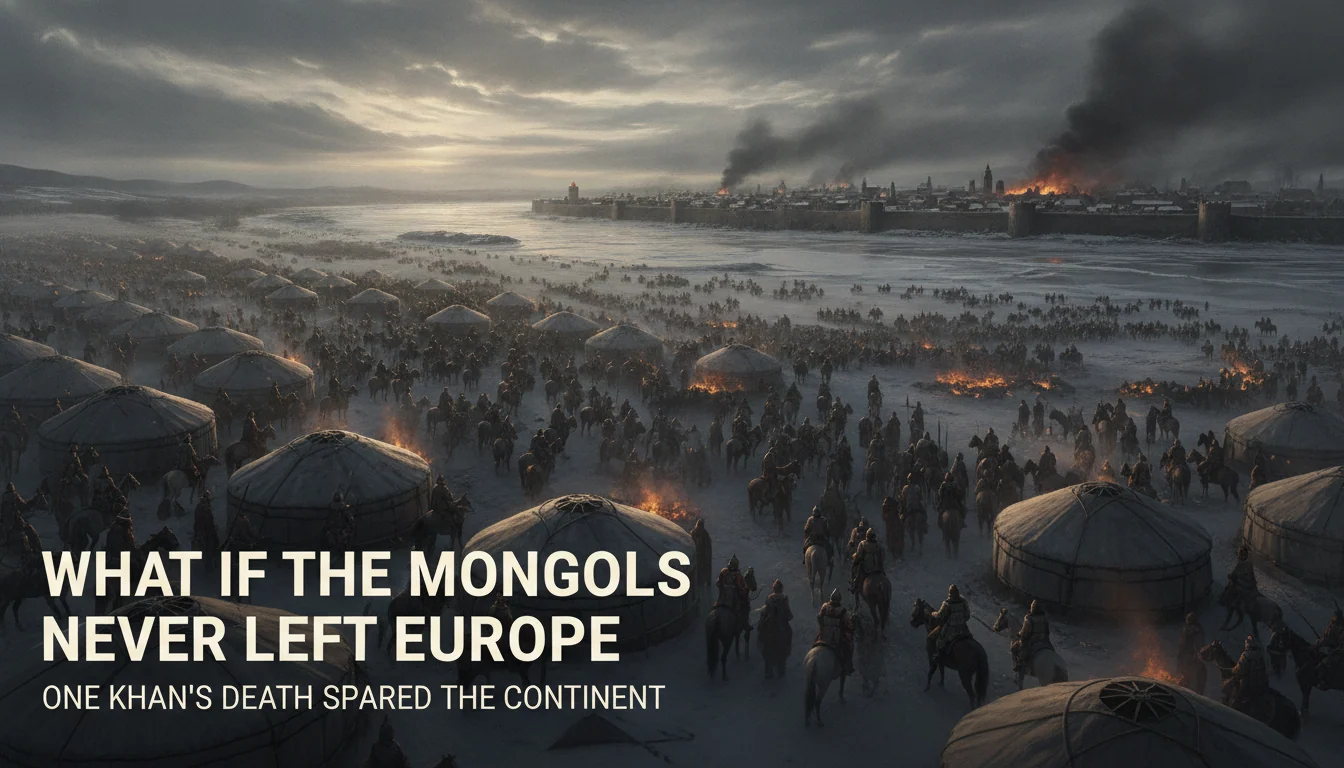
In the spring of 1241, two Mongol armies operating a thousand kilometers apart destroyed the field armies of Hungary and Poland within days of each other, a level of strategic coordination that had no equal anywhere else in the medieval world. A year later, those same armies were gone, withdrawn east through the Balkans and back across the steppe, and Central Europe never saw a Mongol army in that strength again. The trigger was not a defeat. It was a death, four thousand kilometers away in Karakorum.
What actually happened
By the winter of 1241 to 1242, the Mongol position in Central Europe looked less like an invasion than an occupation in progress. General Subutai, the architect of the campaign and already a veteran of the earlier conquest of the Khwarezmian Empire and the Russian principalities, had engineered a two-pronged assault into Hungary and Poland that unfolded with the kind of timing modern military historians still study. At the Battle of Legnica in Silesia on 9 April 1241, a Mongol column under Baidar and Kadan annihilated a combined Polish, German, and Templar force, killing Duke Henry II of Silesia. Two days later, on 11 April, the main Mongol army under Batu Khan and Subutai crushed King Bela IV's Hungarian royal army at the Battle of Mohi, on the Sajo River. Bela fled first to Austria and then to the Dalmatian coast, hunted for months, while Hungary's countryside was subjected to a brutal winter campaign that historians estimate killed a substantial share of the kingdom's population through slaughter, famine, and the disruption of planting.
By early 1242, Mongol scouting parties had reportedly reached the Adriatic coast and probed toward Vienna, and the Mongol high command in the field was, by every available account, planning a continuation of the campaign into the following year. Then, in Karakorum, the Great Khan Ogedei, son of Genghis Khan and ruler of the entire Mongol Empire, died on 11 December 1241, apparently from complications of heavy drinking during a hunting trip. News of a Great Khan's death, and of the kurultai that Mongol custom required to select his successor, took weeks to travel the length of the empire, and it reached Batu Khan's camp in Hungary by roughly February or March 1242.
Mongol succession custom was not a suggestion. Every prince of Genghis Khan's bloodline with a claim to influence the succession, and Batu was one of the most senior surviving princes, was expected to attend or at least weigh in on the kurultai that would choose the next Great Khan. Batu began withdrawing his forces from Hungary in the spring of 1242, moving south and east through the Balkans and the Russian steppe rather than turning immediately for Karakorum himself, a decision likely shaped as much by the ongoing rivalry within the Mongol royal family as by simple obedience to custom. He never did attend the eventual kurultai in person, and the succession dispute that followed Ogedei's death dragged on for years. But the western armies left, and by the end of 1242 organized Mongol occupation of Hungary and Poland had ended.
What If the Mongols Invaded Europe Further?
None of that sequence is disputed. Historians across the field, including the military historian John Man and specialists in Mongol succession custom, treat Ogedei's death as the proximate cause of the withdrawal, though some also point to genuine logistical strain: the Hungarian plain, while good pasture, may not have supported the full Mongol cavalry and horse herd indefinitely, and resistance in fortified towns like Esztergom had been slower and costlier to overcome than the open-field battles. The counterfactual asks what follows if that timing had broken differently.
Suppose Ogedei had lived another two or three years, long enough for Batu's campaign to run its natural course before any succession question forced a withdrawal. Or suppose the news of his death had simply traveled slower, delayed by winter weather on the Eurasian courier routes, buying Subutai another full campaigning season. Either version is a modest, plausible change to a single variable, not a rewrite of the military balance, since the Mongol army in Hungary had already beaten every field force sent against it.
The consequence chain
With another campaigning season and no succession crisis pulling commanders home, it is plausible that Subutai's forces would have pushed further into Austria and the northern Italian states, both of which had fortifications and a political fragmentation not unlike Hungary and Poland's. The Holy Roman Empire under Frederick II was itself locked in a bitter conflict with the papacy at the time, a distraction that historians already credit with weakening the collective European response to the 1241 invasion, and that same disunity would plausibly have continued to hamper any coordinated resistance the following year.
A longer Mongol presence in Hungary would likely have meant the kingdom's incorporation, formally or in practice, into the Mongol tribute and administrative system already applied to the conquered Russian principalities, which endured under the Golden Horde for roughly two and a half centuries. It is reasonable to think Poland's fractured duchies, already devastated at Legnica, would have faced a similar fate rather than the more limited raiding they in fact experienced in subsequent decades. The knock-on effect for the wider region is easier to trace than for Western Europe: a Mongol-dominated Hungary sitting on the Danube would have reshaped the balance of power between the Byzantine remnants, the Bulgarian and Serbian states, and the expanding Ottoman beyliks that would not appear as a serious force for another half-century, though exactly how remains genuinely uncertain.
Further west, the picture gets speculative fast. Mongol columns had already raided into the edges of Austria and probed the Adriatic, so a continued campaign into German-speaking Central Europe is plausible. But the campaign that conquered Hungary relied heavily on the open Hungarian plain, ideal terrain for the mass cavalry tactics and grazing needs of a Mongol army, a resource the more forested, more densely fortified terrain of Bohemia, Bavaria, and northern Italy did not offer in the same quantity. Subutai was a supremely adaptable commander, and Mongol armies had taken fortified Chinese and Khwarezmian cities before, so a stalled advance is not a certainty. But it is the honest place to note that the same open terrain that made Hungary conquerable so easily would not simply repeat itself further west.
The limits of the counterfactual
Even a Mongol Central Europe under long-term occupation would have run into the same administrative strain the Golden Horde faced in Russia: a small ruling elite governing a much larger, linguistically and religiously distinct population, reliant on local princes and bishops for day-to-day administration in exchange for tribute. That arrangement held for generations in Russia, so it is not implausible in Hungary and Poland either, but it was never a costless or fully stable system, and periodic revolts against Golden Horde rule were a recurring feature of Russian history during that occupation.
It is much less certain that a longer Mongol campaign would have reached, let alone held, France, England, or the Iberian kingdoms, whose distance from the steppe, denser network of stone castles, and lack of open grassland for Mongol horse herds represent real logistical limits rather than a simple question of momentum. The wider trajectory of the Renaissance, the Reformation, and the rise of the Atlantic maritime powers rested on developments across the whole of Western Europe that a Mongol presence confined to the Danubian basin and the Balkans would not obviously have derailed. We cannot know how a longer occupation of Hungary would have played out over decades, whether it collapses under a later Mongol succession crisis (the empire did fracture into competing khanates within a generation regardless), or whether it hardens into something like the Golden Horde's long rule over Russia.
None of this happened, because a Great Khan in Karakorum drank heavily on a hunting trip and died at a moment when his empire's western army happened to be sitting astride the Danube. What the record supports is that the withdrawal was a political decision forced by succession custom, not a military retreat forced by European resistance, and that the army that left had already beaten every force Central Europe could put in the field. Move the timing of one death by even a season, and Hungary's story, and quite possibly the Balkans', gets meaningfully darker. Move it much further west than that, and the terrain and logistics that actually shaped Mongol conquest everywhere else start working against the scenario rather than for it.
For a closer look at the empire Batu Khan was being recalled to help decide the future of, see a time traveler's guide to Mongol Karakorum. And for another moment where a single delayed message reshaped a continent, see what if Franz Ferdinand's driver hadn't taken the wrong turn.
Quick Answers
Common questions about this topic
Why did the Mongols actually withdraw from Europe in 1242?
The Great Khan Ogedei died in December 1241, and news of his death reached the Mongol commanders in Hungary by early 1242. Under Mongol succession custom, senior princes of the blood were required to return to Mongolia for the kurultai that would choose a new Great Khan, and Batu Khan, who led the western campaign, withdrew the bulk of his forces east through the Balkans over the following months.
Could the Mongols have conquered all of Europe if they had stayed?
It is reasonable to think they could have overrun the fragmented kingdoms of Central Europe in the near term, since Hungary and Poland had already been defeated in the field at Mohi and Legnica. Whether they could have held and administered Western Europe long term is a separate and much less certain question, given the different terrain, denser fortifications, and longer supply lines further west.
How thoroughly did the Mongols defeat Hungary and Poland in 1241?
Decisively. At the Battle of Mohi in April 1241, Subutai's forces destroyed the main Hungarian royal army and King Bela IV fled the kingdom. Days earlier at Legnica, a separate Mongol column had wiped out a Polish and allied Silesian force and reportedly sent sacks of ears back east as a battlefield count.
Did the Mongols ever invade Europe again after 1242?
Not on the same scale. Mongol and later Golden Horde forces raided into Poland, Hungary, and the Balkans several more times over the following decades, and the Golden Horde continued to dominate the Russian principalities for centuries, but no later campaign matched the coordinated, near-total conquest of Hungary and Poland achieved in 1241.

Debate the Timeline
Chat with historical figures about how differently it could have gone.
Create your free account →No card required. Some figures and features require a paid plan.
Join the HistorIQly Club
Get smarter about the past.
Weekly stories, deep dives, and exclusive content straight to your inbox.