What If the Cuban Missile Crisis Had Gone Nuclear?
During the Cuban Missile Crisis, one Soviet officer's refusal to fire a nuclear torpedo may be the closest brush with nuclear war on record. What if he'd said yes?
Read Wikipedia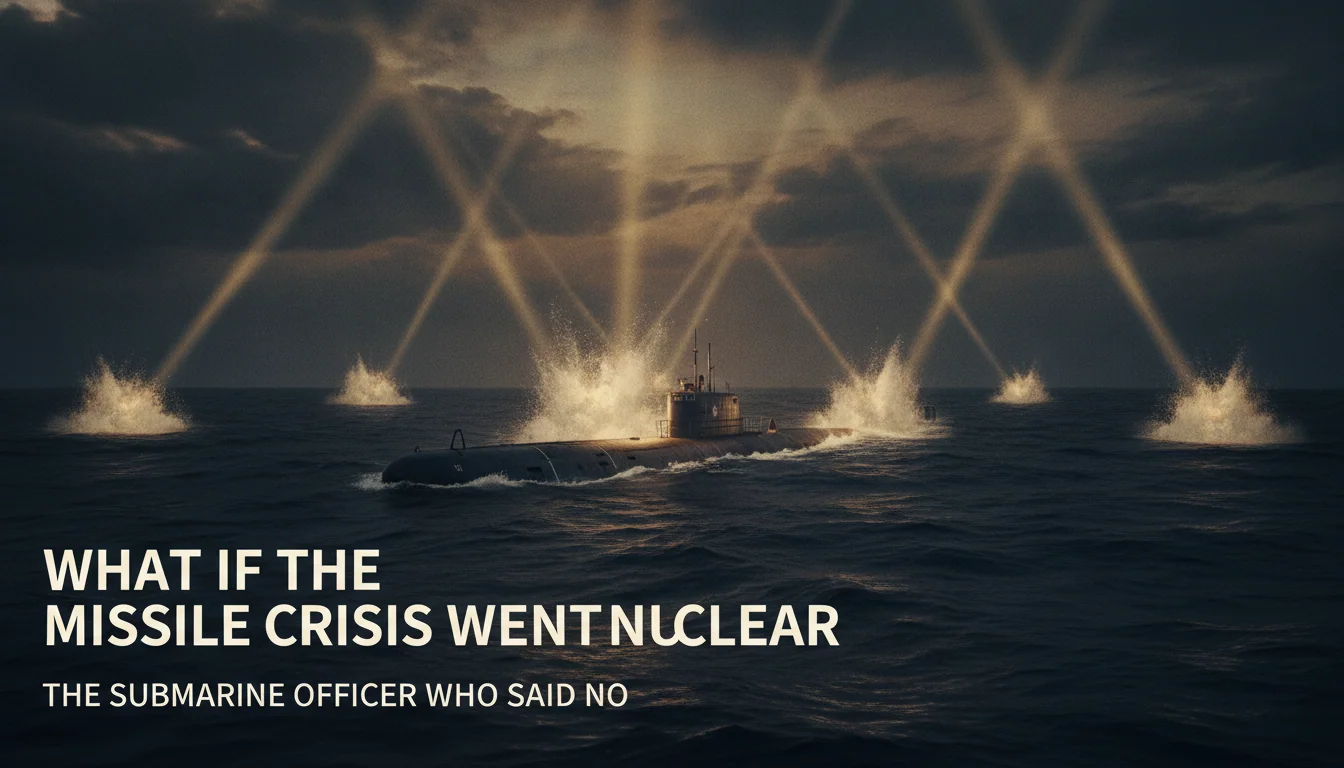
Deep in the warm water north of Cuba, the air inside the Soviet submarine B-59 had gone foul. The batteries were nearly dead, the air conditioning had failed days earlier, and compartments reportedly baked past forty degrees Celsius while carbon dioxide built up faster than the scrubbers could clear it. On the night of 27 October 1962, American destroyers enforcing the naval quarantine of Cuba found the submarine and began dropping small practice depth charges, a signal meant to say surface and identify yourself. Nobody had told the exhausted men trapped inside what those explosions meant. Cut off from Moscow for days, some of them feared a war had already started.
This is not speculation. It is the best-documented account of the closest the Cuban Missile Crisis, and quite possibly the entire Cold War, came to a nuclear exchange. History has a habit of turning on moments this small and this obscure, the way a driver's wrong turn in Sarajevo set off a chain of events nobody controlled. The speculation starts a few paragraphs from now, with a single vote that could easily have gone the other way. First, the record.
What actually happened
The crisis itself is well known in outline. In October 1962, an American U-2 reconnaissance flight photographed Soviet medium-range ballistic missile sites under construction near San Cristobal, Cuba, part of a secret Soviet deployment codenamed Operation Anadyr. President John F. Kennedy convened a small group of advisors, later known as ExComm, and on 22 October announced a naval quarantine of the island rather than the immediate air strike or invasion that several advisors were pushing for. For thirteen days the two superpowers negotiated while American Strategic Air Command sat at DEFCON 2, the only time in its history it reached that level of alert, and Soviet forces in Cuba readied their own weapons.
Saturday 27 October was the worst day of the thirteen. A Soviet surface-to-air missile shot down an American U-2 over Cuba and killed its pilot, Major Rudolf Anderson. Kennedy chose not to retaliate immediately, buying time for a resolution his brother Robert Kennedy was quietly negotiating with the Soviet ambassador, Anatoly Dobrynin. On that same day, in the water north of Cuba, American destroyers found B-59.
The submarine was one of four Soviet diesel-electric submarines sent toward Cuba as part of the wider deployment, and each reportedly carried, alongside its conventional torpedoes, a single nuclear-armed torpedo with a warhead in roughly the same range as the bomb dropped on Hiroshima. American commanders knew Soviet submarines were operating in the area. They did not know the submarines were nuclear-armed, and the depth charges used against B-59 were unarmed signaling charges meant to force a submerged boat up, not to sink it. B-59's own captain, Valentin Savitsky, may not have grasped that distinction either. Exhausted, out of contact with Moscow, and rattled by explosions going off around his hull, he reportedly concluded that war might already have begun and ordered the nuclear torpedo readied to fire.
By most accounts of Soviet submarine protocol at the time, a nuclear launch required the agreement of three officers rather than the usual two, because Vasili Arkhipov, chief of staff of the four-submarine flotilla, happened to be aboard B-59 that week overseeing all four boats. Savitsky wanted to fire. The political officer aboard reportedly agreed with him. Arkhipov did not. Accounts of the argument that followed vary in detail, but the outcome is not disputed: Arkhipov talked Savitsky down, and the submarine surfaced instead of firing, to await orders from Moscow. It broke the surface among the American ships, was identified, and was eventually sent home. The following day, 28 October, Khrushchev announced he would remove the missiles from Cuba in exchange for a public American pledge not to invade the island and a secret promise to remove American Jupiter missiles from Turkey.
The point of divergence
The plausible break from the historical record here is narrow and specific: Arkhipov agrees with Savitsky instead of arguing him down, or simply is not aboard B-59 that week at all.
Both variants are easy to justify historically. Arkhipov was not B-59's designated second-in-command; he was the flotilla's chief of staff, riding along to supervise all four submarines, and by several accounts he only had a vote in the matter because of that seniority. Remove him from the boat, or swap him for an officer without his particular record (he had reportedly already lived through a nuclear reactor accident aboard another Soviet submarine the previous year and was, by temperament as much as training, unusually resistant to panic), and the ordinary two-man rule applies: captain and political officer, both apparently already inclined to fire. Nothing about the physical situation changes. The heat, the dead batteries, the depth charges landing close enough to be felt through the hull, and days of silence from Moscow pressed on any crew the same way regardless of who happened to be standing in the control room.
Given how close the actual vote appears to have been, it is reasonable to think that a different roster aboard, or a slightly more persuasive Savitsky, tips the outcome the other way.
What might have followed
A nuclear torpedo detonating near an American warship enforcing the quarantine would have been, unambiguously, the Soviet Union using a nuclear weapon against United States forces. That is the one link in this chain that is not really speculative: whatever the yield, whatever the confusion behind it, there is no obvious way for Washington to read that as anything other than an act of war.
What happens next is where the chess game starts, and where every claim has to be flagged as speculation. It is plausible that Kennedy's restraint after the Anderson shootdown, which happened on that same terrible day, would not have survived a second and far larger provocation within hours. ExComm was already split between advisors pushing for air strikes and invasion and a smaller group counseling patience; a lost American ship, with a crew that would plausibly have numbered well into the hundreds, would likely have strengthened the hawks' position enormously. We cannot know whether Kennedy would have ordered an immediate strike on Cuba, a naval reprisal against Soviet vessels, or a wider mobilization, but it is reasonable to think some form of retaliation would have followed within hours rather than days.
The deeper uncertainty is whether that retaliation would have stayed limited. Both governments lacked a direct, fast channel between capitals in 1962. The Washington-Moscow hotline was created precisely because of this crisis and did not yet exist; messages still moved through embassies, coded cables, and a slow public back-and-forth. If shooting broke out between American and Soviet forces near Cuba while Strategic Air Command bombers already sat armed and airborne at DEFCON 2, the room for a single miscommunication to escalate further was real. It is plausible, though far from certain, that a nuclear exchange at sea could have dragged both superpowers toward a wider nuclear war that neither government had actually decided to fight.
Where the speculation runs out
A few real constraints argue against assuming the worst automatically.
Khrushchev almost certainly had not ordered B-59 to fire, and a nuclear strike launched by a rattled submarine captain acting without Kremlin authorization is a different animal from a deliberate escalation. It is plausible that Khrushchev, faced with an accidental attack he never sanctioned, would have moved fast to disown it and negotiate, much as he in fact moved fast to end the crisis once he judged the risk had grown too high. Kennedy, for his part, had already shown on 27 October that he was willing to absorb a serious provocation, the killing of an American pilot, without ordering immediate retaliation. That instinct for a pause before pulling the trigger does not vanish just because the next provocation is larger, even though it would become much harder to sustain.
The other limit is arithmetic rather than psychology. In 1962 the Soviet Union's force of missiles able to reach the American mainland was still small, and its early-warning and command systems were primitive compared with what both sides built over the following decade. A full nuclear exchange fought with 1962 arsenals would have been a historic atrocity, not a footnote, but it would not have resembled the balanced mutual destruction of later decades. None of that makes a nuclear detonation off Cuba a survivable, manageable event. It only means that "B-59 fires" does not mechanically equal "the world ends by lunchtime." Nobody, then or now, can specify exactly where between those two outcomes the chain would actually have stopped.
None of this is a claim about what would have happened. It is an exercise in taking one documented, three-way vote inside a steel hull and asking how much of the outcome rode on it, the same kind of narrow margin that decided whether the Titanic missed the iceberg rather than struck it. The historians who eventually pieced together the B-59 story, largely from Soviet veterans who spoke publicly at a 2002 conference in Havana marking the crisis's fortieth anniversary, came away calling Arkhipov, only half in jest, the man who saved the world. The more careful version of that claim is simply that he was one of several people, across thirteen days, whose individual judgment plausibly mattered more than either government's official policy. That is unsettling enough on its own. It needs no embellishment to make the point.
Quick Answers
Common questions about this topic
What actually happened during the Cuban Missile Crisis?
In October 1962, the United States discovered Soviet nuclear missiles being installed in Cuba and responded with a naval quarantine rather than an immediate air strike or invasion. Over thirteen tense days, the two superpowers negotiated in public and in secret while their armed forces reached their highest states of alert, and the crisis ended on 28 October when Nikita Khrushchev agreed to remove the missiles in exchange for a public American pledge not to invade Cuba and a secret promise to remove American missiles from Turkey.
Who was Vasili Arkhipov and why does he matter?
Arkhipov was a Soviet naval officer aboard the submarine B-59 when American destroyers forced it to the surface with signaling depth charges on 27 October 1962. Soviet protocol reportedly required three officers to agree before the submarine could fire its nuclear-armed torpedo, and Arkhipov happened to be the third officer present that week. His refusal to authorize the launch that his captain wanted to order is widely credited with preventing a nuclear detonation.
Could the Cuban Missile Crisis really have gone nuclear?
It came closer than most people realize. Aboard B-59, an exhausted crew cut off from Moscow, rattled by depth charges, and unsure whether a war had already started came within one dissenting vote of firing a nuclear torpedo at American ships. Whether that single act would have triggered a wider nuclear war cannot be proven, but given how tense 27 October 1962 already was, it is a sobering and plausible thought experiment rather than an idle one.
What ended the Cuban Missile Crisis?
Khrushchev publicly announced on 28 October 1962 that Soviet missiles would be withdrawn from Cuba. In exchange, Kennedy publicly pledged not to invade the island and secretly agreed to remove American Jupiter missiles from Turkey within months, an arrangement that stayed hidden from the public for decades.

Debate the Timeline
Chat with historical figures about how differently it could have gone.
Create your free account →No card required. Some figures and features require a paid plan.
Join the HistorIQly Club
Get smarter about the past.
Weekly stories, deep dives, and exclusive content straight to your inbox.