What If Napoleon Won Waterloo?
What if Napoleon won Waterloo instead of losing it by hours, to a delayed attack and a missed interception? A grounded counterfactual.
Read Wikipedia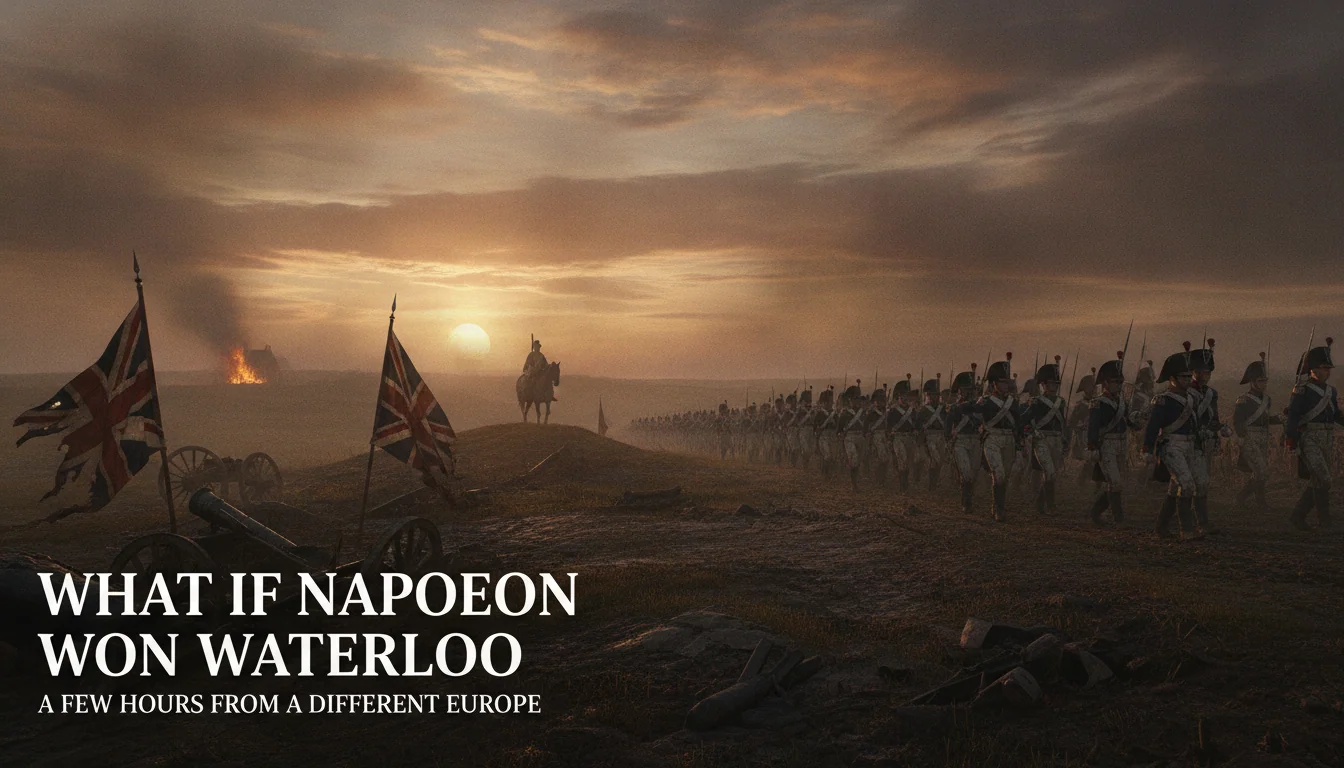
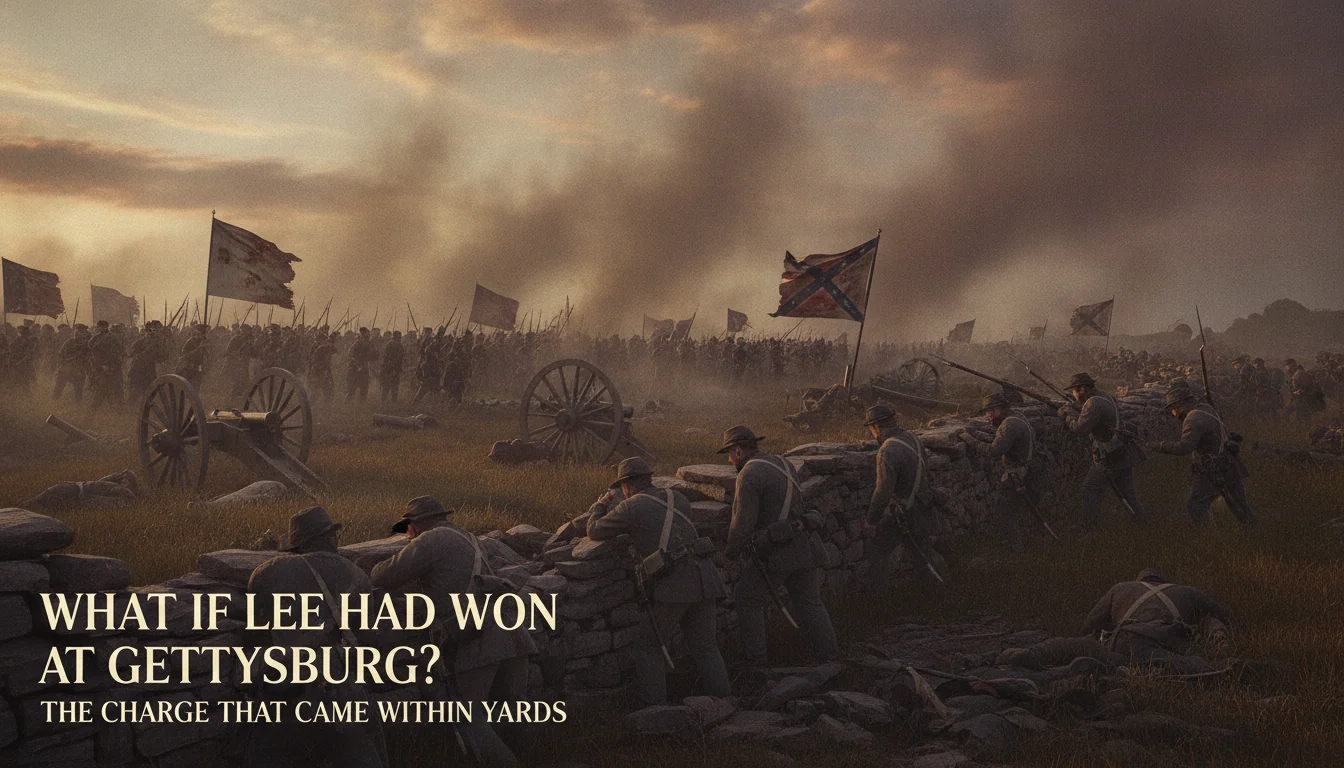
Ask a dozen military historians which single afternoon in European history has been re-argued the most, and a good number will point to the same stretch of Belgian farmland south of Brussels. Napoleon Bonaparte lost there on June 18, 1815, and the loss ended not just a battle but an entire political project. What makes Waterloo such durable counterfactual bait is that the margin was genuinely thin, the kind of near thing that invites the question of what if Napoleon won Waterloo rather than lost it. This is not a case of imagining away a hundred-year technology gap; it belongs on the same short list as what if Lee had won at Gettysburg or what if D-Day had failed, battles where a handful of hours and a few decisions by named men could plausibly have gone the other way.
What actually happened
By March 1815, Napoleon had escaped exile on Elba, landed on the French coast, and marched on Paris without a shot fired against him, sending Louis XVIII fleeing and reopening a war most of Europe considered finished. The powers assembled at the Congress of Vienna, Britain, Austria, Prussia, and Russia among them, declared him an outlaw and began mobilizing what became known as the Seventh Coalition. Napoleon's best chance was to strike before the much larger Austrian and Russian armies could reach France from the east, so he moved into modern Belgium to defeat the Duke of Wellington's Anglo-allied army and Field Marshal Gebhard von Blücher's Prussian army separately, before they could combine.
On June 16, French forces beat the Prussians at Ligny while Marshal Ney fought Wellington's advance guard to a draw at Quatre Bras. Blücher's army withdrew, but not east toward its own supply lines as a defeated force might be expected to. It retreated north, toward Wavre, keeping open the possibility of marching to Wellington's aid. Napoleon detached roughly a third of his army under Marshal Emmanuel de Grouchy to chase the Prussians down and keep them away from the coming battle. Grouchy pursued cautiously and never managed to block the Prussian march toward Waterloo.
On the morning of June 18, heavy overnight rain had left the ground too soft for cavalry and artillery to maneuver well, and Napoleon reportedly delayed his main assault on Wellington's ridge position until around midday to let the ground firm up. The battle that followed included a costly, largely diversionary French assault on the fortified farmhouse of Hougoumont, a major infantry attack under General d'Erlon that was thrown back, and a series of massed French cavalry charges against Wellington's infantry, which had formed defensive squares. Unsupported by coordinated infantry and artillery, the cavalry could not break them. By mid to late afternoon, Prussian corps under General von Bülow began arriving on the French right flank near Plancenoit, forcing Napoleon to divert reserves to hold them off. In the early evening he committed his last reserve, the Imperial Guard, against Wellington's weakened center. It was repulsed. The cry that the Guard was retreating spread through the French ranks, morale broke, and what had been a battle became a rout, finished off by an aggressive Prussian pursuit through the night.
Napoleon returned to Paris, found his political support collapsing, and abdicated for the second time on June 22, 1815. He tried to reach the United States, found British ships blockading the coast, and surrendered instead to the Royal Navy. He was exiled to the remote island of Saint Helena in the South Atlantic, where he died in 1821.
The point of divergence
Of the several near things that day, the one historians return to most often is Grouchy's pursuit of the Prussians. Napoleon had given him a real and defensible mission: hold Blücher's army away from Wellington's while the main French force finished off the Anglo-allied line. It was not an unreasonable plan, and it came close to working. It is plausible to imagine Grouchy marching harder, or reading the sound of the guns at Waterloo correctly, and either intercepting Bülow's corps on its approach march or fighting a delaying action that kept Prussian numbers off the field for several more hours.
Give Napoleon those hours, and the shape of the afternoon changes. Without the drain on his right flank at Plancenoit, more of the Imperial Guard and the reserve cavalry remain available for a concentrated assault on Wellington's center precisely when it was already weakened by the day's fighting. It is reasonable to think that assault, properly supported rather than thrown in piecemeal, might have broken the Anglo-allied line before nightfall.
A second, less popular divergence point is worth naming honestly because it is often raised and often overstated: the midday delay in launching the main attack. Some accounts blame the soft, rain-soaked ground for the wait, arguing an earlier start would have given Napoleon extra daylight to finish Wellington before any Prussian corps came within reach at all. It is a plausible factor, but a shakier one to lean on than Grouchy's pursuit, since the ground genuinely needed time to firm up for cavalry and artillery to operate at all, and pushing an attack into deep mud earlier in the morning carries its own real costs. Treated together, both point in the same direction: Napoleon's actual plan was sound in outline, and it was undone by a matter of hours rather than by any fundamental flaw in his generalship.
The consequence chain
If Wellington's position collapses that evening without Prussian reinforcement, the immediate and most plausible result is a disorderly Anglo-allied retreat toward Brussels and the coast, not a rout on the scale the French army actually suffered. Napoleon would have a genuine battlefield victory to report to Paris, and for the first time since his return the political ground under him might have firmed rather than cracked. A French army bloodied but intact and victorious buys time, and time was the one thing his restored regime desperately needed.
What a single won battle plausibly does not do is end the war. The Austrian army under Schwarzenberg and the Russian army under Barclay de Tolly were already marching toward the Rhine, and neither had been anywhere near Waterloo. Those armies, combined, dwarfed anything France could field in 1815 after two decades of near-continuous war had already drained French manpower and finances. Britain's naval blockade and its subsidies to the coalition were untouched by events on a Belgian ridge. A win at Waterloo plausibly forces the coalition to regroup and slows the advance into France by weeks, perhaps into autumn, and it plausibly gives Napoleon leverage to open negotiations from a position other than total collapse. It does not plausibly hand him a durable peace on his own terms, and it does not plausibly restore the empire of 1810.
There is also the question of what a defeated but not destroyed Blücher would have done next. The historical Prussian army arrived at Waterloo angry, having been mauled at Ligny two days earlier, and Blücher was reportedly determined to have his revenge regardless of the risk. It is reasonable to think that even a French win on June 18 would not have removed the Prussians from the war. Blücher's army, reinforced and resupplied, would plausibly have regrouped within days rather than weeks, meaning any French advantage purchased that evening had a short shelf life before Prussian forces were back in the field, likely alongside the approaching Austrians and Russians rather than ahead of them.
Where the speculation runs out
This is the point where the imagined chain has to stop pretending it knows more than it does. We cannot know whether Wellington's line would actually have broken, only that it is a defensible guess given how close-run the real fight already was by evening. We cannot know how the French Chambers, already uneasy about Napoleon's return, would have responded to a costly win rather than an outright rout, though a return to Paris as victor rather than fugitive was clearly the better of his two available outcomes. What we can say with more confidence is that the deeper structural problems of 1815 France, a population and treasury exhausted by war, a political class that had never fully committed to his second reign, and a coalition with the numbers to keep raising fresh armies, do not disappear because one battle goes differently. Most historians who have worked through this scenario land in roughly the same place: Napoleon at Waterloo was fighting for time, not for the war itself, and a win there most likely postpones the ending rather than rewrites it.
None of this is a claim about what happened. It is an informed thought experiment built on a real hinge moment, a plausible change grounded in what Napoleon actually attempted and how close it came to succeeding, and an honest look at the constraints, manpower, money, and political will, that would have shaped whatever came next. History gave Napoleon a mid-morning downpour, a cautious marshal, and a Prussian army that arrived exactly late enough to matter. Move any one of those by a few hours, and the story of that Sunday changes. Move the underlying arithmetic of an exhausted France against a still-mobilizing continent, and it probably does not.
Quick Answers
Common questions about this topic
What actually happened at the Battle of Waterloo?
On June 18, 1815, Napoleon's Armée du Nord attacked the Duke of Wellington's Anglo-allied army near the village of Waterloo, south of Brussels. Wellington's line held through the afternoon, Prussian forces under Field Marshal Blücher arrived from the east to reinforce him, and Napoleon's final assault with the Imperial Guard was repulsed, triggering a general French collapse.
Could Napoleon plausibly have won at Waterloo?
Yes, in the narrow sense that several near things went against him: a delayed morning attack, Marshal Grouchy's failure to stop the Prussians from reaching the battlefield, and unsupported cavalry charges that failed to break the Anglo-allied infantry. Historians generally agree the margin was thin enough that a different outcome that single day is plausible.
If Napoleon had won at Waterloo, would France have won the war?
Probably not outright. Even a battlefield victory would not have stopped the much larger Austrian and Russian armies of the Seventh Coalition then marching toward France, and Napoleon's political support in Paris was already fragile. Most historians think a Waterloo win would have bought weeks or months, not lasting victory.
What happened to Napoleon after Waterloo?
Napoleon returned to Paris, abdicated for the second time on June 22, 1815, and attempted to flee France. He surrendered to the British and was exiled to the remote South Atlantic island of Saint Helena, where he died in 1821.

Debate the Timeline
Chat with historical figures about how differently it could have gone.
Create your free account →No card required. Some figures and features require a paid plan.
Join the HistorIQly Club
Get smarter about the past.
Weekly stories, deep dives, and exclusive content straight to your inbox.